Swiss man changes gender to retire and receive his pension a year earlier

Link:https://rmx.news/switzerland/swiss-man-changes-gender-to-retire-and-receive-his-pension-a-year-earlier/

Excerpt:

A man in Switzerland has exploited an administrative loophole and formally changed his gender in order to retire a year earlier, it has emerged.

New rules introduced on Jan. 1 enable any Swiss resident with the “intimate conviction” that they do not belong to the sex they are registered as in the civil status register can apply to change their gender, in addition to their first name, for just 75 Swiss francs (€72).

And it took just four days for the system to be taken advantage of with Swiss daily Luzerner Zeitung reporting that a man from Lucerne applied to change his gender so that he could receive his state pension at the Swiss retirement age for women of 64, a year earlier than men.

While there are regulations supposedly in place to prevent individuals from making “manifestly abusive” applications, there is in reality “no obligation” on the part of civil servants to “verify the intimate conviction of the persons concerned” and the sincerity of the applicant is presumed in accordance with the principle of good faith.

Author(s): John Cody

Publication Date: 30 Jan 2022

Publication Site: Remix News
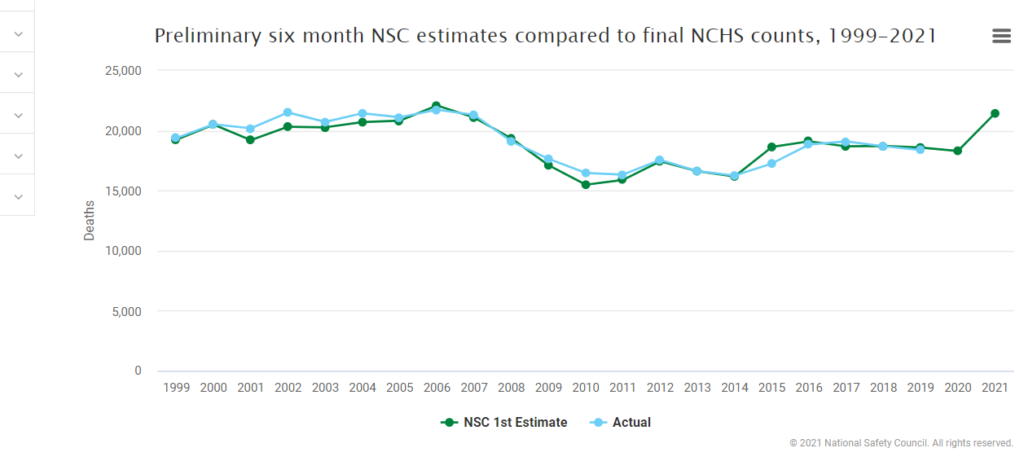
Preliminary Semiannual Estimates

Link:https://injuryfacts.nsc.org/motor-vehicle/overview/preliminary-estimates/

Graphic:

Excerpt:

Deaths up 16% as mileage starts to rebound in first six months of 2021

The National Safety Council (NSC) estimate of total motor-vehicle deaths for the first six months of 2021 is 21,450, up 16% from 18,480 in 2020 and up 17% from 18,384 in 2019. Mileage in the first six months of 2021 rebounded 13% from COVID lows in 2020 but still lags 2019 mileage by nearly 6%. The estimated mileage death rate in 2021 is 1.43 deaths per 100 million vehicle miles traveled, up 3% from 1.39 in 2020 and up 24% from 1.15 in 2019.

A medically consulted injury is an injury serious enough that a medical professional was consulted. Based on the current medically consulted injury-to-death ratio of 114:1, and rounded to the nearest thousand, the estimated number of nonfatal medically consulted injuries resulting from crashes during in the first six months of 2021 was 2,445,000.

The estimated cost of motor-vehicle deaths, injuries, and property damage in the first half of 2021 was $241.9 billion.

Publication Date: accessed 8 Feb 2022

Publication Site: National Safety Council

Pandemic-fueled shortages of home health aides strand patients without care

Link:https://www.cnn.com/2022/02/03/health/home-health-care-aide-shortage-khn-partner-wellness/index.html

Excerpt:

Frail older adults are finding it harder than ever to get paid help amid acute staff shortages at home health agencies.

Several trends are fueling the shortages: Hospitals and other employers are hiring away home health workers with better pay and benefits. Many aides have fallen ill or been exposed to Covid-19 during the recent surge of omicron cases and must quarantine for a time. And staffers are burned out after working during the pandemic in difficult, anxiety-provoking circumstances.

The implications for older adults are dire. Some seniors who are ready for discharge are waiting in hospitals or rehabilitation centers for several days before home care services can be arranged. Some are returning home with less help than would be optimal. Some are experiencing cutbacks in services. And some simply can’t find care.

Author(s):Judith Graham, Kaiser Health News

Publication Date: 3 Feb 2022

Publication Site: CNN

“What If I Can’t Insure My Home At All?”

Link:https://www.dailyposter.com/what-if-i-cant-insure-my-home-at-all/

Excerpt:

Insurance giants Chubb, Liberty Mutual, and AIG are three of the biggest insurers of fossil fuel infrastructure around the world. But the companies have just announced plans to scale back their homeowner coverage in California, where they insist future climate-related losses will likely prevent them from turning a profit.

The coverage withdrawals may soon ignite a big money battle in the state’s legislature, pitting insurance giants against lawmakers trying to preserve coverage for their constituents. Meanwhile, climate campaigners are decrying what they say is a fundamental hypocrisy.

…..

Last year, Chubb’s chairman and CEO Evan Greenberg said the company was reducing its coverage in parts of the state that were “both highly exposed, and even moderately exposed, to wildfire” because it was unable to obtain an “adequate price for the risk, and not by a small amount” due to both the costs of wildfires and California’s regulatory climate.

…..

A main solution proposed by industry is that they be allowed to use “catastrophic modeling,” a method where rates are set based on predictions of future losses, rather than recorded past losses, as is currently the case. All other states allow the use of this technique in at least some cases.

Author(s): Sam Mellins

Publication Date: 7 Feb 2022

Publication Site: The Daily Poster

Climate Scientists Encounter Limits of Computer Models, Bedeviling Policy

Link:https://www.wsj.com/articles/climate-change-global-warming-computer-model-11642191155?mod=hp_lead_pos10

Excerpt:

At least 20 older climate models disagreed with the new one at NCAR, an open-source model called the Community Earth System Model 2, or CESM2, funded mainly by the U.S. National Science Foundation and arguably the world’s most influential. Then, one by one, a dozen climate-modeling groups around the world produced similar forecasts.

The scientists soon concluded their new calculations had been thrown off kilter by the physics of clouds in a warming world, which may amplify or damp climate change. “The old way is just wrong, we know that,” said Andrew Gettelman, a physicist at NCAR who specializes in clouds and helped develop the CESM2 model. “I think our higher sensitivity is wrong too. It’s probably a consequence of other things we did by making clouds better and more realistic. You solve one problem and create another.”

Since then the CESM2 scientists have been reworking their algorithms using a deluge of new information about the effects of rising temperatures to better understand the physics at work. They have abandoned their most extreme calculations of climate sensitivity, but their more recent projections of future global warming are still dire — and still in flux.

…..

Skeptics have scoffed at climate models for decades, saying they overstate hazards. But a growing body of research shows many climate models have been uncannily accurate. For one recent study, scientists at NASA, the Breakthrough Institute in Berkeley, Calif., and the Massachusetts Institute of Technology evaluated 17 models used between 1970 and 2007 and found most predicted climate shifts were “indistinguishable from what actually occurred.”

Still, models remain prone to technical glitches and are hampered by an incomplete understanding of the variables that control how our planet responds to heat-trapping gases.

Author(s): Robert Lee Hotz

Publication Date: 6 Feb 2022

Publication Site: WSJ

Ed Slott: Child Tax Credit Is ‘a Mess!’

Link:https://www.thinkadvisor.com/2022/02/01/ed-slott-child-tax-credit-is-a-mess/

Excerpt:

The Internal Revenue Service issued Tuesday a revised Fact Sheet and frequently asked questions on the 2021 child tax credit and advance child tax credit to help eligible families properly claim the credit when they prepare and file their 2021 tax return.

Tax expert Ed Slott of Ed Slott & Co. told ThinkAdvisor on Tuesday in an email that the child tax credit situation this year is “a mess! Some people may end up paying a tax pro more than the credit!”

Others, Slott said, “may still pay a tax pro only to end up returning money they already received. Advance payments can always be tricky when it’s time to reconcile.”

Author(s): Melanie Waddell

Publication Date: 1 Feb 2022

Publication Site: Think Advisor

Understanding the Covid Odds

Link:https://www.city-journal.org/understanding-the-covid-odds

Excerpt:

Those odds can be gauged from a study by researchers at the National Institutes of Health, published by the Centers for Disease Control. They tracked more than 1 million vaccinated adults in America over most of last year, including the period when the Delta variant was surging, and classified victims of Covid according to risk factors such as being over 65, being immunosuppressed, or suffering from diabetes or chronic diseases of the heart, kidney, lungs, liver or brain.

The researchers report that none of the healthy people under 65 had a severe case of Covid that required treatment in an intensive-care unit. Not a single one of these nearly 700,000 people died, and the risk was miniscule for most older people, too. Among vaccinated people over 65 without an underlying medical condition, only one person died. In all, there were 36 deaths, mostly among a small minority of older people with a multitude of comorbidities: the 3 percent of the sample that had at least four risk factors. Among everyone else, a group that included elderly people with one or two chronic conditions, there were just eight deaths among more than 1.2 million people, so their risk of dying was about 1 in 150,000.

Those are roughly the same odds that in the course of a year you will die in a fire, or that you’ll perish by falling down stairs. Going anywhere near automobiles is a bigger risk: you’re three times more likely during a given year to be killed while riding in a car, and also three times more likely to be a pedestrian casualty. The 150,000-to-1 odds of a Covid death are even longer than the odds over your lifetime of dying in an earthquake or being killed by lightning.

Author(s): John Tierney

Publication Date: 6 Feb 2022

Publication Site: City Journal

California budget surplus is big enough to give every resident $1,100 stimulus check, state lawmaker says

Link:https://ktla.com/news/california/california-budget-surplus-is-big-enough-to-give-every-resident-1100-stimulus-check-state-lawmaker-says/

Excerpt:

In a video released online, Republican State Sen. Brian Jones used grains of rice to break down the projected budget surplus which, as of January, was estimated at $45.7 billion.

“If each grain of rice is $100,000, that means California’s $45 billion surplus is taxes over-collected by this much,” Jones explained as he shifted the large pile of rice around with his hand.

So what to do with all that money?

According to the state senator, the amount is enough to send every Californian a tax rebate of $1,125, or $4,500 for a family of four.

More stimulus checks are a possibility because the surplus is likely to exceed California’s constitutional limit as set by the voter-approved Proposition 4, or what’s more commonly known as the “Gann Limit“. That essentially restricts the amount of tax revenue the state can spend while giving lawmakers options on what to do with the leftover funds — including giving it back to taxpayers in the form of a rebate.

Author(s): Tracy Bloom, Ashley Zavala

Publication Date: 3 Feb 2022

Publication Site: KTLA

Report: Most big cities were in bad fiscal shape before the pandemic. Expect it to get worse

Link:https://www.ocregister.com/2021/02/01/report-most-big-cities-were-in-bad-fiscal-shape-before-the-pandemic-expect-it-to-get-worse/

Excerpt:

In the group’s fifth annual report card on the nation’s 75 biggest cities, Irvine retains its title as the fiscally healthiest city in America — even while the vast majority of its brethren, both in California and across the nation, sink more deeply in debt thanks to promises they’ve made for pensions and retiree health care that are far more expensive than they ever expected.

Joining Irvine in the black was Stockton — testament to the restorative power of municipal bankruptcy — and the city of Fresno.

In the red in California, from least-in-debt to most-in-debt, were Long Beach, Chula Vista, Bakersfield, Riverside, Sacramento, Los Angeles, San Diego, Santa Ana, Anaheim, San Jose, San Francisco and Oakland.

All told, total debt for the 75 most populous cities exceeded $333.5 billion at the end of the 2019 fiscal year. Most of that was pension debt — $180.1 billion — while the rest was for retiree health benefits, at $160.1 billion.

Author(s): Teri Sforza

Publication Date: 1 Feb 2022

Publication Site: Orange County Register

San Diego to Retroactively Replace Thousands of Employees’ DC Plans With Pensions

Link:https://www.plansponsor.com/san-diego-retroactively-replace-thousands-employees-dc-plans-pensions/

Excerpt:

The city of San Diego will be offering retroactive defined benefit (DB) pension benefits to thousands of city employees who were previously only offered defined contribution (DC) plans.

The decision comes after the California Supreme Court overturned 2012’s Proposition B, a law that was passed after being voted on by the public. Proposition B shifted all city employees except police officers away from pensions to DC plans. The law was in effect from July 2012 through July 2021.

Proposition B was controversial and was ultimately deemed to have been illegally placed on the public ballot. The total amount of funds owed to city employees will be approximately $73 million in retroactive pension accruements. The payments will go to approximately 3,850 workers who began working for the city after July 2012.

Author(s): Anna Gordon

Publication Date: 4 Feb 2022

Publication Site: Plan Sponsor

Top Democrats challenge Janet Mills to give retired state workers a big pension boost

Link: https://bangordailynews.com/2022/02/04/politics/top-democrats-challenge-janet-mills-to-give-retired-state-workers-a-big-pension-boost-xoasq1i29i/

Excerpt:

Top legislative Democrats joined a Thursday letter challenging Gov. Janet Mills to give state retirees a bigger cost-of-living increase to address inflation with the governor nearly ready to release a key spending plan.

People in the Maine Public Employee Retirement System, which includes retired state employees and teachers, were told last summer that they would receive a 3 percent increase to their benefits up to nearly $23,000. Inflation during that time was 5.4 percent.

A letter sent to the governor on Thursday by 59 lawmakers led by Sen. Joe Rafferty, D-Kennebunk, and joined by all Democratic leaders in both chambers, including Senate President Troy Jackson, D-Allagash, and House Speaker Ryan Fecteau, D-Biddeford, asks Mills to fund an increase commensurate with the level of inflation in her upcoming budget proposal.

Author(s): Caitlin Andrews

Publication Date: 4 Feb 2022

Publication Site: Bangor Daily News

Milwaukee’s pension spike is coming fast. Here’s how the mayoral candidates would deal with it.

Link:https://www.jsonline.com/story/news/local/milwaukee/2022/02/04/how-milwaukees-mayoral-candidates-would-deal-pension-crisis/6608853001/

Excerpt:

The spike in Milwaukee’s annual pension contribution will be one of the top challenges facing the next mayor — and he or she won’t have much time in office before big decisions must be made.

Next year, current estimates predict the city’s annual pension contribution will increase from about $71 million to about $130 million, according to the city budget office. It is expected to remain elevated for years to come.

The projected increase is driven by factors including a drop in the anticipated future earnings on the city’s pension fund, from 8.24% to 7.5%.

With no solution, a quarter of the city’s workforce could be let go between 2023 and 2025, affecting services the city provides to residents, according to a report from the city’s Pension Task Force. 

Author(s): Alison Dirr

Publication Date: 4 Feb 2022

Publication Site: Milwaukee Journal Sentinel