No, the United States Has Not Always Paid Its Debts

Link:https://reason.com/2021/11/19/no-the-united-states-has-not-always-paid-its-debts/

Excerpt:

Most recently, the U.S. defaulted on Treasury bill payments in 1979 shortly after Congress raised the debt ceiling. According to the Congressional Research Service analysis: “In late April and early May 1979, about 4,000 Treasury checks for interest payments and for the redemption of maturing securities held by individual investors worth an estimated $122 million were not sent on time. Foregone interest due to the delays was estimated at $125,000.” The default was due to technical problems and was cured within a short period of time.

The claim that the United States has never defaulted, despite its frequent repetition, is not strictly true. Officials could make more modest and qualified claims such as “aside from a relatively minor operational snafu, the United States has not defaulted in the post-World War II era.” Such a claim lacks the power of a more sweeping generalization, but at least it’s accurate. If President Joe Biden and Treasury Secretary Janet Yellen want to seem credible, they should avoid making historic statements that are easily refuted by a small amount of Googling. If they cannot be believed about the basic reality of the federal government’s credit history, how can we believe what they say about current policy choices?

Author(s): MARC JOFFE AND JEFFREY ROGERS HUMMEL

Publication Date: 19 Nov 2021

Publication Site: Reason
Ivermectin: Much More Than You Wanted To Know

Link:https://astralcodexten.substack.com/p/ivermectin-much-more-than-you-wanted

Graphic:

Excerpt:


About ten years ago, when the replication crisis started, we learned a certain set of tools for examining studies.

Check for selection bias. Distrust “adjusting for confounders”. Check for p-hacking and forking paths. Make teams preregister their analyses. Do forest plots to find publication bias. Stop accepting p-values of 0.049. Wait for replications. Trust reviews and meta-analyses, instead of individual small studies.

These were good tools. Having them was infinitely better than not having them. But even in 2014, I was writing about how many bad studies seemed to slip through the cracks even when we pushed this toolbox to its limits. We needed new tools.

I think the methods that Meyerowitz-Katz, Sheldrake, Heathers, Brown, Lawrence and others brought to the limelight this year are some of the new tools we were waiting for.

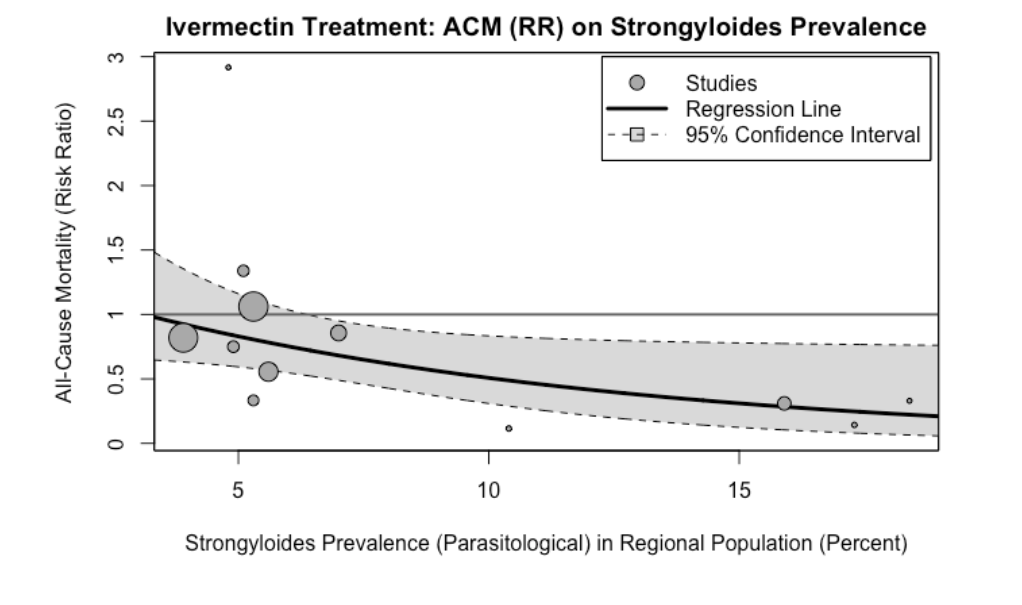
Part of this new toolset is to check for fraud. About 10 – 15% of the seemingly-good studies on ivermectin ended up extremely suspicious for fraud. Elgazzar, Carvallo, Niaee, Cadegiani, Samaha. There are ways to check for this even when you don’t have the raw data. Like:

The Carlisle-Stouffer-Fisher method: Check some large group of comparisons, usually the Table 1 of an RCT where they compare the demographic characteristics of the control and experimental groups, for reasonable p-values. Real data will have p-values all over the map; one in every ten comparisons will have a p-value of 0.1 or less. Fakers seem bad at this and usually give everything a nice safe p-value like 0.8 or 0.9.

GRIM – make sure means are possible given the number of numbers involved. For example, if a paper reports analyzing 10 patients and finding that 27% of them recovered, something has gone wrong. One possible thing that could have gone wrong is that the data are made up. Another possible thing is that they’re not giving the full story about how many patients dropped out when. But something is wrong.

But having the raw data is much better, and lets you notice if, for example, there are just ten patients who have been copy-pasted over and over again to make a hundred patients. Or if the distribution of values in a certain variable is unrealistic, like the Ariely study where cars drove a number of miles that was perfectly evenly distributed from 0 to 50,000 and then never above 50,000.

Author(s): Scott Alexander

Publication Date: 17 Nov 2021

Publication Site: Astral Codex Ten at substack

Covid-19 Breakthrough Hospitalizations Concentrated Among Most Vulnerable

Link:https://www.wsj.com/articles/covid-19-breakthrough-hospitalizations-concentrated-among-most-vulnerable-11637499602

Graphic:

Excerpt:

At the Medical University of South Carolina, nearly all fully vaccinated Covid-19 patients in the ICU have weak immune systems from prior health problems, said Andrew Goodwin, the section chief of critical care. The rest are elderly, which can also compromise the body’s defense against illness.

Truveta Inc., a firm that aggregates hospitals’ medical data for research, found among 1.7 million fully vaccinated people that those with diabetes, chronic lung disease and chronic kidney disease were about twice as likely to be hospitalized for breakthrough cases as vaccinated people without these conditions.

The likelihood of having a breakthrough infection was still low, though confirmed infections were more common for people with these illnesses. About 1.5% of roughly 110,000 people with chronic kidney disease had one, for example. But Truveta found about a quarter of breakthrough patients with chronic kidney disease wound up hospitalized. The likelihood of hospitalizations for people with breakthrough cases but without underlying health problems was about 7.5%.

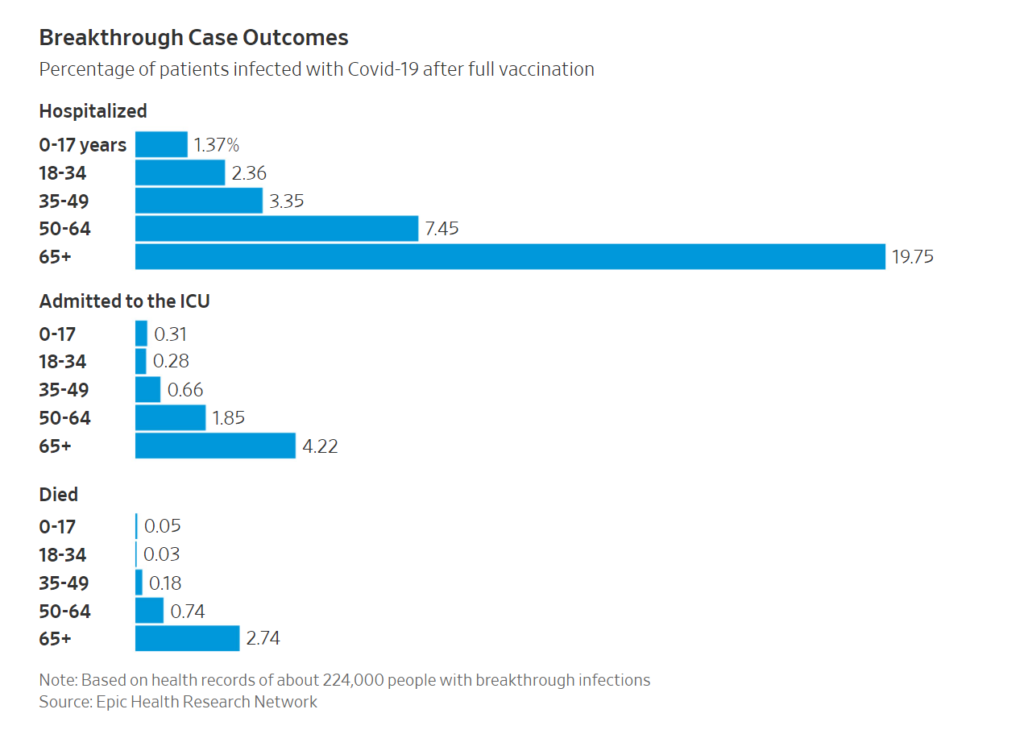
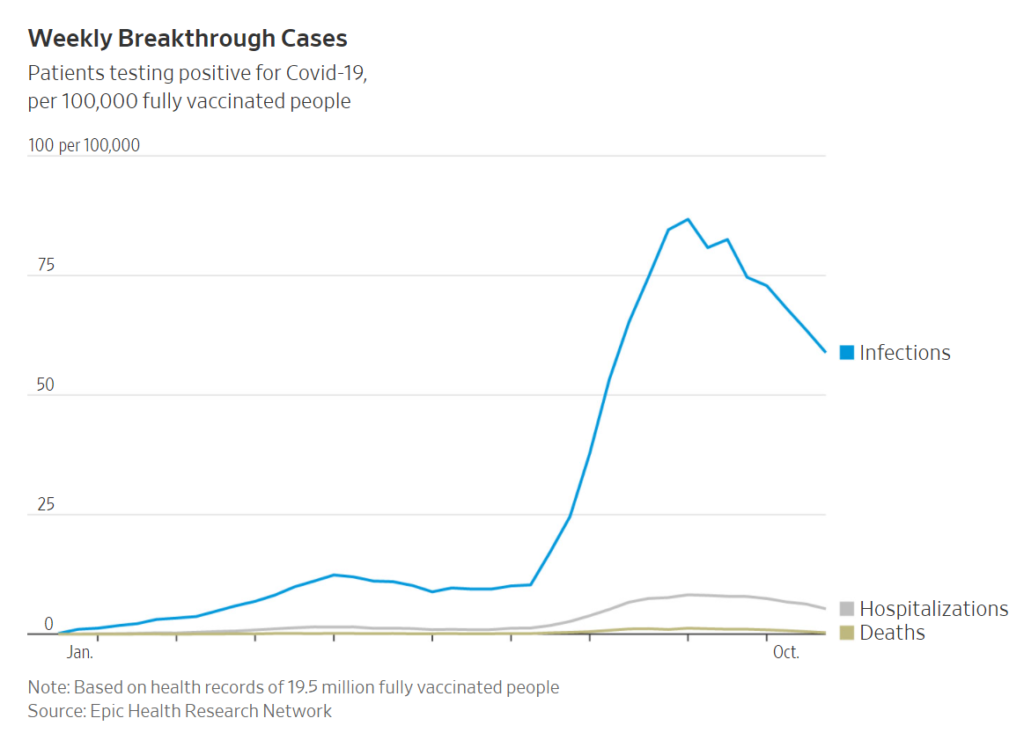
Breakthrough deaths are hitting older people the hardest, amplifying a well-worn pandemic pattern. Exclusive data the Journal reviewed from the Epic Health Research Network, which analyzes data from the medical-record software company Epic Systems Corp., shows about 80% of breakthrough deaths among the vaccinated are in people ages 65 and older. The data included records for 19.5 million fully vaccinated people. Among all Covid-19 deaths this year, that age group represents closer to 69%, according to the CDC.

Author(s): Jon Kamp, Melanie Evans

Publication Date: 21 Nov 2021

Publication Site: Wall Street Journal

Brand-Name Drug Prices: The Key Driver of High Pharmaceutical Spending in the U.S.

Link:https://www.commonwealthfund.org/publications/2021/nov/brand-name-drug-prices-key-driver-high-pharmaceutical-spending-in-us

Graphic:

Excerpt:

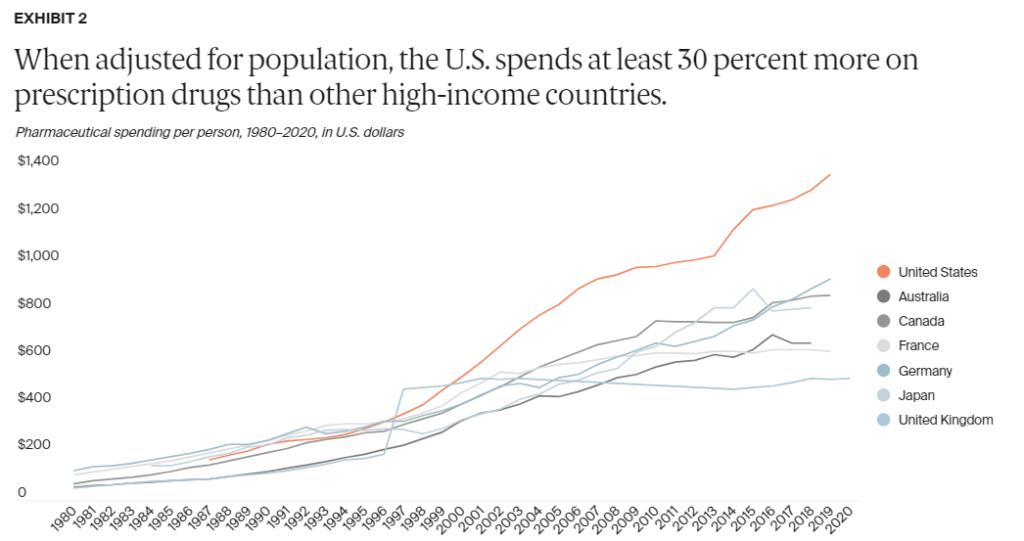
High U.S. drug prices are a financial strain for patients, employers, and state and federal governments. In the following charts, we present the findings from a number of studies on prescription drug costs and spending in the United States with other high-income countries to reveal the main culprit: high U.S. prices for brand-name drugs.

The data for this chartpack come from the following sources: the Commonwealth Fund’s 2020 International Health Policy Survey; 1980–2020 pharmaceutical spending data from the Organisation for Economic Co-operation and Development (OECD); 2020 individual-level administrative claims or registry data compiled by the International Collaborative on Costs, Outcomes, and Needs in Care (ICCONIC); and IQVIA’s MIDAS database for 33 OECD member countries for 2018.

Author(s): Aimee Cicchiello, Lovisa Gustafsson

Publication Date: 17 November 2021

Publication Site: The Commonwealth Fund

Americans are overdosing on a drug they don’t know they’re taking

Link:https://www.cnn.com/2021/11/17/politics/fentanyl-overdose-deaths-what-matters/index.html

Excerpt:

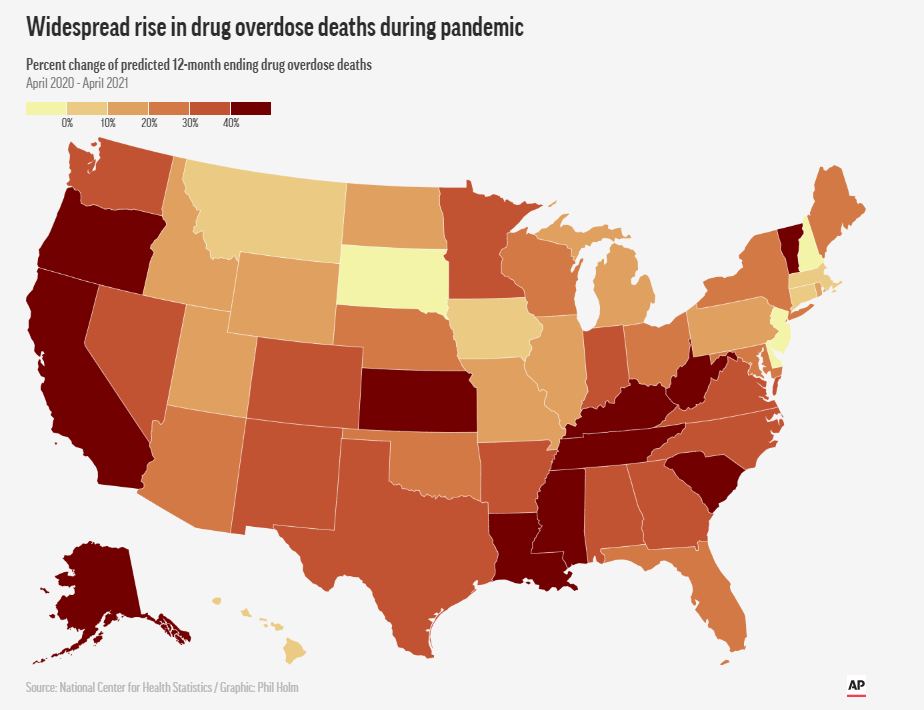
From May 2020 through April 2021, more than 100,000 people died from drug overdoses in the US, according to provisional data released Wednesday by the US Centers for Disease Control and Prevention.

That’s a horrible new record for drug overdose deaths — a near-30% rise from the same period a year earlier and a near-doubling over the past five years.

The drug epidemic grew in tandem with the Covid-19 pandemic, which claimed about 509,000 deaths in the same period.

Author(s): Zachary B. Wolf

Publication Date: 18 Nov 2021

Publication Site: CNN

California public employees’ pension bill to go up after CalPERS lowers market expectations

Link:https://www.thecentersquare.com/california/california-public-employees-pension-bill-to-go-up-after-calpers-lowers-market-expectations/article_54d02942-47e4-11ec-940a-e3e851214b73.html

Excerpt:

The CalPERS board voted Monday to select a portfolio with a return of 6.8% and an expected volatility rate of 12.1%. This expected rate of return is two-tenths of a percentage point lower than last year’s target of 7%. The vote concluded a review of the pension fund’s assets, which occurs once every four years. 

This expected reduction in the rate of return means that some employees will have to contribute more to their pension funds because the fund expects to earn less from its investment portfolio.

For employees hired after the implementation of the Public Employees’ Pension Reform Act (PEPRA) in January 2013, CalPERS estimates they will contribute an average of 1.2% to 1.5% more toward their pensions. These changes will go into effect for school employees, excluding teachers, in July 2022 and will be enacted for most other local government employees in July 2023.

Author(s): Madison Hirneisen

Publication Date: 17 Nov 2021

Publication Site: The Center Square

US overdose deaths topped 100,000 in one year, officials say

Link:https://apnews.com/article/overdodse-deaths-fentanayl-health-f34b022d75a1eb9776e27903ab40670f

Graphic:

Excerpt:

An estimated 100,000 Americans died of drug overdoses in one year, a never-before-seen milestone that health officials say is tied to the COVID-19 pandemic and a more dangerous drug supply.

Overdose deaths have been rising for more than two decades, accelerated in the past two years and, according to new data posted Wednesday, jumped nearly 30% in the latest year.

President Joe Biden called it “a tragic milestone” in a statement, as administration officials pressed Congress to devote billions of dollars more to address the problem.

“This is unacceptable and it requires an unprecedented response,” said Dr. Rahul Gupta, director of National Drug Control Policy.

Experts believe the top drivers of overdose deaths are the growing prevalence of deadly fentanyl in the illicit drug supply and the COVID-19 pandemic, which left many drug users socially isolated and unable to get treatment or other support.

Author(s): Mike Stobbe

Publication Date: 18 Nov 2021

Publication Site: Associated Press

Illinois pension shortfall surpasses $500 billion, average debt burden now $110,000 per household – Wirepoints Special Report

Link:https://wirepoints.org/illinois-pension-shortfall-surpasses-500-billion-average-debt-burden-now-110000-per-household-wirepoints-special-report/

Graphic:

Excerpt:

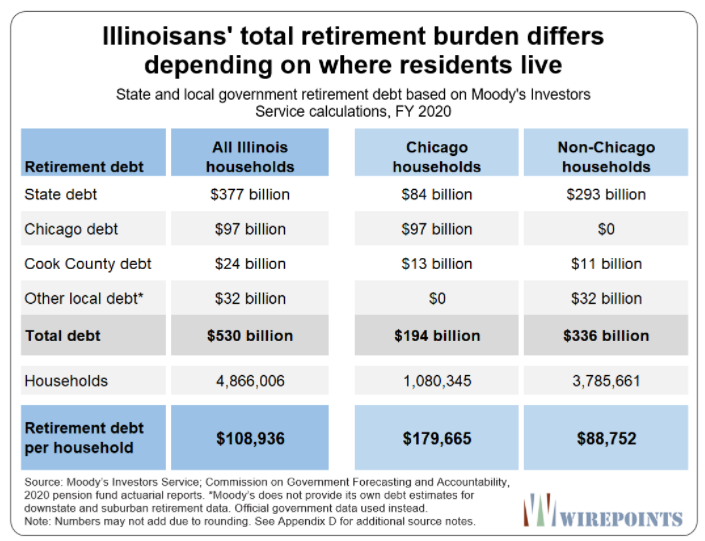
The $110,000 per household is an average across the entire state, but the precise burden for Illinoisans differs depending on where they live. The debt burden on Chicago’s one million households is larger because of the city’s deeper debt crisis. There, each household is on the hook for $180,000 for their share of state and local retirement debts.

Illinoisans living outside of Chicago, meanwhile, face an overall average burden of $90,000 per household. For comparison purposes, the burdens for Chicago and non-Chicago households, based on official state and local retirement debts, are $95,000 and $53,000, respectively.

Author(s): Ted Dabrowski and John Klingner

Publication Date: 17 Nov 2021

Publication Site: Wirepoints

Municipal Budgets 2021 (4) Pension Contributions

Link:https://burypensions.wordpress.com/2021/11/17/municipal-budgets-2021-4-pension-contributions/

Graphic:

Excerpt:

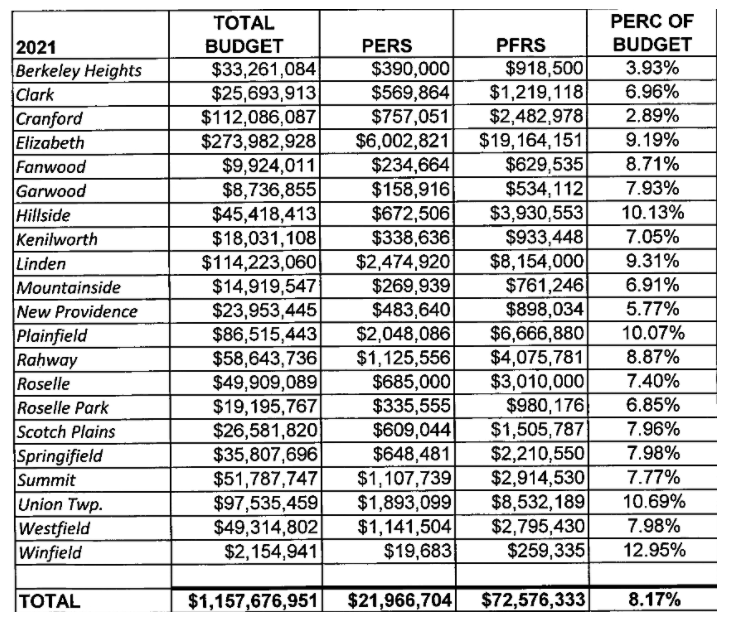
Over at countywatchers I have a series comparing 2021 budget items for the municipalities in Union County and part 4 relates to this blog so here it is.

Comparing pension records to 2021 budget allocations that municipalities in Union County made for their contributions to the New Jersey Public Employees Retirement System (PERS) and Police and Firemen’s Retirement System (PFRS) shows that, on average, PERS and PFRS contributions made up 8.17% of total budgets, representing $170 per resident. The average contribution as a percentage of a participant’s salary came to 25.03% with $19,942 as the average contribution per participant.

Author(s): John Bury

Publication Date: 17 Nov 2021

Publication Site: burypensions

Equity, tech and climate change: Three big takeaways from the infrastructure bill

Link:https://lizfarmer.substack.com/p/equity-tech-climate-change-infrastructure-bill

Excerpt:

Green bonds. Issuance is expected to hit a record high this year and so are municipal green bond offerings. My friend and colleague Mark Funkhouser explains why local leaders should take advantage of this alignment of financial interests and moral ones.

More spending flexibility in the American Rescue Plan. Legislation now making its way through Congress would allow governments to use some of their ARP funds for highway and transit projects and to address natural disasters.

Rising income tax revenue. The K-shaped recovery and federal stimulus has resulted in the largest median state personal income jump in 14 years. According to Fitch Ratings, state income tax revenues increased by 6.3% last year and this year is expected to produce similar growth. This has implications for public pensions, tax cuts and — of course — the 2022 midterms.

Author(s): Liz Farmer

Publication Date: 17 Nov 2021

Publication Site: Long Story Short at substack

19,000 Retired Ohio Teachers Want Pension Prospectuses, Wall Street Wolves Say No Way

Link:https://www.forbes.com/sites/edwardsiedle/2021/11/09/19000-retired-ohio-teachers-want-pension-prospectuses-wall-street-wolves-say-no-way/

Excerpt:

For nearly two decades, alternative investment managers have been permitted to handle public pension money while they refuse to play by the rules applicable to these funds and submit to public scrutiny.

Wall Street alternative managers have successfully argued that the very same investment information widely distributed to wealthy individuals somehow amounts to “trade secrets” exempt from public records laws… when requested by state workers.

While it’s not surprising Wall Street’s biggest gamblers want to keep investors in the dark as to their misdeeds, it’s unconscionable that STRS Ohio and other public pensions around the nation are willing to abandon transparency, exposing workers to unfathomable risks and jeopardizing their retirement security.

Alternative investment managers may seek to keep secrets, but it’s no secret what’s often in these well-guarded documents: excessive and illegal fees; outrageous conflicts of interest and self dealing; fiduciary breaches and outright violations of law—even criminal conduct. For example, eight years ago the SEC staff found that a majority of private equity firms inflate fees and expenses charged to companies in which they hold stakes.

Author(s): Edward Siedle

Publication Date: 9 Nov 2021

Publication Site: Forbes