The Pandemic Hit Public Pension Funds Hard — But Now They’re Better Funded Than They’ve Been in Years

Link: https://www.institutionalinvestor.com/article/b1rmn95n2tb93d/The-Pandemic-Hit-Public-Pension-Funds-Hard-But-Now-They-re-Better-Funded-Than-They-ve-Been-in-Years

Excerpt:

Plans that experienced larger declines in funded status may have “erased” losses and experienced “incrementally higher asset returns and funded status gains” as risk assets rallied through the latter half of the year, the report said.

“The same thing that caused volatility in their portfolios on the way down actually helped on the way back up,” said William Chang, pension strategist at GSAM.  “When the pandemic hit last year, it was one of the quickest drawdowns, one of the quickest declines in equity markets. And the subsequent recovery and exit out of that bear market was equally as quick.” 

At the end of March 2020, the top quartile of plan funded status was around 81 to 90 percent. By March 2021, that figure increased to 91 to 100 percent funded status, according to the report. GSAM attributed the improvement to the subsiding effects of the pandemic: rising vaccination numbers, declining initial jobless claims, and rising consumer confidence.

Author(s): Jessica Hamlin

Publication Date: 3 May 2021

Publication Site: Institutional Investor

Relaxing State and Local Tax Deduction Cap Would Make Tax Code Less Progressive

Graphic:

Excerpt:

All three options would primarily benefit higher-earning tax filers, with repeal of the SALT cap increasing the after-tax income of the top 1 percent by about 2.8 percent; the bottom 80 percent would see minimal benefit.

Removing the marriage penalty and raising the SALT cap would also mostly benefit higher earners, though after-tax incomes of filers in the 95th to 99th income percentiles would rise the most. For example, raising the SALT cap to $15,000 single and $30,000 joint would result in a 0.8 percent increase in after-tax income for the 95th to 99th income percentiles and a 0.4 percent increase for the top 1 percent.

The top 1 percent benefits less because the SALT cap remains in place, so there is less of a benefit as a portion of their incomes when slightly increasing the cap. For example, a joint filer with $5 million in after-tax income could receive an additional $7,400 in reduced tax liability ($20,000 in increased SALT deductions times the 37 percent top individual income tax rate), which is a 0.1 percent increase in after-tax income.

Author(s): Garrett Watson

Publication Date: 3 May 2021

Publication Site: Tax Foundation

What NJ Tells Creditors On Benefits

Graphic:

Excerpt:

According to the EMMA website New Jersey borrowed another $400 million last week for which they had to provide an Official Statement which included 20 pages on the situation with public pensions and benefits. Excerpts follow.

…..

The contribution of the Lottery Enterprise is valued as of June 30, 2020 at $12.569 billion, based on a 30-year straight line amortization. However, the first reevaluation of the value of the Lottery Enterprise required by LECA has not yet been performed. If the contribution of the Lottery Enterprise were not taken into consideration in calculating the funded ratio of the Pension Plans, the funded ratio of the Pension Plans as of June 30, 2020 would have been 37.6% instead of 49.8%. (page I-60)

Author(s): John Bury

Publication Date: 3 May 2021

Publication Site: Burypensions

NY State Pension Commits to $400 Million in Sustainable Investments

Link: https://www.ai-cio.com/news/ny-state-pension-commits-400-million-sustainable-investments/

Excerpt:

The $247.7 billion New York State Common Retirement Fund has committed approximately $400 million to two funds as part of its Sustainable Investments and Climate Solutions (SICS) Program.

The commitments are part of New York State Comptroller Thomas DiNapoli’s climate action plan to lower investment risks from climate change and help shift the pension fund to net-zero greenhouse gas emissions within the next 20 years.

Author(s): Michael Katz

Publication Date: 26 April 2021

Publication Site: ai-CIO

The Music City Meltdown

Link: https://www.wsj.com/articles/the-music-city-meltdown-11619649990

Excerpt:

Like many cities, Nashville is also in hock to pensioners, with $4.3 billion in unfunded promises for retiree healthcare. And though Nashville’s pension system is well-funded, it is also expensive to maintain because employees contribute almost nothing, leaving taxpayers on the hook for about $110 million in annual contributions—and potentially more when investments tank. Despite the burden, the city resisted adopting reforms the state enacted in 2013, when Tennessee switched to a pension plan that requires employees to contribute 5% of their wages.

Nashville’s balance sheet wasn’t in any shape to endure a massive pandemic hit. Led by a 50% decline in tourism, the city’s economy slumped last spring, and unemployment soared above 15%. That punched a $332 million hole in the fiscal 2021 budget, prompting then-Tennessee Comptroller Justin Wilson to warn in September of a state takeover. The city could become “kind of like a teenager coming to their parent asking for $20 to go to the movies,” he said.

Author(s): Steven Malanga

Publication Date: 28 April 2021

Publication Site: Wall Street Journal

Morning with Meep – ASOP 56 – Modeling

Description:

I take a look at the Actuarial Standard of Practice 56: Modeling — in effect as of October 2020.

Links: Keep Up With the Standards: On ASOP 56, Modeling

https://www.soa.org/sections/modeling/modeling-newsletter/2021/april/mp-2021-04-campbell/

ASOP 56: Modeling

http://www.actuarialstandardsboard.org/asops/modeling-3/

Author(s): Mary Pat Campbell

Publication Date: 3 May 2021

Publication Site: Meep’s Math Matters at Youtube

Your Pension Board Thinks It’s Smarter Than Warren Buffett—It’s Not

Link: https://www.forbes.com/sites/edwardsiedle/2021/05/01/your-pension-board-thinks-its-smarter-than-warren-buffett-its-not/?sh=b3fdc2611302

Excerpt:

Buffett has a consistent history of blasting Wall Street firms for charging high fees for actively managed investments and has recommended pensions invest in low-cost passively managed index funds.

You might think that underfunded pensions struggling to pay benefits would heed Buffett’s advice and seek to cut the fees they pay Wall Street.

Embrace austerity. Tighten their belts. Trim the fat. 

In fact, every forensic investigation I’ve ever undertaken has exposed that the nearer a pension is to insolvency, the higher the fees and the greater the risks the pension takes on.

Author(s): Ted Siedle

Publication Date: 1 May 2021

Publication Site: Forbes

Members of teacher pension fund planning lawsuit to force transparency

Link: https://news.yahoo.com/members-teacher-pension-fund-planning-110300430.html?guccounter=1

Excerpt:

About 1,000 current and retired Ohio educators skeptical of the true financial shape of their $90 billion state pension fund are preparing to sue to force greater cooperation with a $75,000 self-funded investigation of its books.

The forensics audit, financed through money raised from members, is being undertaken by pension investment expert Ted Siedle — a former Securities Exchange Commission attorney, financial forensics investigator, and co-author of the book “Who Stole My Pension?”

The public records lawsuit will ask the Ohio Supreme Court to force the State Teachers Retirement System, serving some 500,000 active, inactive, and retired members, to release information that investment firms have claimed is proprietary or a trade secret.

Author(s): Jim Provance, The Blade, Toledo, Ohio

Publication Date: 3 May 2021

Publication Site: Yahoo News

Data visualizations: Choosing colors with purpose

Link: https://uxdesign.cc/data-visualizations-choosing-colors-with-purpose-4a672ac0215a

Graphic:

Excerpt:

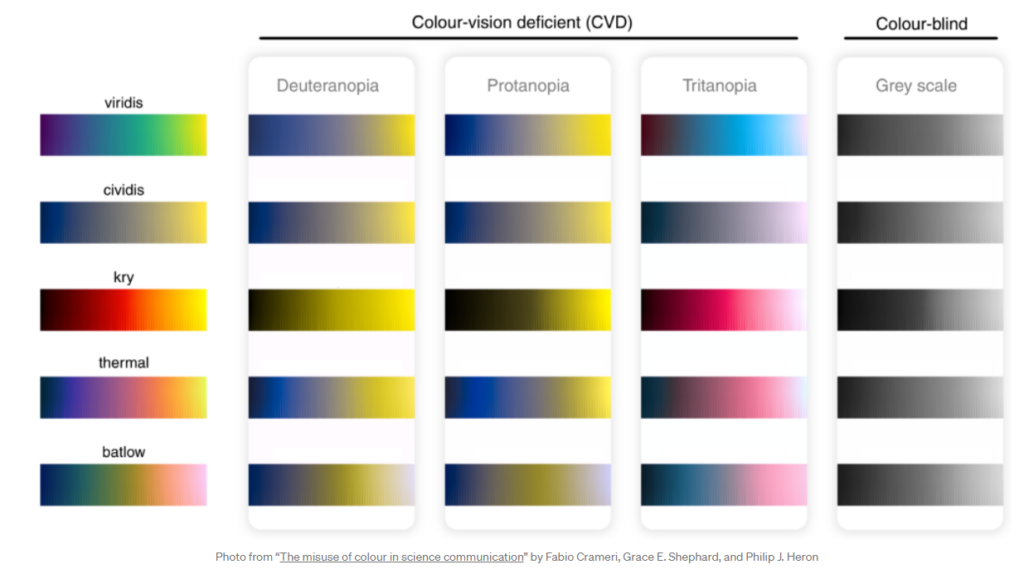
The incorporation of intuitive color maps in data visualizations is an extremely useful tool, but has one major drawback: the information conveyed by the colors is lost to those who cannot distinguish between them. According to the Colour Blind Awareness Organisation (UK-based), approximately 8% of men and 0.5% of women worldwide have some form of color vision deficiency (CVD). Fortunately, certain scientifically derived color maps have been created which are able to maintain distinguishability across various different types of color blindness. Several such color maps are shown below with their corresponding CVD-adjusted perceptions.

Author(s): T. J. Kyner

Publication Date: 30 April 2021

Publication Site: UX Collective

Warren Buffett Defends Berkshire’s Moves Over Pandemic Year

Link: https://www.wsj.com/articles/warren-buffett-set-to-discuss-pandemic-markets-at-berkshires-annual-meeting-11619887342?reflink=desktopwebshare_twitter

Excerpt:

Warren Buffett defended Berkshire Hathaway Inc.’s investments over the past year, while saving his harshest comments for some of the hottest investment vehicles at the company’s annual meeting.

Speaking onstage from Los Angeles, Mr. Buffett, Berkshire’s chairman and chief executive, and his business partner, Charlie Munger, took questions for roughly four hours. The two men said some special-purpose acquisition companies, day traders and private-equity funds that have driven valuations in both private and public companies to record levels were more gamblers than investors.

“I don’t mind the poor fish that gamble,” Mr. Munger said Saturday. “I don’t like the professionals that take the suckers.”

“It’s a moral failing. It’s not just stupid, it’s shameful,” he said of SPACs.

Author(s): Jenna Telesca, Geoffrey Rogow

Publication Date: 1 May 2021

Publication Site: Wall Street Journal

India is struggling with a catastrophic second wave

Link: https://www.economist.com/asia/2021/04/24/india-is-struggling-with-a-catastrophic-second-wave

Excerpt:

More disturbing still, India’s soaring official covid-19 count represents the tip of an iceberg. Because of low testing rates outside big cities, say epidemiologists, the actual caseload could be anything from ten to 30 times higher. A national serological survey conducted in December found 21% of Indians were carrying covid-19 antibodies, compared with an official tally which suggested that only about 1% of India’s people had been infected by that time. More recently, local journalists who have cross-checked hospital and funeral records against government numbers have found similar, gaping discrepancies across the country. One report revealed that in the second week of April, when authorities in Vadodara, a city in the state of Gujarat, announced seven covid-19 deaths, the count in two hospitals alone was more than 300. This suggests that India could be facing not 2,000 deaths a day, as the current official count shows, but something much higher.

Publication Date: 24 April 2021

Publication Site: The Economist