RIP Gold. Killed by Bitcoin

Excerpt:

Can the store of value argument hold up for BTC without it being a medium of exchange? It has for gold for thousands of years so quite possibly. Gold is money but it’s not readily usable currency. BTC could be considered in the same light.

The artificiality of BTC’s value is a problem. It can be argued using cultural relativism that gold is no more intrinsically valuable than BTC. But it does have a long history, especially as a reserve currency, that must be worth something. Can we see central banks buying BTC? Certainly not if it develops as a parallel medium of currency that undermines them.

Likewise, gold is the outcome of production. BTC consumes resources to produce nothing. Not that that is necessarily a problem in a virtual world but it again weighs against the perception of BTC as a store of value. So does the fact that BTC is a truly useless item if some kind catastrophe befalls society which does underping the value of gold in some measure.

Author(s): David Llewellyn-Smith, Yves Smith

Publication Date: 4 March 2021

Publication Site: naked capitalism
US ‘excess savings’ are not excessive

Link: https://voxeu.org/article/us-excess-savings-are-not-excessive

Graphic:

Excerpt:

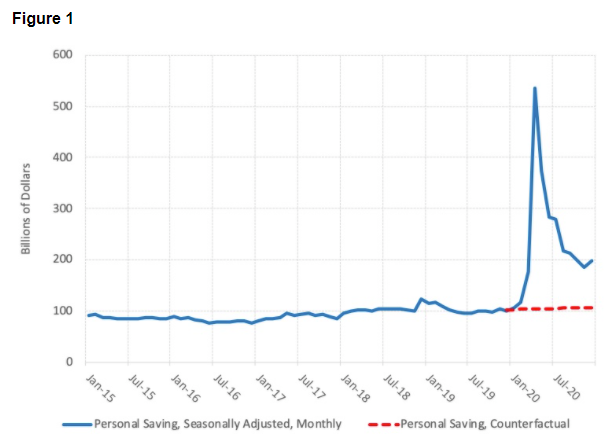
Calculating ‘excess savings’ is simple: they are the cumulative amount by which personal saving during the pandemic exceeded a counterfactual path without COVID-19. As shown in blue in Figure 1, personal saving has been elevated since last March. The red line represents one plausible counterfactual scenario, in which the saving rate out of disposable income is constant at its pre-pandemic level (7.3%), while disposable personal income grows at its average rate over the previous twenty years (3.5%). ‘Excess savings’ are the area between the two lines. According to this calculation, they amount to $1.6 trillion. Different plausible assumptions on the counterfactual evolution of personal saving in the absence of the pandemic lead to relatively small differences in this headline number. 

Author(s): Florin Bilbiie, Gauti Eggertsson, Giorgio Primiceri

Publication Date: 1 March 2021

Publication Site: VoxEU

Coronavirus Deranges the Immune System in Complex and Deadly Ways

Excerpt:

Scientists say the coronavirus could undermine the immune system in several ways.

For example, it’s possible that immune cells become confused because some viral proteins resemble proteins found on human cells, Luning Prak said. It’s also possible that the coronavirus lurks in the body at very low levels even after patients recover from their initial infection.

“We’re still at the very beginning stages of this,” said Luning Prak, director of Penn Medicine’s Human Immunology Core Facility.

Author(s): Liz Szabo

Publication Date: 4 March 2021

Publication Site: Kaiser Health News

Covid Baby Bust Has Governments Rattled

Graphic:

Excerpt:

Of course, there’s a case to be made that fewer people in advanced economies is a good thing. But arrayed against that are all the “because groaf” forces. The two drivers of growth are demographic growth, as in more people, and productivity increases. National leaders are afraid of becoming the new Japan, having an aging population and falling in the “size of economy” pecking order, when Japan has weathered a financial system crisis and implosion of real estate prices with remarkable grace. And the demographic time bomb? The feared dependency ratio? More older Japanese work. Japanese even more so than Westerners prize attachment to communities and organizations, so it would probably suit those who are able to handle it to remain in the saddle or get a part-time job.

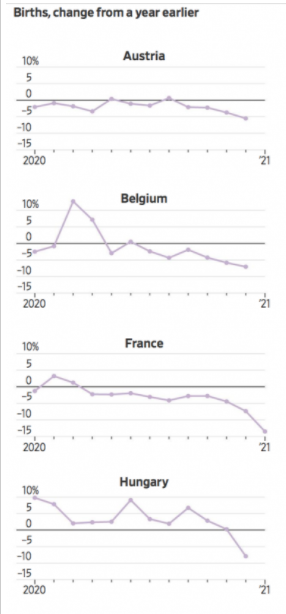
But the big point is that the Covid impact on child-bearing is widespread and looks set to continue for quite a while. The old solution in advanced economies for low birth rates was immigration. But that’s now become fraught. First is that neoliberalism-induced widening income disparity means those on the bottom are extremely insecure. Bringing more people in to them sure looks like a mechanism for keeping their crappy wages down. Second is advanced economies now eschew assimilation as if it were racist. But what did you expect, say, when Germany brought in Syrian refugees, who skewed male and young, and didn’t even arrange to teach them German? The notion that there’s a public sphere, where citizens hew to national norms versus a private sphere seems to have been lost (having said that, I don’t understand the fuss about headscarves; Grace Kelly wore them, so why should a religious intent matter?).

Author(s): Yves Smith

Publication Date: 5 March 2021

Publication Site: naked capitalism
The U.S. Grid Isn’t Ready For A Major Shift To Renewables

Link: https://oilprice.com/Energy/Energy-General/The-US-Grid-Isnt-Ready-For-A-Major-Shift-To-Renewables.html

Excerpt:

This is one massive system, and the sources that feed it electricity have become increasingly diversified. And while the shortage of natural gas was a big reason for the power outages in Texas, it was certainly not a shortage of gas that caused the blackouts in California last summer during a heatwave. Grid reliability has come to the fore because the decarbonization of electricity generation is not all fun, games, and zero-emission power.

The U.S. grid, as it is now, cannot support the massive shift to low-carbon power generation, Westhaven Power says. Operators need better control of regional grids to be able to anticipate dangerous situations like the ones in Texas and California, but obtaining it would become trickier with more intermittent wind and solar feeding the grid, the utility explains.

“What events in Texas and California demonstrate is the shortcomings of having highly-centralised power systems and the true value of resilience and flexibility in our energy grids, a value that is going to become even more vital as we continue to transition to renewable energy,” says Dr. Toby Gill, the chief executive of UK-based climate tech startup Intelligent Power Generation.

Author(s): Irina Slav

Publication Date: 3 March 2021

Publication Site: Oil Price

Bad Stimulus: Government Payments to Individuals Are a Terrible Way to Solve America’s Structural Economic Problems

Excerpt:

Biden’s stimulus is not the stuff of economic revolution—it’s a mix of common sense and keeping the lights on. And the fundamental thinking behind the stimulus approach reflects a continuation of neoliberal policies of the past 40 years; instead of advancing broader social programs that could uplift the population, the solutions are predicated on improving individual purchasing power and family circumstances. Such a vision of society as a collection of enterprising individuals is a hallmark of the neoliberal policy formula—which, as the stimulus bill is about to make clear, is still prevalent within the Democratic and the Republican parties. This attention to individual purchasing power promises to be the basis for bipartisan agreement over the next four years.

The reality is that social programs on health care and education, and a new era of labor and banking regulation, would put the wider society on sounder feet than a check for $1,400.

Author(s): Albena Azmanova

Publication Date: 4 March 2021

Publication Site: naked capitalism

The Violin Plot

Graphic:

Excerpt:

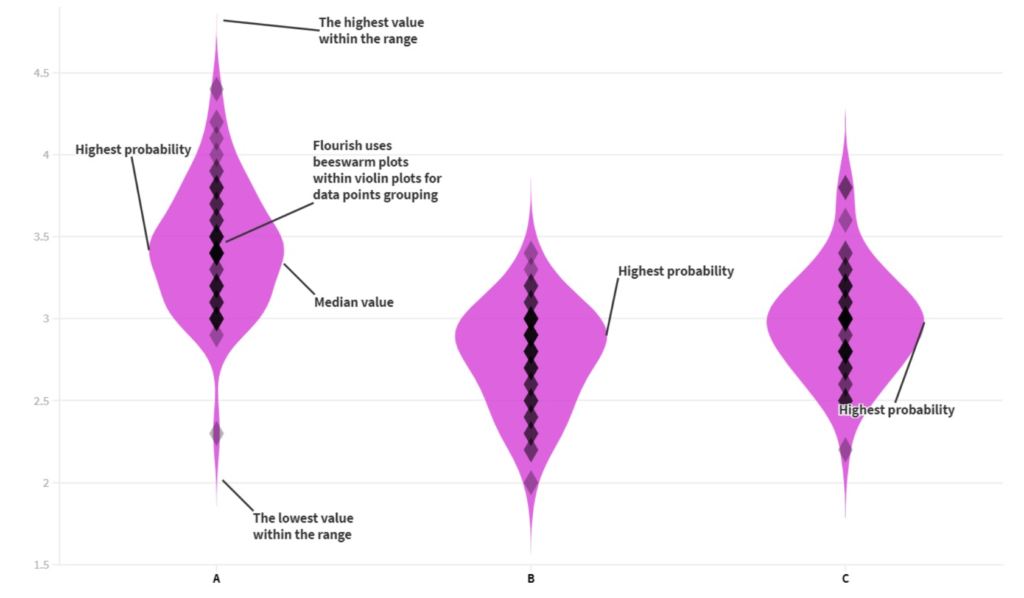
How to interpret a violin plot? While they may look a bit overwhelming at first sight to understand, violin plots are easy to read. I created a graph that shows the anatomy of the volin plot. The top, bottom and middle of the violin are the highest, lowest and middle value point respectively, while the widest part of the violin shows the highest probability. The widest part of the violin can appear on any spectrum of its height, it can be close to the highest, lowest or mid value point.

Author(s): stelayordanova

Publication Date: 3 March 2021

Publication Site: stelayordanova

What Do Vaccine Efficacy Numbers Actually Mean?

Link: https://www.nytimes.com/interactive/2021/03/03/science/vaccine-efficacy-coronavirus.html

Graphic:

Excerpt:

Efficacy depends on the details of a trial, such as where it took place. Johnson & Johnson ran trials at three sites: in the United States, Latin America and South Africa. The overall efficacy was lower than that in the United States alone. One reason for that appears to be that the South Africa trial took place after a new variant had swept across that country. Called B.1.351, the variant has mutations that enable it to evade some of the antibodies produced by vaccination. The variant didn’t make the vaccine useless, however. Far from it: In South Africa, Johnson & Johnson’s efficacy was 64 percent.

Efficacy can also change when scientists look at different outcomes. Johnson & Johnson’s vaccine had an 85 percent efficacy rate against severe cases of Covid-19, for example. That’s important to know, because it means that the vaccine will prevent a lot of hospitalizations and deaths.

Author(s): Carl Zimmer, Keith Collins

Publication Date: 3 March 2021

Publication Site: New York Times

Municipal Bond Outlook: Recovering at Different Speeds

Link: https://www.pimco.com/en-us/insights/investment-strategies/featured-solutions/municipal-bond-outlook-recovering-at-different-speeds/

Graphic:

Excerpt:

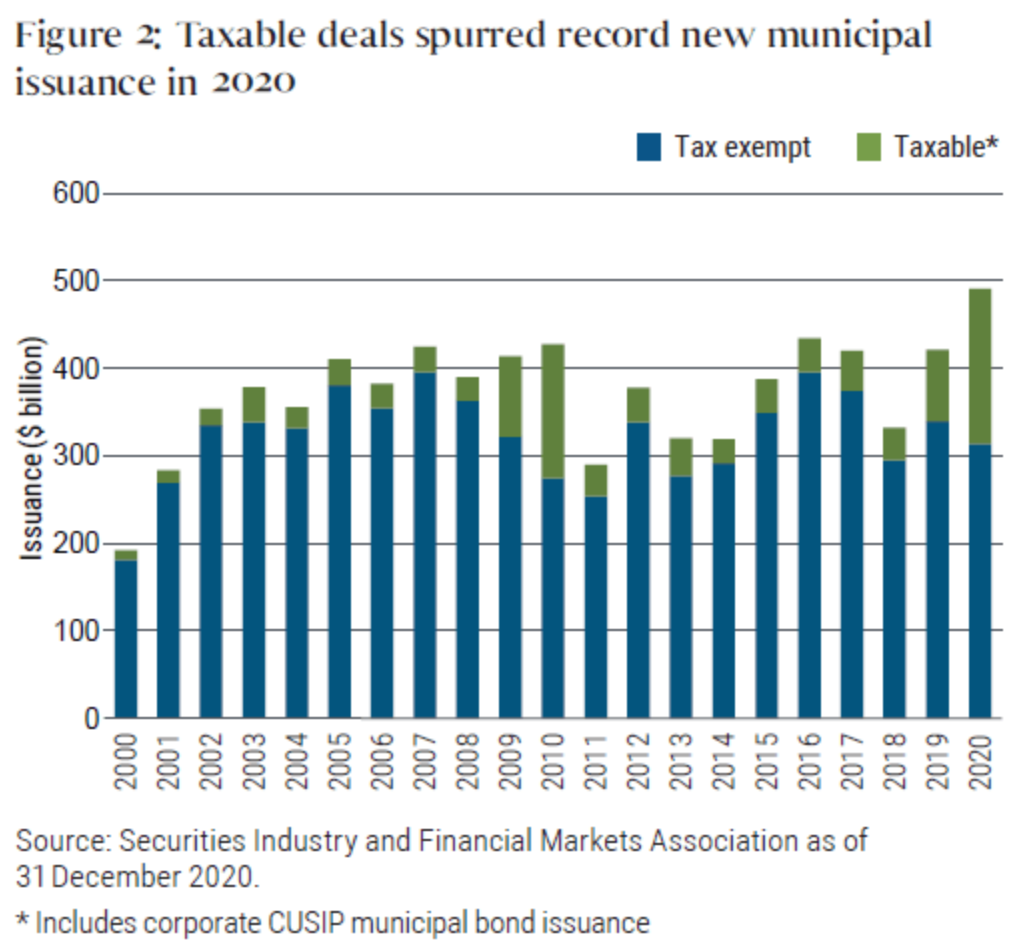
In 2021, the composition of municipal supply could be a key swing factor for high quality muni performance. Last year, taxable muni supply hit an all-time record of $181 billion, due in no small part to the elimination of tax-exempt advance refundings in the 2017 Tax Cuts and Jobs Act (TCJA). The shrinking supply of tax exempts has provided a tailwind to muni market performance, particularly for high quality tax-exempt munis, which have enjoyed a full recovery to pre-pandemic levels.

Author(s): David Hammer

Publication Date: 19 February 2021

Publication Site: PIMCO

New York City Comptroller Scott Stringer Loosening City Pension Private Equity Rules Will Help Him, Hurt Pensioners

Link: https://www.forbes.com/sites/edwardsiedle/2021/02/24/new-york-city-comptroller-scott-stringer-loosening-city-pension-private-equity-rules-will-help-him-hurt-pensioners/?sh=6bdb3ceb2592

Excerpt:

What a remarkable coincidence that New York City Comptroller Scott Stringer is looking to loosen strict rules that govern private-equity firms managing the city’s pensions when the Democrat is running for mayor in this year’s election. Presumably, private equity firms who may earn hundreds of millions in fees if the pension restrictions are lifted will let him know just how grateful they are.

Author(s): Edward Siedle

Publication Date: 24 February 2021

Publication Site: Forbes

Can States Be Trusted To Manage Retirement Savings? Two New Reasons For Concern

Link: https://www.forbes.com/sites/ebauer/2021/02/28/can-states-be-trusted-to-manage-retirement-savings-two-new-reasons-for-concern/

Excerpt:

Readers, I have long been of the opinion that it’s a sensible approach to enable savers to choose among multiple retirement funds, so that they are able to reflect their particular ethical concerns, whether this means an “ESG” (environmental, social, and governance-issue focused) fund or a religious-screening approach, such as excluding companies which donate to Planned Parenthood (Ave Maria Funds) or which are in the alcohol industry (GuideStone Funds).

But no state official should be using investors’ money to play politics — not the money of individual investors through state-run IRAs or the retirement savings accounts of state employees, and not the money of public pension funds. And, frankly, I find it appalling that these sorts of actions aren’t universally considered to be wholly out of bounds — but I suppose living in Illinois (newly-declared the third-most-corrupt state, with Chicago as the most-corrupt city), I suppose I should lower my expectations. Readers in the remaining 49 states, however, should watch carefully.

Author(s): Elizabeth Bauer

Publication Date: 28 February 2021

Publication Site: Forbes