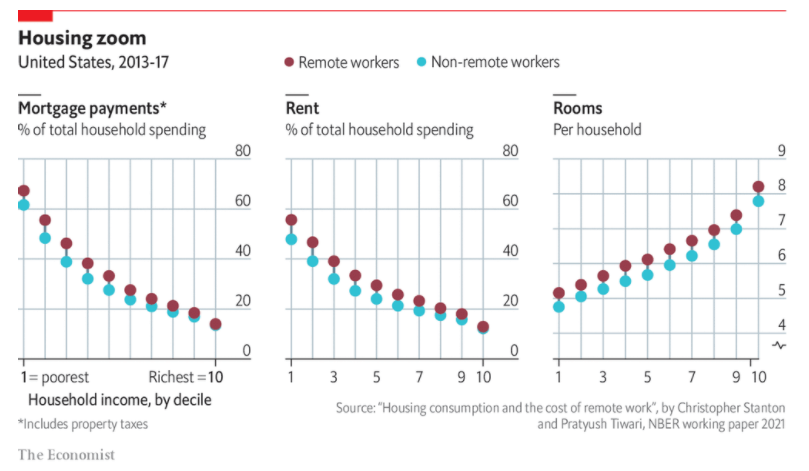
Remote workers spend more on housing than those who commute

Link: https://www.economist.com/graphic-detail/2021/03/02/remote-workers-spend-more-on-housing-than-those-who-commute

Graphic:

Excerpt:

This shift will be a welcome change for many employees, especially those who used to have long, arduous commutes. But those who go remote on a full-time basis will incur at least one cost: paying for extra workspace at home. Such expenses are not trivial. A recent working paper by Christopher Stanton and Pratyush Tiwari of Harvard University estimates that, between 2013 and 2017, American renters who worked from home spent roughly 7% more of their incomes on housing than similar workers who commuted to the office. Homeowners who worked remotely spent an extra 9% on their mortgage payments and property taxes.

Publication Date: 2 March 2021

Publication Site: The Economist

Economy: Inflation Concerns Are Growing

Link: https://cgfa.ilga.gov/Upload/0221revenue.pdf

Excerpt:

It has been over a year since the COVID-19
recession began in February of 2020. After going
through a brutal loss of 31.4% in the second quarter
and an immediate, rapid rebound of 33.4% in the
third quarter last year, the economy appears headed
for a recovery. Overall, the U.S. economy shrank by
3.5% in 2020, compared to 2019. This was the worst
growth since one year after World War II. In
January, personal income rose 10% and consumer
spending jumped by 2.4%, the biggest increase since
June of 2020, both of which mostly resulted from the
COVID-19 relief payments by Congress. Housing
markets are still robust, partly supported by low
mortgage rates.
However, the employment report in January showed
weaker-than-expected data. The unemployment rate
fell to 6.3% from 6.7% mostly due to a decrease in
the labor force (i.e. people gave up looking for jobs).
The economy gained 49,000 jobs, which was lower
than expected. Inflation, currently at 1.5%, is
persistently below the Fed’s average goal of 2%.
Having said that, the outlook on the U.S. economy
has improved as daily COVID-19 infection cases are
falling and more dosages of the vaccines are being
administered. In addition, $1.9 trillion is ready to be
pumped into the economy once a third COVID-19

relief bill passes Congress. However, the recovery
rate will not be as fast as the rate seen in the third
quarter of the previous year.

Author(s): Julie Bae

Publication Date: February 2021

Publication Site: Illinois Commission on Government Forecasting and Accountability
State budget shaping up as embarrassment of riches—for now

Excerpt:

Governor Cuomo’s Division of the Budget (DOB) and the Legislature’s fiscal committees have agreed to boost New York State’s revenue projection for fiscal years 2021 and 2022 by $2.45 billion—the latest in a series of upward adjustments that have dramatically improved Albany’s short-term outlook, even as sexual harassment allegations against the governor will complicate negotiations towards a new budget for the fiscal year beginning April 1.

The Consensus Revenue and Economic Forecast issued late last night by DOB splits the difference between the governor’s budget agency, which wasn’t budging from its already improved 30-day amended financial plan outlook, and a very optimistic projection from the Assembly Ways and Means Committee staff, which forecast $5 billion more in revenue through FY 2022. The Senate Finance Committee staff estimate came in a total $3.4 billion higher than the governor’s latest number.

Author(s): E.J. McMahon

Publication Date: 2 March 2021

Publication Site: Empire Center for Public Policy

Our View: Federal stimulus checks should not increase state taxes

Link: https://www.bluemountaineagle.com/coronavirus/our-view-federal-stimulus-checks-should-not-increase-state-taxes/article_5efb3986-7ae2-11eb-9c94-e30cd7275f13.html

Excerpt:

The federal stimulus checks helped a lot of Oregonians out when they needed it. And it is also going to help out Oregon government — about $100 million in federal stimulus payments is going to wind up in the state treasury.

The federal government is not taxing the stimulus payments. In Oregon, they are not taxed as income, either. But the payments can impact the federal tax calculations used on your Oregon income tax. And so the stimulus payment may mean you owe state tax on more of your income and wind up paying more taxes or get a reduced refund.

Does that sound right to you? The stimulus checks sure seemed to be aimed at helping individuals, not helping state government.

Author(s): Editorial board

Publication Date: 2 March 2021

Publication Site: Blue Mountain Eagle

Damschroder: Ohio teachers pension mauled by Panda

Link: https://www.thenews-messenger.com/story/news/2021/03/03/damschroder-ohio-teachers-pension-mauled-panda/6883736002/

Excerpt:

The Ohio Retirement Study Council (ORSC) revived oversight theater, a suit and tie simulation of supervising the $200 billion state pensions. In the first act, ORSC started the process for fiduciary audits of the teachers and police and fire pensions a mere five years after their legal deadline.

….

In reality, STRS has recent evidence that alternative investments come with the risk of massive losses. The Ohio teachers’ pension was one of the first investors in Dallas-based Panda Power. Panda is a merchant generator building plants run by cheap shale gas to produce more profitable electricity. The business model collapsed when utility regulators did not approve anticipated rates. Panda’s bankruptcy filing showed debt of $400 million against cash on hand of $2,000.

Author(s): John Damschroder

Publication Date: 3 March 2021

Publication Site: Fremont News Messenger

Risk Rating 2.0

Link: https://www.fema.gov/flood-insurance/work-with-nfip/risk-rating

Excerpt:

The National Flood Insurance Program (NFIP) is redesigning its risk rating by leveraging industry best practices and current technology, FEMA will deliver rates that are fair, make sense, are easier to understand and better reflect a property’s unique flood risk. FEMA calls this effort Risk Rating 2.0.

alert – warning
Risk Rating 2.0 implementation has been deferred To October 1, 2021.

While the agency initially announced that new rates for all single-family homes would go into effect nationwide on October 1, 2020, some additional time is required to broaden the agency’s analyses of the proposed rating structure across its entire book of business, to include its relationship to communities behind levees. Therefore, FEMA decided to adjust implementation of Risk Rating 2.0 by one year to October 1, 2021.

Date Accessed: 4 March 2021

Publication Site: FEMA

Advisory committee says North Carolina should put more toward pensions

Link: https://www.montgomeryherald.com/news/article_ac128a46-7b94-11eb-b480-230aa039ee18.html

Excerpt:

North Carolina’s Debt Affordability Advisory Committee says the state should set aside $100 million a year to help the state pension systems remain solvent.

A draft released Wednesday, Feb. 24, of the committee’s 2021 debt affordability study also calls for North Carolina to maintain its 4% borrowing cap.

The committee said more money is needed to support post-employment benefits, including pensions and health care. Officials said the state’s pension systems show a $12.1 billion shortfall, while the State Health Plan is underfunded by $27.7 billion.

The committee said the state should put $100 million annually into the Unfunded Liability Solvency Reserve through fiscal 2025 to help lower that number.

Author(s): Johnny Kampis

Publication Date: 3 March 2021

Publication Site: Montgomery Herald

In Democrats’ progressive paradise, borrowing is free, spending pays for itself, and interest rates never rise

Link: https://www.washingtonpost.com/business/2021/03/03/democrats-stimulus-spending-inflation/

Excerpt:

To hear it from liberal economists, progressive activists and Democratic politicians, there is no longer any limit to how much money government can borrow and spend and print.

In this new economy, we no longer have to worry that stock prices might climb so high, or companies take on so much debt, that a financial crisis might ensue. In this world without trade-offs, we can shut down the fossil fuel industry and transition to a zero-carbon economy without any risk to employment and economic growth. Nor is there any amount of infrastructure investment that could possibly exceed the capacity of the construction industry to absorb it.

Rest assured that the economy won’t miss a beat no matter how far or fast the minimum wage is raised. And whatever benefits are required by the always struggling middle class can be financed by raising taxes on big corporations and the undeserving rich.

Author(s): Steven Pearlstein

Publication Date: 3 March 2021

Publication Site: Washington Post

Anthony Starks on Recreating Du Bois’s Iconic Style

Graphic:

Excerpt:

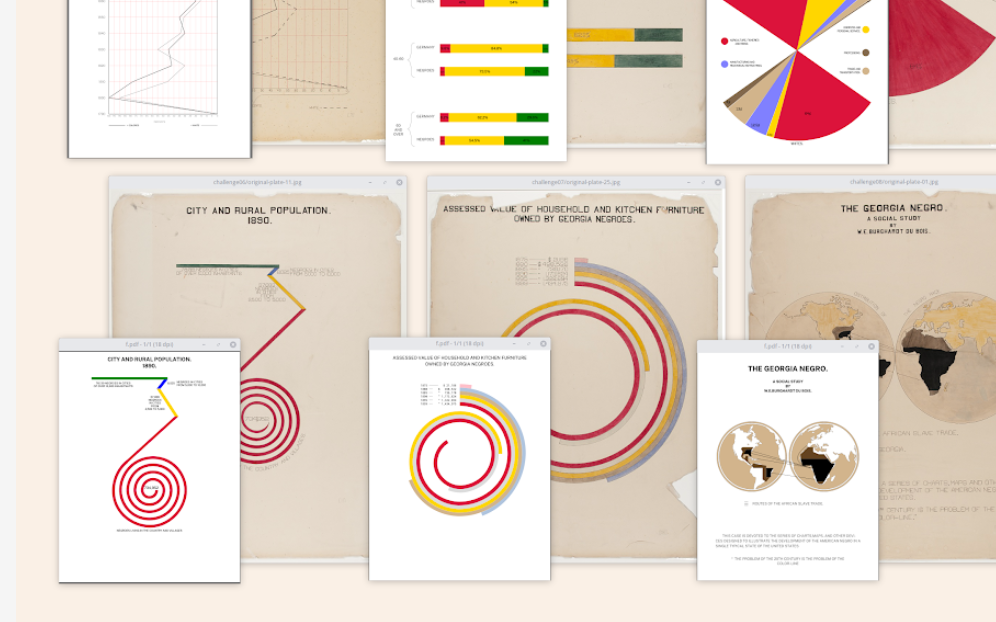
When Sekou and I met with Anthony to discuss his Du Bois recreations, he explained that he was “immediately struck” by Howard Wainer’s presentation on “Historical Development of W.E.B. Du Bois Graphical Narrative.” This was back in May 2017 at a Data Visualization New York meetup hosted by data viz pioneer Naomi Robbins. He was in awe of the existence and artistry of Du Bois’s work. The thought that immediately came to his mind was, “How can I reproduce this?”

Author(s): Allen Hillery

Publication Date: 25 February 2021

Publication Site: Data Literacy

Illinois House speaker, minority leader have different ideas about tax policy, ending state’s decline in population

Link: https://www.thecentersquare.com/illinois/illinois-house-speaker-minority-leader-have-different-ideas-about-tax-policy-ending-states-decline-in/article_d7fc1596-786a-11eb-b045-47c45d3e4bf5.html#new_tab

Excerpt:

The state lost nearly 80,000 people in the year that ended July 2020, according to an analysis of U.S. Census data. That’s 22,000 more than were lost the year before and the seventh consecutive loss of population in the past 10 years. Illinois led the nation in population decline for the past decade at 255,000.

Illinois House Speaker Emanuel “Chris” Welch, D-Hillside, told the Economic Club of Chicago on Wednesday the state has been losing population for years. Without details, he said the state needs to support small and big businesses. He also said leaders need to unite on messaging.

Author(s): Greg Bishop

Publication Date: 26 February 2021

Publication Site: The Center Square

Editorial: Former House Speaker Michael Madigan’s pension illustrates the broken system

Link; https://www.chicagotribune.com/opinion/editorials/ct-edit-fixing-illinois-chicago-budget-madigan-pension-20210226-tt4kmbn7hbetldxgez57x4ioqq-story.html#new_tab

Excerpt:

Former House Speaker Michael Madigan, after 50 years as a member of the Illinois House and a contributor into one of the state’s five pension funds, the General Assembly Retirement System, will receive an annual pension of around $85,117, about 85% of his final salary.

In July 2022, his pension will rise to about $148,995 due to padding lawmakers built into the system for themselves over the years. He’ll receive a guaranteed 3% raise on his pension each year, no matter what the actual cost of living is.

During those 50 years in office, Madigan contributed from his own paycheck about $351,000 toward his retirement account. He quickly will start receiving far more than he put in.

Author(s): Editorial board

Publication Date: 26 February 2021

Publication Site: Chicago Tribune

New COVID-19 cases among nursing home residents fell 80 percent in a month

Link: https://thehill.com/homenews/news/540614-new-covid-19-cases-among-nursing-home-residents-fell-80-percent-in-a-month?rl=1

Excerpt:

New coronavirus cases among nursing home residents have plummeted by nearly 80 percent from late December to early February, according to The New York Times.

In an analysis of federal data, the news outlet found that outbreaks at long-term care facilities have dropped at a rate almost double that of the general population.

“I’m almost at a loss for words at how amazing it is and how exciting,” David Gifford, the chief medical officer for the American Health Care Association, told the Times. “If we are seeing a robust response with this vaccine with the elderly with a highly contagious disease, I think that’s a great sign for the rest of the population.”

Author(s): Cameron Jenkins

Publication Date: 25 February 2021

Publication Site: The Hill