L.A. Tries to Combat Racial Inequities of COVID Inoculations

Link: https://www.governing.com/community/LA-Tries-to-Combat-Racial-Inequities-of-COVID-Inoculations.html

Excerpt:

As stark disparities emerge in vaccination rates, L.A. County officials are jump-starting efforts to improve access for people of color. Strategies include creating more vaccination sites as well as better public messaging campaigns, improving access to transportation and reserving spots at neighborhood vaccination locations before people from other parts of the county can scoop them up.

“We have a lot of work to do to fix this,” L.A. County public health director Barbara Ferrer said Tuesday at a county Board of Supervisors meeting. “However way you cut this data, it’s clear that in some of our hardest-hit communities, there are populations that are not getting vaccinated at the same rate as other groups.”

On Tuesday morning, Darby stood in line yet again, this time at a vaccination blitz in South Park aimed at administering doses to 800 seniors, particularly Blacks and Latinos, as well as healthcare workers in four days. Though there are historical and cultural issues that may make Black residents skeptical of vaccines, the biggest issue in L.A. County thus far has been access, said Councilman Curren Price, who helped plan the event.

Author(s): RUBEN VIVES, JACLYN COSGROVE AND SOUMYA KARLAMANGLA, LOS ANGELES TIMES

Publication Date: 10 February 2021

Publication Site: Governing
Can Vaccines Keep Up With Rapidly Evolving Coronavirus?

Link: https://www.governing.com/now/Can-Vaccines-Keep-Up-With-Rapidly-Evolving-Coronavirus.html

Excerpt:

Experts told cleveland.com that although the virus may continue to mutate, there’s no reason to think it will render the vaccines ineffective. Pharmaceutical companies are already in the process of updating their vaccines to provide protection against the emerging variants, but the existing vaccines should provide enough protection to get the pandemic under control.

The prevalence of variants is partly the result of a global failure to contain the spread of COVID-19, experts said. The virus has had ample opportunity to evolve while infecting more than 100 million people worldwide.

Vaccines should limit the spread of infection, and that should reduce the chance that another concerning variant might emerge, said Gigi Gronvall, senior scholar at Johns Hopkins Center for Health Security. There will be even fewer chances for those mutations to occur if everyone who is still waiting for a vaccine continues to follow precautions like wearing face masks.

Author(s): EVAN MACDONALD AND JULIE WASHINGTON, CLEVELAND.COM

Publication Date: 10 February 2021

Publication Site: Governing

To the union allies of the victor go the pension spoils

Link: https://www.washingtonexaminer.com/opinion/op-eds/to-the-union-allies-of-the-victor-go-the-pension-spoils

Excerpt:

Last week, the House Ways and Means Committee approved a massive taxpayer bailout of private sector multiemployer defined benefit pension plans, or MEPs, as part of a budget reconciliation package that is purportedly meant to deal with COVID-19. Senate Budget Committee Chairman Bernie Sanders claims MEPs are underfunded because “of the greed on Wall Street.” But MEPs are troubled because of mismanagement, not because of COVID-19 or Wall Street.

MEPs are jointly sponsored by a union and companies employing members of that union. It is not clear why taxpayers, who had no role in making these pension promises, should be funding them.

The proposal would saddle taxpayers with unfunded pension promises made by eligible MEPs, which are underfunded by more than $100 billion, while providing perverse incentives for other MEPs to subsequently qualify. This would be extremely expensive as MEPs are already underfunded by $673 billion as of 2017 (a funding ratio of 42%).

Author(s): Aharon Friedman

Publication Date: 15 February 2021

Publication Site: Washington Examiner

COVID-19: Cuomo Admits Lack Of Transparency On Reporting Nursing Home Data Amid Backlash

Link: https://dailyvoice.com/new-york/northsalem/politics/covid-19-cuomo-admits-lack-of-transparency-on-reporting-nursing-home-data-amid-backlash/803321/

Excerpt:

In his first public comments on a top aide’s admission that his administration “froze” when asked by both federal and state officials to release data on COVID-19 nursing home fatalities, Gov. Andrew Cuomo said the lack of transparency was a mistake.

Cuomo said “there was a delay,” in reporting the data, and that void led to “skepticism, cynicism and conspiracy theories which furthered confusion” in a news briefing held in Albany on Monday, Feb. 15.

“We should have provided more information faster,” Cuomo said. “We were too focused on doing the job and addressing the crisis of the moment. I take total responsibility for that.”

Author(s): Joe Lombardi

Publication Date: 15 February 2021

Publication Site: Daily Voice

Baltimore Budget Director describes city’s financial outlook amid pandemic as “ugly”

Link: https://foxbaltimore.com/news/local/baltimores-budget-director-ugly-describes-citys-financial-outlook-amid-pandemic

Excerpt:

Christopher Summers, a public policy expert at the Maryland Public Policy Institute, says the pandemic only complicates financial matters for a city reeling from financial troubles long before the pandemic’s nearly one-year grip.

One example includes a study by the non-profit “Truth in Accounting” released in January last year. The study gave Baltimore a grade of “D,” saying the city fell $2 billion short of paying its bills.

At the time, former Mayor Jack Young called the city fiscally sound and said the study was wrong.

Author(s): Keith Daniels

Publication Date: 9 February 2021

Publication Site: Fox 5 News

States of Budget Surplus

Link: https://www.wsj.com/articles/states-of-budget-surplus-11612999662?mod=opinion_lead_pos2

Excerpt:

Governors—especially from Democratic states—have been pleading revenue poverty since the pandemic began. But as we approach the anniversary of Covid-19 in America, that tall tale is becoming more difficult to sell.

Even the left-tilting media are beginning to figure out what we’ve been reporting for some time. One of our sources is Dan Clifton, of Strategas Research Partners, who has been tracking state revenue trends and Covid relief from the beginning. His latest analysis shows that state revenues have been doing far better than advertised, especially states that have kept their economies largely open.

He estimates that a majority of the 50 states are seeing revenues arrive above their pre-Covid levels despite the 2020 economic damage. The big exceptions are states that had the most restrictive business lockdowns (New York), those that rely on sales taxes and have no income tax (Florida and Texas), and those that depend on travel and tourism (Nevada).

Author(s): Editorial board

Publication Date: 10 February 2021

Publication Site: Wall Street Journal

A public option for health insurance could be a disaster, especially in times of crisis

Excerpt:

Basic assumptions about the long-term costs of a public option are flawed. Research we have done shows that a public option will mean soaring deficits and debts because politicians in Washington will eventually succumb to political pressure both to subsidize enrollee premiums and to pay doctors and hospitals closer to what they are paid by private insurance rather than by existing government programs like Medicare and Medicaid. According to our calculations, the public option would add $800 billion to deficits in the first 10 years and increase the federal debt by more than 30% of the gross domestic product by 2050 — the equivalent of $6 trillion in today’s economy.

The effects on the budget are even worse when the economy suffers or if health costs unexpectedly rise. How much worse? With support from the Partnership for America’s Health Care Future — a coalition of leading health care providers, insurers, biopharmaceutical companies and employers that oppose one-size-fits-all health care — we looked at a few ways policymakers might adjust the public option to respond to future economic shocks and the impact these changes would have on long-term deficits and debt.

Author(s): Lanhee J. Chen, Tom Church, and Daniel L. Heil

Publication Date: 11 February 2021

Publication Site: Stat News

AI, Privacy, Racial Bias Among State Insurance Regulator Priorities for 2021

Link: https://www.carriermanagement.com/news/2021/02/10/216927.htm

Excerpt:

The NAIC 2021 priorities and the charges to its key committees are (in no specific order):

COVID-19 — In 2021, the NAIC will continue its “Priority One” initiative designed to support state insurance departments in their response to the ongoing pandemic and its impact on consumers and insurance markets. NAIC has a COVID resource page that includes information on actions taken by individual states in response to the COVID 19 pandemic that impact various lines of insurance. NAIC said insurance regulators will continue to analyze data and develop the tools so that consumer protection keeps pace with changes brought on by the virus.

Big Data/Artificial Intelligence — The Big Data and Artificial Intelligence Working Group is chaired by Doug Ommen, Iowa, joined by Elizabeth Kelleher Dwyer, co-vice chair, Rhode Island and Mark Afable, co-vice chair, Wisconsin.

…..

Race & Insurance — The Special Committee on Race and Insurance is co-chaired by Maine Superintendent Eric Cioppa and New York Executive Deputy Superintendent of Insurance My Chi To.

The 2021 agenda for this panel calls for research into the level of diversity and inclusion within the insurance sector; engagement with a broad group of stakeholders on issues related to race, diversity and inclusion in, and access to, the insurance sector and insurance products; and an examination of current practices or barriers in the insurance sector that potentially disadvantage people of color and historically underrepresented groups.

Publication Date: 10 February 2021

Publication Site: Carrier Management

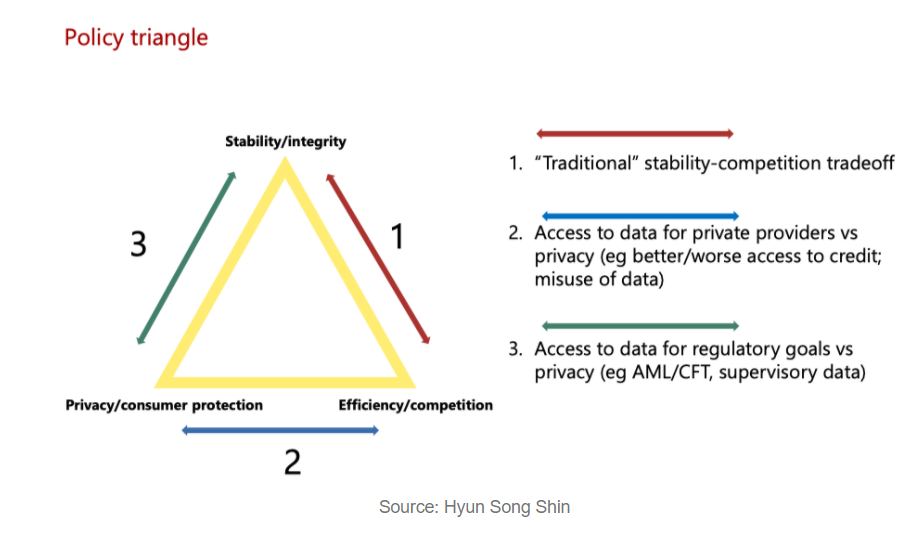
The Policy Triangle

Link: https://netinterest.substack.com/p/the-policy-triangle

Graphic:

Excerpt:

Policymakers are increasingly confronting a new problem, though: the entry of technology companies into financial services throws their trade-off framework off-kilter. There are two issues. 

First, financial regulators don’t have jurisdiction over technology companies. They have jurisdiction over their financial activities but not over the companies themselves. At the entry level, this works fine. When a company wants to do payments, they need to get a payments license and when they want to do credit underwriting, they need a credit license.

Sometimes, new entrants skate round these rules. Afterpay in Australia is not regulated as a credit provider since it doesn’t impose a charge for the ability to pay; nor as a payment system since it conducts relationships bilaterally between consumers on the one hand and merchants on the other. In response to impending regulatory scrutiny, the company points out that the major card providers got away with it for 20 years. “The dominant international card payment systems…were launched in Australia in 1984 and were not subject to RBA [Reserve Bank of Australia] regulation until 2004.”

Author(s): Marc Rubinstein

Publication Date: 12 February 2021

Publication Site: Net Interest on Substack

Chicago thinks Zocdoc can help solve its vaccine chaos

Link: https://www.technologyreview.com/2021/02/12/1018092/vaccine-signup-chicago-zocdoc-frustrating-as-tech-companies-step-in-deeper-inequalities-harder-to-fix/

Excerpt:

In early February, the Department of Public Health announced a plan to help ease some of those technical problems: a partnership with Zocdoc, the popular online health-care scheduling company. Zocdoc is acting as a unified portal for multiple providers, so that people can sign up with a single, more user-friendly tool rather than wrestle with several different systems at once. While Chicago is the first city to make this specific agreement with Zocdoc, other health agencies are launching similar partnerships with private startups.

Before the pandemic, Zocdoc acted as a one-stop shop where patients could check out different doctors, compare medical providers, and make appointments. The company’s CEO, Oliver Kharraz, says the years spent bridging a fragmented health-care system unknowingly prepared it for taking on covid-19 vaccination appointments. After the idea was tested with the Mount Sinai Health System in New York, Zocdoc says, Chicago reached out about a partnership—and the system was up and running within a few weeks. Zocdoc connects with 1,400 different scheduling systems: doctors’ workflows remain unchanged, but patients all see the same simple interface no matter which provider they’re using.

Author(s): Mia Sato

Publication Date: 12 February 2021

Publication Site: MIT Technology Review

EPPRA Bailout Bill Advances

Excerpt:

According to an email blast from the Road Carriers 707 Pension Fund on Thursday..

the House Ways and Means Committee reported out (passed) the Butch Lewis Emergency Pension Plan Relief Act with only technical amendments. The Bill now moves onto the Budget Committee and the Rules Committee. It is expected to move through these Committees without incident and onto a vote on the House floor. As we reported yesterday this Bill is part of a larger Covid Relief Bill expected to be voted on in mid March in the Senate after House passage.

There was a lot of discussion about workers deserving a bailout as they did nothing wrong (trusting politicians, actuaries, and union heads notwithstanding) but what struck me was the perspicacity of Congressman Adrian Smith (R-Nebraska):

Author(s): John Bury

Publication Date: 13 February 2021

Publication Site: Burypensions

Pritzker said the failure of his graduated-rate income tax would leave Illinois with two options. He’s eliminated both of them.

Link: https://www.chicagotribune.com/politics/ct-jb-pritzker-illinois-budget-proposal-20210214-bjbay24vpvggfpg2urhbn4ojsy-story.html#new_tab

Excerpt:

Gov. J.B. Pritzker long warned that without his graduated-rate income tax, which voters rejected in November, Illinois would be left with only two options to address its chronic budget problems: raising income taxes or double digit across-the-board spending cuts.

But ahead of his budget address to lawmakers Wednesday, Pritzker outlined a state spending plan that would neither raise the income tax or alter the total budget outlay.

He did call for closing $900 million in unspecified “corporate tax loopholes,” which opponents are already labeling a tax hike on businesses in the middle of the coronavirus pandemic.

What remains to be seen is whether the governor will look to other avenues to increase revenue, although his options appear limited. He has opposed two of the leading options favored by some budget watchers: instituting a tax on retirement income and applying the sales tax to some services.

Author(s): DAN PETRELLA

Publication Date: 14 February 2021

Publication Site: Chicago Tribune