Tufts University joins the growing number of colleges that have pledged to end direct investments into coal and tar sands companies. The decision comes after a review from an internal school sustainability committee.
A list of 120 of the largest energy firms will be banned by the $1.9 billion endowment, the university said Wednesday. At the moment, the school has no direct investments into the excluded companies, though the list will be reviewed and updated every year.
Multiemployer pension plans eligible for the program would include plans in critical and declining status, and plans with significant underfunding that have more retirees than active workers in any plan year beginning in 2020 through 2022. Additionally, plans that have suspended benefits and certain plans that have already become insolvent would also be eligible.
The plans would have to apply for the special financial assistance, and, if approved, the payment made by PBGC would be in the form of a single, lump sum. The amount of financial assistance would be equal to the amount required for the plan to pay all benefits due during the period beginning on the date of enactment and ending on the last day of the plan year ending in 2051. Plans would also be required to invest the amounts in investment-grade bonds or other investments as permitted by PBGC.
More than 9,000 recovering coronavirus patients in New York state were released from hospitals into nursing homes early in the pandemic under a controversial directive that was scrapped amid criticism it accelerated outbreaks, according to new records obtained by The Associated Press.
The new number of 9,056 recovering patients sent to hundreds of nursing homes is more than 40% higher than what the state health department previously released. And it raises new questions as to whether a March 25 directive from Gov. Andrew Cuomo’s administration helped spread sickness and death among residents, a charge the state disputes.
The public pension system lost $1 trillion, a 21 percent loss for the fiscal year, following the COVID-19 lockdowns in March. In turn, these losses have added an overwhelming amount of stress on our public pension systems, as state and local pensions were already facing a $4.1 trillion shortfall. Public pension liabilities are on track to increase to $1.62 trillion this year, up from $1.35 trillion in 2019. These numbers are alarming as many governments now have less capacity to defer cost hikes or take mitigating actions because their non-asset cash flow has greatly declined.
Two of America’s most dire pension plan systems are in California and Illinois, two of the country’s largest states with large numbers of workers in defined contribution plans. In California, the economic effects of the virus are evident on the already strained public pension system. At the end of the first quarter, the California Public Employees’ Retirement System, reported that their asset value had dropped 10.5 percent since June 2019 — a loss of $35 billion. Matters have only gotten worse in Illinois and could soon hit a level of catastrophe if aid does not come forth. Moody’s estimates that Illinois’ pension liability will rise from $230 billion in 2019 to $261 billion in 2020.
Author(s): Kevin O’Connor
Publication Date: 28 January 2021
Publication Site: Institute for Pension Fund Integrity
Of course, if there’s one thing America’s national political class does not like or understand, it is lulz. Lulz are inherently chaotic and disorderly, and that tends to cause headaches for most anyone with a bureaucratic bent. But it also produces reactions like one we saw yesterday, in which Sen. Elizabeth Warren (D–Mass.) used the GameStop episode to call for intervention by the Securities and Exchange Commission (SEC).
It’s not at all clear what the SEC could do to stop what is essentially a financial market flash mob, aside from ensure that no large institutional investors are secretly in on the WallStreetBets side of the trade. If that’s the case (and it may well be, though who knows), then the SEC will probably end up taking some sort of action based on existing rules designed to prohibit fraudulent pump-and-dump schemes, where stocks are artificially boosted and sold off.
Long-held strategies such as evaluating company fundamentals have gone out the window in favor of momentum. War has broken out between professionals losing billions and the individual investors jeering at them on social media. Meanwhile, the frenzy of activity is stirring regulatory and legal concerns, as well as the attention of the Biden administration. The White House press secretary said on Wednesday that its economic team, including Treasury Secretary Janet Yellen, is monitoring the situation.
The newbie investors are gathering on platforms such as Reddit, Discord, Facebook and Twitter . They are encouraging each other to pile into stocks, bragging about their gains and, at times, intentionally banding together to intensify losses among professional traders, who protest that social-media hordes are conspiring to move stock prices.
Author(s): Gunjan Banerji, Juliet Chung and Caitlin McCabe
The scale of trading in GameStop shares is as extraordinary as the daily gains in price, suggesting widespread disturbance to people’s judgment. On Tuesday, $22 billion of shares changed hands, more than in Apple, the world’s largest company, and double GameStop’s market value. Adam Smith, the founder of economics, called speculative manias “overtrading,” and this is what they look like.
The hope of getting rich is only part of what is inflating the bubble. Mr. Kindleberger argued that speculative manias needed innovative sources of financing, and the private traders on r/WSB have one: the shift last year to make trading in options free on Robinhood and several other platforms.
State Representative Amy Elik (R-Fosterburg) kept her promise to Metro East taxpayers by rejecting the lawmaker pension. The pension benefit is available to all lawmakers serving in the part-time legislature.
“I refused the taxpayer-funded pension because the state can’t afford to offer this lavish benefit to lawmakers anymore,” said Rep. Elik. “The pension offered to lawmakers is swimming in debt with over $314 million in unfunded liabilities. By rejecting the pension, I am reducing the debt forced onto Illinois taxpayers.”
Orlando Cruz, senior vice president of ICMA-RC, says the layoffs following the Great Recession took years to recover from. “The layoffs, the furloughs, the early retirements we saw then really put states and localities in a hole through next decade to the point where — even before Covid — they had hard time recruiting in certain skill sets,” he said.
Now, he added, “governments are thinking strategically in terms of hiring.” State and local worker layoffs appear to have peaked in April — that’s different from the slow and steady layoffs that occurred over many months during the last recession. “Governments know they have to compete with other sectors for talent,” Cruz said during a call with reporters. What’s more, he said, budget constraints in the coming years will “make it harder to back fill those positions laid off.”
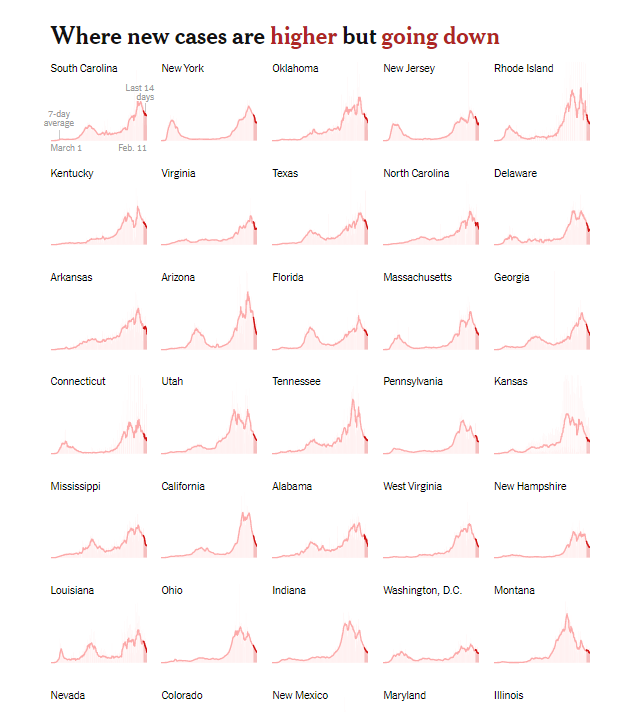
At least 3,878 new coronavirus deaths and 105,515 new cases were reported in the United States on Feb. 11. Over the past week, there has been an average of 101,655 cases per day, a decrease of 36 percent from the average two weeks earlier. As of Friday morning, more than 27,433,900 people in the United States have been infected with the coronavirus according to a New York Times database.
Author(s): Jordan Allen, Sarah Almukhtar, Aliza Aufrichtig, Anne Barnard, Matthew Bloch, Sarah Cahalan, Weiyi Cai, Julia Calderone, Keith Collins, Matthew Conlen, Lindsey Cook, Gabriel Gianordoli, Amy Harmon, Rich Harris, Adeel Hassan, Jon Huang, Danya Issawi, Danielle Ivory, K.K. Rebecca Lai, Alex Lemonides, Eleanor Lutz, Allison McCann, Richard A. Oppel Jr., Jugal K. Patel, Alison Saldanha, Kirk Semple, Julie Walton Shaver, Anjali Singhvi, Charlie Smart, Mitch Smith, Albert Sun, Derek Watkins, Timothy Williams, Jin Wu and Karen Yourish. · Reporting was contributed by Jeff Arnold, Ian Austen, Mike Baker, Brillian Bao, Ellen Barry, Samone Blair, Nicholas Bogel-Burroughs, Aurelien Breeden, Elisha Brown, Emma Bubola, Maddie Burakoff, Alyssa Burr, Christopher Calabrese, Zak Cassel, Robert Chiarito, Izzy Colón, Matt Craig, Yves De Jesus, Brendon Derr, Brandon Dupré, Melissa Eddy, John Eligon, Timmy Facciola, Bianca Fortis, Matt Furber, Robert Gebeloff, Thomas Gibbons-Neff, Matthew Goldstein, Grace Gorenflo, Rebecca Griesbach, Benjamin Guggenheim, Barbara Harvey, Lauryn Higgins, Josh Holder, Jake Holland, Jon Huang, Anna Joyce, John Keefe, Ann Hinga Klein, Jacob LaGesse, Alex Lim, Alex Matthews, Patricia Mazzei, Jesse McKinley, Miles McKinley, K.B. Mensah, Sarah Mervosh, Jacob Meschke, Lauren Messman, Andrea Michelson, Jaylynn Moffat-Mowatt, Steven Moity, Paul Moon, Derek M. Norman, Anahad O’Connor, Ashlyn O’Hara, Azi Paybarah, Elian Peltier, Sean Plambeck, Laney Pope, Elisabetta Povoledo, Cierra S. Queen, Savannah Redl, Scott Reinhard, Thomas Rivas, Frances Robles, Natasha Rodriguez, Jess Ruderman, Kai Schultz, Alex Schwartz, Emily Schwing, Libby Seline, Sarena Snider, Brandon Thorp, Alex Traub, Maura Turcotte, Tracey Tully, Lisa Waananen Jones, Amy Schoenfeld Walker, Jeremy White, Kristine White, Bonnie G. Wong, Tiffany Wong, Sameer Yasir and John Yoon. · Data acquisition and additional work contributed by Will Houp, Andrew Chavez, Michael Strickland, Tiff Fehr, Miles Watkins, Josh Williams, Shelly Seroussi, Rumsey Taylor, Nina Pavlich, Carmen Cincotti, Ben Smithgall, Andrew Fischer, Rachel Shorey, Blacki Migliozzi, Alastair Coote, Jaymin Patel, John-Michael Murphy, Isaac White, Steven Speicher, Hugh Mandeville, Robin Berjon, Thu Trinh, Carolyn Price, James G. Robinson, Phil Wells, Yanxing Yang, Michael Beswetherick, Michael Robles, Nikhil Baradwaj, Ariana Giorgi, Bella Virgilio, Dylan Momplaisir, Avery Dews, Bea Malsky and Ilana Marcus
[MPC here: I am not tagging all these people. Sorry, y’all]
Urban Democratic lawmakers attacked Gov. Ned Lamont’s new budget proposal Thursday, charging the two-year package does little to nothing to reverse long-standing gaps in education, health care and economic opportunity.
During a two-hour hearing with Lamont’s budget director, the governor’s fellow Democrats on the Appropriations Committee also questioned whether the $46 billion biennial package sets Connecticut up for another budget crisis after the next state election.
“I am so disappointed in this budget when it comes to human services,” said Rep. Cathy Abercrombie, D-Meriden. “Again, here we are, balancing a budget on the backs of our most vulnerable.”