FIX OR SELL? ILLINOIS’ HIGH PROPERTY TAXES MAKE EITHER TOUGH

Link: https://www.illinoispolicy.org/fix-or-sell-illinois-high-property-taxes-make-either-tough/

Graphic:

Excerpt:

Illinois has 859 school districts and 25% of them serve just one school. Florida, which serves over 700,000 more students than Illinois, has 75 districts. Florida averages 38,000 students per district.

In addition to Illinois being home to the second-highest property taxes in the country, one of the most painful facts about owning a home here is that tax dollars don’t go to the services people expect and value.

Author(s): Hilary Gowins

Publication Date: 11 February 2021

Publication Site: Illinois Policy Institute

Silver is surging but users on WallStreetBets say they’re not behind the rally

Link: https://edition.cnn.com/2021/01/31/investing/silver-price-squeeze-reddit-wallstreetbets/index.html

Excerpt:

Silver futures surged as much as 13% to Monday, touching eight-year highs. That follows a 6% rally last week when some posts on the WallStreetBets group on Reddit called for betting on silver as a way to hurt big banks they believe are artificially suppressing prices.

Meanwhile, retail sites warned customers over the weekend they could not meet skyrocketing demand for silver bars and coins. The Commodity Futures Trading Commission said it is monitoring the silver markets and “remains vigilant in surveilling these markets for fraud and manipulation.” And “#silversqueeze” is trending on Twitter.

However, it’s not clear who the Reddit users are — nor whether their market moves match the claims online.

Author(s): Matt Egan

Publication Date: 2 February 2021

Publication Site: CNN

People are fed up with broken vaccine appointment tools — so they’re building their own

Link: https://www.technologyreview.com/2021/02/01/1016725/people-are-building-their-own-vaccine-appointment-tools/

Excerpt:

That very day, January 2, Craver worked from 3 in the afternoon until 11:30 at night to create Covid19 Vaccine TX, a site listing possible vaccination locations across the state. As a digital product designer, she knew that a site like this would have to be easy to read, intuitive to navigate, and quick to update. The idea was that people could upload information about vaccination sites, with each entry answering three questions: Was the vaccine available that day? Was the location taking appointments? Was there a wait list?

Craver loaded the project on the cloud-based spreadsheet service Airtable, posted a link on Reddit, and went to bed. When she woke up the next morning at 7 a.m., one entry was filled out. “At least somebody cares,” she remembers thinking. She spent the rest of the day manually inserting information for about 1,400 locations in the state. “I’ve been going nonstop since,” she says, estimating that she puts in about 40 hours of her free time every week to maintain the site. It has received 50,000 total visitors since launch.

Author(s): Tanya Basu

Publication Date: 1 February 2021

Publication Site: MIT Technology Review

Should we stop GameStop?

Link: https://tinyletter.com/acs171/letters/known-unknowns-41

Excerpt:

But the whole thing is being framed in an odd way—i.e., that the individual retail investor is rising up against the big, bad hedge funds. This is a compelling narrative, and that’s why it’s all anyone is talking about. And I suppose that could be the takeaway after a single day of trading. But making money in markets requires knowing when to get out (or having power friends who will lend you money when you need it), and I worry about some people betting money they don’t have without realizing the risks that they’re taking on. Taking down a hedge fund is only fun when you make money at it, and we don’t know whether these day traders care so much about taking down big whales until they actually lose money while doing so. And these funds have much deeper pockets and access to a lot more capital. It’s sad to say, but the game is rigged in their favor. So, as satisfying as it may be in the short run, I don’t see it ending well.
 
It feels like all of these discussions about risk, class, and fairness are dancing around the real question here, a question few will dare to ask: Should retail investors be able to buy individual stocks? Or should we only be able to buy mutual funds?
 
Investing in individual stocks is risky, and most people would be better off owning an index fund. If they did, they’d make more money on average and face less risk at the same time. Day-trading options are even riskier. So is shorting. My mentor, Robert Merton, has likened owning an individual stock to buying a single piece of car—it’s pretty useless, especially if you don’t know what you are doing. After all, a security’s value is largely about how it contributes to your entire portfolio as a whole.

Author(s): Allison Schrager

Publication Date: 1 February 2021

Publication Site: Known Unknowns

The problem with a 100-year US government bond

Link: https://qz.com/1962075/the-problem-with-janet-yellens-100-year-treasury-bond/

Excerpt:

The US is running up debt like never before, and one of the reasons Washington can get away with it is because interest rates are hovering around their lowest levels ever. This raises the question—should the Treasury lock in these rates for 50 years? How about a century?

Government borrowing is under renewed scrutiny as politicians consider their third mega-spending package to support the US economy, adding to more than $3 trillion already earmarked since the onset of the Covid-19 pandemic. Federal debt owned by the public is expected to ramp up from 81% of GDP this year to nearly 100% in 2030, the highest ratio since 1946, according to Congressional Budget Office (CBO) projections in December. That ratio could hit 180% by 2050, by far the highest debt burden the US has ever had.

Debt levels are high, but the government’s borrowing cost is low. In March, 10-year Treasury bond yields fell below 1% for the first time and they’ve only ticked up modestly since, rising to about 1.1%. That helps explain why the US has amassed so much debt and, yet, is spending less on interest expense than it did in the 1980s and 1990s. The worry is that the unprecedented mountain of debt could have to be refinanced at higher yields down the road.

Author(s): John Detrixhe

Publication Date: 27 January 2021

Publication Site: Quartz

NJ Retirees – Politicians

Excerpt:

Public servants often spend multiples of what their salaries will be in the jobs they seek in order to get those jobs since they have other incentives. One of those is likely the pension, even for part time employment, that comes with the job.

Though job-hopping makes it impossible to finger all the mayors or council people who game the system, here are some whose last employer was the Office of the Governor, Senate, or General Assembly who, based on data on retirees in the New Jersey Retirement System taken from the the state pension website are getting over $50,000 annually – along with some other familiar names.

Author(s): John Bury

Publication Date: 1 February 2021

Publication Site: Burypensions

Public Health Systems Still Aren’t Ready for the Next Pandemic

Link: https://www.governing.com/next/Public-Health-Systems-Still-Arent-Ready-for-the-Next-Pandemic.html

Excerpt:

Like public health officials everywhere, Dr. Jeffrey Duchin marvels at the miraculous production of highly effective vaccines against COVID-19 in mere months.

But Duchin, head of public health in Seattle and King County, Washington, doesn’t dwell on the only triumph of the pandemic response. Instead, he quickly pivots to the huge deficiencies plaguing the rollout of those lifesaving injections.

The lack of planning and coordination. The insufficient workforce and training. The inadequate public messaging and outreach. And the failure to create a uniform database to track inventory and equitably distribute shots.

“We’re seeing the consequences now of a complete and utter failure to ensure we have a full and robust vaccination system,” Duchin said. The chaotic execution of state and local vaccination programs is only the latest in a series of missteps by public health departments during the worst pandemic in more than a century. They include lackluster testing, contact tracing and data collection, and the failure to protect minority communities, which have borne the brunt of this disease.

Author(s): MICHAEL OLLOVE AND CHRISTINE VESTAL

Publication Date: 1 February 2021

Publication Site: Governing

Buy or sell: GameStop frenzy has Washington teasing action on Reddit vs. Wall Street

Link: https://www.nbcnews.com/politics/politics-news/buy-or-sell-gamestop-frenzy-has-washington-teasing-action-reddit-n1256142

Excerpt:

A number of Democrats and Republicans united in opposition this week to the strict limits imposed by Robinhood and other online stock brokerages on the purchasing of GameStop and other stocks swept up in a Reddit-fueled trading frenzy.

Disparate members of Congress like Alexandria Ocasio-Cortez, D-N.Y., Ro Khanna, D-Calif., Ted Lieu, D-Calif., Ken Buck, R-Colo., and Sens. Pat Toomey, R-Pa. and Ted Cruz, R-Texas, were among those who criticized the move, with many calling for hearings that Democratic leaders say will soon take place in both the House and Senate as what began as an internet movement continues to roil Wall Street.

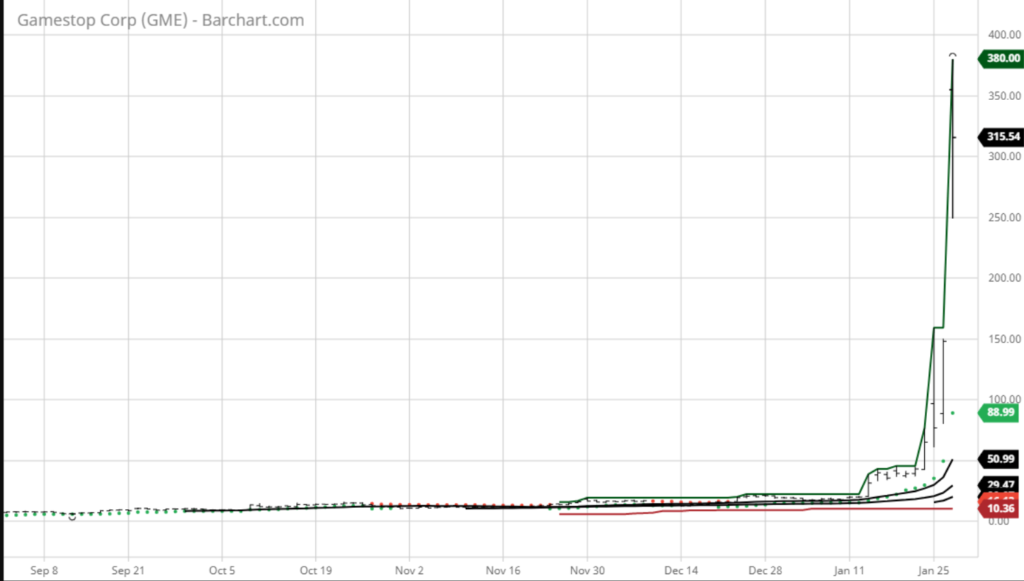
Lawmakers trained attention on the volatility surrounding GameStop’s stock as several others this week. The stock climbed from $4 only a few months ago to more than $400 this week, juiced by an online movement not dissimilar to others that have broadly altered the political landscape in recent years. At the same time, hedge funds that made large bets on GameStop’s stock cratering — known as “shorting” — began to pile up big losses. Then the brokerages instituted limits, leading to charges of collusion with the larger financial entities facing big losses.

Author(s): Allan Smith

Publication Date: 29 January 2021

Publication Site: NBC News

No, WallStreetBets isn’t robbing Wall Street to help the little guy

Link: https://arstechnica.com/tech-policy/2021/01/the-gamestop-bubble-is-going-to-hurt-a-lot-of-ordinary-investors/

Excerpt:

There’s just one problem: the billions of dollars in new “wealth” people have supposedly gained is mostly in the form of inflated GameStop stock. Before they can actually use that wealth, they need to convert it to cash. And if a lot of people start selling their shares, the stock will crash. Most of that GameStop “wealth” will evaporate, with many shareholders getting a fraction of the value they expected.

Meanwhile, if GameStop’s stock price starts to fall, short sellers will start to make money. Any short sellers who maintained their short positions through the bubble will make back most of what they lost.

Sooner or later, GameStop’s stock is going to return to normal levels. And when it does, we are likely to find that little wealth was actually transferred from wealthy hedge fund investors to the general public. Short losses as the stock appreciated will be largely balanced out by short gains as the stock falls. The gains of GameStop shareholders as the stock appreciates will be balanced by losses as the stock declines.

Author(s): TIMOTHY B. LEE

Publication Date: 29 January 2021

Publication Site: Ars Technica

Why Brokers Had to Restrain Trading in GameStop Shares

Link: https://www.wsj.com/articles/why-brokers-had-to-restrain-trading-in-gamestop-shares-11612201242

Excerpt:

When clients trade, especially on margin, they use the broker’s money to play. Imagine a client buys 100 shares of GameStop for $400 a share, using $20,000 of his own money and borrowing $20,000 from Robinhood. If the stock drops from $400 to $120 (as it did on Jan. 28), the client’s position may be sold for $12,000 due to the margin violation, leaving Robinhood trying to collect an unsecured $8,000 debt. Good luck. Multiply this by hundreds or thousands of similar clients. Option trading is worse because the leverage is much greater.

The broker’s risk is asymmetrical: If half its clients are winning big by buying during a short squeeze, while its short clients are suffering losses they can’t pay, the broker can’t offset these gains and losses, but must pay the winning clients while possibly eating the losing trades. It is rare, but brokers go bankrupt during market events like this.

Brokers therefore are subject to strict financial requirements, including that they maintain large security deposits at the clearinghouses. When risk rises, clearinghouses raise their requirements, even intraday. On Jan. 28, when GameStop dropped from $483 to $112, the clearinghouse DTCC raised requirements by an aggregate $7.5 billion. Brokers had to post that money to DTCC whether or not their clients had it.

Author(s): David Battan

Publication Date: 1 February 2021

Publication Site: Wall Street Journal

Let the GameStop Games Begin!

Graphic:

Excerpt:

That chart ends at yesterday’s close. Things have been even more crazy overnight, with the price hitting $500/share. There have been gyrations caused by the shutdown of the chatrooms and some retail platforms stopping trading in this and other heavily shorted stocks. But the fundamental dynamic in play now–shorts slitting their own throats in panicked buying to cover–means that attempts to constrain the long herd will not have a lasting impact.

The short interest that had to (and has to) be covered is huge–short interest in GME was 140 percent of outstanding shares–and a larger share of the float. (How can there be more shorts than shares? The same share can be borrowed and lent multiple times!) The effects of the short covering are seen not only in the price, but in the stratospheric cost of borrowing shares. Earlier this week it was about 30 percent–juice loan territory. Now it is at 100 percent.

In many respects, this is reminiscent of some of the more storied episodes in Wall Street history, or more recently the 2008 VW corner which punished shorts severely. But there is a major difference. In some of the earlier episodes (including major corners of shorts in railroad stocks in the 19th century, or battles between shorts and stock pools in the 1920s, or the VW case), there was a single dominant long squeezing the overextended shorts. Here, it seems that the driving force is a relatively large group of small longs, acting with a common purpose.

Author(s): Craig Pirrong

Publication Date: 28 January 2021

Publication Site: Streetwise Professor

The Insiders’ Game

Link: https://www.persuasion.community/p/the-insiders-game

Excerpt:

First, the digital distribution platform Discord banned the WallStreetBets account after the close Wednesday for “hate speech, glorifying violence, and spreading misinformation.” (For a moment, it looked like Reddit had also banned the group, but they resisted pressure to do so.) If the quoted justification sounds familiar, it’s nearly identical to the one given by Google, Apple, and Amazon for deplatforming Parler just three weeks earlier. Echoing Amazon, Discord said it had sent the group repeated warnings about objectionable content before deciding, on that day of all days, to shut them down. 

Meanwhile, WallStreetBets investors were locked out of their trading accounts by online brokers such as Robinhood on Thursday morning. Based on new collateral requirements that it says were imposed by an industry consortium, Robinhood forbade its users from buying GameStop and other stocks that WallStreetBets had identified as short squeeze opportunities. Users were allowed only to “close their positions”—in other words, to sell to the shorts desperate to buy. When angry users registered their disapproval by leaving over 100,000 one-star reviews of the Robinhood app in the Google Play Store, Google deleted them. 

Author(s): David Sacks

Publication Date: 1 February 2021

Publication Site: Persuasion