Link: https://home.treasury.gov/resource-center/data-chart-center/interest-rates/
Graphic:
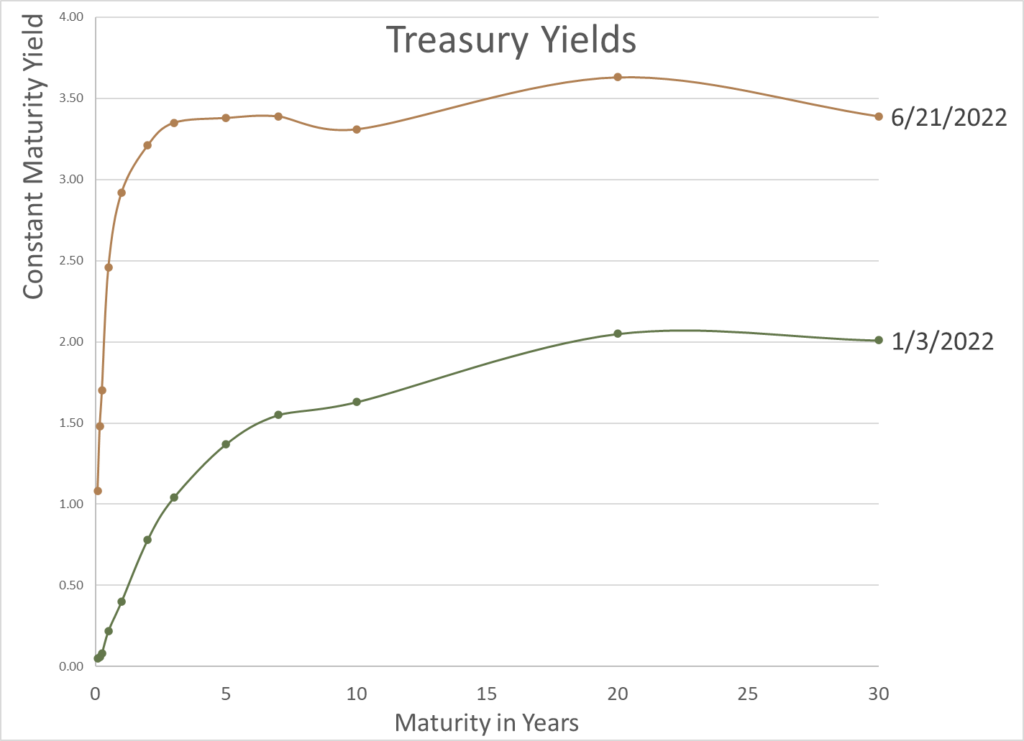
Publication Date: accessed 22 Jun 2022 6:19am ET
Publication Site: Treasury.gov
All about risk
Link: https://home.treasury.gov/resource-center/data-chart-center/interest-rates/
Graphic:
Publication Date: accessed 22 Jun 2022 6:19am ET
Publication Site: Treasury.gov
Link: https://polimath.substack.com/p/essential-terms-of-the-authority
Graphic:
Excerpt:
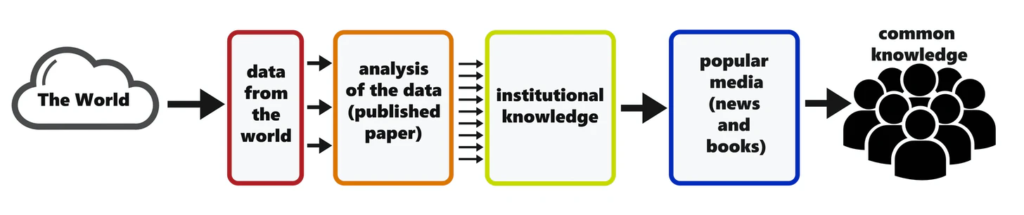
This last week, the CDC held their ACIP meeting to discuss whether or not they should recommend the COVID vaccines for children 6 months to 5 years old. While presenting on the danger of the virus for children, a slide was shown claiming that COVID presented as one of the leading causes of death for children.
Kelley, who runs covid-georgia.com, saw this slide and immediately knew it was false. She has been tracking COVID data in excruciating detail in Georgia since the beginning of the pandemic and has recently become an expert on the CDC’s pediatric death data simply because it was such a disaster and she wanted to get down to the truth of the matter.
This slide above is no small error. Not only did it count the wrong number for pediatric COVID deaths, it compared all pediatric COVID deaths in a 26-month period to annualized deaths from other causes. This is a massive data error, and yet it persisted through a supposedly rigorous data check from 11 authors and was selected by top-tier scientists for their landmark presentation to the most knowledgeable experts in the field.
Author(s): Matt Shapiro
Publication Date: 21 Jun 2022
Publication Site: Marginally Compelling at substack
Graphic:
Excerpt:
Amendment 1 would grant government unions unprecedented bargaining powers as a “fundamental right,” including the power to override voters and state lawmakers. Proponents are selling it as a constitutional ban on passing right-to-work laws – laws that protect employees’ rights to keep their jobs without having to pay fees to a union. Illinois is not among the 28 states that currently have right-to-work laws, so that aspect has little meaning.
The amendment does include three other provisions that together would severely weaken taxpayers’ voices in state government and make it easier for government union bosses to make unaffordable demands in collective bargaining contracts. First, virtually anyone would have a fundamental right to collective bargaining if they could be considered an employee in any context, including even prisoners. Second, bargaining would be expanded beyond just wages, hours and working conditions to include broad new subjects covering public policy decisions or how to run a businesses. Third, the amendment prevents lawmakers from ever limiting or scaling back on these rights in any way.
Even without these provisions, powerful government unions helped public sector wages grow 60% faster than the private sector in Illinois from 1998 to 2019.
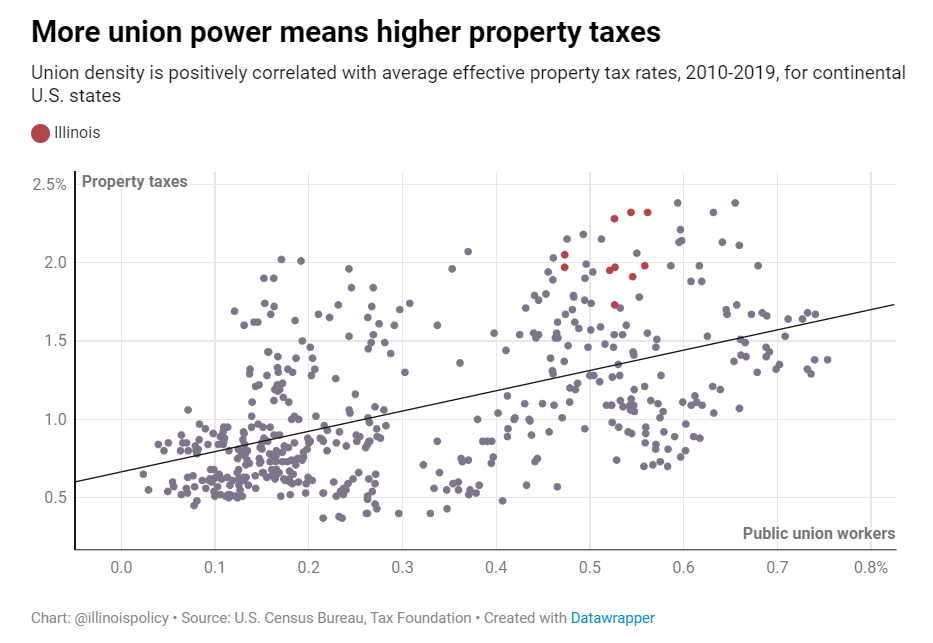
Peer-reviewed research shows stronger government worker unions cause the cost of government to increase, with powerful unions putting even more upward pressure on benefits than on wages. Government worker retirement benefits, which flow mostly to government union workers, have left Illinois local governments with $75 billion in pension debt and are already the primary cause of rising property taxes. Government unions helped Illinois politicians build the state and local pension crisis by supporting both unaffordable benefits as well as irresponsible funding games that pushed costs into the future.
Nationwide data from 2010 to 2019 show a significant statistical association between the percentage of government workers who are members of a government worker union and each state’s average effective property tax rate.
Author(s): Adam Schuster
Publication Date: 15 Jun 2022
Publication Site: Illinois Policy Institute
Excerpt:
School districts sent $8,839,754.35 to the Teachers’ Retirement System of the state of Illinois to cover the cost of excess salary and excess sick time payments given to educators at the end of their careers in years 2018-2019 and 2019-2020, according to records obtained by The Center Square. That’s on top of the more than $50 million in penalties districts have paid to TRS since the 2005 law passed, including $23.8 million since fiscal 2014. But districts only paid a fraction of what they actually owed due to exemptions built into the 2005 law.
“In the first 10 years of the program, 2005 to 2015, the excess salary contributions levied against school districts totaled $149.5 million, or an average of $14.95 million per year,” said Dave Urbanek, director of communications for the Teachers’ Retirement System of the state of Illinois. “However, because of exemptions to the 6% threshold built into the law at that time, districts paid only $39 million during that decade, or an average of $3.9 million per year.”
State Sen. Craig Wilcox, R-McHenry, said some local taxpayers probably aren’t aware of how school districts are spending tax dollars. The majority of school district funding in Illinois comes from local property taxes. Most national analyses show Illinois residents pay, on average, the second highest property taxes in the U.S., behind only New Jersey.
Author(s): Brett Rowland
Publication Date: 18 Mar 2022
Publication Site: The Center Square
Link: https://www.milliman.com/en/insight/2021-Milliman-Variable-Annuity-Mortality-Study
Excerpt:
Milliman Variable Annuity Mortality Study shows mortality increases of 11% as a result of COVID-19 pandemic
Life insurers and annuity writers are now beginning to understand the impact of the COVID-19 pandemic on their lines of business, as mortality data for the year 2020 is reported and analyzed. While the pandemic has affected different carriers in different ways, future mortality rates are a key assumption for annuity writers.
With Milliman’s acquisition of Ruark Consulting in December 2021, the industry’s leading variable annuity mortality study has been rebranded as the Milliman Variable Annuity Mortality Study. The study is based on data from 2008 through 2020, totaling $674 billion in account value as of the end of the study period, with over 1 million deaths across 19 companies.
Author(s): Timothy Paris
Publication Date: 14 Mar 2022
Publication Site: Milliman
Graphic:
Excerpt:
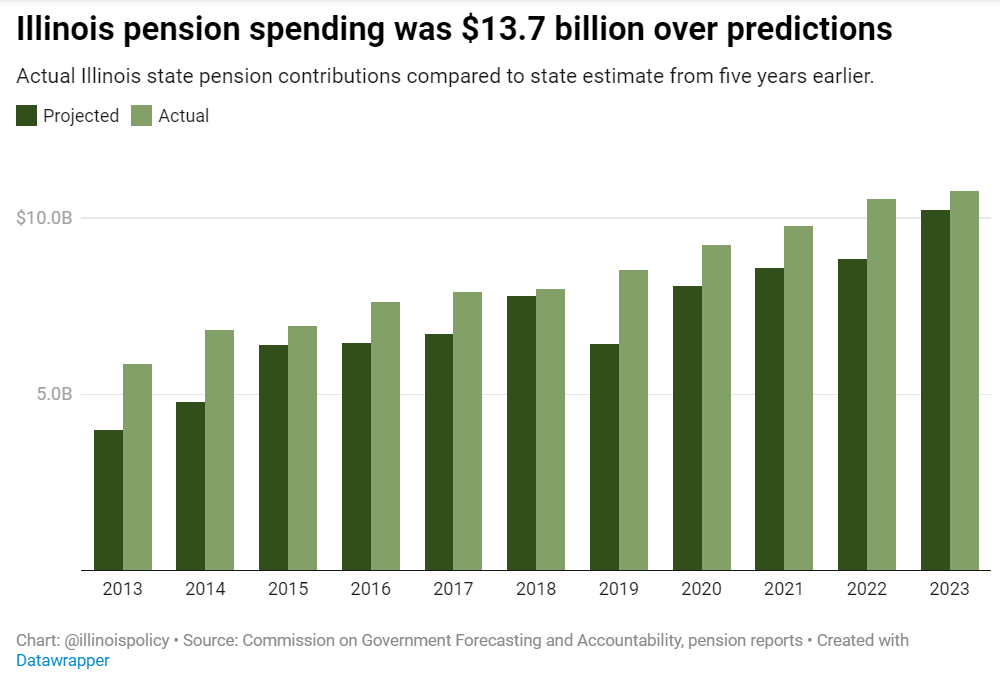
Unrealistic assumptions and missed investment returns have meant Illinois taxpayers paid $13.7 billion more for public pensions than state leaders projected five years earlier. Unless the estimates improve, taxpayers will pay an extra $21.3 billion during the next decade.
Illinois does a particularly poor job of figuring out how much money is needed to pay its public pensions: The past decade has seen the projections miss by 16%, which meant taxpayers needed to give $13.7 billion more than was estimated.
Author(s): Justin Carlson
Publication Date: 17 Jun 2022
Publication Site: Illinois Policy Institute
Graphic:
Excerpt:
On Feb. 11, the Actuarial Standards Board issued a revised Actuarial Standard of Practice No. 4, effective February 15, 2023. The rollout has been low-key. The announcement says:
“Notable changes made to the existing 2013 version include expanding the scope to clarify the application of the standard when the actuary selects an output smoothing method and when an assumption or method is not selected by the actuary.”
But this description obscures a significant new required disclosure, one which follows years of controversy and acrimony within and among actuaries and the public pension plan community at large. The requirement was the overwhelming focus during the drafting and comment period.
The new required disclosure reflects economic reality better than any currently required number.
Author(s): Larry Pollack
Publication Date: 25 Mar 2022
Publication Site: Reason
Link: https://www.visualcapitalist.com/cp/charted-the-global-decline-of-fertility-rates/
Graphic:
Excerpt:
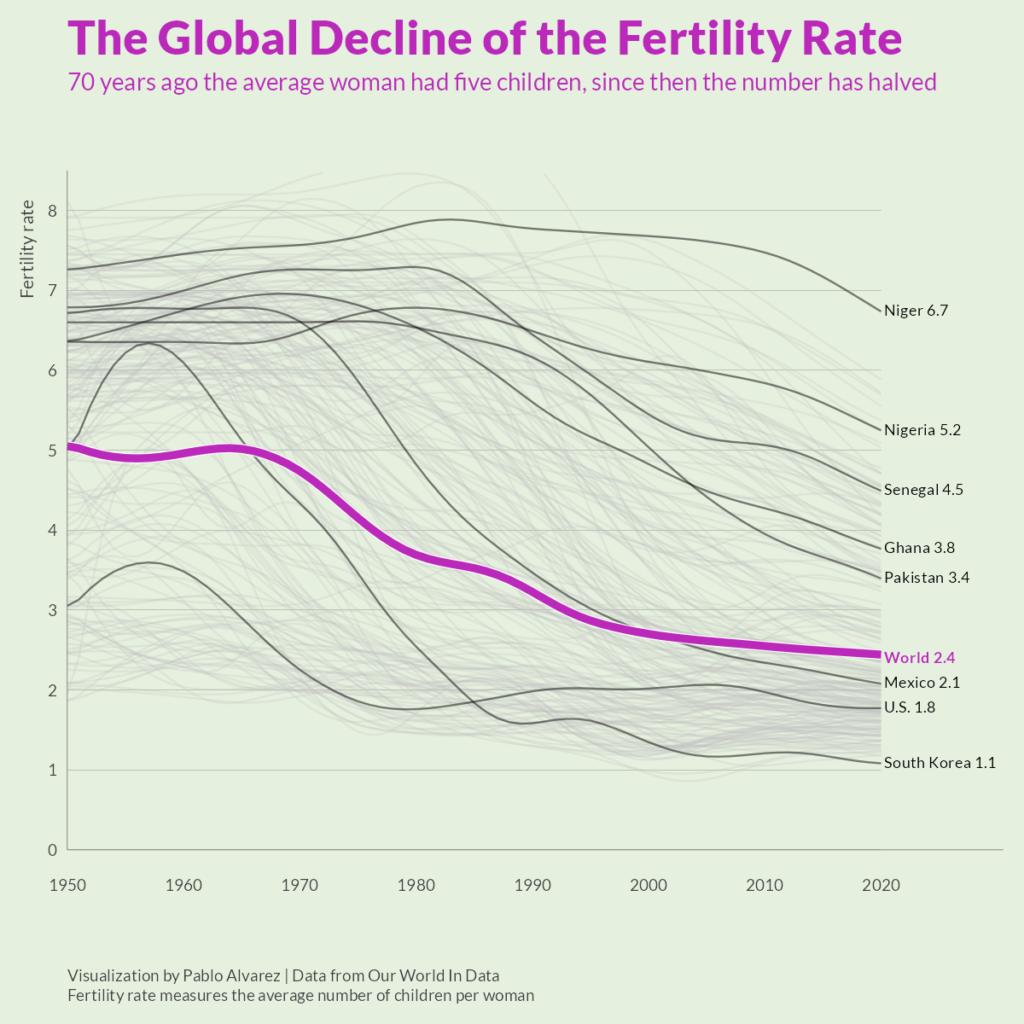
Over the last 50 years, fertility rates have dropped drastically around the world. In 1952, the average global family had five children—now, they have less than three.
This graphic by Pablo Alvarez uses tracked fertility rates from Our World in Data to show how rates have evolved (and largely fallen) over the past decades.
Though both measures relate to population growth, a country’s birth rate and fertility rate are noticeably different:
Author(s): Pablo Alvarez
Publication Date: 10 Jun 2022
Publication Site: Visual Capitalist
Graphic:
Excerpt:
Former mayor — and congressional hopeful — Bill de Blasio is calling out the state teachers union for investing $13 million of its pension funds with firms that manufacture guns and ammo following the shooting massacre of 19 students and two teachers in Uvalde, Texas.
De Blasio is urging both the New York State Teachers Retirement Fund and the NYS Common Retirement Fund representing state and local government workers and retirees — separately overseen by state Comptroller Tom DiNapoli — to divest their holdings in the weapons industry.
The holdings of the two pension funds combined in gun and manufacturing firms add up to $26 million.
The NYS Teachers Retirement Fund has assets in Sturm Ruger, Vista Outdoor Inc. Olin Corp. (Winchester Ammo) and National Presto Industries, records show.
….
The state comptroller’s office said in a statement that already divested gun companies after Sandy Hook.
Author(s): Carl Campanile
Publication Date: 31 May 2022
Publication Site: NY Post
Excerpt:
Viewers of Berkshire Hathaway’s 2022 Annual Meeting recently learned that some public pension funds feel strongly about how the corporations they own stock in should be governed. At the Berkshire meeting, a group of three pension systems offered a series of shareholder resolutions, all of which were rejected. While there may be instances where it is reasonable for public pension funds to try to influence corporate decision-making, the pension funds should determine whether proxy fights can appreciably enhance the value of their assets before picking a fight.
….
Pension funds and other institutional investors sometimes withhold their support for corporate-endorsed board candidates and submit resolutions. But changing the outcome of corporate elections is typically an uphill battle. According to ProxyPulse, only 2.2% of corporate board candidates failed to obtain majorities during the 2021 proxy season. Sullivan & Cromwell found that only 9% of shareholder proposals submitted were ultimately ratified.
In comparison, the prospects for shareholder resolutions being adopted appear to be improving. ProxyPulse found that the mean share of votes for shareholder proposals increased from 34% in 2017 to 40% in 2021. The threat of a shareholder proposal passing may also be encouraging boards to go ahead and adopt some recommended policies.
Between January 1, 2020, and April 30, 2022, pension funds filed 81 forms with the Securities and Exchange Commission in which they disclosed shareholder solicitations, accounting for over 10% of all such disclosures filed during this period. Shareholders who send letters to other shareholders asking them to vote against recommendations of management in their proxy statements disclose the fact that they have done so on SEC Form PX14A6G.
Author(s): Marc Joffe
Publication Date: 27 May 2022
Publication Site: Reason
Graphic:
Excerpt:
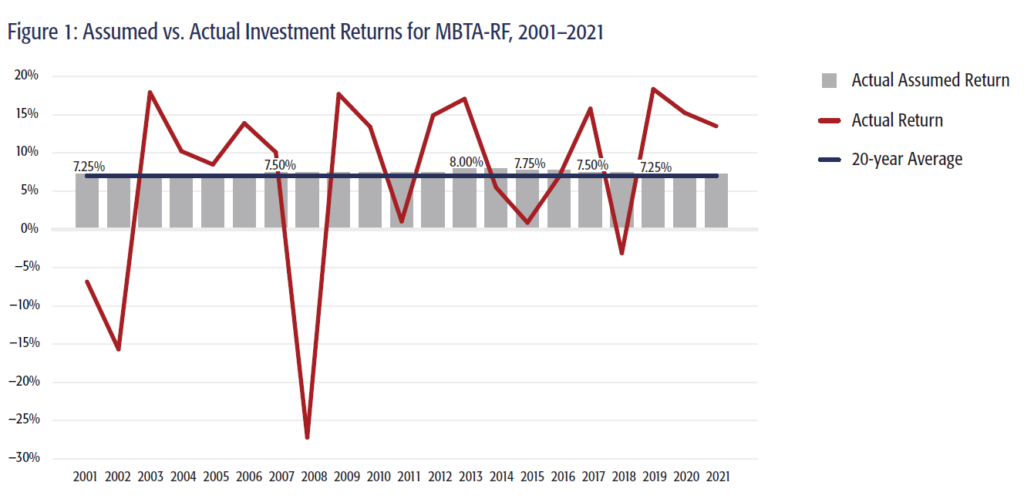
A new study published by Pioneer Institute finds that issuing pension obligation bonds (POBs) to refinance $360 million of the MBTA Retirement Fund’s (MBTARF’s) $1.3 billion unfunded pension liability would only compound the T’s already serious financial risks.
With POBs, government entities deposit revenues from bond sales into their pension funds and use the money to make investments they hope will deliver returns that outpace borrowing costs.
“Virtually every study of POBs finds that timing and duration of the bond issues are critical,” said E.J. McMahon, author of “Rolling the Retirement Dice.” “Bonds floated at the end of a bull market are the most likely to lose money, and that makes this idea a wrong turn at the worst possible time.”
If investments don’t meet a pension fund’s assumed rate of return, it could be left with debt service costs in addition to the pre-existing unfunded liability. In 2015, the Government Finance Officers Association bluntly warned that “State and local governments should not issue POBs.” It reaffirmed its guidance last year.
Author(s): E.J. McMahon
Publication Date: 21 Jun 2022
Publication Site: Pioneer Institute
Link: https://marypatcampbell.substack.com/p/pension-obligation-bonds#details
Graphic:
Excerpt:
The dollar auction is a truly evil game. I used to forbid people from playing it at Mathcamp. That’s not a joke.
I had a really ugly graph on that post, and yes, I’ve gotten better with the graphs over the years. The ugliness of that graph was a partial inspiration to seek solutions. (Other ugly graphs as well).
You can barely see it, but there was a POB between 2003 and 2005. It barely made a dent in the unfunded pension liability.
And what then? In the ten years since 2005, Illinois underfunded the TRS pension fund by at least a billion dollars a year.
With regards to contributions, there was a choice on the part of the “government”.
With regards to all the other reasons for shortfalls — investment experience, experience in salary changes and longevity — the government had less direct control. But they definitely had a choice with regards to how much of the budget to apply to the pensions.
And every damn year, the Illinois government made a conscious decision to shortchange the pension. That was not an accident.
POBs are most often used by governments that were shortchanging the pensions, or goosing the benefits in insane and seemingly sane ways, to paper over said shortchanging. This farce lasts only so long.
Author(s): Mary Pat Campbell
Publication Date: 20 Jun 2022
Publication Site: STUMP at substack