Individual Income Tax Payments on Pace to Reach Record Level

Link: https://www.wsj.com/articles/individual-income-tax-payments-on-pace-to-reach-record-level-11654421400

Graphic:

Excerpt:

An unprecedented gush of income-tax revenue is flowing into the federal government, driven in part by investors and business owners, and the size and speed of the increase has surprised even the nation’s fiscal-policy experts.

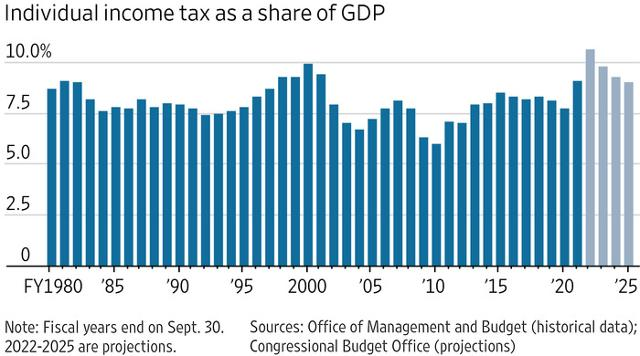
Individual income tax collections are poised to reach $2.6 trillion, or 10.6% of the economy in the fiscal year that ends Sept. 30, according to the Congressional Budget Office. That is up from 9.1% in 2021 and would mark a record in the 109-year history of the tax, topping the war-tax receipts of 1944 and the dot-com boom of 2000.

The surge has been particularly notable in taxes outside paycheck withholding, a signal that capital gains and business income are driving the trend. The Penn Wharton Budget Model estimates collections of non-withheld taxes reached an inflation-adjusted $522 billion in April 2022, compared with just over $300 billion in 2018 and 2019, before the pandemic.

Author(s): Richard Rubin, Amara Omeokwe

Publication Date: 5 June 2022

Publication Site: WSJ
Teslas running Autopilot involved in 273 crashes reported since last year

Link: https://www.washingtonpost.com/technology/2022/06/15/tesla-autopilot-crashes/

Excerpt:

Tesla vehicles running its Autopilot software have been involved in 273 reported crashes over roughly the past year, according to regulators, far more than previously known and providing concrete evidence regarding the real-world performance of its futuristic features.

The numbers, which were published by the National Highway Traffic Safety Administration for the first time Wednesday, show that Tesla vehicles made up nearly 70 percent of the 392 crashes involving advanced driver-assistance systems reported since last July, and a majority of the fatalities and serious injuries — some of which date back further than a year. Eight of the Tesla crashes took place before June 2021, according to data released by NHTSA on Wednesday morning.

Previously, NHTSA said it had probed 42 crashes potentially involving driver assistance, 35 of which included Tesla vehicles, in a more limited data set that stretched back to 2016.

Of the six fatalities listed in the data set published Wednesday, five were tied to Tesla vehicles — including a July 2021 crash involving a pedestrian in Flushing, Queens, and a fatal crash in March in Castro Valley, Calif. Some dated as far back as 2019.

Author(s): Faiz Siddiqui, Rachel Lerman and Jeremy B. Merrill

Publication Date: 15 Jun 2022

Publication Site: Washington Post

Sanders’ Social Security Bill Would Extend Payroll Tax to Capital Gains for High Earners

Link:https://www.thinkadvisor.com/2022/06/10/bernie-sanders-new-social-security-bill-would-extend-payroll-tax-to-capital-gains-for-high-earners/

Excerpt:

Sen. Bernie Sanders, I-Vt., and Rep. Peter DeFazio, D-Ore., introduced Thursday the Social Security Expansion Act (SSEA), which would, among other measures, boost benefits, adopt the Consumer Price Index for the Elderly, or CPI-E, for benefit increases, and subject all income above $250,000 — including capital gains — to the Social Security payroll tax.

Dan Adcock, Director of Government Relations and Policy at the National Committee to Preserve Social Security and Medicare, told ThinkAdvisor Friday in an email that the DeFazio-Sanders bill, like the Social Security 2100: A Sacred Trust, introduced by Rep. John Larson, D-Conn., “both extend solvency and improve benefits.”

The Larson bill, however, “is consistent with President Biden’s pledge not to raise taxes on Americans earning less than $400,000 per year,” Adcock said, while “the Sanders-DeFazio bill is not.”

A Sacred Trust adopts the consumer price index for the elderly as the basis of the annual cost-of-living adjustment (COLA) and applies the payroll tax to annual wages above $400,000.

Author(s): Melanie Waddell

Publication Date: 10 June 2022

Publication Site: Think Advisor

Why Social Security Looks ‘Relatively Good’ — for Now

Link: https://www.thinkadvisor.com/2022/06/03/social-security-looks-relatively-good-now-long-term-outlook-still-ugly-ssa-actuary/

Graphic:

Excerpt:

In a post-mortem of the Social Security Trust Fund report released Thursday, the Bipartisan Policy Center hosted a webinar featuring speaker Steve Goss, chief actuary of the Social Security Administration. Goss looked beyond the headlines stating that the Old-Age and Survivors Insurance will run out in 2034 (a slight improvement from last year’s forecasted demise of 2033) and that the Disability Insurance fund is now solvent for another 75 years.

“We’re in a little better shape [than 2021] because the economy has come roaring back to such a wonderful extent,” Goss said.

He also pointed out that labor demand has had a “remarkable rebound.” For example, it took 10 years for the job market to come back after the 2008 Great Recession. However, the 2020 recession, which was “very deep and very abrupt,” has also reversed just as quickly and in the first quarter of 2022, “we are virtually back to the high level that we had just before the start of the recession.”

Author(s): Ginger Szala

Publication Date: 3 June 2022

Publication Site: Think Advisor

Was ‘The Staircase’ murder really about life insurance?

Link: https://www.policygenius.com/life-insurance/news/staircase-michael-peterson/

Excerpt:

It’s been 21 years since novelist Michael Peterson was on trial for the murder of his wife, Kathleen, but the case is still capturing the public’s attention—most recently in an HBO Max series, “The Staircase.”

….

The case also involved the potential for a large life insurance payout. Kathleen had a $1.4 million life insurance policy, which was due to be paid to Michael in the event of her death. Prosecutors said Peterson was hoping to use the payout to address his debt [1] , including $143,000 in credit card debt.

…..

Peterson signed away any claim to the life insurance proceeds during the trial. However, because of the slayer rule, Peterson wouldn’t have been able to collect any money. Under the slayer rule, anyone suspected of murder or plotting a murder is prevented from benefiting from the dead person’s life insurance policy. Instead, Kathleen’s biological daughter, Caitlin Atwater, and her daughter’s father, Fred Atwater, received the money. [2]

In the scope of insurance fraud, life insurance murders aren’t a huge occurrence but they do happen, says Matthew J. Smith, executive director of the Coalition Against Insurance Fraud. For instance, in 2017, Joaquin Shadow Rams Sr., was convicted of killing his 15-month-old son for insurance money. Rams had taken out a $500,000 life insurance policy on the boy soon after he was born, which Smith says, should have been a red flag. 

Author(s): Lisa Rabasca Roepe

Publication Date: accessed 18 June 2022

Publication Site: Policygenius

Visualizing the Three Different Types of Inflation

Link: https://advisor.visualcapitalist.com/three-different-types-of-inflation/

Graphic:

Excerpt:

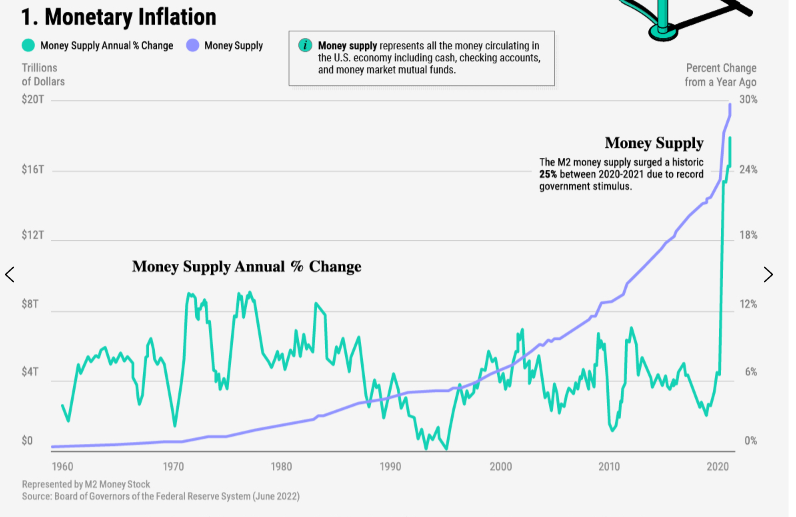
Monetary inflation occurs when the U.S. money supply increases over time. This represents both physical and digital money circulating in the economy including cash, checking accounts, and money market mutual funds.

The U.S. central bank typically influences the money supply by printing money, buying bonds, or changing bank reserve requirements. The central bank controls the money supply in order to boost the economy or tame inflation and keep prices stable.

Between 2020-2021, the money supply increased roughly 25%—a historic record—in response to the COVID-19 crisis. Since then, the Federal Reserve began tapering its bond purchases as the economy showed signs of strength.

Author(s): Dorothy Neufeld

Publication Date: 16 Jun 2022

Publication Site: Visual Capitalist

Evaluating Unintentional Bias in Private Passenger Automobile Insurance

Link: https://disb.dc.gov/page/evaluating-unintentional-bias-private-passenger-automobile-insurance

Public Hearing Notice: Evaluating Unintentional Bias in Private Passenger Automobile Insurance, June 29, 2022, 3 pm

Excerpt:

In 2020, Commissioner Karima Woods, Commissioner for the District of Columbia Department of Insurance, Securities and Banking (DISB) directed the creation of the Department’s first Diversity Equity and Inclusion Committee to engage in a wide-ranging review of financial equity and inclusion and to make recommendations to remove barriers to accessing financial services. Department staff developed draft initiatives, including an initiative related to insurers’ use of factors such as credit scores, education, occupation, home ownership and marital status in underwriting and ratemaking. Stakeholder feedback on this draft initiative resulted in the Department concluding that data was necessary to properly address this initiative. Department staff conducted research and contacted subject matter experts before determining that relevant data was not generally available.

The Department is undertaking this project to collect the relevant data. We determined this initiative will be deliberative and transparent to ensure the resultant data would address the issue of unintentional bias. We also decided to initially focus on private passenger automobile insurance as that is a line of insurance that affects many District consumers and has previously had questions raised about the use of non-driving factors. The collected data will build on previous work done by the Department through the 2018 and 2019 public hearings and examinations that looked at private passenger automobile insurance ratemaking methodologies.

For this project to look at the potential for unintentional bias in auto insurance, DISB will conduct a review of auto insurers’ rating and underwriting methodologies. As a first step, DISB will hold a public hearing on Wednesday, June 29, 2022 at 3 pm to gather stakeholder input on the review plan, which is outlined below. The Department has engaged the services of O’Neil Risk Consulting and Algorithmic Auditing (ORCAA) to assist the Department and provide subject matter expertise. Additionally, the Department will hold one or more meetings to follow up on any items raised during the public hearing.

Publication Date: accessed 18 Jun 2022

Publication Site: District of Columbia Department of Insurance, Securities & Banking

Debtor Nation

Link: https://reason.org/debtor-nation/

Graphic:

Excerpt:

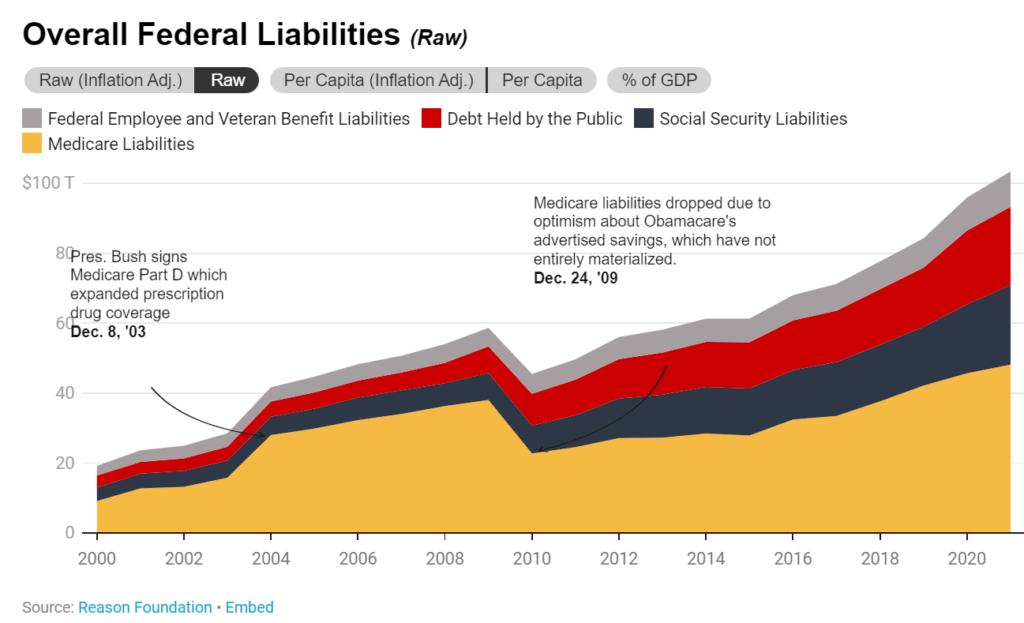
Organizations incur long-term financial obligations in forms other than bonds and the U.S. federal government is no exception. Some common types of financial obligations include pension and retiree health care costs for veterans, civilian federal employees, and the general public (through Social Security and Medicare benefit commitments). Looking at the federal government’s balance sheet as of 2021, public holdings of U.S. Treasury securities make up less than one-quarter of total federal liabilities. Unfunded entitlements, like Medicare and Social Security, account for the most at 59% of obligations.

Overall federal obligations have now surpassed $300,000 per American. While substantial in their own right, the debt obligations of state and local governments across the country are dwarfed by the various categories of federal debt.

Author(s): Jordan Campbell, Marc Joffe

Publication Date: 16 May 2022

Publication Site: Reason

A New Estimate of the Average Earth Surface Land Temperature Spanning 1753 to 2011

Link: https://static.berkeleyearth.org/papers/Results-Paper-Berkeley-Earth.pdf

Graphic:

Abstract:

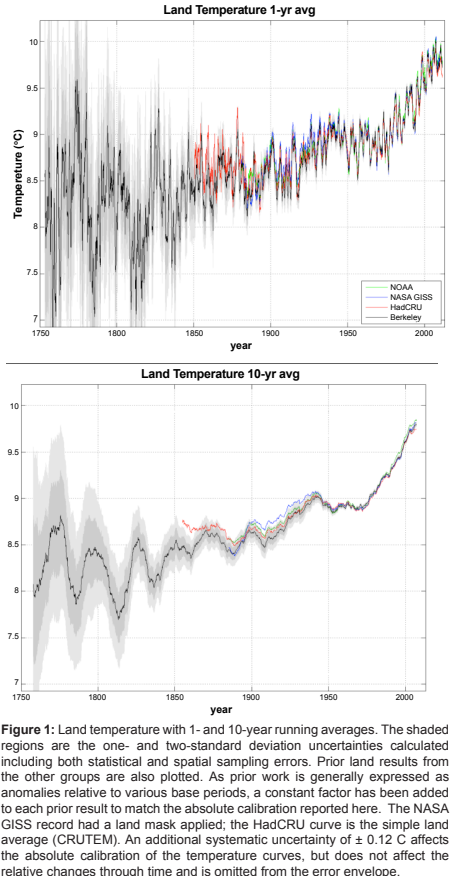
We report an estimate of the Earth’s average land surface temperature for the period 1753 to 2011. To address issues of potential station selection bias, we used a larger sampling of stations than had prior studies. For the period post 1880, our estimate is similar to those previously reported by other groups,
although we report smaller uncertainties. The land temperature rise from the 1950s decade to the 2000s decade is 0.90 ± 0.05°C (95% confidence). Both maximum and minimum temperatures have increased during the last century. Diurnal variations decreased from 1900 to 1987 and then increased; this increase is significant but not understood. The period of 1753 to 1850 is marked by sudden drops in land surface temperature that are coincident with known volcanism; the response function is approximately
1.5 ± 0.5°C per 100 Tg of atmospheric sulfate. This volcanism, combined with a simple proxy for anthropogenic effects (logarithm of the CO2 addition of a solar forcing term. Thus, for this very simple model, solar forcing does not appear to contribute to the observed global warming of the past 250 years; the entire change can be modeled by a sum of volcanism and a single anthropogenic proxy. The residual variations include interannual and multi-decadal variability very similar to that of the Atlantic Multidecadal Oscillation (AMO).


Keywords: Global warming; Kriging; Atlantic multidecadal oscillation;
Amo; Volcanism; Climate change; Earth surface temperature; Diurnal
variability

Author(s):

Robert Rohde1
, Richard A. Muller1,2,3
*, Robert Jacobsen2,3
,
Elizabeth Muller1
, Saul Perlmutter2,3
, Arthur Rosenfeld2,3
,
Jonathan Wurtele2,3
, Donald Groom3
and Charlotte Wickham4

Citation:

Rohde et al., Geoinfor Geostat: An Overview 2013, 1:1
http://dx.doi.org/10.4172/2327-4581.1000101

Publication Date: 2013

Publication Site: Geoinformatics & Geostatistics: An Overview

DiNapoli: State pension fund adds $350 million to investment funds geared to New York companies

Link: https://www.wnypapers.com/news/article/current/2022/06/14/151309/dinapoli-state-pension-fund-adds-350-million-to-investment-funds-geared-to-new-york-companies

Excerpt:

The New York State Common Retirement Fund is committing another $350 million to two investment funds through its in-state private equity investment program, fund trustee and state Comptroller Thomas P. DiNapoli recently announced.

“The in-state program has helped hundreds of New York businesses add and retain thousands of jobs and grow while achieving solid returns for the retirement system members and their beneficiaries that rely on the pension fund for their retirement security,” DiNapoli said. “We’ve committed more than $2 billion through this program to invest in New York state companies, and I’m proud to continue building on our successful track record.”

The fund will provide $50 million in additional capital to the Hudson River co-investment fund III, which it already invests in, and another $300 million in the new Hudson River co-investment fund IV. The funds make equity co-investments (investments alongside a lead sponsor) in growing New York-based companies.

Author(s): Thomas P. DiNapoli

Publication Date: 14 Jun 2022

Publication Site: Niagara Frontier Publications

The Berkeley Earth Land/Ocean Temperature Record

Link: https://essd.copernicus.org/articles/12/3469/2020/essd-12-3469-2020.html

Graphic:

Abstract:

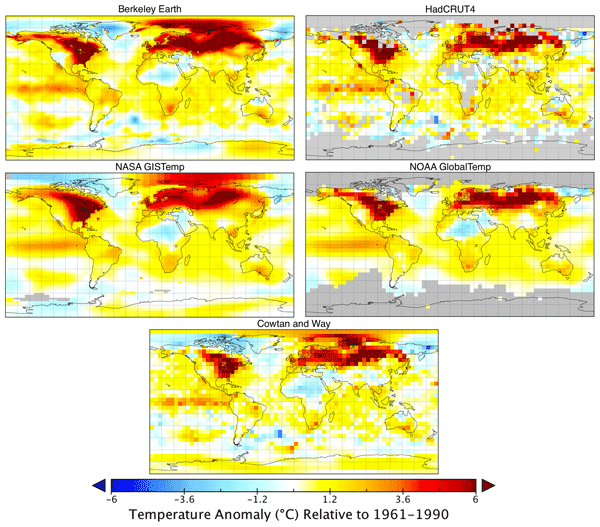
A global land–ocean temperature record has been created by combining the Berkeley Earth monthly land temperature field with spatially kriged version of the HadSST3 dataset. This combined product spans the period from 1850 to present and covers the majority of the Earth’s surface: approximately 57 % in 1850, 75 % in 1880, 95 % in 1960, and 99.9 % by 2015. It includes average temperatures in 1∘×1∘ lat–long grid cells for each month when available. It provides a global mean temperature record quite similar to records from Hadley’s HadCRUT4, NASA’s GISTEMP, NOAA’s GlobalTemp, and Cowtan and Way and provides a spatially complete and homogeneous temperature field. Two versions of the record are provided, treating areas with sea ice cover as either air temperature over sea ice or sea surface temperature under sea ice, the former being preferred for most applications. The choice of how to assess the temperature of areas with sea ice coverage has a notable impact on global anomalies over past decades due to rapid warming of air temperatures in the Arctic. Accounting for rapid warming of Arctic air suggests ∼ 0.1 ∘C additional global-average temperature rise since the 19th century than temperature series that do not capture the changes in the Arctic. Updated versions of this dataset will be presented each month at the Berkeley Earth website (http://berkeleyearth.org/data/, last access: November 2020), and a convenience copy of the version discussed in this paper has been archived and is freely available at https://doi.org/10.5281/zenodo.3634713 (Rohde and Hausfather, 2020).

Author(s): Robert A. Rohde1 and Zeke Hausfather1,2

Citation:
Rohde, R. A. and Hausfather, Z.: The Berkeley Earth Land/Ocean Temperature Record, Earth Syst. Sci. Data, 12, 3469–3479, https://doi.org/10.5194/essd-12-3469-2020, 2020.

Publication Date: 17 Dec 2020

Publication Site: Earth System Science Data

A Filmmaker Imagines a Japan Where the Elderly Volunteer to Die

Link: https://www.nytimes.com/2022/06/17/world/asia/japan-plan75-hayakawa-chie.html?smid=url-share

Excerpt:

The premise for Chie Hayakawa’s film, “Plan 75,” is shocking: a government push to euthanize the elderly. In a rapidly aging society, some also wonder: Is the movie prescient?

TOKYO — The Japanese film director Chie Hayakawa was germinating the idea for a screenplay when she decided to test out her premise on elderly friends of her mother and other acquaintances. Her question: If the government sponsored a euthanasia program for people 75 and over, would you consent to it?

….

Close to one-third of the country’s population is 65 or older, and Japan has more centenarians per capita than any other nation. One out of five people over 65 in Japan live alone, and the country has the highest proportion of people suffering from dementia. With a rapidly declining population, the government faces potential pension shortfalls and questions about how the nation will care for its longest-living citizens.

….

Aging politicians dominate government, and the Japanese media emphasizes rosy stories about happily aging fashion gurus or retail accommodations for older customers. But for Ms. Hayakawa, it was not a stretch to imagine a world in which the oldest citizens would be cast aside in a bureaucratic process — a strain of thought she said could already be found in Japan.

Euthanasia is illegal in the country, but it occasionally arises in grisly criminal contexts. In 2016, a man killed 19 people in their sleep at a center for people with disabilities outside Tokyo, claiming that such people should be euthanized because they “have extreme difficulty living at home or being active in society.”

Author(s): Motoko Rich

Publication Date: 17 June 2022

Publication Site: NYT