The Most Splendid Housing Bubbles in America, May Update: Mania at the Eve of Holy-Moly Mortgage Rates

Link: https://wolfstreet.com/2022/05/31/the-most-splendid-housing-bubbles-in-america-may-update-mania-at-the-eve-of-holy-moly-mortgage-rates/

Graphic:

Excerpt:

The home price data released today by the S&P CoreLogic Home Price Index represents the three-month average of closed home sales that were entered into public records in January, February, and March, reflecting deals that were agreed to a few weeks earlier, roughly in December, January, and February, funded with mortgages that were pre-approved before then, and had rate locks from when they were pre-approved.

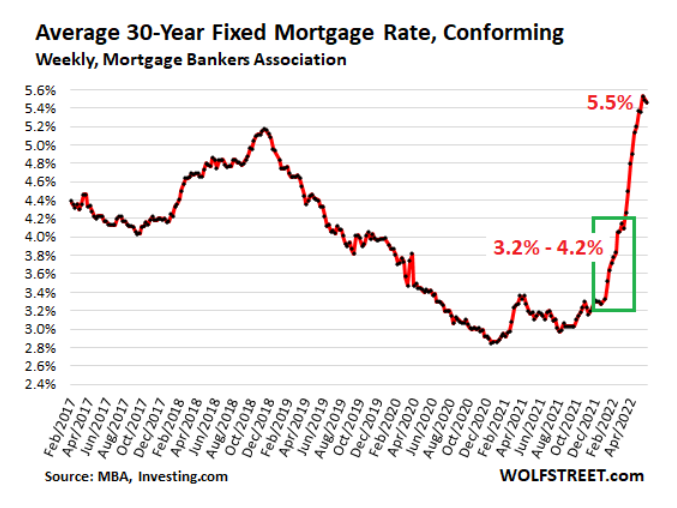
These rate locks were based on interest rates in effect roughly from November into February, when the average 30-year fixed rate ranged from 3.2% to 4.2%, with the majority of the time being below 3.8% (green box in the chart). These are the rates that funded home purchases reflected in today’s home price index.

There have already been numerous indicators that the markets for existing home sales and new home sales have run into difficulties at the current holy-moly mortgage rates of over 5%, including sharply lower sales volume and rising inventories in existing homes and falling sales and record spiking inventories in new houses.

Author(s): Wolf Richter

Publication Date: 31 May 2022

Publication Site: Wolf Street
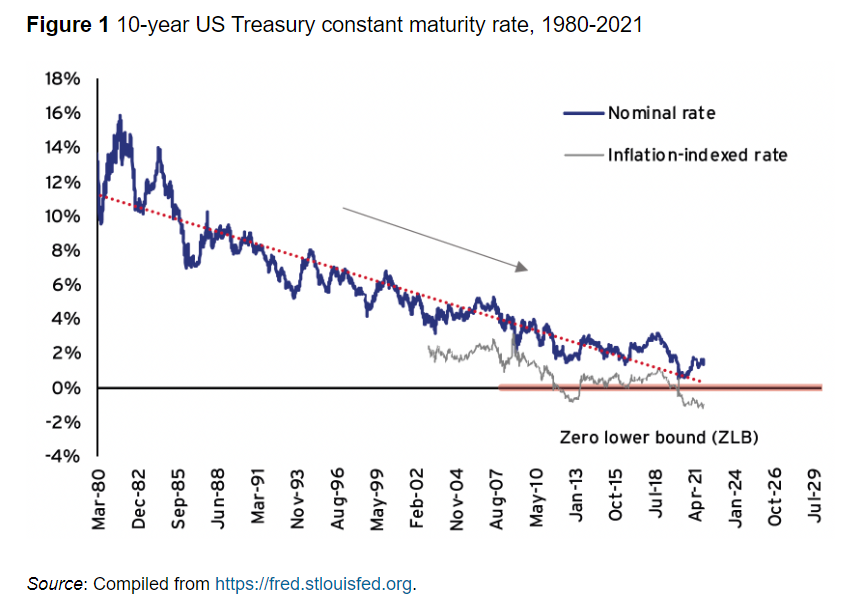
The private equity industry in the new interest rate environment

Link: https://voxeu.org/article/private-equity-industry-new-interest-rate-environment

Graphic:

Excerpt:

First, the illiquid and long-term nature of the private equity asset class, significant dispersion in returns across funds, as well as bilateral and relationship-driven fundraising, creates scarcity in access to individual funds, giving private equity funds the bargaining power when splitting the returns. As the industry’s growth deaccelerates, the pendulum of bargaining power will start to shift to limited partners, but more permanently than what we saw during the GFC. 

Second, we will see larger scrutiny of the cost structure and the industry’s value-add. Put simply, it is an expensive asset class, with the net returns to limited partners lacking consistency in beating public benchmarks (e.g. Harris et al. 2014).3 A central tension is large funds’ management fees, which typically run at 1.5% to 2% of committed capital already in the first five years of the fund life.4 This structure is lucrative for managers but underscores the disconnect between the private equity firm’s income stream and its fund performance, especially for large funds. 

Third, such pressures would make new and smaller funds particularly vulnerable. The proliferation of new funds, especially generalists’ funds, in the past decade was partly explained by the strength of capital flow and investment managers’ desire to capture a more significant share of fund economics. These funds have a higher embedded cost structure. Larger funds, therefore, have more room to compress the fees and have a higher ability to experiment in the investment space. All this gives larger-scale firms a better chance to withstand adverse pressures, resulting in market consolidation.

Author(s): Victoria Ivashina

Publication Date: 24 Feb 2022

Publication Site: VoxEU

Despite a First-Ever ‘Right-to-Repair’ Law, There’s No Easy Fix for Wheelchair Users

Link: https://khn.org/news/article/power-wheelchair-users-right-to-repair-law-no-easy-fix/

Excerpt:

The multibillion-dollar power-wheelchair market is dominated by two national suppliers, Numotion and National Seating and Mobility. Both are owned by private equity firms that seek to increase profits and cut spending. One way they do that is by limiting what they spend on technicians and repairs, which, when combined with insurance and regulatory obstacles, frustrates wheelchair users seeking timely fixes.

The $70 billion durable medical equipment market has been an attractive target for private equity investment because of the aging U.S. population, the increasing prevalence of chronic conditions, and a growing preference for older adults to be treated at home, according to the investment banking firm Provident Healthcare Partners. Medicare’s use of competitive bidding favors large companies that can achieve economies of scale in manufacturing and administrative costs, often at the price of quality and customer service.

Regulations set by Medicare and adopted by most Medicaid and commercial health plans have led to lower-quality products, no coverage for preventive maintenance, and enough red tape to bring wheelchairs to a halt.

Power wheelchair users have long been fighting for the right to repair their wheelchairs themselves or through independent repair shops. Medicare and most insurance companies will replace complex wheelchairs only every five years. The wheelchair suppliers that have contracts with public and private health insurance plans restrict access to parts, tools, and service manuals. They usually keep a limited inventory of parts on hand and wait until health plans approve repair claims before ordering parts.

Some chairs require a software passcode or a physical key for any repairs. Wheelchair users who make fixes themselves may void their warranty or lose out on insurance payments for repairs.

Author(s): Markian Hawryluk

Publication Date: 2 June 2022

Publication Site: Kaiser Health News

Hacker Laws — The Hype Cycle – Amara’s Law

Link: https://github.com/dwmkerr/hacker-laws#the-hype-cycle–amaras-law

Graphic:

Excerpt:

The Hype Cycle on Wikipedia

We tend to overestimate the effect of a technology in the short run and underestimate the effect in the long run.

(Roy Amara)

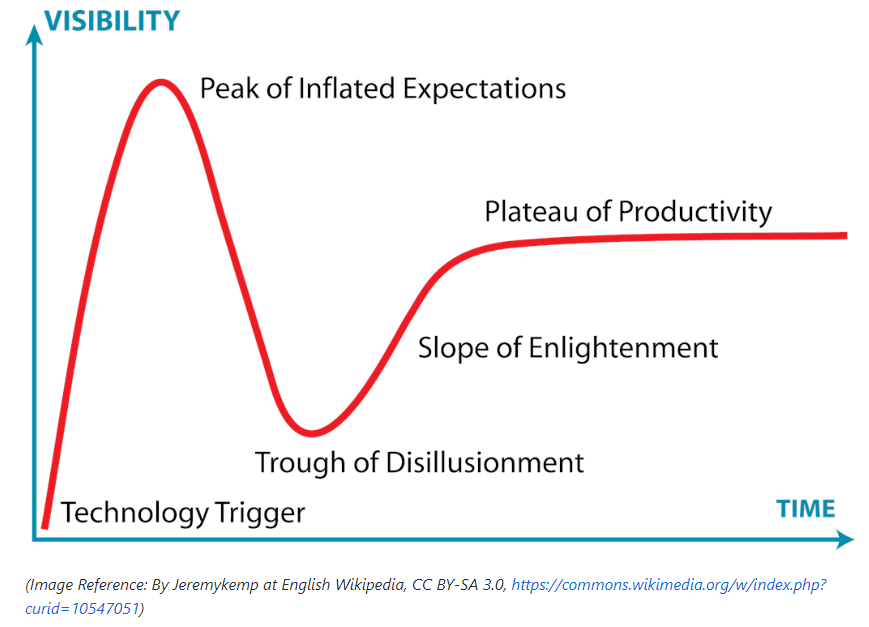
The Hype Cycle is a visual representation of the excitement and development of technology over time, originally produced by Gartner. It is best shown with a visual:

In short, this cycle suggests that there is typically a burst of excitement around new technology and its potential impact. Teams often jump into these technologies quickly, and sometimes find themselves disappointed with the results. This might be because the technology is not yet mature enough, or real-world applications are not yet fully realised. After a certain amount of time, the capabilities of the technology increase and practical opportunities to use it increase, and teams can finally become productive. Roy Amara’s quote sums this up most succinctly – “We tend to overestimate the effect of a technology in the short run and underestimate in the long run”.

Publication Date: accessed 5 June 2022

Publication Site: github

WHAT’S THE PRICE OF FORGETTING FAT LEONARD?

Link: https://inkstickmedia.com/whats-the-price-of-forgetting-fat-leonard/

Graphic:

Excerpt:

“How is this not a movie?”

This is the common response when people learn about the US Navy’s Fat Leonard scandal. The high stakes drama and salacious details do seem made for the silver screen, but what’s more surprising is how many people — among them Hill staff, Pentagon budget experts, and other defense policy participants — are unaware of the crimes that proliferated up and down the ranks of the 7th Fleet less than a decade ago. That military leaders, Congress, and the public seem to have forgotten this affair that took down rising leaders, defrauded the US government, and undermined our national security is at least as troubling as the events themselves. 

Here’s the short version of events: 

The US Navy contracted with Glenn Marine Group (GMG), a ship husbanding company that assisted the Navy with port security, repairs, fueling, restocking and other dockside needs. The president of GMG, Francis Leonard (aka Fat Leonard), overbilled the Navy for things like fresh water and redirected carrier movements to ports where he could charge the most. He bribed officers with $18,000 meals and extravagant hotel stays, prostitutes, parties, cash, and luxury goods. He gained access to sensitive information and paid off people in roles who could help avoid investigations into his activities. Only after the US Department of Justice stepped in — to investigate a suspected mole within the Naval Criminal Investigative Service (NCIS) who was tipping off Leonard — did the enterprise start to unravel. 

In 2013, federal agents arrested Leonard in San Diego and charged another 33 people with various crimes, though Leonard’s activities cast a much wider net. In 2018, the Washington Post reported that: “According to the Navy, an additional 550 active-duty and retired military personnel — including about 60 admirals — have come under scrutiny for possible violations of military law or ethics rules.” 

Author(s): Nan Swift

Publication Date: 18 March 2022

Publication Site: Inkstick Media

Study: Jersey Girls’ Refusal To Pump Gas Is Costing Everyone a Lot of Money

Link: https://reason.com/2022/05/24/study-jersey-girls-refusal-to-pump-gas-is-costing-everyone-a-lot-of-money/

Excerpt:

Bills that would have ended the last state-level bans on adults pumping their own gas in Oregon and New Jersey both flamed out this year. A new study purports to show how much the failure of reform is costing drivers.

In March, the Oregon Legislature adjourned without passing a bill allowing gas stations all over the Beaver State to make some of their pumps self-service. Self-service pumps are currently only allowed in smaller rural counties.

Over in New Jersey, another bill similarly allowing gas stations to have some self-service pumps stalled after legislative leaders came out against it in March, reports NJ.com.

…..

By not wanting to take on the political and regulatory costs of reform, politicians from both states are forcing the costs of higher gas prices onto motorists. That’s according to a new study from Clemson University’s Vitor Melo which finds that bans on self-service gas stations reduce supply and drive up prices.

In 2018, Oregon implemented a slight reform of its full-service mandate by allowing gas stations in counties of 40,000 or fewer people to have self-service pumps. Melo’s study used daily gas prices for all gas stations in the state reported to the website Gas Buddy between 2016 and 2019 to tease out what impact the repeal of self-service had on gas prices.

After controlling for counties’ levels of unemployment, poverty, and median income, Melo finds that allowing self-service saw gas prices drop in the affected counties by 4.4 cents per gallon. The price decline nets out to $90 a year for a household with three drivers.

Author(s): CHRISTIAN BRITSCHGI

Publication Date: 24 May 2022

Publication Site: Reason

Professionalism Webinar Examines Unfair
Discrimination in Insurance

Link: https://www.actuary.org/sites/default/files/2022-05/Actuarial-Update-May-2022.pdf

Graphic:

Excerpt:

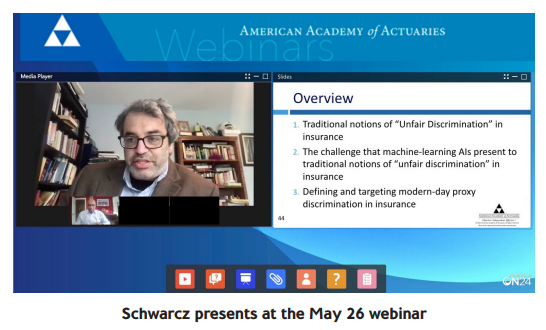
THE ACADEMY hosted a May 26 webinar, “What Is Unfair Discrimination in Insurance?” in which presenters explored the current regulatory infrastructure relating to unfair and unlawful discrimination in insurance and the challenges presented by the increased use of big data and artificial Intelligence (AI)-enabled systems.


Presenters were Daniel Schwarcz, an award-winning professor and scholar; former Illinois Director of Insurance Nat Shapo; and Brian Mullen, chairperson of the task force currently revising ASOP No. 12, Risk Classification ( for All Practice Areas). General Counsel and Director of Professionalism Brian Jackson moderated.

Mullen opened by providing background on ASOP No. 12. Schwarcz discussed prohibitions on “unfair discrimination”—which occurs when an insurer considers factors unrelated to actuarial risk—in rates and underwriting. He noted that machine learning AI tends to produce the same results as intentional proxy discrimination. As a result, insurance becomes less available and less affordable to individuals because of their race, sex, genetics, health, or income. He also discussed a proposed definition of proxy discrimination, practical tests for proxy discrimination, and the benefits of such a definition.

Publication Date: May 2022

Publication Site: American Academy of Actuaries

Naked mole rats defy the biological law of aging

Link: https://www.science.org/content/article/naked-mole-rats-defy-biological-law-aging

Excerpt:

The first study to analyze the life histories of thousands of naked mole rats has found that their risk of death doesn’t go up as they grow older, as it does for every other known mammalian species. Although some scientists caution against any sweeping conclusions, many say the new data are important and striking.

“This is remarkably low mortality,” says Caleb Finch, a biogerontologist at the University of Southern California in Los Angeles who was not involved in the new study. “At advanced ages, their mortality rate remains lower than any other mammal that has been documented.”

Scientists have long noted that naked mole rats—burrowing rodents with wrinkled, pink skin and large protruding teeth that live in large, subterranean colonies—show few signs of aging and far surpass the life span expected of a rodent this size. Mice in captivity live at most 4 years; based on their size, naked mole rats would not be expected to live past 6 years. Instead, some live beyond 30 years, and even at that age breeding females stay fertile.

Author(s): KAI KUPFERSCHMIDT

Publication Date: 26 JAN 2018

Publication Site: Science

Pension Withdrawals Drain Savings in Chile and Peru

Link: https://www.fitchratings.com/research/sovereigns/pension-withdrawals-drain-savings-in-chile-peru-01-06-2022

Excerpt:

Peru, Chile and Bolivia have allowed early withdrawals from their funds as a source of relief for households and to support recoveries during the pandemic and the global price shock. But these have had negative financial and confidence ramifications, contributing to downgrades of Peru in 2021 and Chile in 2020. Longstanding private pension funds have been important supports for sovereign creditworthiness where they exist in Latin America.

….

Peru’s Congress approved a sixth withdrawal from private pension funds in May. Prior rounds due to the pandemic led to withdrawals of USD17.8 billion or 8% of 2021 GDP. In Chile, a fourth withdrawal proposal failed in April 2022, but Chileans have already withdrawn about USD50 billion (16% of 2021 GDP) in 2020-2021. Bolivia allowed early withdrawals once in 2021 for more limited amounts (0.4% of 2021 GDP).

Publication Date: 1 June 2022

Publication Site: Fitch Ratings

NAIC Rejects Need for Federal Help With Private Equity-Owned Life Insurers

Link: https://www.thinkadvisor.com/2022/06/02/naic-rejects-need-for-federal-help-with-private-equity-owned-life-insurers/

Excerpt:

State regulators are not seeking help from Washington with monitoring those private equity firm owners, the officers of the National Association of Insurance Commissioners wrote in a public letter sent to Brown earlier this week.

Brown is the chairman of the U.S. Senate Banking, Housing and Urban Affairs Committee.

The NAIC officers told Brown that U.S. life insurers have been writing complicated products and using large, complicated investment strategies for some time.

“Our system has experience at assessing and understanding this dynamic through market highs and lows,” the regulators said. “State insurance regulators are fully capable of assessing and managing the risks of these insurers, and there is nothing PE firms add to the playing field that changes this fact.

Author(s): Allison Bell

Publication Date: 2 June 2022

Publication Site: Think Advisor

UMWA 5500 Update – 6/30/21

Link: https://burypensions.wordpress.com/2022/06/02/umwa-5500-update-6-30-21/

Excerpt:

Five years ago retired coal miners traveled to Washington, D.C. to lobby lawmakers to put in place a federal safety net in case the United Mine Workers of America (UMWA) pension fund fails. Coal plant closures and company bankruptcies have sent the pension fund to the edge of collapse. In October, 2019 Murray Energy, the last major company propping up the dwindling fund, also went bankrupt and the prediction was insolvency in FY23.

By the April 15, 2022 deadline, the plan submitted their 5500 form for the year ended 6/30/21 showing only 68 active participants remaining and providing an idea of how much more taxpayers will now be on the hook for on top of what appears to be the $330 million that came in during the plan year.

Author(s): John Bury

Publication Date: 3 June 2022

Publication Site: Burypensions