Vote to increase Swiss retirement age clears signature hurdle

Excerpt:

The youth chapter of the PLR (FDP) has successfully collected enough signatures for an initiative to raise the official retirement age in Switzerland to 66 years old, reported RTS.

On 16 July 2021, initiative organisers submitted 145,000 voter signatures as part of the formal process of launching a referendum in Switzerland. Under referendum rules a minimum of 100,000 valid signatures must be collected within 18 months.

The official retirement age in Switzerland is currently 65 for men and 64 for women, although the government recently passed laws to create a universal retirement age of 65 for both men and women. The federal government also agreed to increase VAT up to 8% to help improve pension system finances.

The perilous state of Switzerland’s state pension system is well known. People are living longer and the nation’s population is ageing, leaving fewer working-age tax payers to fund the pensions of a rising number of retirees. Without reform a funding shortfall of CHF 200 billion is forecast over the next 25 years.

Publication Date: 23 July 2021

Publication Site: Le News
Predictably inaccurate: The prevalence and perils of bad big data

Link: https://www2.deloitte.com/us/en/insights/deloitte-review/issue-21/analytics-bad-data-quality.html

Graphic:

Excerpt:

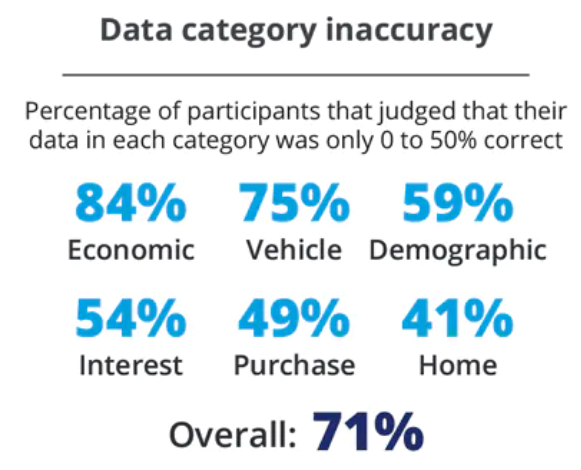
More than two-thirds of survey respondents stated that the third-party data about them was only 0 to 50 percent correct as a whole. One-third of respondents perceived the information to be 0 to 25 percent correct.

Whether individuals were born in the United States tended to determine whether they were able to locate their data within the data broker’s portal. Of those not born in the United States, 33 percent could not locate their data; conversely, of those born in the United States, only 5 percent had missing information. Further, no respondents born outside the United States and residing in the country for less than three years could locate their data.

The type of data on individuals that was most available was demographic information; the least available was home data. However, even if demographic information was available, it was not all that accurate and was often incomplete, with 59 percent of respondents judging their demographic data to be only 0 to 50 percent correct. Even seemingly easily available data types (such as date of birth, marital status, and number of adults in the household) had wide variances in accuracy.

Author(s): John Lucker, Susan K. Hogan, Trevor Bischoff

Publication Date: 31 July 2017

Publication Site: Deloitte

The Downton Abbey effect: British aristocratic matches with American business heiresses in the late 19th century

Link: https://voxeu.org/article/downton-abbey-effect-british-aristocrats-american-brides

Graphic:

Excerpt:

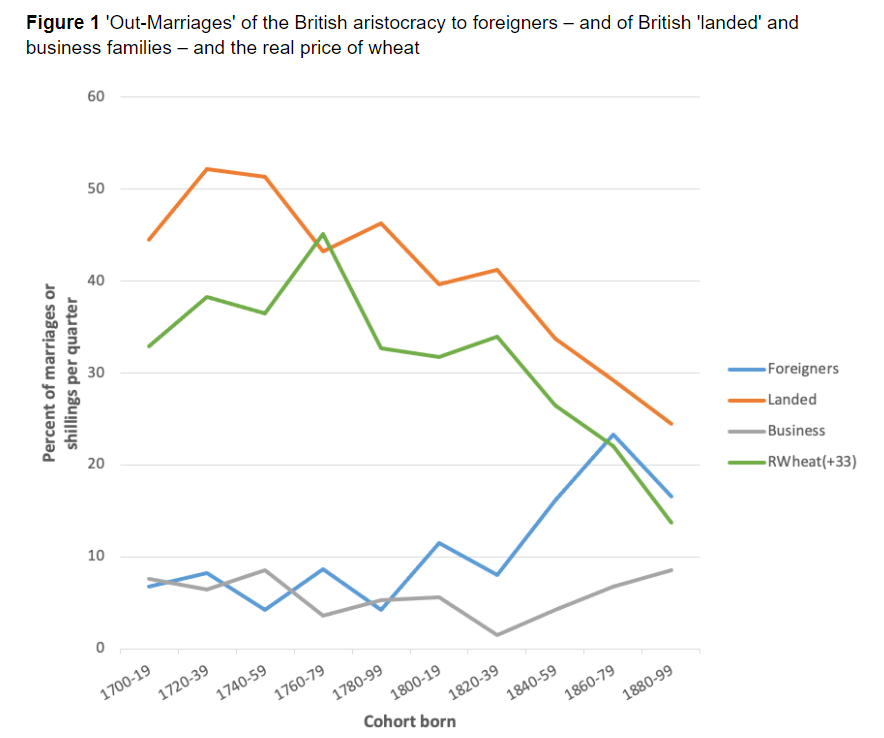
The premise of my recent paper (Taylor 2021) is that the rapid decline in British agricultural prices in the last quarter of the 19th century, which shrank not only the income of aristocratic landed estates but also the income of ‘commoner’ (i.e. non-aristocratic) families who owned land, led to a significant proportion of male aristocrats marrying American heiresses with rich dowries as substitutes for the traditional source – namely, brides from British families with landed estates but no titles. 

British agricultural prices began their drop in the mid-1870s for several reasons, from the development of US railroads and prairies to the advent of steamships, all of which led to the UK market being flooded with cheap prairie wheat. Meanwhile, in the US, high society shunned the families of the newly rich businessmen making their fortunes during the Gilded Age. East Coast high society was the jealously guarded preserve of families who could trace their ancestry back to the earliest Dutch or English settlers, and who socially ostracised the nouveau riche business magnates and their families. So, what were these newly rich families to do? They married into the British aristocracy as a means of establishing a social pedigree, whatever the cost.

…..

Figure 1 shows the percentage of marriages between British aristocrats and non-aristocrats (‘out-marriages’) for British males born in 20-year cohorts between 1700 and 1899, as well as the 20-year average real price of wheat in London 33 years later (33 being the average age at which British aristocrats married during the 18th and 19th centuries). The positive correlation between the decline in the price of wheat and the percentage of brides from landed families marrying into the aristocracy is striking, as is the rise in the percentage of ‘out-marriages’ to foreigners as wheat prices fell.

Link to paper: https://cepr.org/active/publications/discussion_papers/dp.php?dpno=16209

Author(s): Mark Taylor

Publication Date: 5 September 2021

Publication Site: Vox EU

What explains the decline in r∗? Rising income inequality versus demographic shifts

Link: https://www.kansascityfed.org/documents/8337/JH_paper_Sufi_3.pdf

Graphic:

Excerpt:

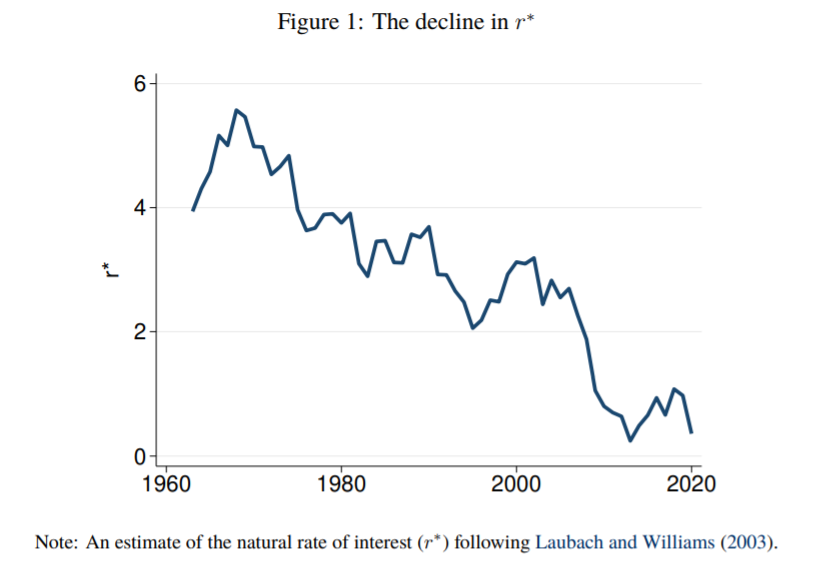
Downward pressure on the natural rate of interest (r∗) is often attributed to an increase in saving. This study uses microeconomic data from the SCF+ to explore the relative importance of demographic shifts versus rising income inequality on the evolution of saving behavior in the United States from 1950 to 2019. The evidence suggests that rising income inequality is the more important factor explaining the decline in r∗. Saving rates are significantly higher for high income households within a given birth cohort relative to middle and low income households in the same birth cohort, and there has been a large rise in income shares for high income households since the 1980s. The result has been a large rise in saving by high income earners since the 1980s, which is the exact same time period during which r∗ has fallen. Differences in saving rates across the working age distribution are smaller, and there has not been a consistent monotonic shift in income toward any given age group. Both findings challenge the view that demographic shifts due to the aging of the baby boom generation explain the decline in r∗.
.

Author(s): Atif Mian, Ludwig Straub, Amir Sufi

Publication Date: August 2021

Publication Site: Kansas City Federal Reserve

Stark Inequality: Financial Asset Inequality Undermines Retirement Security

Link to full report: https://www.nirsonline.org/wp-content/uploads/2021/08/Stark-Inequality-F2.pdf

Graphic:

Excerpt:

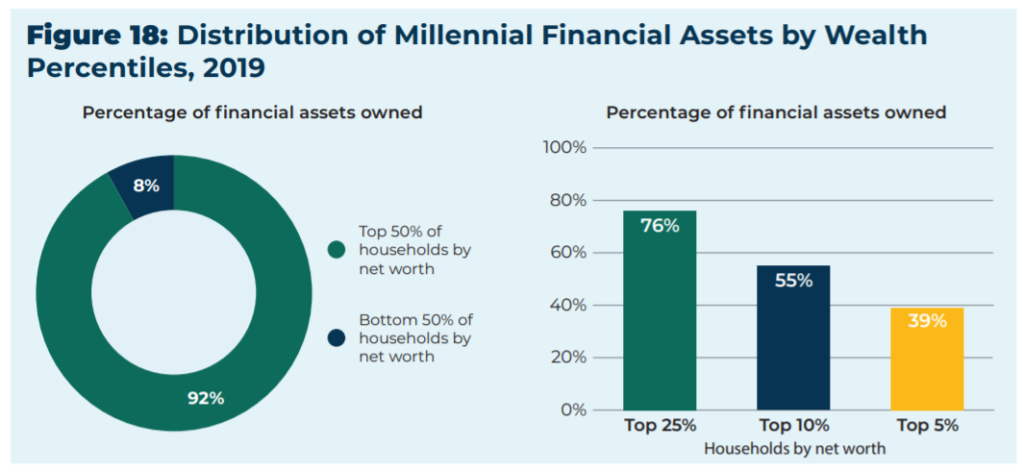
Inequality in the ownership of financial assets both persists and deepens over time. The top five percent of Baby Boomers by net worth owned a greater percentage of that generation’s financial assets in 2019 (58 percent) than in 2004 (52 percent).

Inequality in the ownership of financial assets is consistent across generations. In 2019, the top 25 percent by net worth of Millennials, Generation X, and Baby Boomers owned three-quarters or more of their generation’s financial assets.

Financial asset ownership is highly concentrated among white households. In 2019, white households in all three generations owned three-quarters or more of their generation’s financial assets. Ownership is especially concentrated among white households in the top 25 percent of net worth.

Both mean and median financial assets were significantly higher for white households in 2019 than Black or Hispanic households.

A range of potential solutions exists to address this stark inequality including strengthening and expanding Social Security, protecting pensions, increasing access to savings-based plans for low-income workers, and reforming retirement tax incentives.

Author(s): Tyler Bond

Publication Date: September 2021

Publication Site: National Institute on Retirement Security

More Than An Insolvency Date: What Else To Know About The Social Security And Medicare Trustees’ Reports

Link: https://www.forbes.com/sites/ebauer/2021/09/01/more-than-an-insolvency-date-what-else-to-know-about-the-social-security-and-medicare-trustees-reports/

Excerpt:

This year, Social Security’s deficit is unusually high due to lower revenues and higher benefits: 1.75%. In 2040, the deficit climbs to 3.70% rather than 3.54%. In 2080, the deficit stands at 4.87% rather than 4.59%.

Put another way, if there were no Trust Fund accounting mechanism now, the OASI program would have been able to pay 93% of benefits. This would drop to 76% in 2035 – 2040 – 2045, then drop further to being able to pay 70% of benefits.

What’s more, this year, the actuaries changed several assumptions. They assume that by the year 2036, fertility rates will increase to 2.00 children per woman, an increase from the 2020 report’s assumption of 1.95. They also assume a long-term unemployment rate of 4.5% rather than 5%. At the same time, they calculate alternate projections with more pessimistic assumptions, including a continuingly low fertility rate (1.69), a higher rate of mortality improvement (that is, longer-lived recipients), a higher rate of unemployment (5.5%), and others. In these alternate calculations, the 2040 deficit becomes 6.47% rather than 3.7% (benefits 64% payable), and the 2080 deficit becomes 12.39% rather than 4.87% (benefits 50% payable).

Also consider that, at the moment, there are 2.7 workers for each Social Security recipient (2.8 in 2020). This is forecast to drop to 2.2 in 2040 and ultimately down to 2.1. But if the population trends are those of the pessimistic scenario, then that 2.1 would drop to 1.5 by the year 2080.

Author(s): Elizabeth Bauer

Publication Date: 1 September 2021

Publication Site: Forbes

SYSTEMIC DISCRIMINATION AMONG LARGE U.S. EMPLOYERS

Link: https://eml.berkeley.edu//~crwalters/papers/randres.pdf

Graphic:

Abstract:

We study the results of a massive nationwide correspondence experiment sending more than
83,000 fictitious applications with randomized characteristics to geographically dispersed jobs
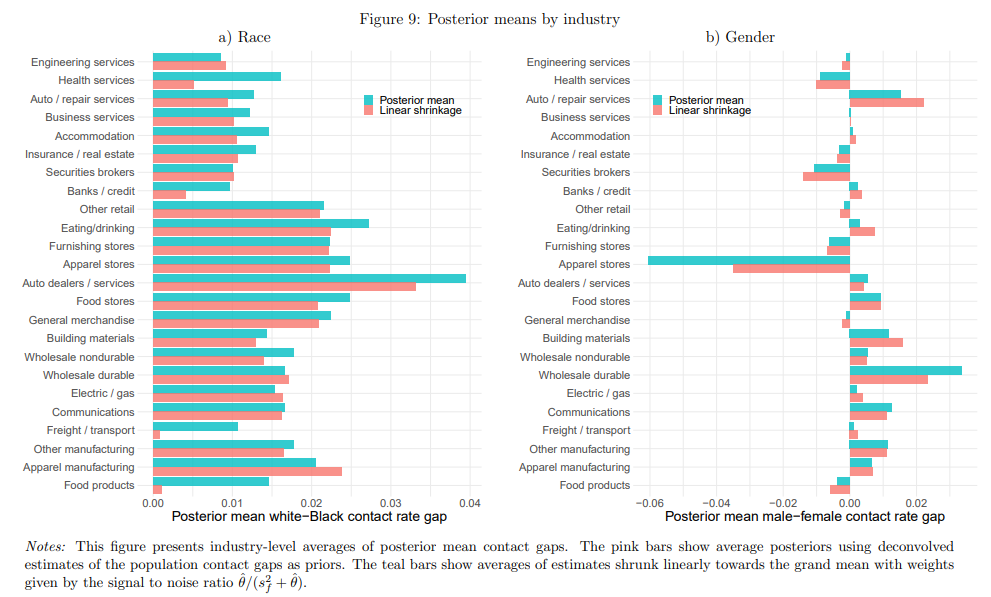
posted by 108 of the largest U.S. employers. Distinctively Black names reduce the probability of
employer contact by 2.1 percentage points relative to distinctively white names. The magnitude
of this racial gap in contact rates differs substantially across firms, exhibiting a between-company
standard deviation of 1.9 percentage points. Despite an insignificant average gap in contact rates
between male and female applicants, we find a between-company standard deviation in gender
contact gaps of 2.7 percentage points, revealing that some firms favor male applicants while
others favor women. Company-specific racial contact gaps are temporally and spatially persistent,
and negatively correlated with firm profitability, federal contractor status, and a measure of
recruiting centralization. Discrimination exhibits little geographical dispersion, but two digit
industry explains roughly half of the cross-firm variation in both racial and gender contact gaps.
Contact gaps are highly concentrated in particular companies, with firms in the top quintile of
racial discrimination responsible for nearly half of lost contacts to Black applicants in the
experiment. Controlling false discovery rates to the 5% level, 23 individual companies are found
to discriminate against Black applicants. Our findings establish that systemic illegal
discrimination is concentrated among a select set of large employers, many of which can be
identified with high confidence using large scale inference methods.

Author(s): Patrick M. Kline, Evan K. Rose, and Christopher R. Walters

Publication Date: July 2021, Revised August 2021

Publication Site: NBER Working Papers, also Christopher R. Walters’s own webpages

We’re Going The Wrong Way

Link: https://www.dailyposter.com/were-going-the-wrong-way/

Graphic:

Excerpt:

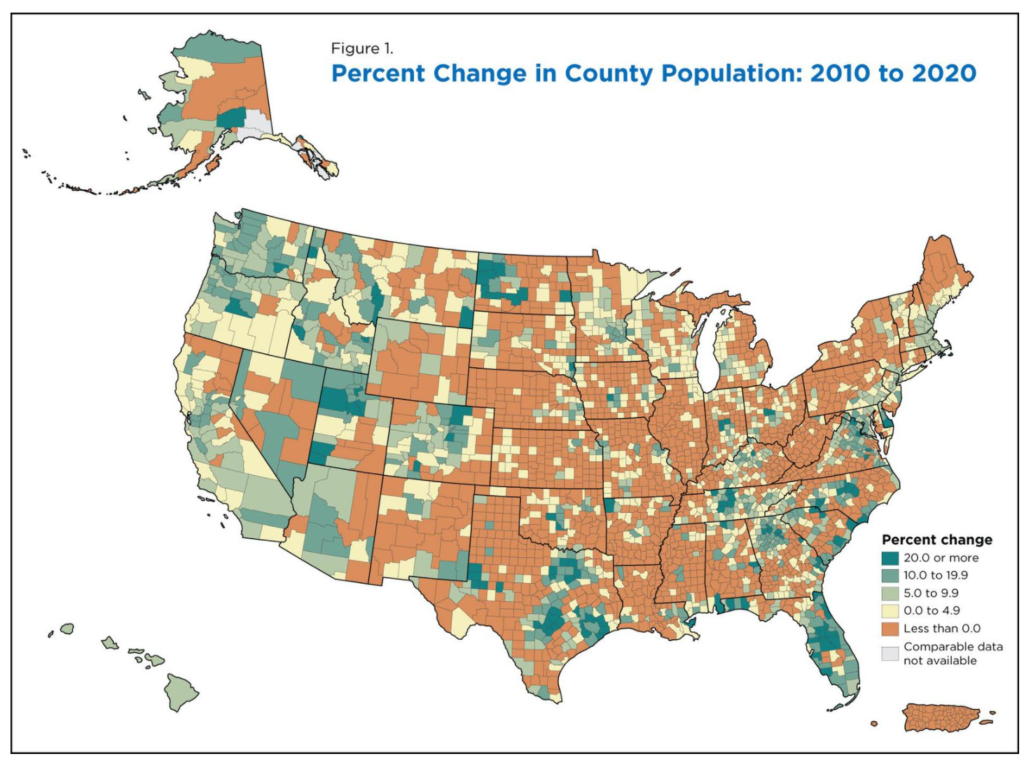
Science has provided America with a decent idea of which areas of our country will be most devastated by climate change, and which areas will be most insulated from the worst effects. Unfortunately, it seems that population flows are going in the wrong direction — today’s new Census data shows a nation moving out of the safer areas and into some of the most dangerous places of all.

…..

Some of the examples are genuinely mind-boggling. For instance, upstate New York is considered one of the country’s most insulated regions in the climate crisis — and yet almost all of upstate New York saw population either nearly flat or declining. At the same time, there were big population increases in and around the Texas gulf coast, which is threatened by extreme heat and coastal flooding.

Similarly, the city of Philadelphia is comparatively well situated in the climate crisis — but it saw only modest population growth of 5 percent. It was surpassed on the list of biggest cities by Phoenix, which saw an 11 percent population growth, despite that city facing some of the worst forms of extreme heat and drought in the entire country.

Author(s): David Sirota, Julia Rock

Publication Date: 12 August 2021

Publication Site: The Daily Poster

Population Growth Sputters in Midwestern, Eastern States

Link: https://www.pewtrusts.org/en/research-and-analysis/articles/2021/07/27/population-growth-sputters-in-midwestern-eastern-states

Graphic:

Excerpt:

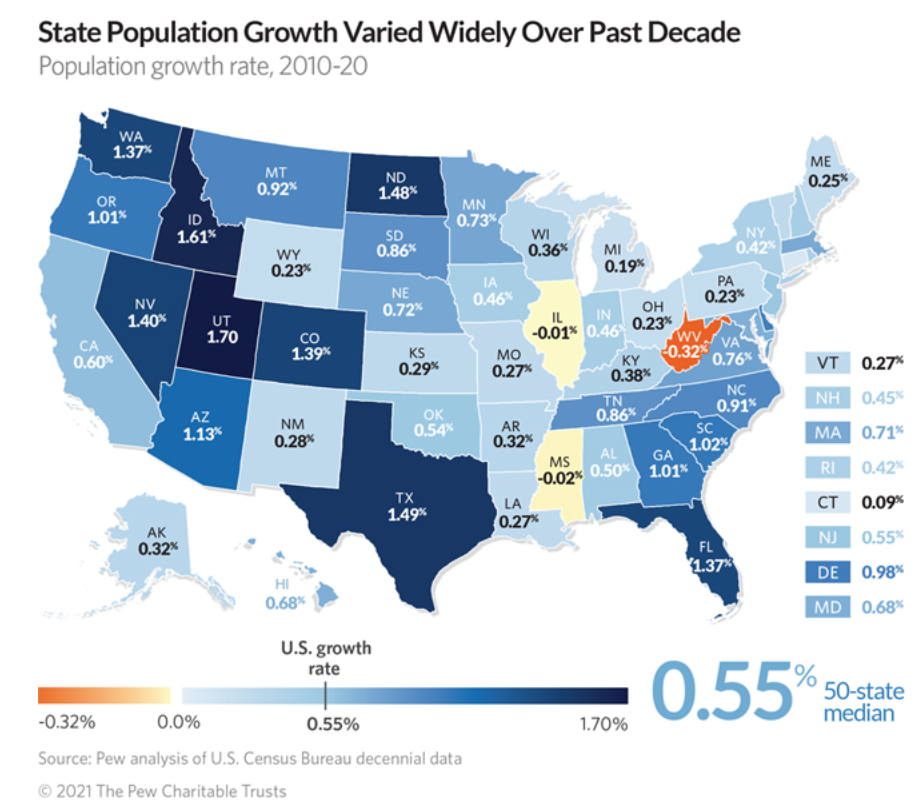
Apart from states with declines—West Virginia, Mississippi, and Illinois—the slowest population growth rates were recorded in Connecticut (0.09%); Michigan (0.19%); and Ohio, Wyoming, and Pennsylvania (0.23% each).

States experiencing their slowest decade of growth ever were Illinois, Connecticut, and six others: Missouri (0.27%), Wisconsin (0.36%), California (0.60%), Hawaii (0.68%), Arizona (1.13%), and Florida (1.37%).

After Utah, Idaho, and Texas, the next fastest-growing states over the past decade were North Dakota (1.48%), Nevada (1.40%), Colorado (1.39%), and Washington and Florida (both 1.37%).

Growth was faster in the 2010s than in the 2000s in only 12 states: Iowa, Louisiana, Massachusetts, Michigan, Nebraska, New Jersey, New York, North Dakota, Ohio, Rhode Island, South Dakota, and Washington.

Author(s): Barb Rosewicz, Melissa Maynard, Alexandre Fall

Publication Date: 27 July 2021

Publication Site: Pew

Restrict Insurers’ Use Of External Consumer Data, Colorado Senate Bill 21-169

Link: https://leg.colorado.gov/sites/default/files/2021a_169_signed.pdf

Link: https://leg.colorado.gov/bills/sb21-169

Excerpt:

The general assembly therefore declares that in order to ensure
that all Colorado residents have fair and equitable access to insurance
products, it is necessary to:
(a) Prohibit:
(I) Unfair discrimination based on race, color, national or ethnic
origin, religion, sex, sexual orientation, disability, gender identity, or gender
expression in any insurance practice; and
(II) The use of external consumer data and information sources, as
well as algorithms and predictive models using external consumer data and
information sources, which use has the result of unfairly discriminating
based on race, color, national or ethnic origin, religion, sex, sexual
orientation, disability, gender identity, or gender expression; and
(b) After notice and rule-making by the commissioner of insurance,
require insurers that use external consumer data and information sources,
algorithms, and predictive models to control for, or otherwise demonstrate
that such use does not result in, unfair discrimination.

Publication Date: 6 July 2021

Publication Site: Colorado Legislature

Mortgage Rates Are Low: Why Aren’t Minority Homeowners Refinancing?

Excerpt:

The reasons behind the racial disparity in refinancing align with documented evidence about other inequities in housing, Keys said during an interview with Wharton Business Daily on SiriusXM. (Listen to the podcast above.) Structural racism built into both public policy and the private sector has led to longstanding asymmetry in income, credit scores, loan-to-value ratios and other risk factors that inhibit refinancing for minorities.

The coronavirus pandemic is exacerbating the problem, Keys said, because Black and Hispanic households are more likely to experience job loss than white households. The U.S. unemployment rate in May dropped to 5.8%, yet it was 7.3% for Hispanics and 9.1% for Blacks.

“Some of this may be a function of just measuring incomes and employment disruptions, but I think there is another factor, which is related to just how tight mortgage credit is right now,” Keys added. “Mortgage credit is perceived as being very tight. It can be a hard time to get a loan, and there are a lot of hoops to jump through when you’re refinancing.”

Author(s): Benjamin Keys interviewed on Wharton Business Daily

Publication Date: 6 July 2021

Publication Site: Knowledge @ Wharton