As World Runs Short of Workers, a Boost for Wages—and Inflation

Link: https://www.wsj.com/articles/as-world-runs-short-of-workers-a-boost-for-wagesand-inflation-11620824675

Graphic:

Excerpt:

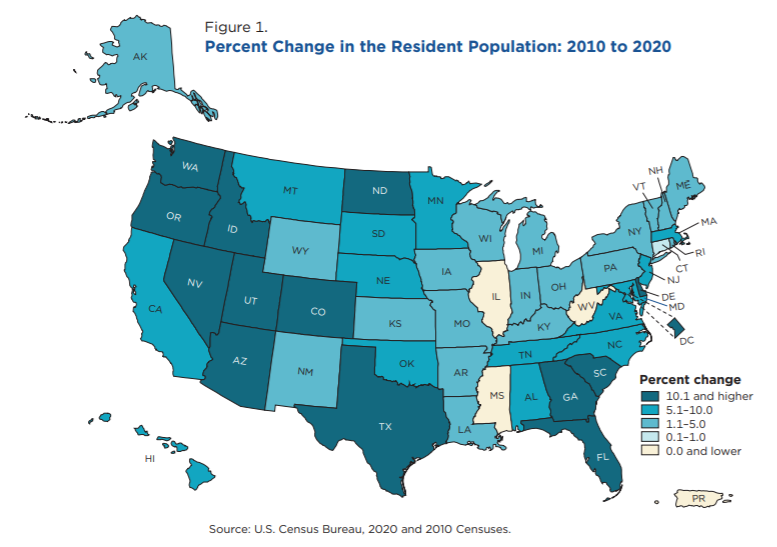
The U.S. population grew 7% between 2010 and 2020, according to census results. The age breakdown isn’t yet available, but a smaller sample by the Census Bureau and the Bureau of Labor Statistics shows that the working-age population — those 16 to 64 — grew just 3.3%. Because the share of those people working or looking for work has shrunk, the working-age labor force grew only 2%, and actually shrank last year. Some of those missing workers will return when the virus recedes. But many won’t: Baby boomer retirements have soared.

Reversing this move would require either a dramatic increase in births, which has eluded countries with more-family-friendly policies, or immigration, which is politically hard.

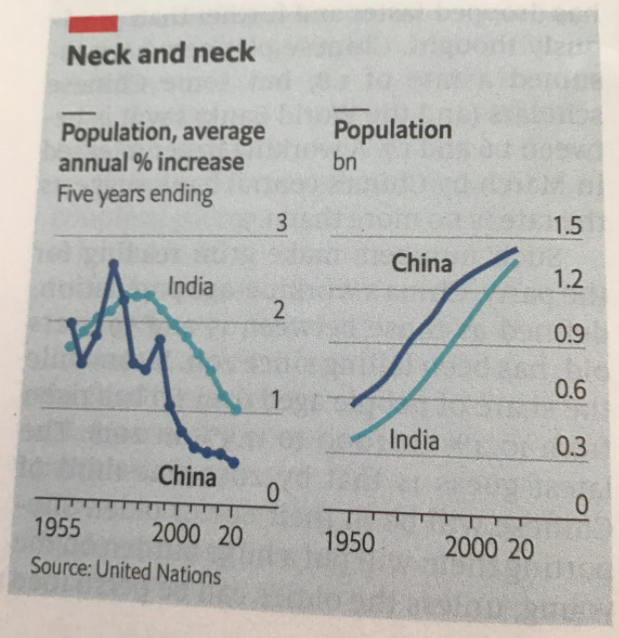
The demographic squeeze is far more severe in China, which admits almost no immigrants and for years limited families to one child. Tuesday, authorities said the population in China had grown just 5.4% in the past decade. The working-age population — those 15 to 59 — shrank 5%, or roughly 45 million people. When worker shortages began emerging over a decade ago, factories began moving to poorer inland provinces and then cheaper countries including Vietnam. In recent years some indicators suggest jobs are getting harder to fill, though the data might not be nationally representative.

Author(s): Greg Ip

Publication Date: 12 May 2021

Publication Site: Wall Street Journal
It’s the old that get the benefits, and the Tories the election wins

Link: https://www.theguardian.com/business/2021/apr/24/old-get-the-benefits-tories-the-election-wins

Excerpt:

A study due this week from the Intergenerational Foundation thinktank shows that while spending on pensioners and children respectively increased at similar rates before 2010-11, the austerity years to 2019 proved much more generous to the old.

The report finds that in 2018-19, the government spent “on average £14,660 on each child, £10,180 on each working-age adult, and £20,790 on each pensioner” and that the gap in per capita spending on children and pensioners more than doubled over the previous 20 years.

This means pensioners captured 30% of the growth in public expenditure throughout the period, with most of the gains coming after 2010 and the introduction of the triple lock, though many and varied ancillary benefits also played a part.

Author(s): Phillip Inman

Publication Date: 24 April 2021

Publication Site: The Guardian

The Gender Gap in Pandemic Job Losses Has Been Wildly Exaggerated

Excerpt:


“Labor force participation—defined as all civilians working full or part time, as well as those who are unemployed but looking for work—fell dramatically for both genders between March and April 2020,” noted Gallup. In April 2020, men’s labor force participation was at 97.8 percent of its February 2020 level and women’s labor force participation was 96.9 percent of its February 2020 level—a gender gap of just 0.9* percentage points.

By February 2021, labor force participation for both sexes had ticked back up somewhat. And while women were still seeing a less full recovery, the gap was again less than one percentage point. Compared to February 2020, men’s February 2021 labor force participation was 2.2 percent smaller and women’s was 3.1 percent smaller.

That’s not nothing—“the gap in labor force changes amounts to roughly 493,000 more women than men being absent from the labor force since the pandemic began,” Gallup pointed out in early March. But it’s also not evidence that women have been uniquely devastated by pandemic-related job losses, especially when—contra previous economic downturns—many of the circumstances that initially created the job losses will remedy quickly as life returns to a more normal pace.

Author(s): Elizabeth Nolan Brown

Publication Date: 11 May 2021

Publication Site: Reason

A Preliminary Analysis of U.S. and State-Level Results From the 2020 Census

Link: https://www.census.gov/library/working-papers/2021/demo/POP-twps0104.html

Graphic:

Choropleth of change in population by state (plus DC & Puerto Rico), 2010-2020

Description:

This paper considers the 2020 Census national and state-level resident population counts in historical and evaluative contexts. By comparing the first results of the 2020 Census against benchmark data sources, we examine how the nation has changed at the highest levels and set the stage for the comprehensive analyses still to come.

Link to paper: https://www.census.gov/content/dam/Census/library/working-papers/2021/demo/pop-twps0104.pdf

Publication Date: 26 April 2021

Publication Site: Census Bureau

Is China’s population shrinking?

Link: https://www.economist.com/china/2021/04/29/is-chinas-population-shrinking

Graphic:

Excerpt:

The Communist Party has long known that, partly as the result of its brutal birth-control policies, China’s population would soon peak and start to shrink. It has been startled, however, by how rapidly that moment has drawn near. Now, it looks as if it might have arrived.

….

There are also indications that China’s total fertility rate (the number of children a woman is expected to have in her lifetime) has dropped faster than previously thought. Chinese planners have assumed a rate of 1.8, but some Chinese scholars (and the World Bank) say it between 1.6 and 1.7. A working paper released in March by China’s central bank suggests the rate is no more than 1.5.

Publication Date: 1 May 2021

Publication Site: The Economist

China says population grew in 2020 after report of decline

Link: https://apnews.com/article/china-census-2020-business-2dff85f90c7f1bcfb3bfa3fe7fd6ce36

Excerpt:

China’s population grew last year, the government said Thursday, following a report that a census might have found a surprise decline, possibly adding to downward pressure on economic growth.

The National Bureau of Statistics gave no details in its one-sentence statement and said the population figure would be reported later. But the unusual decision to respond to the report by The Financial Times reflected the issue’s political sensitivity.

The Financial Times said people familiar with China’s 2020 census expect it to show the population, which edged above 1.4 billion in 2019, declined for the first time since famine in 1959-61 killed millions of people.

Author(s): JOE McDONALD

Publication Date: 29 April 2021

Publication Site: Associated Press

Is China’s population growing or shrinking? It’s a touchy topic for Beijing

Link: https://fortune.com/2021/04/30/china-population-2020-census-growing-shrinking/

Excerpt:

China’s National Bureau of Statistics (NBS) was scheduled to release the census it conducts once every decade in early April. But in mid-April a government spokesperson said publication of the census had been delayed for an unspecified length of time to allow for “more preparation work.”

China still has not indicated when it may release the report, according to Chinese media.

But on Wednesday, the Financial Times, citing “people familiar with the research,” reported that when published the census will show that China’s population was smaller in 2020 than it was in 2019, the first year-on-year drop in over five decades. In 2019, China reported that its population surpassed 1.4 billion people for the first time, up 4.67 million from the previous year. This year, China’s population fell back down below 1.4 billion, according to the Financial Times.

Author(s): GRADY MCGREGOR

Publication Date: 30 April 2021

Publication Site: Fortune

US birth rate lowest since 1979 as pandemic-led stress rises

Link: https://www.reuters.com/world/us/cdc-says-us-recorded-lowest-number-births-last-year-since-1979-2021-05-05/

Excerpt:

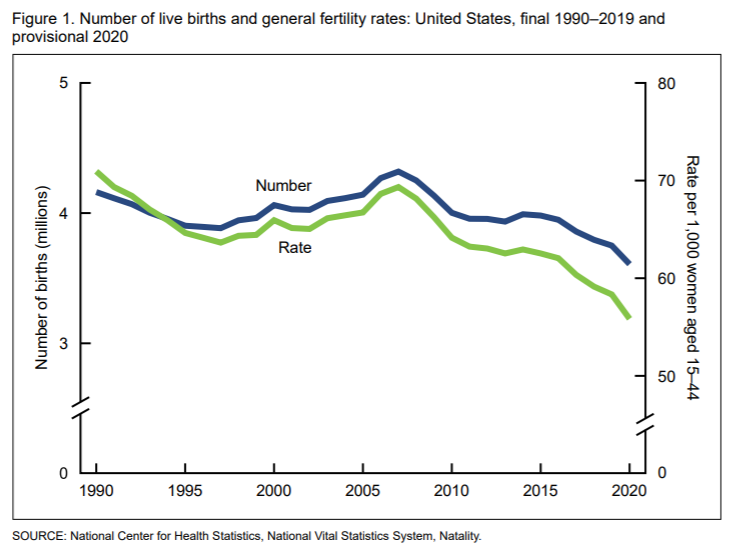
Birth rate in the United States fell 4% in 2020 to about 3.6 million babies, its sixth straight annual decline and the lowest since 1979, according to the U.S. Centers for Disease Control and Prevention (CDC).

The CDC did not attribute the overall decline to the pandemic, but experts have predicted that pandemic-led reasons including anxiety will hit the country’s birth rate.

“The recent decline in birth rates reflects both a longer-term downward trend in birth rates that was apparent prior to the pandemic and pandemic-related reduction,” Lorna Thorpe, director of epidemiology at the Department of Population Health at NYU Langone, said.

Author(s): Bhargav Acharya

Publication Date: 5 May 2021

Publication Site: Reuters

Births: Provisional Data for 2020

Link: https://www.cdc.gov/nchs/data/vsrr/vsrr012-508.pdf

Graphic:

Excerpt:

The provisional number of births for the United States in 2020 was 3,605,201, down 4% from 2019. The general fertility rate was 55.8 births per 1,000 women aged 15–44, down 4% from 2019 to reach another record low for the United States. The total fertility rate was 1,637.5 births per 1,000 women in 2020, down 4% from 2019 to also reach another record low for the nation. In 2020, birth rates declined for women in all age groups 15–44 and were unchanged for adolescents aged 10–14 and women aged 45–49. The birth rate for teenagers aged 15–19 declined by 8% in 2020 to 15.3 births per 1,000 females; rates declined for both younger (aged 15–17) and older (aged 18–19) teenagers. The cesarean delivery rate rose to 31.8% in 2020; the low-risk cesarean delivery rate increased to 25.9%. The preterm birth rate declined to 10.09% in 2020, the first decline in the rate since 2014.

Author(s): Brady E. Hamilton, Ph.D., Joyce A. Martin, M.P.H., and Michelle J.K. Osterman, M.H.S., Division of Vital Statistics, National Center for Health Statistics

Publication Date: May 2021

Publication Site: CDC

Here’s the average net worth of Americans ages 65 to 74

Link: https://www.cnbc.com/select/average-net-worth-of-americans-ages-65-to-74/

Graphic:

Excerpt:

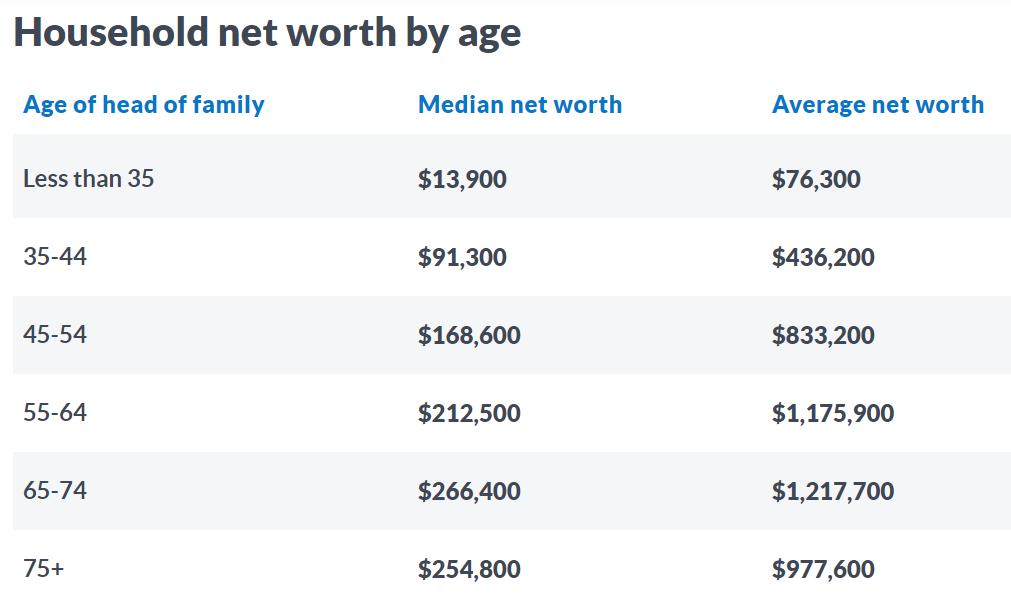
According to the Fed data, the median net worth for Americans in their late 60s and early 70s is $266,400. The average (or mean) net worth for this age bracket is $1,217,700, but since averages tend to skew higher due to high net worth households, the median is a much more representational amount.

While $266,400 may seem like a lot of money at first, people in their 60s usually start tapping into their net worth to cover living expenses in retirement. When planning for your non-working years, it’s important to understand how net worth works and how it relates to living on a fixed income.

Here’s a look at the average and median net worth by age in the U.S., according to the Fed. As you can see, net worth tends to peak for most American during the decade after age 65.

Author(s): Megan DeMatteo

Publication Date: 4 May 2021

Publication Site: CNBC

Nearly 1.5 Million Mothers Are Still Missing From the Workforce

Link: https://www.wsj.com/articles/nearly-1-5-million-mothers-are-still-missing-from-the-workforce-11619472229

Graphic:

Excerpt:

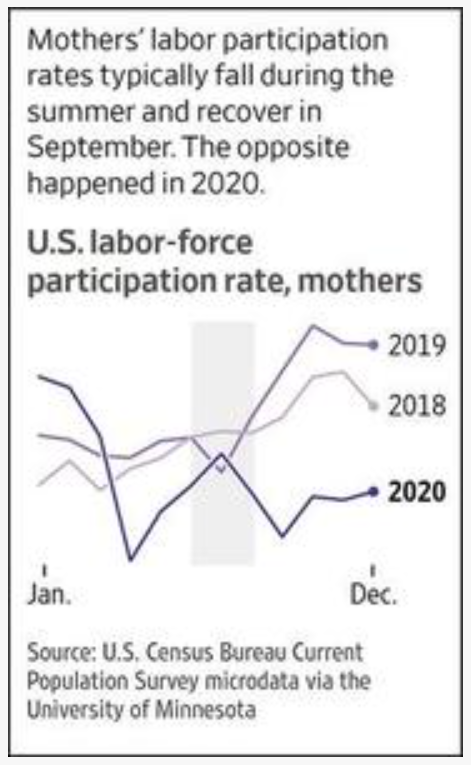
Black and Hispanic women disproportionately work in industries — such as leisure and hospitality — that were most negatively affected by the pandemic, said Valerie Wilson, director of the Economic Policy Institute’s Program on Race, Ethnicity and the Economy.

Since February of last year, participation rates for white women, including mothers, haven’t dropped more than 3.2 percentage points. Rates for women of color — especially Black and Hispanic mothers with children under 5 — have at times fallen more.

Large numbers of Black and Hispanic women work in essential sectors — most notably healthcare — that have seen increased demand in the past year. But in those industries, according to Dr. Wilson, they tend to hold jobs that offer comparatively low pay and flexibility.

The average number of hours men and women work per week has varied more widely since the start of the pandemic than in recent years. People have worked fewer hours overall, with men’s time dropping more significantly. That has narrowed — but not closed — the gap between hours worked by men and women.

Author(s): Katherine Riley, Stephanie Stamm |

Publication Date: 27 April 2021

Publication Site: Wall Street Journal
Computer and Internet Use in the United States: 2018

Link: https://www.census.gov/newsroom/press-releases/2021/computer-internet-use.html

Graphic:

Excerpt:

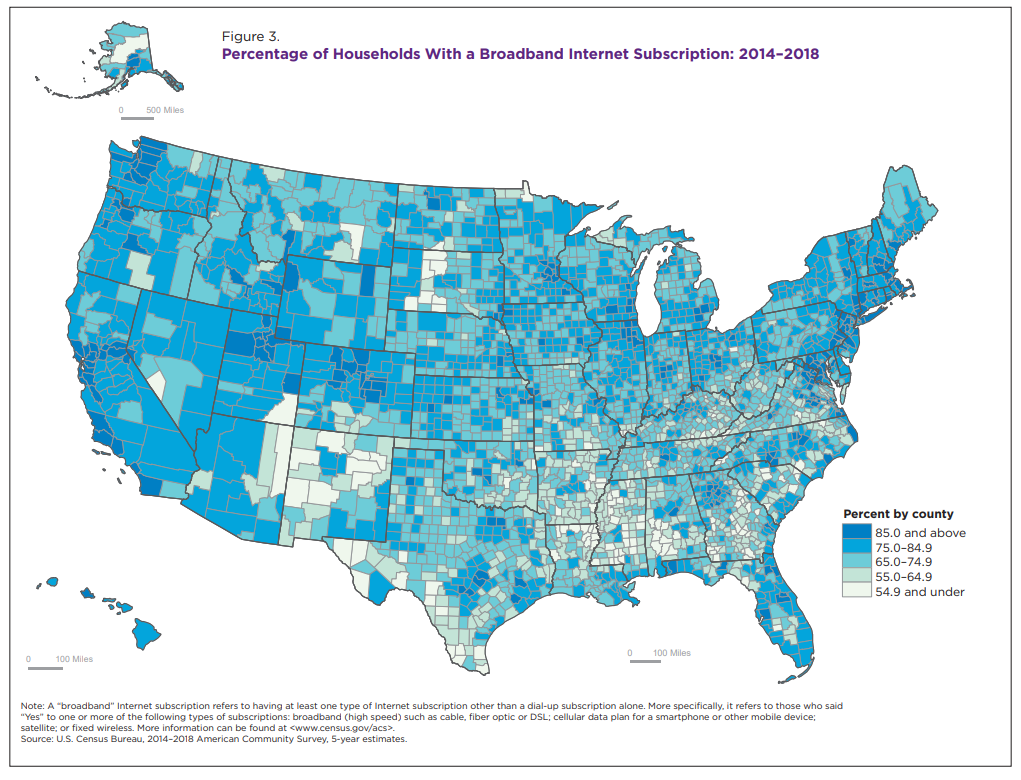
Among all households in 2018, 92% had at least one type of computer and 85% had a broadband internet subscription. The ACS considers desktops, laptops, tablets, and smartphones as computers, along with selected computing technologies such as smart home devices and single-board computers.

Smartphone ownership surpassed ownership of all other computing devices. Smartphones were present in 84% of households, while 78% of households owned a desktop or laptop. Tablet ownership fell behind at 63%.

Urban residents were more likely than rural residents to use computing devices (93% of urban households compared to 89% of rural households) and were more likely to have any sort of internet subscription (86% of urban households compared to 81% of rural households).

Author(s):

Publication Date: 21 April 2021

Publication Site: U.S. Census Bureau