Annual Report to the Nation on the Status of Cancer, Part 1: National Cancer Statistics

Link:https://academic.oup.com/jnci/article/113/12/1648/6312532?login=false

Citation: JNCI: Journal of the National Cancer Institute, Volume 113, Issue 12, December 2021, Pages 1648–1669, https://doi.org/10.1093/jnci/djab131

Graphic:
Excerpt:

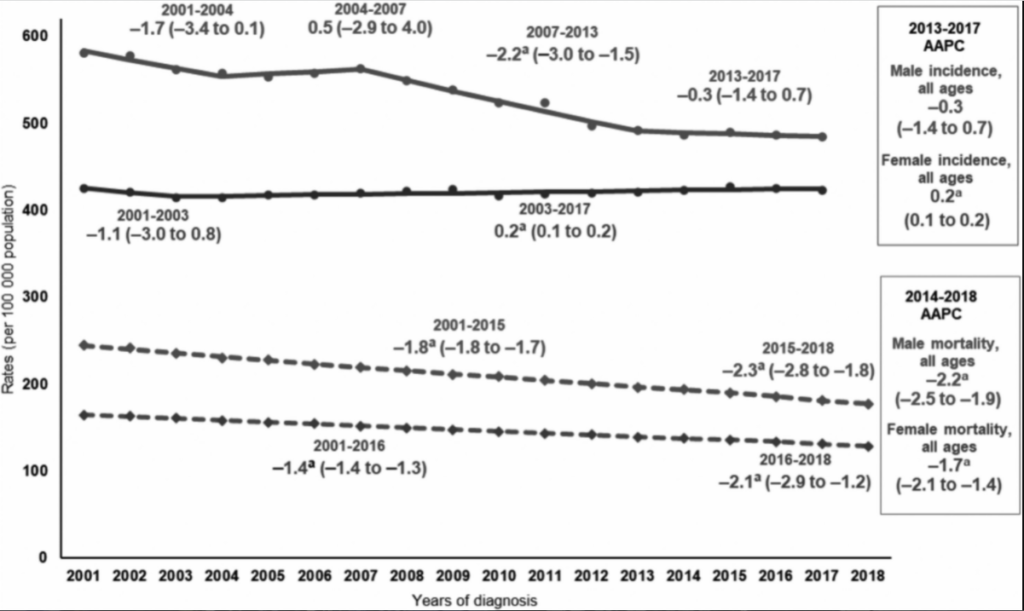
Overall cancer incidence rates (per 100 000 population) for all ages during 2013-2017 were 487.4 among males and 422.4 among females. During this period, incidence rates remained stable among males but slightly increased in females (AAPC = 0.2%, 95% confidence interval [CI] = 0.1% to 0.2%). Overall cancer death rates (per 100 000 population) during 2014-2018 were 185.5 among males and 133.5 among females. During this period, overall death rates decreased in both males (AAPC = −2.2%, 95% CI = −2.5% to −1.9%) and females (AAPC = −1.7%, 95% CI = −2.1% to −1.4%); death rates decreased for 11 of the 19 most common cancers among males and for 14 of the 20 most common cancers among females, but increased for 5 cancers in each sex. During 2014-2018, the declines in death rates accelerated for lung cancer and melanoma, slowed down for colorectal and female breast cancers, and leveled off for prostate cancer. Among children younger than age 15 years and adolescents and young adults aged 15-39 years, cancer death rates continued to decrease in contrast to the increasing incidence rates. Two-year relative survival for distant-stage skin melanoma was stable for those diagnosed during 2001-2009 but increased by 3.1% (95% CI = 2.8% to 3.5%) per year for those diagnosed during 2009-2014, with comparable trends among males and females.

Conclusions

Cancer death rates in the United States continue to decline overall and for many cancer types, with the decline accelerated for lung cancer and melanoma. For several other major cancers, however, death rates continue to increase or previous declines in rates have slowed or ceased. Moreover, overall incidence rates continue to increase among females, children, and adolescents and young adults. These findings inform efforts related to prevention, early detection, and treatment and for broad and equitable implementation of effective interventions, especially among under resourced populations.

Author(s): Farhad Islami, MD, PhD, Elizabeth M Ward, PhD, Hyuna Sung, PhD, Kathleen A Cronin, PhD, Florence K L Tangka, PhD, Recinda L Sherman, PhD, Jingxuan Zhao, MPH, Robert N Anderson, PhD, S Jane Henley, MSPH, K Robin Yabroff, PhD, Ahmedin Jemal, DVM, PhD, Vicki B Benard, PhD

Publication Date: 8 July 2021

Publication Site: Journal of the National Cancer Institute
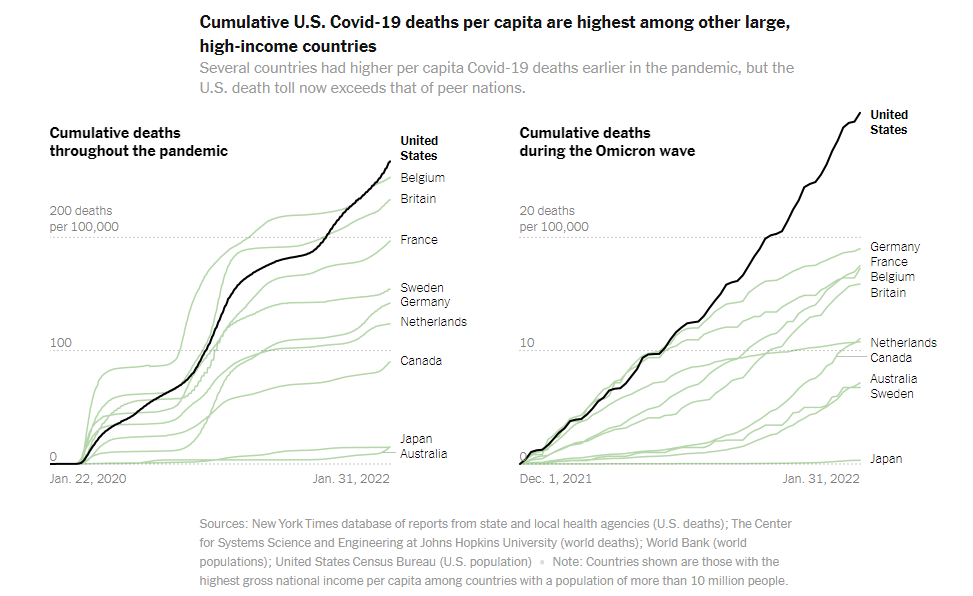
U.S. Has Far Higher Covid Death Rate Than Other Wealthy Countries

Link:https://www.nytimes.com/interactive/2022/02/01/science/covid-deaths-united-states.html

Graphic:

Excerpt:

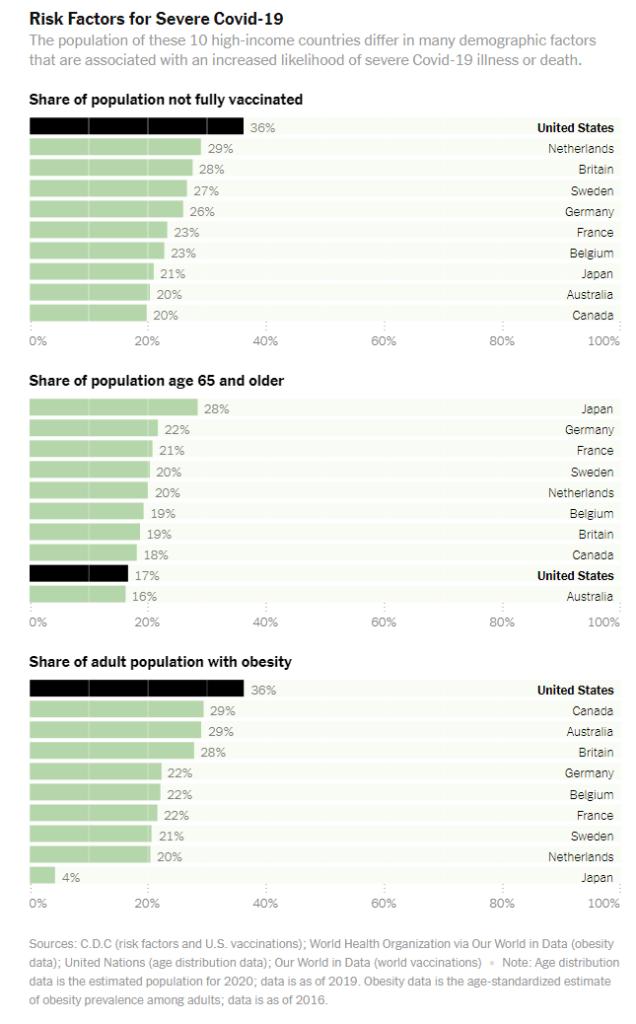
“We’ve finally started getting to a stage where most of the population has been exposed either to a vaccine or the virus multiple times by now,” said Dr. David Dowdy, an epidemiologist at the Johns Hopkins Bloomberg School of Public Health. Referring to American and European death rates, he continued, “I think we’re now likely to start seeing things be more synchronized going forward.”

Still, the United States faces certain steep disadvantages, ones that experts worry could cause problems during future Covid waves, and even the next pandemic. Many Americans have health problems like obesity and diabetes that increase the risk of severe Covid.

Author(s): Benjamin Mueller and Eleanor Lutz

Publication Date: 1 Feb 2022

Publication Site: NYT

Illinois data: Deaths of people 18 to 49 soar in 2020-21; most of excess not COVID-related

Link: https://www.thecentersquare.com/illinois/illinois-data-deaths-of-people-18-to-49-soar-in-2020-21-most-of-excess/article_091b8228-807c-11ec-b235-239935b60883.html#new_tab

Graphic:

Excerpt:

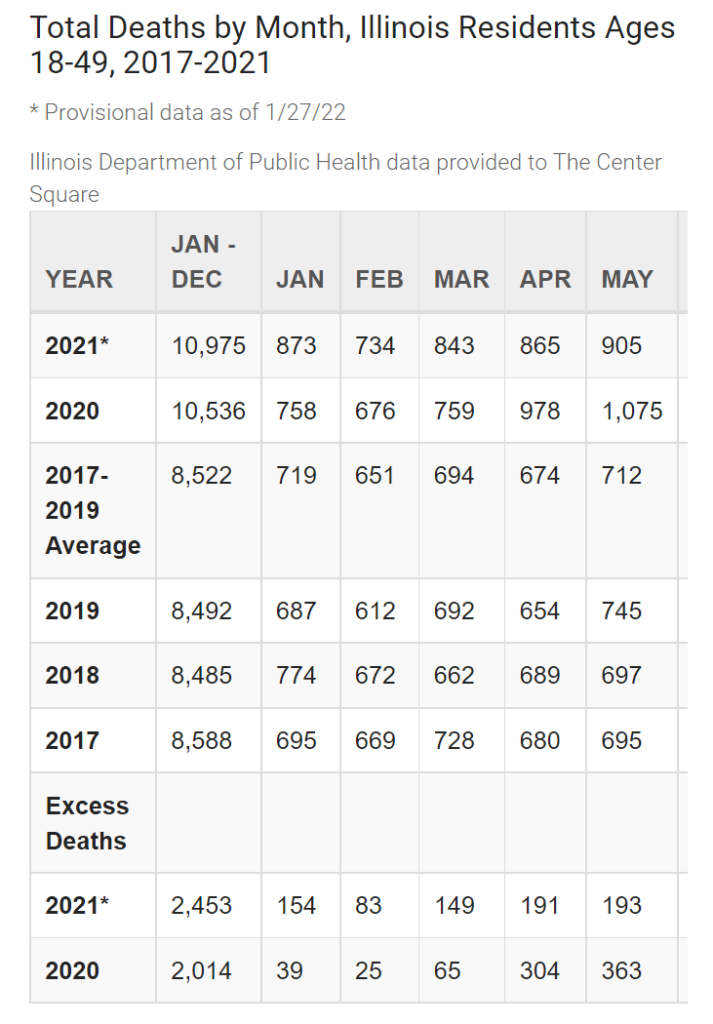
Nearly 27% more people ages 18 to 49 in Illinois have died in each of the past two years than in each of the three years prior. COVID-related deaths in that age group account for just a minority of the excess deaths.

Data the Illinois Department of Public Health provided The Center Square show 29% more fatalities in 2021 and 24% more in 2020 when compared to the average for the three years prior for those ages 18 to 49. Combined for 2020 and 2021, the total number of deaths among that demographic is 21,511.

…..

COVID-related deaths in the past two years totals about 1,700 for that age group. Subtracting the 1,700 COVID deaths from the excess death total of 4,467 leaves 2,767 excess deaths for 2020 and 2021 that are not categorized by IDPH, meaning the causes of death for the excess 2,767 are not described.

…..

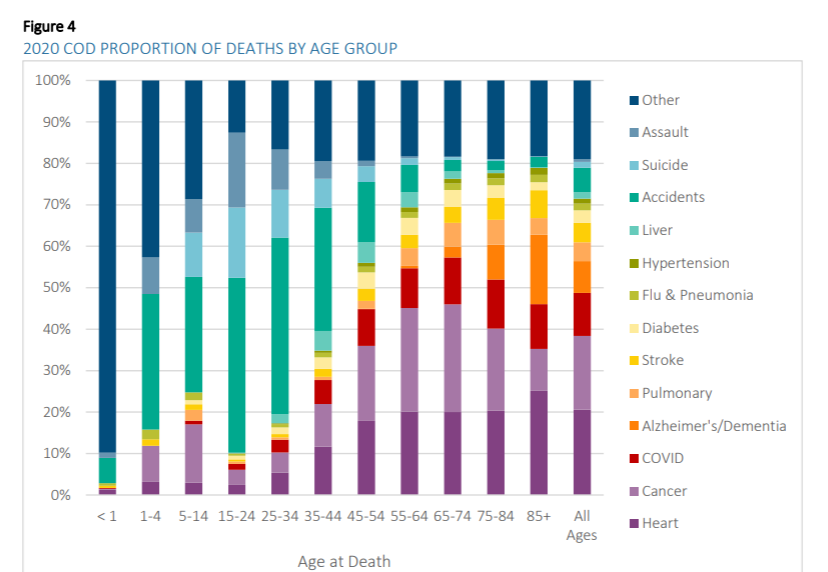
While COVID-19 is listed as the third leading cause of death in Illinois for all ages in 2020, the leading cause of deaths IDPH lists for those 18 to 44 is accidents, assaults, suicides and heart disease. COVID-19 is not listed as a leading cause of death at all for ages 18 to 24. COVID-19 does show up at No. 6 for those 25 to 44, or 370 out of a total of 6,439.

Author(s): Greg Bishop

Publication Date: 28 Jan 2022

Publication Site: The Center Square

U.S. Population Mortality Observations – Updated with 2020 Experience

Link:https://www.soa.org/resources/research-reports/2022/us-population-mortality/

pdf: https://www.soa.org/globalassets/assets/files/resources/research-report/2022/population-mortality-observation.pdf

Graphic:

Excerpt:

The overall age-adjusted mortality rate (both sexes) from all causes of death recorded the historically highest increase of published records dating back to 1900 of 16.8% in 2020, following a 1.2% decrease in 2019. The increase eclipsed the size of recent years’ annual volatility and exceeded the 11.7% increase in
1918 that occurred during the Spanish influenza pandemic. When COVID deaths are removed, all other
CODs’ (Cause of Death) combined mortality increased by 4.9%, which was last exceeded by a 5.6% increase in 1936.

All other CODs featured in this report had increased 2020 mortality. In many instances, the single year
mortality increases were the largest for the span of this report. Heart disease and Alzheimer’s/Dementia
had 4.7% and 7.8% increases, respectively. Other physiological CODs with lower death rates had double-digit increases. Diabetes, liver and hypertension had increases of 14.9%, 16.0% and 13.3%, respectively.
The external CODs of assaults and opioid overdoses had extreme increases at ages 15-24 of 35.9% and
61.2%, respectively.

Author(s):

Jerome Holman, FSA, MAAA, RJH Integrated Solutions, LLC
Cynthia S. MacDonald, FSA, MAAA, Society of Actuaries Research Institute

Publication Date: Jan 2022

Publication Site: SOA

More than 1 million have died in the overdose crisis, but still the response is scandalously inadequate

Link:https://www.washingtonpost.com/opinions/2022/01/24/dopesick-author-on-opioid-crisis/

Excerpt:

These are measures taken by people desperately fighting, largely on their own, against a drug-overdose death toll that historically has killed more Americans than the coronavirus pandemic. Since 1996, the year OxyContin launched and the United States’ health-care system fell prey to the lie that opioid painkillers were safe for virtually everything from headaches to wisdom-tooth surgery, more than 1 million Americans have died of overdoses; the coronavirus pandemic has claimed about 850,000. During the first year of the pandemic, the Centers for Disease Control and Prevention reported a record 100,000 annual overdose deaths.

….

But with an even more lethal overdose crisis — and that’s not counting all the addiction-related deaths from hepatitis, endocarditis and suicide — the nation’s leadership appears capable of only minor tweaks.

Some blue-leaning states and cities now offer evidence-backed practices such as supplying drug users with clean needles and fentanyl test strips, and even offering medically supervised spaces to inject illicit drugs — all of which foster important connections to professional care and wraparound services. But in much of the world’s richest nation, where a few million Americans suffer with opioid use disorder, these measures remain anathema.

The pandemic-prompted loosening of federal regulations for the telehealth prescribing of buprenorphine, the lifesaving addiction medication, has been a bright spot, particularly for rural people who have long struggled with transportation issues. But that policy change remains temporary and the treatment gap (with an estimated 10 to 12 percent of addicted people receiving treatment in an average year) has barely budged.

….

Epidemiologists predict that by 2029, U.S. overdose deaths will have doubled to nearly 2 million. Until we stop arresting and abandoning people who use drugs and start meeting them where they are with treatment and compassion, rare will be the family that remains untouched.

Author(s): Beth Macy

Publication Date: 24 Jan 2022

Publication Site: Washington Post

Suicide Risk Screenings Can Save Lives

Link: https://www.pewtrusts.org/en/research-and-analysis/articles/2022/01/25/suicide-risk-screenings-can-save-lives

Excerpt:

Suicide was the 12th leading cause of death in the United States in 2020.

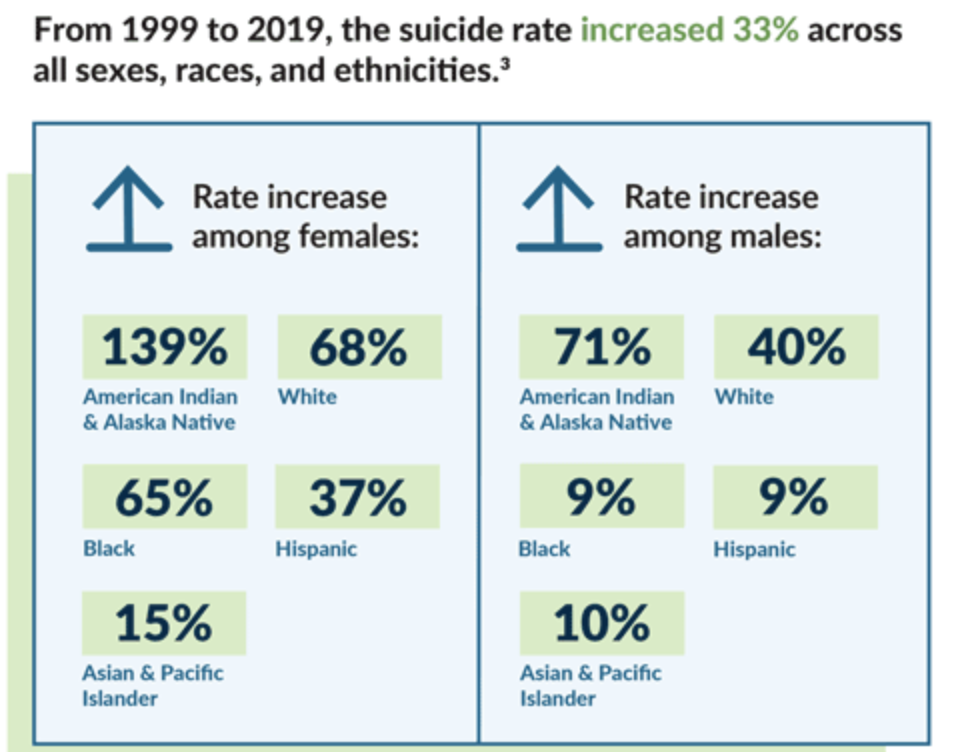
The overall U.S. suicide rate grew 33% from 1999 to 2019, according to the Centers for Disease Control and Prevention. CDC reports even higher increases among certain racial and ethnic groups: American Indian and Alaska Native women (139%) and men (71%), Black women (65%), White women (68%) and men (40%), and Hispanic women (37%). Other people at greater risk of suicide include veterans, people who identify as LGBTQ, youth and young adults, and disaster survivors.

….

According to a recent study, about half of people who died by suicide over the 10-year period examined had seen a health care professional at least once in the month before their death. Additional research suggests that, if they were screened for suicide risk by those providers, many might have received care and survived. Indeed, a 2017 study of eight emergency departments across seven states found 30% fewer suicide attempts among patients who were screened and received evidence-based care compared with patients who were not screened. Another study that looked at veterans affairs hospitals found that patients who were screened and then received clinical interventions were half as likely to experience suicidal behavior and more than twice as likely to attend mental health treatment compared with those who received usual care.

Author(s): Kristen Mizzi Angelone

Publication Date: 25 Jan 2022

Publication Site: Pew

2021 U.S. January-June Cause-of-Death Ranking Table

Link:https://marypatcampbell.substack.com/p/2021-us-january-june-cause-of-death

Graphic:

Excerpt:

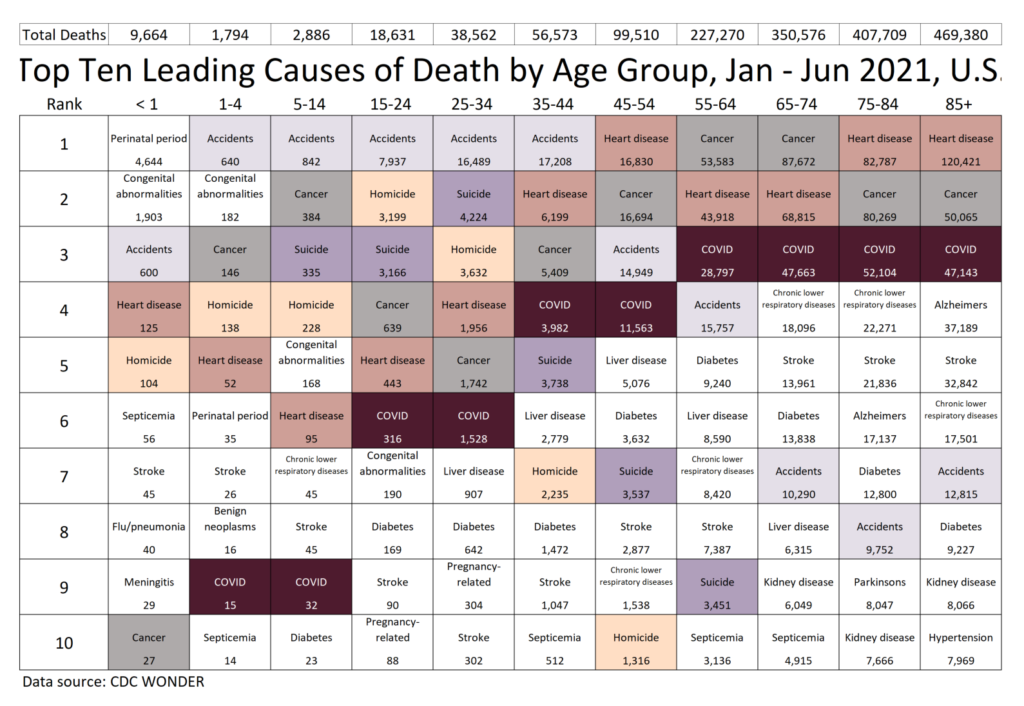
I don’t recommend simply doubling the numbers from the ranking table and comparing them to the 2020 table, especially for the COVID numbers. I know that won’t work, because of the overall 2021 mortality trend we saw:

….

However, I have been making estimates and projections, and I see some really worrying numbers for the ages 15-44 grouping, especially for external causes of death: suicide, homicide, and accidents. The worrying trend is that these may extend past the time COVID mortality wanes. It looks worse for 2021 than for 2020.

I will be doing posts looking at these three large categories, starting with suicide, in upcoming posts, by more detailed demographics than just age. Some of these trends have geographic components to consider as well.

Author(s): Mary Pat Campbell

Publication Date: 27 Jan 2022

Publication Site: STUMP at substack

Mortality Nuggets: Videos on 2020 Death Rates by Cause of Death, Querying WONDER, and Actuarial News

Link:https://marypatcampbell.substack.com/p/mortality-nuggets-videos-on-2020

Video:

Excerpt:

Actuarial News is a website Stu created for me to use as a place to collect all the articles, websites, data sources, etc. that I like to use for my research and writing. I tend to develop ideas over long periods, and I prefer my selections over trying to use regular search.

As noted in the video, I used to use the old Actuarial Outpost (RIP) as a repository for my articles on public pensions and finance, but now I use Actuarial.News.

By the way, for any readers seeking actuarial discussion as once was provided by the old Outpost, check out goActuary. I have a thread on spreadsheet screwups and one on non-pandemic mortality, for instance.

Author(s): Mary Pat Campbell

Publication Date: 25 Jan 2022

Publication Site: STUMP at substack

A LITERATURE REVIEW AND META-ANALYSIS
OF THE EFFECTS OF LOCKDOWNS ON
COVID-19 MORTALITY

Link: https://sites.krieger.jhu.edu/iae/files/2022/01/A-Literature-Review-and-Meta-Analysis-of-the-Effects-of-Lockdowns-on-COVID-19-Mortality.pdf

Graphic:

Abstract:

This systematic review and meta-analysis are designed to determine whether there is empirical
evidence to support the belief that “lockdowns” reduce COVID-19 mortality. Lockdowns are
defined as the imposition of at least one compulsory, non-pharmaceutical intervention (NPI).
NPIs are any government mandate that directly restrict peoples’ possibilities, such as policies that
limit internal movement, close schools and businesses, and ban international travel. This study
employed a systematic search and screening procedure in which 18,590 studies are identified
that could potentially address the belief posed. After three levels of screening, 34 studies
ultimately qualified. Of those 34 eligible studies, 24 qualified for inclusion in the meta-analysis.
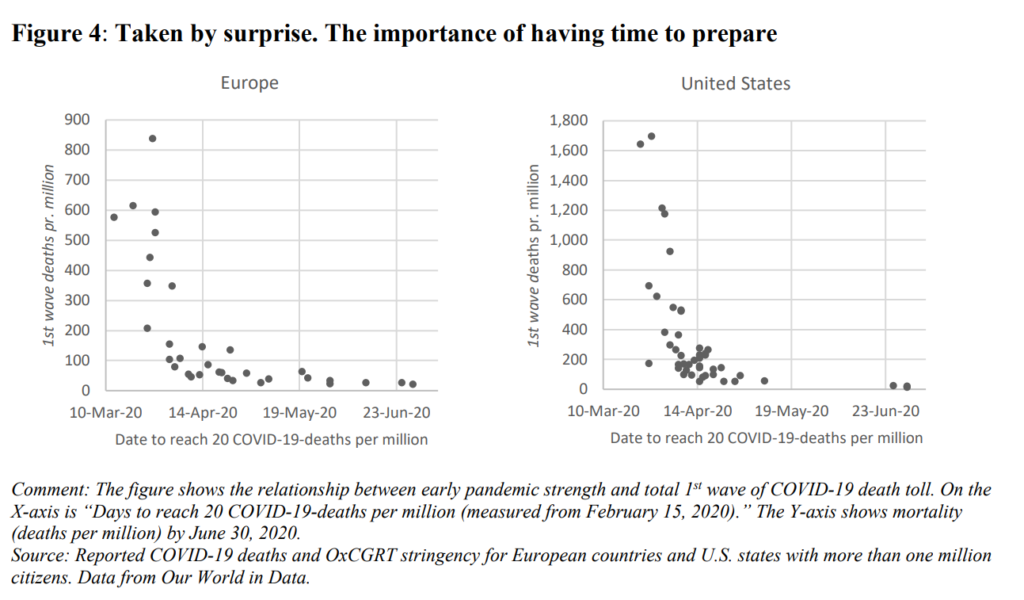
They were separated into three groups: lockdown stringency index studies, shelter-in-placeorder (SIPO) studies, and specific NPI studies. An analysis of each of these three groups support
the conclusion that lockdowns have had little to no effect on COVID-19 mortality. More
specifically, stringency index studies find that lockdowns in Europe and the United States only
reduced COVID-19 mortality by 0.2% on average. SIPOs were also ineffective, only reducing
COVID-19 mortality by 2.9% on average. Specific NPI studies also find no broad-based evidence
of noticeable effects on COVID-19 mortality.
While this meta-analysis concludes that lockdowns have had little to no public health effects,
they have imposed enormous economic and social costs where they have been adopted. In
consequence, lockdown policies are ill-founded and should be rejected as a pandemic policy
instrument.

Author(s): Jonas Herby, Lars Jonung, and Steve H. Hanke

Publication Date: January 2022

Publication Site: Johns Hopkins Institute for Applied Economics

Tokyo’s ‘oldest man’ had been dead for 30 years

Link:https://www.bbc.com/news/world-asia-pacific-10809128

Excerpt:

He was thought to be the oldest man in Tokyo – but when officials went to congratulate Sogen Kato on his 111th birthday, they uncovered mummified skeletal remains lying in his bed.

Mr Kato may have been dead for 30 years according to Japanese authorities.

They grew suspicious when they went to honour Mr Kato at his address in Adachi ward, but his granddaughter told them he “doesn’t want to see anybody”.

Police are now investigating the family on possible fraud charges.

…..

But the family had received 9.5 million yen ($109,000: £70,000) in widower’s pension payments via Mr Kato’s bank account since his wife died six years ago, and some of the money had recently been withdrawn.

Publication Date: 29 July 2010

Publication Site: BBC