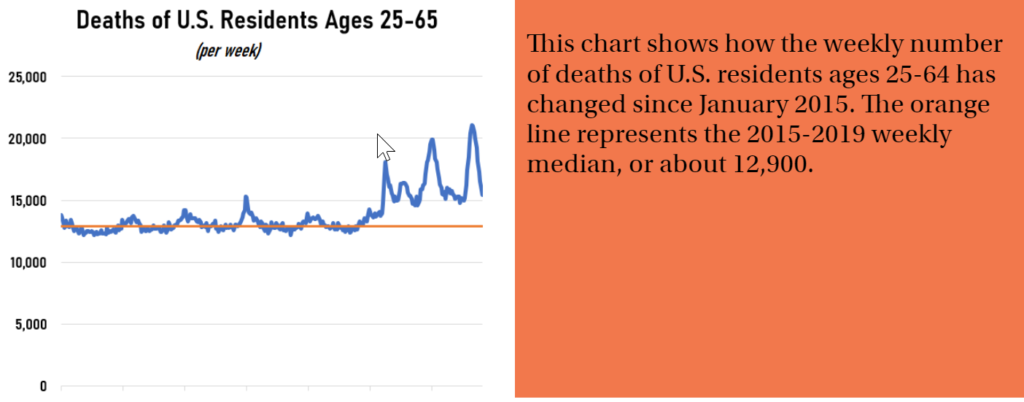
Whatever the omicron variant of COVID-19 does to U.S. life insurance insurance claims, the delta variant and its siblings have been continuing to drive up the number of deaths of working-age Americans.
Some life and health insurers reported that an enormous surge of COVID-19 deaths appeared in September and then seemed to end quickly.
In September, the number climbed more than 7,000, or more than 50%, over the median.
That total includes both people killed directly by COVID-19 and by the effects of the pandemic on the health care system, the economy and U.S. society as a whole.
The head of Indianapolis-based insurance company OneAmerica said the death rate is up a stunning 40% from pre-pandemic levels among working-age people.
“We are seeing, right now, the highest death rates we have seen in the history of this business – not just at OneAmerica,” the company’s CEO Scott Davison said during an online news conference this week. “The data is consistent across every player in that business.”
OneAmerica is a $100 billion insurance company that has had its headquarters in Indianapolis since 1877. The company has approximately 2,400 employees and sells life insurance, including group life insurance to employers in the state.
Davison said the increase in deaths represents “huge, huge numbers,” and that’s it’s not elderly people who are dying, but “primarily working-age people 18 to 64” who are the employees of companies that have group life insurance plans through OneAmerica.
“And what we saw just in third quarter, we’re seeing it continue into fourth quarter, is that death rates are up 40% over what they were pre-pandemic,” he said.
But the 1918 Spanish flu has, as far as I know, legitimately died out. Lots of people like saying that in a sense it’s still with us. This NEJM paper (with a celebrity author!) points out that it’s the ancestor of all existing flu strains. But most of these flu strains are less infectious than it was. This didn’t make sense to me the first, second, or third time I asked about it: why would a flu evolve into an inferior flu? Sure, it might evolve into a less deadly flu because it’s perfectly happy being more infectious but less deadly. But I think the Spanish flu was also especially infectious; so why would it evolve away from that?
One possible answer is “because by 1919, everyone had immunity to the 1918 flu, so it evolved away from it – and now nobody has immunity, but it lost the original blueprint.” The 1918 flu was a really optimal point in fluspace, but during all of history up until 1918, the flu’s evolutionary hill-climbing algorithm didn’t manage to find that point, and since flu has no memory it’s not going to be any easier for it to find it the second time, after it evolved away from it. So plausibly, existing flus are strictly worse at their job than Spanish flu was, and digging up an intact copy of the latter would be really bad.
And then there’s smallpox. No mystery why smallpox died out – we killed it. But then we stopped vaccinating people against it, and now if it comes back it would be really bad.
As the coronavirus pandemic approaches the end of a second year, the United States stands on the cusp of surpassing 800,000 deaths from the virus, and no group has suffered more than older Americans. All along, older people have been known to be more vulnerable, but the scale of loss is only now coming into full view.
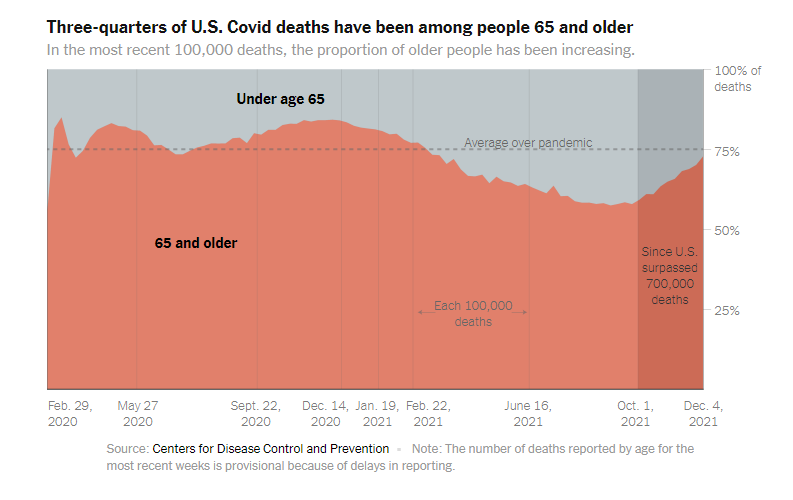
Seventy-five percent of people who have died of the virus in the United States — or about 600,000 of the nearly 800,000 who have perished so far — have been 65 or older. One in 100 older Americans has died from the virus. For people younger than 65, that ratio is closer to 1 in 1,400.
…..
After the first known coronavirus death in the United States in February 2020, the virus’s death toll in this country reached 100,000 people in only three months. The pace of deaths slowed throughout summer 2020, then quickened throughout the fall and winter, and then slowed again this spring and summer.
Throughout the summer, most people dying from the virus were concentrated in the South. But the most recent 100,000 deaths — beginning in early October — have spread out across the nation, in a broad belt across the middle of the country from Pennsylvania to Texas, the Mountain West and Michigan.
These most recent 100,000 deaths, too, have all occurred in less than 11 weeks, a sign that the pace of deaths is moving more quickly once again — faster than at any time other than last winter’s surge.
By now, Covid-19 has become the third leading cause of death among Americans 65 and older, after heart disease and cancer. It is responsible for about 13 percent of all deaths in that age group since the beginning of 2020, more than diabetes, accidents, Alzheimer’s disease or dementia.
Author(s): Julie Bosman, Amy Harmon and Albert Sun
The Covid-19 pandemic last year drove the biggest increase in death benefits paid by U.S. life insurers since the 1918 influenza epidemic, an industry trade group said.
Death-benefit payments rose 15.4% in 2020 to $90.43 billion, mostly due to the pandemic, according to the American Council of Life Insurers. In 1918, payments surged 41%.
The hit to the insurance industry was less than expected early in the pandemic because many of the victims were older people who typically have smaller policies. The industry paid out $78.36 billion in 2019, and payouts have typically increased modestly each year.
….
In the 1918 flu pandemic, the number of U.S. deaths reached about 675,000, with mortality high in people younger than 5 years old, 20 to 40 years old, and 65 years and older, according to the CDC’s website.
The ACLI’s data show two other years, both in the 1920s, when year-over-year increases topped 15%, when there also were influenza epidemics, said Andrew Melnyk, the ACLI’s vice president of research and chief economist.
Two new studies show that drivers 70 and over tend to drive older, smaller vehicles that are not equipped with important safety features. The first study compared the vehicles driven by 1.5 million crash-involved Florida drivers ages 35-54 and 70 and older over 2014-18. The second surveyed 900 drivers in those age groups from various states about the factors that influenced their most recent vehicle purchase.
“Persuading older drivers to take another look at the vehicles they’re driving could reduce crash fatalities substantially,” says Jessica Cicchino, IIHS vice president of research and a co-author of both studies. “One big challenge is that, for those on a fixed income, cost often overrides other concerns.”
The study of Florida crashes found that drivers in their 70s and older were significantly more likely to be driving vehicles that were at least 16 years old than drivers ages 35-54. The older drivers were also substantially less likely to be driving vehicles less than 3 years old.
The average age of cars on the road keeps going up, and as these cars get older they are becoming less suited to the drivers most likely to own them. A new study from the IIHS says that older drivers are at much greater risk of getting hurt or killed in their so-called “retirement cars.”
According to the study, drivers 70 and over are sticking with their older cars, which lack modern safety features. As driver age goes up, so does the likelihood of death in accidents by some pretty staggering figures. Drivers who are over 75 are four times as likely to die in a side-impact crash, and three times as likely to die in a frontal crash than drivers who are middle-aged, per the IIHS.
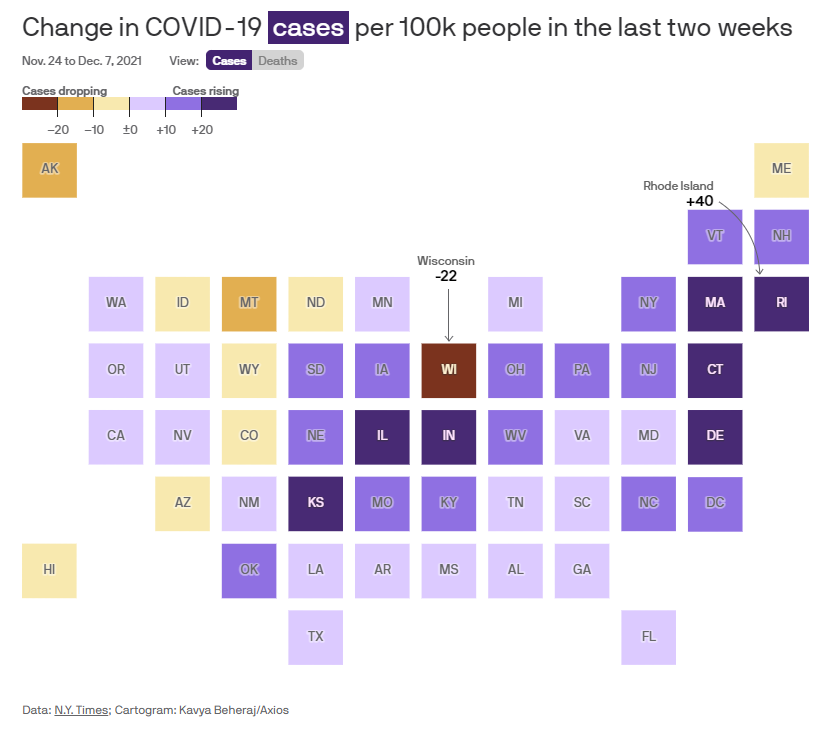
Where it stands: The U.S. is now averaging roughly 120,000 new COVID cases per day, a 26% increase over the past two weeks.
Average cases briefly dipped below 100,000 as the summer’s Delta wave receded, but the virus has rebounded quickly. New infections were climbing even before Thanksgiving, and holiday travel likely is accelerating the virus’ spread even further.
Deathsare also on the rise, after tapering off in the fall.
The virus is now killing about 1,300 Americans per day, on average. That’s a 14% increase over the past two weeks.
At this rate, the U.S. will pass 800,000 total deaths — roughly equivalent to the population of the Charleston, South Carolina, metro area — before Christmas.
South African excess deaths, a measure of mortality above a historical average, almost doubled in the week ending Nov. 28 from the preceding seven-day period as a new coronavirus variant spread across the country.
During the period 2,076 more people died than would normally be expected, the South African Medical Research Council said in a report on Wednesday. That compares with 1,091 the week earlier.
The rise, while only reflecting a week of data, contrasts with hospitalization numbers that show that most admissions have mild forms of the coronavirus, spurring hope that the omicron variant is more benign than earlier strains.
On Monday, December 6, 2021, I gave a talk with the title “COVID Data Follies: Vaccination Rates, Relative Risk, and Simpson’s Paradox”, to the Actuarial Science program at Illinois State University (thanks for the t-shirt, y’all!):
You may have heard statistics in the news that most of the people testing positive for COVID, currently, in a particular location, or most of the people hospitalized for COVID, or even most of the people dying of COVID were vaccinated! How can that be? Does that prove that the vaccines are ineffective? Using real-world data, the speaker, Mary Pat Campbell, will show how these statistics can both be true and misleading. Simpson’s Paradox is involved, which has to do with comparing differences between subgroups with very different sizes and average results. Simpson’s Paradox actually appears quite often in the insurance world.
I will embed a recording of the event, copies of the slides, the spreadsheets, and the links from the talk.
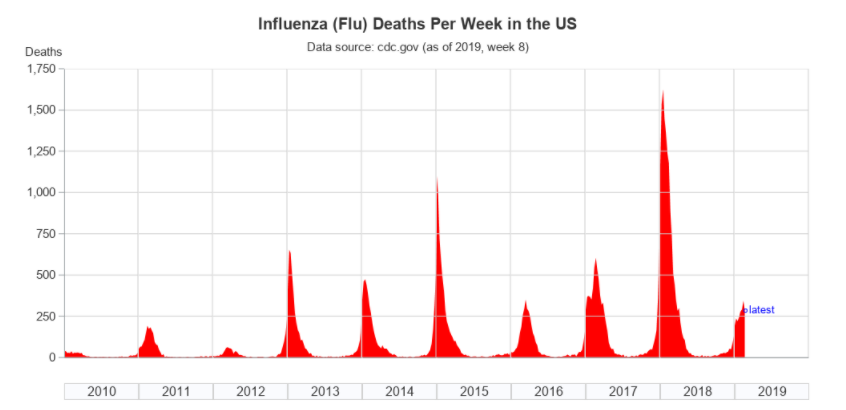
Cold and humidity are definitely important – scientists can make flu spread faster or slower in guinea pigs just by altering the temperature and humidity of their cages. But it can’t just be cold and humidity. But if it was just cold, you would expect flu to track temperature instead of seasonality. Alaska is colder in the summer than Florida in the winter, so you might expect more summer flu in Alaska than winter flu in Florida. But Alaska and Florida both have lots of flu in the winter and little flu in the summer.
(if it was just humidity, same argument, but change the place names to Arizona and Florida.)
It’s the same story with people being cramped indoors. Common-sensically, this has to be some of the story. But if it were the most important contributor, you would expect to see the opposite pattern in very hot areas, where nobody will go out during the summer but it’s pleasant and balmy in the winter. Yet I have never heard anyone claim that any winter diseases happen in summer in Arizona or Saudi Arabia or terrible places like that.
If it was just vitamin D…look, it’s not vitamin D. Nothing is ever vitamin D. People try so hard to attribute everything to vitamin D, and it never works. The most recent studies show it doesn’t prevent colds or flu, and I think the best available evidence shows it doesn’t prevent coronavirus either. African-Americans, who are all horrendously Vitamin D deficient, don’t get colds at a higher rate than other groups (they do get flu more, but they’re vaccinated less, so whatever).