Why Black Lives Got Longer

Link:https://www.wsj.com/articles/why-black-lives-got-longer-nber-longevity-racial-gap-11631905217

Excerpt:

“Between 1990 and 2018,” the paper reports, “the U.S. White-Black life expectancy gap decreased from 7.0 to 3.6 years.” A black person born in the U.S. in 1990 could be expected to live to about age 69, compared to 76 for a white person. In the intervening generation, black life expectancy rose about twice as fast as white life expectancy. A black person born in 2018 could be expected to live just over age 75, compared to just under 79 for a white person.

The drivers, the authors say, are primarily “greater reductions in Black relative to White death rates due to cancer, homicide, HIV, and causes originating in the fetal or infant period.” The most pronounced reductions in black mortality are among children and adults under age 65, rather than the elderly.

“Deaths of despair” (deaths from suicide, drug overdoses, and alcohol-related disease) increased among black and white Americans, especially in the last decade, but took a larger toll on white life expectancy. That accounted for 16.2% of the narrowing of the racial gap. The linear extension of life expectancies for both races stopped after 2012, meaning that it’s hard to see much effect from ObamaCare’s health insurance expansion in the data.

Author(s): The Editorial Board

Publication Date: WSJ

Publication Site: 11 Oct 2021
COVID-19-Associated Orphanhood and Caregiver Death in the United States

Link:https://pediatrics.aappublications.org/content/pediatrics/early/2021/10/06/peds.2021-053760.full.pdf

Graphic:

Excerpt:

Methods: We quantified COVID-19-associated caregiver loss and orphanhood in the US and for
each state using fertility and excess and COVID-19 mortality data. We assessed burden and rates
of COVID-19-associated orphanhood and deaths of custodial and co-residing grandparents,
overall and by race/ethnicity. We further examined variations in COVID-19-associated
orphanhood by race/ethnicity for each state.


Results: We found that from April 1, 2020 through June 30, 2021, over 140,000 children in the
US experienced the death of a parent or grandparent caregiver. The risk of such loss was 1.1 to
4.5 times higher among children of racial and ethnic minorities, compared to Non-Hispanic
White children. The highest burden of COVID-19-associated death of parents and caregivers
occurred in Southern border states for Hispanic children, Southeastern states for Black children,
and in states with tribal areas for American Indian/Alaska Native populations.

Author(s): Hillis SD, Blenkinsop A, Villaveces A, et al.

Publication Date: 2021, accessed 12 Oct 2021

DOI: 10.1542/peds.2021-053760

Citation: Hillis SD, Blenkinsop A, Villaveces A, et al. COVID-19-associated orphanhood and
caregiver death in the United States. Pediatrics. 2021; doi: 10.1542/peds.2021-053760

Publication Site: Pediatrics

Quantifying impacts of the COVID-19 pandemic through life-expectancy losses: a population-level study of 29 countries

Link:https://academic.oup.com/ije/advance-article/doi/10.1093/ije/dyab207/6375510

Graphic:

Life expectancy at birth (age 0, left panel) and at age 60 years (right panel) by country and sex, in 2015, 2019 and 2020. Estimates for females (red), males (blue), 2015 (|), 2019 (+), 2020 (○). Countries are sorted from highest to lowest levels of female life expectancy at birth in 2019. *Estimates for Chile, Greece and Germany were available from 2016. All data points are provided in a table in Supplementary File 2, available as Supplementary data at IJE online. An interactive version of this visualization is available at https://covid19.demographicscience.ox.ac.uk/lifeexpectancy.

Abstract:

Background

Variations in the age patterns and magnitudes of excess deaths, as well as differences in population sizes and age structures, make cross-national comparisons of the cumulative mortality impacts of the COVID-19 pandemic challenging. Life expectancy is a widely used indicator that provides a clear and cross-nationally comparable picture of the population-level impacts of the pandemic on mortality.Methods

Life tables by sex were calculated for 29 countries, including most European countries, Chile and the USA, for 2015–2020. Life expectancy at birth and at age 60 years for 2020 were contextualized against recent trends between 2015 and 2019. Using decomposition techniques, we examined which specific age groups contributed to reductions in life expectancy in 2020 and to what extent reductions were attributable to official COVID-19 deaths.Results

Life expectancy at birth declined from 2019 to 2020 in 27 out of 29 countries. Males in the USA and Lithuania experienced the largest losses in life expectancy at birth during 2020 (2.2 and 1.7 years, respectively), but reductions of more than an entire year were documented in 11 countries for males and 8 among females. Reductions were mostly attributable to increased mortality above age 60 years and to official COVID-19 deaths.Conclusions

The COVID-19 pandemic triggered significant mortality increases in 2020 of a magnitude not witnessed since World War II in Western Europe or the breakup of the Soviet Union in Eastern Europe. Females from 15 countries and males from 10 ended up with lower life expectancy at birth in 2020 than in 2015.

Author(s): José Manuel Aburto, Jonas Schöley, Ilya Kashnitsky, Luyin Zhang, Charles Rahal, Trifon I Missov, Melinda C Mills, Jennifer B Dowd, Ridhi Kashyap

Publication Date: 26 Sept 2021

Publication Site: International Journal of Epidemiology

Human mortality at extreme age

Link:https://royalsocietypublishing.org/doi/10.1098/rsos.202097#.YVbZ5p_Ajtc.twitter

doi: https://doi.org/10.1098/rsos.202097

Graphic:

Figure 3.
Figure 3. Power functions based on the IDL (excluding French records), France 2019 and ISTAT databases and combined dataset, with rugs showing the lifetimes above 115. (a) Power for testing the null hypothesis of infinite endpoint against the alternative of a finite endpoint ι, based on the likelihood ratio statistic. The endpoint cannot be below the largest lifetime in each database. (b) Power of the Wald statistic for testing the null hypothesis γ = 0 against the one-sided alternative γ < 0, as a function of γ; the dashed line represents the power obtained by rejecting exponentiality when any of the three one-sided tests rejects. The curves are obtained by conditioning on the birthdates and left-truncated values in the databases, then simulating generalized Pareto data whose parameters are the partial maximum likelihood estimates (σˆγ,γ). The simulated records are censored if they fall outside the sampling frame for the ISTAT data and are simulated from a left- and right-truncated generalized Pareto distribution for IDL and France 2019. See appendix A.6 for more details.

Abstract:

We use a combination of extreme value statistics, survival analysis and computer-intensive methods to analyse the mortality of Italian and French semi-supercentenarians. After accounting for the effects of the sampling frame, extreme-value modelling leads to the conclusion that constant force of mortality beyond 108 years describes the data well and there is no evidence of differences between countries and cohorts. These findings are consistent with use of a Gompertz model and with previous analysis of the International Database on Longevity and suggest that any physical upper bound for the human lifespan is so large that it is unlikely to be approached. Power calculations make it implausible that there is an upper bound below 130 years. There is no evidence of differences in survival between women and men after age 108 in the Italian data and the International Database on Longevity, but survival is lower for men in the French data.

Author(s): Léo R. Belzile, Anthony C. Davison, Holger Rootzén and Dmitrii Zholud

Publication Date: 29 Sept 2021

Publication Site: Royal Society Open Science

Weekly COVID-19 age-standardised mortality rates by vaccination status, England: methodology

Link:https://www.ons.gov.uk/peoplepopulationandcommunity/birthsdeathsandmarriages/deaths/methodologies/weeklycovid19agestandardisedmortalityratesbyvaccinationstatusenglandmethodology#age-standardised-mortality-rates

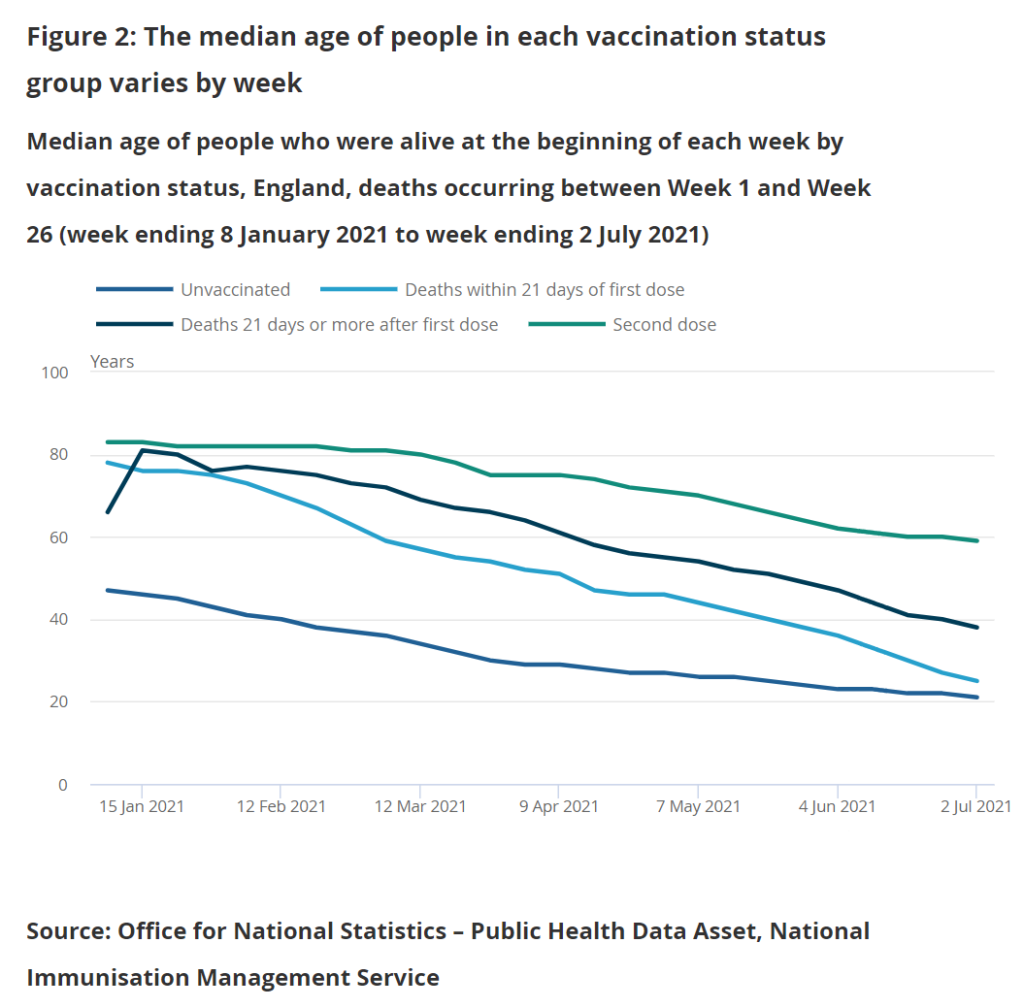
Graphic:

Excerpt:

Age-standardised mortality rates are calculated for vaccination status groups using the Public Health Data Asset (PHDA) dataset. The PHDA is a linked dataset combining the 2011 Census, the General Practice Extraction Service (GPES) data for pandemic planning and research, and the Hospital Episode Statistics (HES). We linked vaccination data from the National Immunisation Management Service (NIMS) to the PHDA based on NHS number, and linked data on positive coronavirus (COVID-19) Polymerase Chain Reaction (PCR) tests from Test and Trace to the PHDA, also based on NHS number.

The PHDA dataset contains a subset of the population and allows for analyses to be carried out that require a known living population with known characteristics. These characteristics include age-standardised mortality rates (ASMRs) by vaccination status and the use of variables such as health conditions and census characteristics.

Author(s): UK government, ONS

Publication Date: Accessed 27 Sept 2021

Publication Site: Office of National Statistics

Thousands more people than usual are dying … but it’s not from Covid

Link:https://www.yahoo.com/news/analysis-thousands-more-usual-dying-170117640.html

:

Excerpt:

While focus remains firmly fixed on Covid-19, a second health crisis is quietly emerging in Britain. Since the beginning of July, there have been thousands of excess deaths that were not caused by coronavirus.

According to health experts, this is highly unusual for the summer. Although excess deaths are expected during the winter months, when cold weather and seasonal infections combine to place pressure on the NHS, summer generally sees a lull.

….

Data from Public Health England (PHE) shows that during that period there were 2,103 extra death registrations with ischemic heart disease, 1,552 with heart failure, as well as an extra 760 deaths with cerebrovascular diseases such as stroke and aneurysm and 3,915 with other circulatory diseases.

Acute and chronic respiratory infections were also up with 3,416 more mentions on death certificates than expected since the start of July, while there have been 1,234 extra urinary system disease deaths, 324 with cirrhosis and liver disease and 1,905 with diabetes.

Alarmingly, many of these conditions saw the biggest drops in diagnosis in 2020, as the NHS struggled to cope with the pandemic.

Author(s): Sarah Knapton

Publication Date: 24 Sept 2021

Publication Site: Yahoo News

COVID-19 Scenario Modeling Hub: Projections

Link:https://covid19scenariomodelinghub.org/viz.html

Graphic:

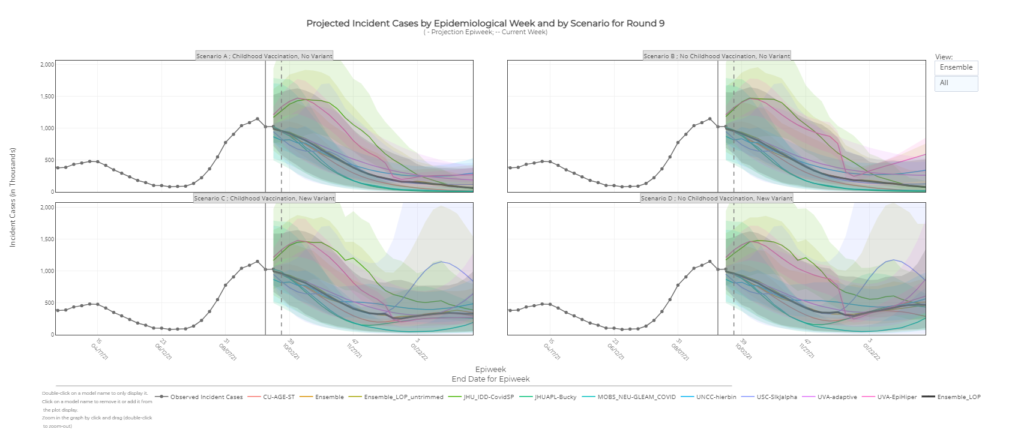
Excerpt:

Definitions

NPI: NonPharmaceutical Interventions (e.g. masks, social distancing)
Epiweek: Epidemiological Week as defined by MMWR
LOP: Linear Opinion Pool; method used to calculate Ensemble_LOP and Ensemble_LOP_untrimmed by averaging cumulative probabilities of a given value across submissions. See Notes for more details.

Publication Date: Accessed 24 Sept 2021

Publication Site: COVID-19 Scenario Modeling Hub

Is The Worst Over? Models Predict A Steady Decline In COVID Cases Through March

Link:https://www.npr.org/sections/health-shots/2021/09/22/1039272244/is-the-worst-over-modelers-predict-a-steady-decline-in-covid-cases-through-march?utm_source=facebook.com&utm_term=nprnews&utm_campaign=npr&utm_medium=social

Graphic:

Excerpt:

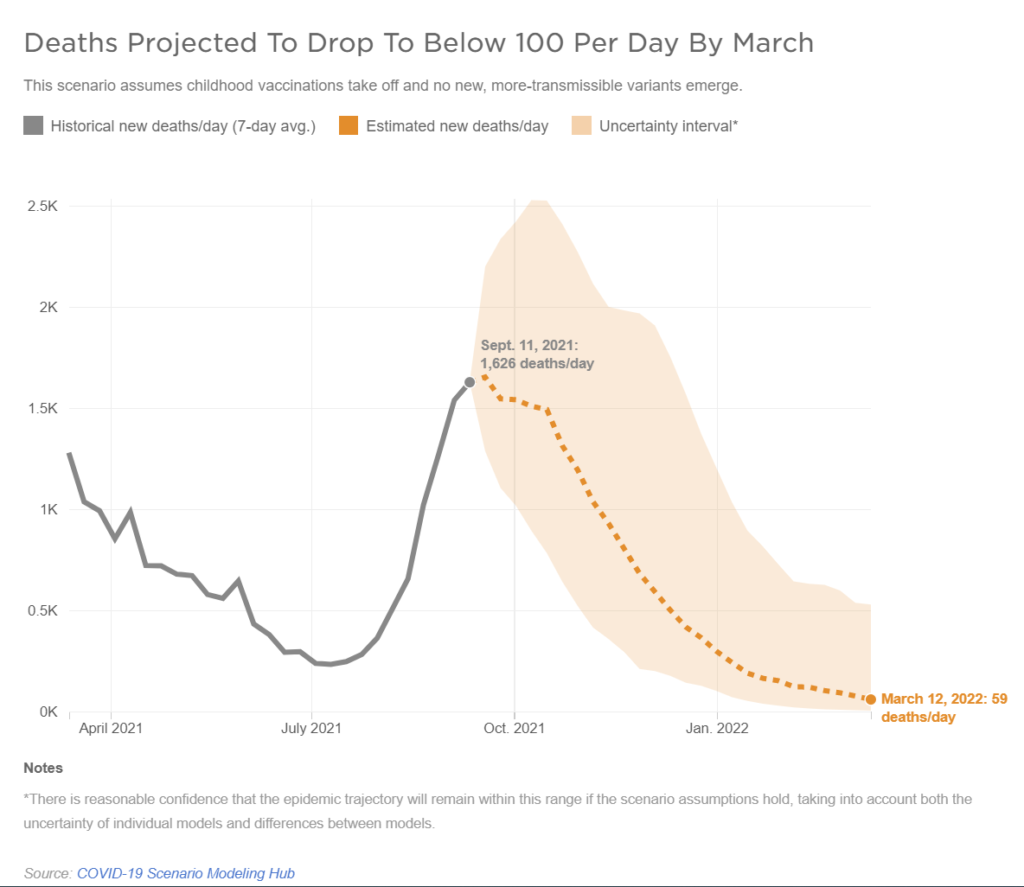
The most likely scenario, says Lessler, is that children do get vaccinated and no super-spreading variant emerges. In that case, the combo model forecasts that new infections would slowly, but fairly continuously, drop from about 140,000 today now to about 9,000 a day by March.

Deaths from COVID-19 would fall from about 1,500 a day now to fewer than 100 a day by March 2022.

That’s around the level U.S. cases and deaths were in late March 2020 when the pandemic just started to flare up in the U.S. and better than things looked early this summer when many thought the pandemic was waning.

And this scenario projects that there will be no winter surge, though Lessler cautions that there is uncertainty in the models and a “moderate” surge is still theoretically possible.

There’s wide range of uncertainty in the models, he notes, and it’s plausible, though very unlikely, that cases could continue to rise to as many as 232,000 per day before starting to decline.

Author(s): Rob Stein, Carmel Wroth

Publication Date: 22 Sept 2021

Publication Site: NPR

Covid-19: Life expectancy is down but what does this mean?

Link:https://www.bbc.com/news/health-58659717

Graphic:

Excerpt:

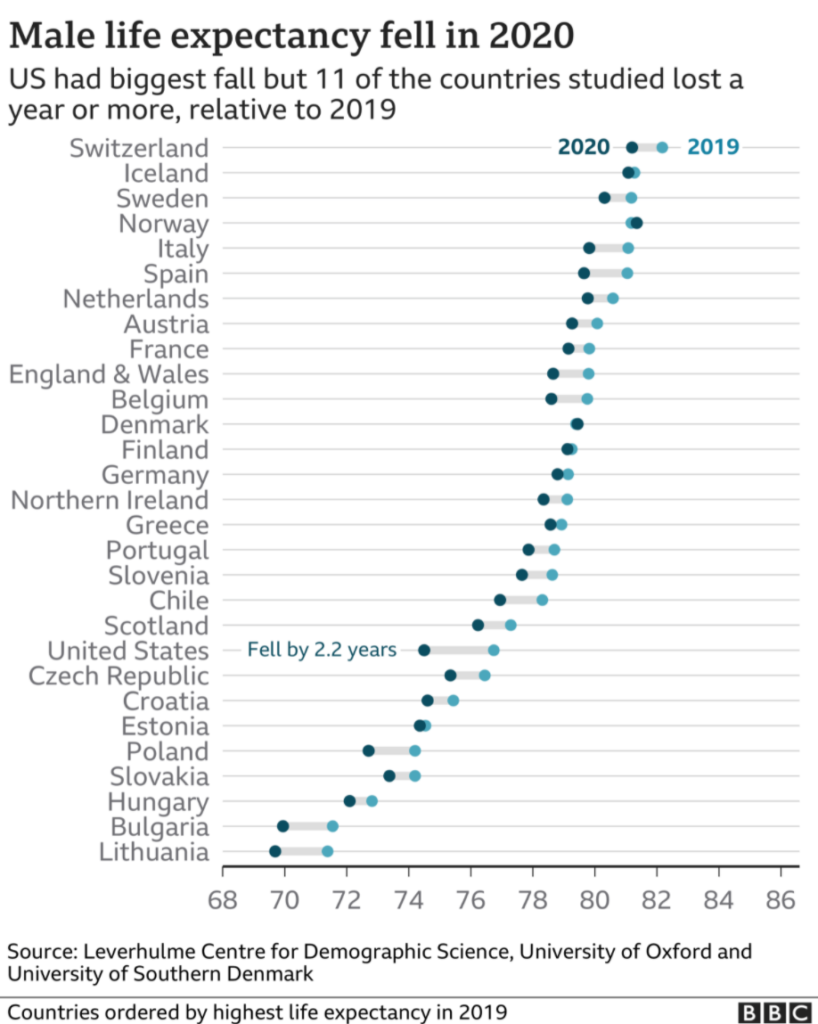
Despite the name, these life expectancy figures, known as “period life expectancy”, do not predict an actual lifespan.

Instead, they show the average age a newborn would live to if current death rates continued for their whole life.

And as Covid death rates are unlikely to continue long-term, the new estimates do not mean a boy born in 2020 will have a shorter life than one born in 2019.

But they do provide a snapshot of the effect of the pandemic that can be compared over time and between countries and different populations.

Author(s): Christine Jeavans

Publication Date: 23 Sept 2021

Publication Site: BBC

Murder Rose by Almost 30% in 2020. It’s Rising at a Slower Rate in 2021.

Link: https://www.nytimes.com/2021/09/22/upshot/murder-rise-2020.html

Graphic:

Excerpt:

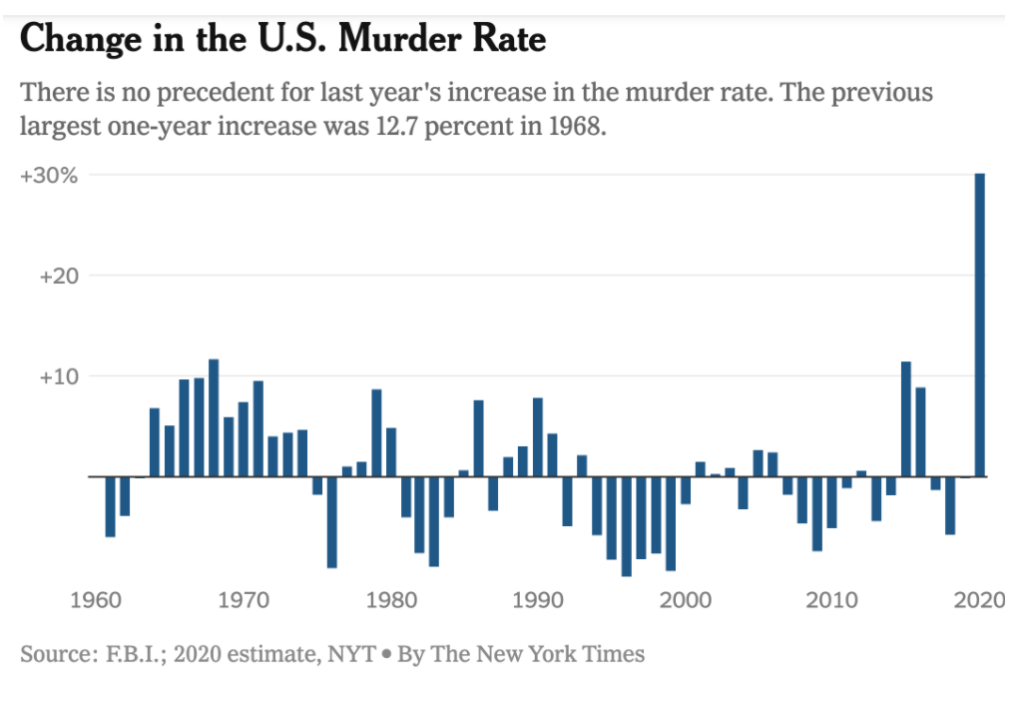
Previously, the largest one-year increase in total number of murders was 1,938 in 1990. The F.B.I. data shows almost 5,000 more murders last year than in 2019, for a total of around 21,500 (still below the particularly violent era of the early 1990s).

The reasons for the rise may never be fully sorted out, but analysts have pointed to many possible contributing factors, including various pandemic stresses; increased distrust between the police and the public after the murder of George Floyd, including a pullback by the police in response to criticism; and increased firearm carrying.

About 77 percent of reported murders in 2020 were committed with a firearm, the highest share ever reported, up from 67 percent a decade ago.

The change in murder was widespread — a national phenomenon and not a regional one. Murder rose over 35 percent in cities with populations over 250,000 that reported full data.

Author(s): Jeff Asher

Publication Date: 22 Sept 2021

Publication Site: NY Times

Europe’s Covid-19 Vaccination Success Faces Winter Test

Link: https://www.wsj.com/articles/europes-covid-19-vaccination-success-faces-winter-test-11632303001?mod=djemwhatsnews

Excerpt:

Europe has pushed ahead of the U.S. in vaccinating its citizens and has experienced a summer of relatively subdued Covid-19 caseloads, hospitalizations and deaths, despite the spread of the Delta variant.

Deaths from Covid-19 in the European Union averaged around 525 over the seven days through Tuesday and around 140 in the U.K. In January, daily deaths peaked at 3,500 in the EU and around 1,200 in the U.K., according to national data compiled by the University of Oxford’s Our World in Data project.

Adjusted for population, EU deaths equate to around 1.2 per million a day, and U.K. deaths to 2.1 per million. That compares with 6.1 per million currently in the U.S.

The difference reflects wider vaccine coverage, especially of older and high-risk groups. The 27 countries of the EU have fully vaccinated 61% of the bloc’s 448 million population, compared with 55% in the U.S., according to data from the U.S. Centers for Disease Control and Prevention and its EU counterpart. Big EU nations picked up the vaccination pace after a slow start this year. France has fully vaccinated 67% of its population, Germany 63% and Italy 66%. The U.K., which left the EU in 2020, has fully vaccinated 66% of its residents.

Author(s): Jason Douglas in London, Erin Delmore in Berlin and Eric Sylvers in Milan

Publication Date: 22 Sept 2021

Publication Site: Wall Street Journal

Mega trend 10: The democratization of longevity

Link: https://www.clubvita.us/news-and-insights/mega-trend-10-the-democratization-of-longevity

Graphic:

Excerpt:

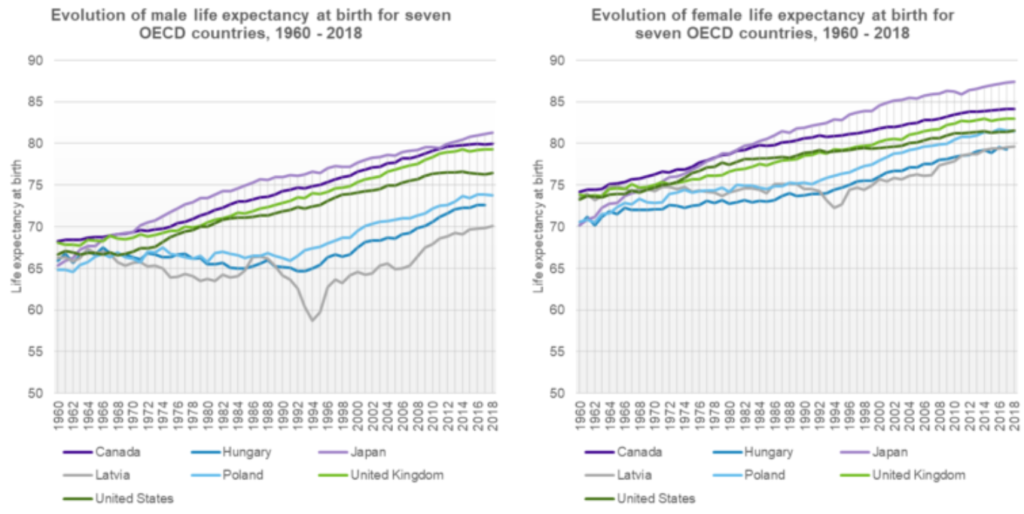
Illustrated below is the evolution of life expectancy at birth for seven Organization for Economic Co-operation and Development (OECD) countries: Canada, Hungary, Japan, Latvia, Poland, the United Kingdom, and the United States. Across the seven countries, male life expectancy at birth ranged from 64.8 years to 68.2 years in 1960, and 69.8 years to 81.1 years in 2017, demonstrating an increase in the inequality of life expectancy of almost eight years between these countries over the period. For females, the increase was approximately four years. The inequality in life expectancy is more apparent and unsettling if we consider, for example, developing countries in Africa, averaging a life expectancy of around 63 years in 2019.

….

Altogether, I believe greater democratization of longevity is achievable with the adoption of health technologies, while ensuring they are accessible and affordable. I am hopeful but I see several challenges ahead. Such a reality will be reliant on governments, health care professionals, and patients’ acceptance and reliance on what the future of health holds. It will also require global partnerships to build out ecosystems that will facilitate inclusive innovation.

Author(s): Shantel Aris

Publication Date: 22 Sept 2021

Publication Site: Club Vita