Vaccinated vs Not vaccinated

Link: https://covidmitigationmonitoring.wordpress.com/2021/09/13/vaccinated-vs-not-vaccinated/

Graphic:
Excerpt:

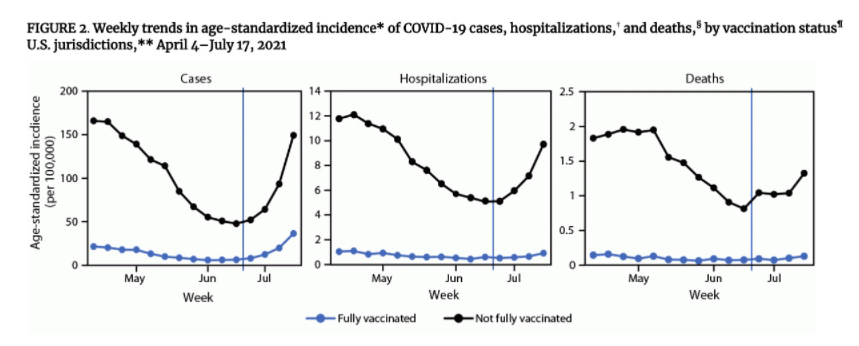
Here is a fairly clear picture from the CDC of the impact of vaccination on infections (cases), Hospitalizations and Deaths, through July. You can see here that infections are increasing for vaccinated people, hospitalizations and deaths are increasing also, but to a much lesser degree. In all cases, the fully vaccinated people are experiencing infections, hospitalizations, and deaths at a much lower level than the Not Fully Vaccinated people.

That is the message we keep hearing, but I find that this picture tells the story better than the words.

Publication Date: 13 Sept 2021

Publication Site: Covid Mitigation Monitoring Project
What the Delta variant did to South-East Asia

Link: https://www.economist.com/asia/what-the-delta-variant-did-to-south-east-asia/21804360

Graphic:

Excerpt:

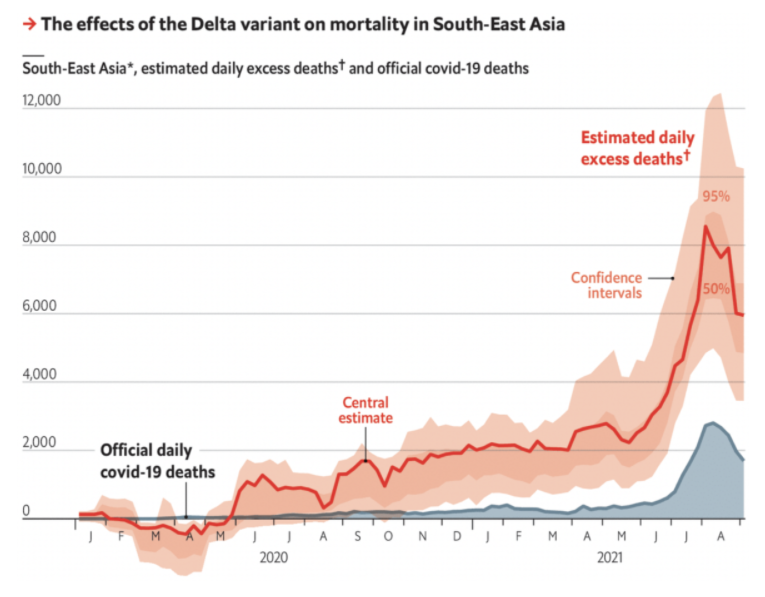
As news circulated of a worrying new virus spreading in the Chinese city of Wuhan in the early days of 2020, experts worried that infections would quickly reach South-East Asia and overwhelm the region’s health-care systems. Thailand was one of the main destinations for Chinese tourists; the first case outside China was reported there on January 13th, 2020. The first known death from covid-19 outside China occurred in the Philippines. A Chinese tourist who had visited Indonesia from Wuhan tested positive on returning home, suggesting he took the virus on holiday with him.

Yet it was Iran and Italy that became the first global hotspots. America, the rest of Europe and Brazil were soon engulfed. India got walloped. All through 2020 and the early part of this year, South-East Asia remained relatively unscathed. By the start of June, the region of 668m people had reported fewer than 77,000 deaths from the disease. Britain, with a tenth as many people, had chalked up more than 128,000. South-East Asia, it seemed, had escaped the worst of the pandemic.

Publication Date: 7 Sept 2021

Publication Site: The Economist

Applying Predictive Analytics for Insurance Assumptions—Setting Practical Lessons

Graphic:

Excerpt:

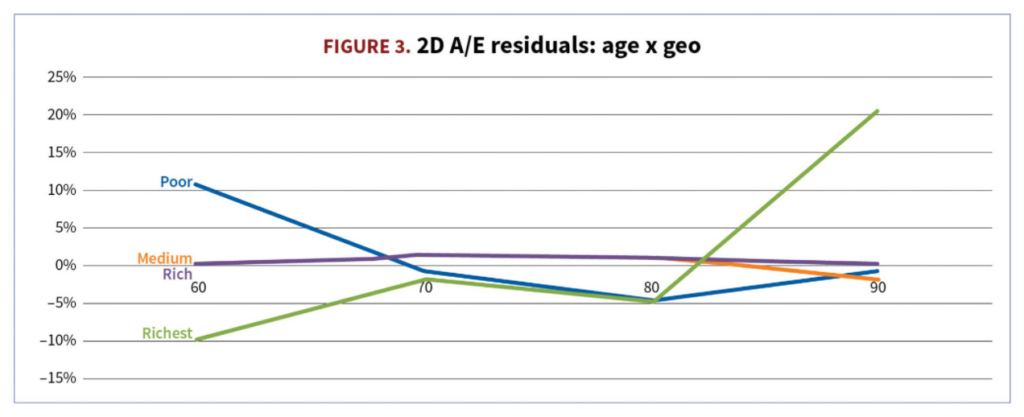
3. Identify pockets of good and poor model performance. Even if you can’t fix it, you can use this info in future UW decisions. I really like one- and two-dimensional views (e.g., age x pension amount) and performance across 50 or 100 largest plans—this is the precision level at which plans are actually quoted. (See Figure 3.)

What size of unexplained A/E residual is satisfactory at pricing segment level? How often will it occur in your future pricing universe? For example, 1-2% residual is probably OK. Ten to 20% in a popular segment likely indicates you have a model specification issue to explore.

Positive residuals mean that actual mortality data is higher than the model predicts (A>E). If the model is used for pricing this case, longevity pricing will be lower than if you had just followed the data, leading to a possible risk of not being competitive. Negative residuals mean A<E, predicted mortality being too high versus historical data, and a possible risk of price being too low.

Author(s): Lenny Shteyman, MAAA, FSA, CFA

Publication Date: September/October 2021

Publication Site: Contingencies

Why Are Pedestrian Deaths at Epidemic Levels?

Link: https://www.governing.com/now/why-are-pedestrian-deaths-at-epidemic-levels

Graphic:

Excerpt:

For years, transportation consultant and writer Angie Schmitt has tried to pick apart why it works that way and how the U.S. could become a less car-centric and less dangerous place. In 2020 she published Right of Way: Race, Class, and the Silent Epidemic of Pedestrian Deaths in America, an examination of the toll that the nation’s auto-centric infrastructure takes on those who are not encased in steel and glass when they travel.

Schmitt found that even as reported rates of walking among Americans have been on the decline, pedestrian deaths have surged in recent years. Between 2009 and 2019, total driving miles increased by 10 percent but pedestrian deaths increased by 50 percent. In Europe, by contrast, they fell by 36 percent over the last decade. Since then, the U.S. toll has only grown worse.

…..

Schmitt: Design is important, but I think we also need to change cars. We can go a lot of the way there just with better vehicle safety regulations. The RAND Corporation estimated we could be saving at least 10,000 lives a year, maybe 20,000, if we were requiring some existing vehicle technologies in all cars like automatic emergency braking. Or blind spot detection and alcohol ignition interlocks. A combination of things like that already exists, and we could save tens of thousands of lives. We’re just not doing it. There’s been so little attention paid, it’s been hard to generate political will.

Author(s): Jake Blumgart

Publication Date: 23 July 2021

Publication Site: Governing

Social Security: Benefit Terminations and the Trust Fund Running out

Link: https://marypatcampbell.substack.com/p/social-security-benefit-terminations

Graphic:

Excerpt:

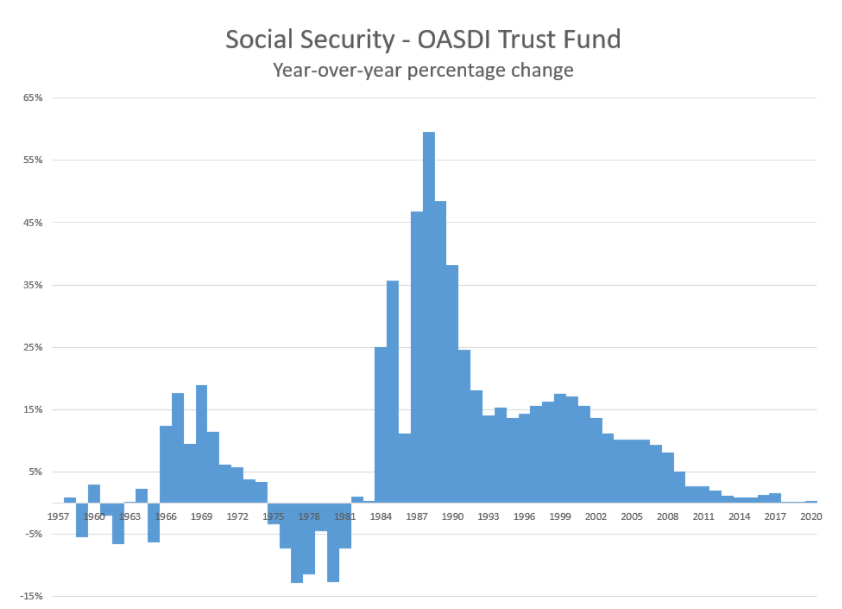
Through the mechanism of the Trust Fund, Congress can put off having to act on the fundamental demographic problem that they can’t do much about. They hope they can run the Magic Money Machine to cover all the goodies they want, and in 2034, the Boomers will mostly be over age 80. Maybe another pandemic will deal with them….

(and nobody cares about us Gen Xers. In 2034, I won’t even be eligible for Social Security old age benefits.)

Nobody expects the Social Security benefits to be cut in 2034, or whatever other magic date when the Trust Fund runs out. The only thing the current Trust Fund mechanism requires is cuts… only if Congress doesn’t actually pass legislation to “fix” the issue.

They have been doing ad hoc “fixes” to Medicare and other parts for years so as to avoid massive cuts.

Author(s): Mary Pat Campbell

Publication Date: 6 September 2021

Publication Site: STUMP at substack

A Call for More Proportionality in Pandemic Coverage

Link: https://dicktofel.substack.com/p/a-call-for-more-proportionality-in

Excerpt:

My late wife spent the last two and half years of her life in a nursing home with a form of early onset dementia. While she was in her fifties, almost everyone else there was elderly. In each of the three winters she was in the home, the place was closed to visitors at some point because of flu. This added heartbreak to heartbreak, but it was entirely reasonable. Nearly three in four flu deaths in the last pre-pandemic season occurred among seniors. Someone aged 65 or more who contracted the flu had a chance of dying of it of about one in 120. (By contrast, while more than 85% of the breakthrough deaths are among those over 65, the COVID death rate for fully vaccinated seniors is one in about 25,000.)

That is to say that the risk of death from flu in a nursing home was almost a thousand times as large as the risk of death from COVID to the overall vaccinated population, and the risk of dying from the flu if you caught it as a senior was more than 200 times greater than the risk from COVID if you are currently disease-free, similarly aged and fully vaccinated.

Author(s): Richard J. Tofel

Publication Date: 2 September 2021

Publication Site: Second Rough Draft

The pandemic’s true death toll

Link: https://www.economist.com/graphic-detail/coronavirus-excess-deaths-estimates

Graphic:

Excerpt:

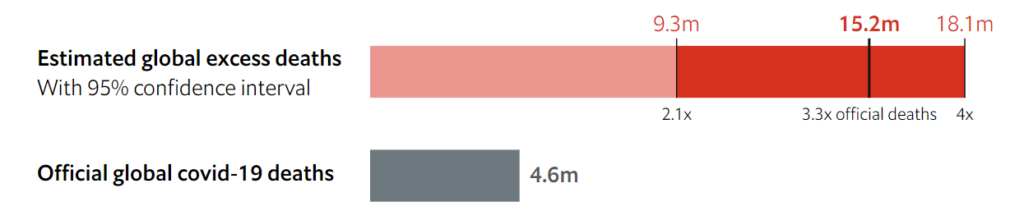
ow many people have died because of the covid-19 pandemic? The answer depends both on the data available, and on how you define “because”. Many people who die while infected with SARS-CoV-2 are never tested for it, and do not enter the official totals. Conversely, some people whose deaths have been attributed to covid-19 had other ailments that might have ended their lives on a similar timeframe anyway. And what about people who died of preventable causes during the pandemic, because hospitals full of covid-19 patients could not treat them? If such cases count, they must be offset by deaths that did not occur but would have in normal times, such as those caused by flu or air pollution.

Publication Date: updated 4 September 2021

Publication Site: The Economist

Florida Alters COVID-19 to Show Artificial Decline in Deaths

Link: https://www.governing.com/now/florida-alters-covid-19-to-show-artificial-decline-in-deaths

Excerpt:

The downloadable data sets on cases and deaths included the report date as well as the date a person died or got sick, allowing journalists and independent researchers to select the best metric for their purposes. The daily reports showed additional cases and deaths added from one day to the next.

In June, as case numbers dropped and vaccination rates continued to rise, the health department discontinued the dashboard and changed to a weekly report. The only near-daily data was submitted by the health department to the CDC and published on the CDC Trend Tracker website.

At first, the data on the CDC website was updated in a largely predictable manner, similar to the way that the DOH had reported daily changes throughout the pandemic. Then on Aug. 10, without warning or any explanation from the health department or the CDC, the data for nearly every day of the previous year changed. Neither agency immediately explained the changes.

Author(s): Sarah Blaskey, Ana Claudio Chacin and Devoun Cetoute, McClatchy Washington Bureau

Publication Date: 31 August 2021

Publication Site: Governing

Every State’s COVID Numbers in Context, August 2021

Link: https://polimath.substack.com/p/every-states-covid-numbers-in-context-cf7

Graphic:

Excerpt:

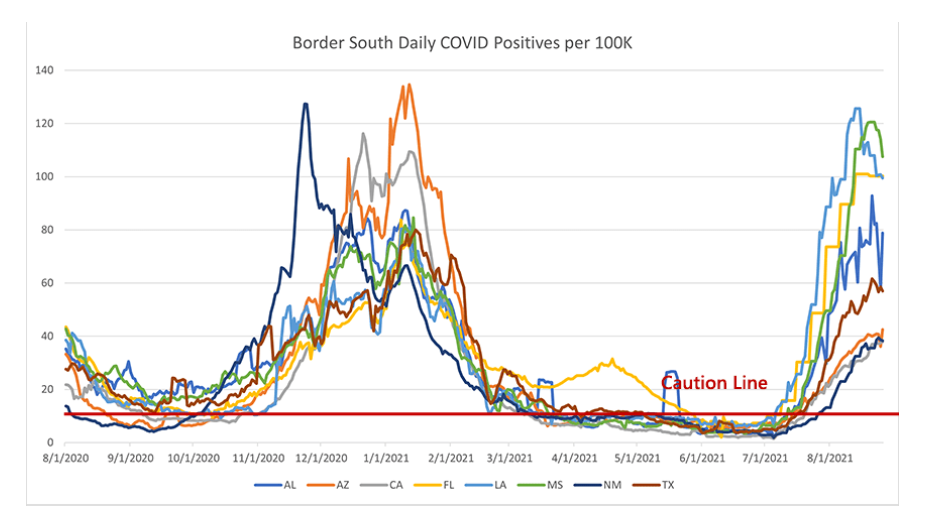
This region has been the tough one. It looks like we’re on the other side of the case surge in the worst hit states (LA, MS, FL, AL). Daily cases went up much higher than I would have expected, even higher than the winter surge. What has been truly surprising is that Florida is substantially more vaccinated than those other states, about 15-20% higher in adult vaccination and up at 95% vaccinated for seniors. That should shrink their pool of COVID-vulnerable individuals massively and reduce their death rate substantially.

And, while Florida’s death rate is lower than LA and MS, it’s not nearly at the levels we would have hoped or expected. I’m at a loss to explain this. Certain proposals have been tossed around: Florida is an older state, so more of their population is vulnerable. But their vaccination rates (nearly universal coverage among the elderly!) really should suppress this enormously. If a particular age group had +90% vaccination rates, I would expect that group’s COVID deaths to be reduced by at least 70%. Instead, the elderly are still making up the vast majority of COVID deaths in Florida.

Author(s): PoliMath, aka Matt Shapiro

Publication Date: 31 August 2021

Publication Site: Marginally Compelling at substack

Final Report of the Activities of 2019 HMD Project

Link: https://www.soa.org/resources/research-reports/2021/activities-2019-hmd-project/

Full paper:

Graphic:

Excerpt:

Work accomplished under the 2019 agreement between the Human Mortality Database (HMD) team and the
Society of Actuaries (SOA) was divided between two main projects: 1) the continuous development of the United
States Mortality Database (USMDB) and 2) the publication of cause-specific mortality series for selected HMD
countries. Due to administrative delays at both the University of California, Berkeley, and the Society of Actuaries,
work on these projects did not begin until July 2019. Furthermore, due to restriction in data access associated with
the Covid-19 pandemic, a no-cost extension was requested by Magali Barbieri, the Principal Investigator for the
projects, and accepted by the SOA to extend the project beyond the initial December 31, 2019 deadline.

Author(s): Magali Barbieri, Ph.D University of California-Berkeley

Publication Date: August 2021

Publication Site: Society of Actuaries

New NY governor adds 12,000 deaths to publicized COVID tally

Link: https://apnews.com/article/andrew-cuomo-health-coronavirus-pandemic-7312b49695e726eda8d59848e82271c5

Excerpt:

Delivering another blow to what’s left of former Gov. Andrew Cuomo’s legacy, New York’s new governor acknowledged on her first day in office that the state has had nearly 12,000 more deaths from COVID-19 than Cuomo told the public.

“The public deserves a clear, honest picture of what’s happening. And that’s whether it’s good or bad, they need to know the truth. And that’s how we restore confidence,” Gov. Kathy Hochul said on NPR.

In its first daily update on the outbreak Tuesday evening, Hochul’s office reported that nearly 55,400 people have died of the coronavirus in New York based on death certificate data submitted to the Centers for Disease Control and Prevention.

That’s up from about 43,400 that Cuomo reported to the public as of Monday, his last day in office. The Democrat who was once widely acclaimed for his leadership during the COVID-19 outbreak resigned in the face of an impeachment drive after being accused of sexually harassing at least 11 women, allegations he disputed.

The higher number is not entirely new. Federal health officials and some academic institutions tracking COVID-19 deaths in the U.S. have been using the higher tally for many months because of known gaps in the data Cuomo had been choosing to publicize.

Author(s): MARINA VILLENEUVE

Publication Date: 25 August 2021

Publication Site: AP News

Five truths about covid that defy our intuitions

Excerpt:

1. If a large share of hospitalised people are vaccinated, that’s a sign of success. It has been common to see headlines noting that a substantial minority of people who have been hospitalised or even killed by Covid have been fully vaccinated. These numbers suggest vaccine failure is alarmingly common. The fallacy only becomes clear at the logical extremes: before vaccines existed, everyone in hospital was unvaccinated; if vaccines were universal, then everybody in hospital would be vaccinated. Neither scenario tells us whether the vaccines work.

So try this. Imagine that 1 per cent of the unvaccinated population will end up in hospital with Covid over a given time period. In a city of a million people, that would be 10,000 hospital stays. Now let’s say that 950,000 people get fully vaccinated, that the vaccine is 95 per cent effective against hospitalisation, and that the vaccine doesn’t reduce transmission (although it does). Here’s the arithmetic: 500 of the 50,000 unvaccinated people end up in hospital. A total of 9,500 of the vaccinated people would be at risk of a hospital visit, but the vaccine saves all but 5 per cent of them. These unlucky 475 still go to hospital. The hospital contains 500 unvaccinated and 475 vaccinated people — almost half and half — which makes it seem as though the vaccine barely works. Yet when 95 per cent of people take a 95 per cent effective vaccine, hospital visits fall from 10,000 to fewer than 1,000.

Author(s): Tim Harford

Publication Date: 19 August 2021

Publication Site: TimHarford.com