Wrong Way CalPERS Increased Private Equity Allocation by Over 50% as Investors Are Dumping Holdings

Link: https://www.nakedcapitalism.com/2022/08/wrong-way-calpers-increased-private-equity-allocation-by-over-50-as-investors-are-dumping-holdings.html

Excerpt:

CalPERS is so reliably bad at market timing that the giant fund serves as a counter indicators. Last fall, CalPERS increased its allocation to private equity from 8% of its total portfolio to 13%, which is an increase of over 50%. This is after this humble blog, regularly citing top independent experts, pointed out that the investment raison d’etre for private equity had vanished in the 2006-2008 time frame, not once, but many many times as various studies kept confirming that finding. Not only did private equity no longer earn enough to compensate for its much higher risks (leverage and illiquidity) but it was no longer beating straight up large cap equities.

Now there is a way out of this conundrum: to bring private equity in house. Private equity fees and costs are so egregious (an estimated 7% per annum) that even a bit of underperformance relative to private equity indexes will be more than offset by greatly lower fees. A simpler option would be public market replication of private equity.

But the dogged way funds like CalPERS stick to private equity points to rank corruption, of the sort that landed CalPERS former CEO Fred Buenrostro in Federal prison for four and a half years.

…..

Another problem is cash flow management. Private equity funds do not take investor money at closing. Instead, investors get “capital calls” to pony up part of their commitment to the fund so the fund manager can buy a company. These capital calls require the dough to be sent as specified in the offering memorandum, usually in five to ten days. The consequences of missing a capital call are draconian. The fund manager can seize all the investments made so far and distribute them to the other limited partners.

In the financial crisis, CalPERS had too little cash on hand to meet private equity capital calls. It wound up dumping stocks at distressed prices to satisfy the private equity demands. So the risk outlined below is real.

Author(s): Yves Smith

Publication Date: 9 Aug 2022

Publication Site: naked capitalism

Citizens must be accurately informed for government to work

Link: https://www.news-gazette.com/opinion/columns/sheila-weinberg-citizens-must-be-accurately-informed-for-government-to-work/article_5d93e9cf-73c5-54c9-b762-133f91a94824.html

Excerpt:

An example of questionable disclosure practices is found in the Illinois budgeting and financial reporting process, specifically regarding pension contributions. In 1994, then-Gov. Jim Edgar led an effort to pass a bipartisan bill to solve the state’s $15 billion pension deficit. The plan would resolve the deficit within 50 years. The plan was structured to pay down the debt very slowly in the first 15 years and accelerate at the end. This ensured that sitting politicians in the early days of the plan would not be required to make the necessary tax increases or budget cuts to pay down the debt in a meaningful way.

This program is shown in charts to look like a skateboard ramp, appropriately named the “Edgar Ramp.” The problem is, the plan doesn’t work.

It is so unsuccessful that the Illinois pension deficit has grown from $15 billion to $317 billion as of June 30, 2020, according to Moody’s Investors Service. The state’s latest bond offering document emphasizes, “The state’s contributions to the retirement systems, while in conformity with state law, have been less than the contributions necessary to fully fund the retirement systems as calculated by the actuaries of the retirement systems.”

The latest Illinois Annual Comprehensive Financial Report discloses cash-flow problems, significantly underfunded pension obligations, other post-retirement benefit deficits and multiple references to debt-obligation bonds.

Author(s): Shiela Weinberg

Publication Date: 7 Aug 2022

Publication Site: News Gazette

The Government Pension Reckoning Cometh

Link: https://www.wsj.com/articles/the-government-pension-reckoning-cometh-equable-institute-report-11660084312?st=j8a7o7efyyvjtdp&reflink=article_email_share&utm_source=Wirepoints+Newsletter&utm_campaign=24f39fc2e0-RSS_EMAIL_CAMPAIGN&utm_medium=email&utm_term=0_895ee9abf9-24f39fc2e0-30506353#new_tab

Excerpt:

The California Public Employees’ Retirement System reported a negative 6.1% return for the year, which includes a 21.3% positive return on private equity and 24.1% return on real estate as reported through the second quarter of 2022. What will happen if real-estate prices start to fall and some leveraged private-equity buyouts go south amid rising interest rates?

Collective-bargaining agreements limit how much workers must contribute to their pensions, so taxpayers are required to make up for investment losses. Employer retirement contributions—that is, taxpayers—make up 20% of government worker compensation. That amount has soared over the past decade as pension funds tried to make up for losses during the 2008-2009 financial panic.

A recent report by the Equable Institute found that state and local pension plans now are only 77.9% funded on average, which is about the same as in 2008. But some like Chicago’s are less than 40%. Advice to taxpayers in Illinois: Run.

Author(s): WSJ Editorial Board

Publication Date: 9 Aug 2022

Publication Site: WSJ

Ken Griffin talks the pension crisis, a once-secret meeting with Pritzker

Link: https://www.chicagotribune.com/opinion/commentary/ct-opinion-ken-griffin-illinois-pension-jb-pritzker-desantis-20220809-jnrzlzbpvbfcnjauz522qcvi4m-story.html?utm_source=Wirepoints+Newsletter&utm_campaign=24f39fc2e0-RSS_EMAIL_CAMPAIGN&utm_medium=email&utm_term=0_895ee9abf9-24f39fc2e0-22956053

Excerpt:

Ken Griffin, founder and CEO of Citadel, spoke in his Chicago office to Editorial Page Editor Chris Jones on Aug. 2. This transcript has been edited for length.

Gov. J.B. Pritzker has said you and he met privately and that you agreed to drop your opposition to his graduated tax proposal if he took on pension reform in Illinois. True?

The Illinois pension crisis is rooted in the issue that politicians of the moment are able to make promises to the public sector workers, where the cost of those promises are borne by taxpayers, far into the future. So we have an intrinsic lack of accountability within the state when it comes to that dynamic between the leaders in Springfield and the public sector unions. (Former Gov.) Bruce Rauner and I actually would speak about this problem from time to time because it’s pretty well known that Bruce felt the state should move to a defined contribution program for the state employees.

And there are elements of that I think are attractive, but because the state employees do not participate in Social Security, a strictly defined contribution proposal leaves the state employee, in my opinion, at undue risk of adverse events if they do not invest their money successfully. … And there’s another issue, which is that the costs of the promises made by cities and counties are not borne by the cities and counties directly, they’re socialized across the entire taxpayer base of the state. So it’s pretty easy for the behavior of a number of Illinois cities to offer incredible increases in pay in final years to boost pension benefits, and that cost comes back to all Illinois taxpayers.

So these are some of the areas in which the average man in the street is really being handed a very significant bill. And the most tragic part of this whole story is that when the state hires people early in their careers, they’re not even placing that much value on these pension plans.

Twenty-two-year-olds don’t make lifetime career decisions on pension benefits. So, from my perspective, as a state we’re much better off having higher starting salaries to attract really good people to serve in the public sector. And, as with Bruce, my advice to the governor was consistently that either the state should mirror the benefits of Social Security as a baseline or, even better, go back to the federal government and get into Social Security again. We should reverse our opt-out from decades ago. And then to the extent that a city wants to offer benefits in excess of the Social Security baseline amount, that’s pay-as-you-go through a 401(k)-equivalent program. …

The proposal that I gave to J.B. to solve the state’s pension problems is exactly what I just shared with you. … It would, in all likelihood, require us to amend the constitution for the state to head in this direction. It might be for new employees only. I’m very sensitive to a promise made and earned. That’s your benefit. That’s a very different talking point than you’re 22 years old and it’s your first day working for the state.

But, big picture, we get the state into a program that looks like what I just described. And it’s gonna accelerate, in all likelihood, the costs of the current system. It may require revenue increases.

And like many of the business leaders in this city, I was very direct. I said, “If you’re willing to engage in pension reform, I’m willing to publicly support you in a tax increase.” It wasn’t graduated versus not graduated. It was just a tax increase.

I would’ve assumed that this meeting would’ve been private for the rest of my life until J.B. decided to open the door and talk about this. What he did talk about in terms of fiscal reform for the state was to restructure the state’s (information technology) budget.

And he felt he could achieve $50 million in budget savings for the state of Illinois by taking an ax toward our IT budget for the state, and that was going to be his victory lap for fiscal discipline in the state of Illinois. Here we have a multibillion-dollar problem on the left and 50 million (dollars) on the right. I was like, “J.B., we’re not having the same conversation here.”

To be clear, that was a fracturing moment between the two of us. … He does not want to use his political capital for good. He wants to maintain that capital to maintain the certainty of staying in power.
Author(s): Chris Jones

Publication Date: 10 Aug 2022

Publication Site: Chicago Tribune

NY Woman Admits To Hiding Mom’s Death, Stealing $240K In Pension Benefits

Link: https://dailyvoice.com/new-york/northsalem/news/ny-woman-admits-to-hiding-moms-death-stealing-240k-in-pension-benefits/840187/

Excerpt:

A New York woman is facing prison time after admitting that she hid her mother’s death for years in order to steal hundreds of thousands of dollars in her teacher pension benefits.

Long Island resident Cynthia Rozzell, of Hempstead, pleaded guilty to second-degree grand larceny on Tuesday, Aug. 9.

Prosecutors said Rozzell concealed the death of her mother, Mary Garrett, and collected pension benefits issued to Garrett by the New York State Teachers’ Retirement System (NYSTRS) between May 2014 and May 2020.

…..

“Pension theft is not a victimless crime,” said New York Attorney General Letitia James. “By stealing her deceased mother’s pension benefits, Ms. Rozzell dishonored countless hardworking New Yorkers who have dedicated their lives to one of our most noble professions: teaching and enriching our youth.”

Author(s): Michael Mashburn

Publication Date: 9 Aug 2022

Publication Site: Daily Voice

The Teacher Retirement System of Texas needs to adjust its investment return assumptions

Link: https://reason.org/commentary/the-teacher-retirement-system-of-texas-needs-to-adjust-its-investment-return-assumptions/

Graphic:

Excerpt:

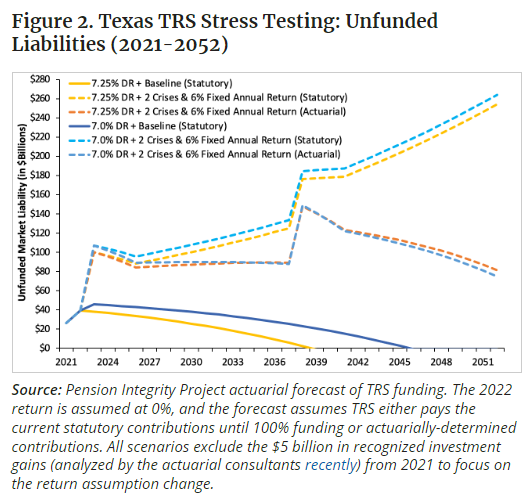
An adjustment of the assumed rate of return down to 7.0% means the plan will recalculate pension debt upwards in 2023, but will also be better positioned to avoid future debt growth over the longer run. The forecast in Figure 2 compares the growth of TRS’ unfunded liabilities under three scenarios: 

  1. Returns meet TRS assumptions;
  2. TRS experiences two major recessions over the next 30 years;
  3. And, TRS makes actuarially determined contributions (also using the two-recession scenario).

With this actuarial modeling of the system, it is clear that statutorily limited contributions will continue to pose funding risks for TRS that will be borne by Texas taxpayers. A proposed 7.0% assumed return will readjust 2023 unfunded liabilities upwards by $6.5 billion, but the plan will suffer fewer investment losses over the next 30 years when the plan inevitably experiences returns that diverge from expectations. TRS’ unfunded liabilities will remain elevated under the rigid statutorily-set contributions. If, however, TRS was to transition to Actuarially Determined Employer Contributions (ADEC) each year, then even by recognizing higher 2023 debt (under a 7.0% assumption) TRS could shave billions off its unfunded liabilities by 2052 ($74.7 billion down from $81.3 billion with current 7.25% assumption).  

Author(s): Anil Niraula, Zachary Christensen

Publication Date: 15 Jun 2022

Publication Site: Reason

Justice Department Ends Investigation of Pennsylvania PSERS

Link: https://www.ai-cio.com/news/justice-department-ends-investigation-of-pennsylvania-psers/

Excerpt:

The Department of Justice has dropped its investigation into the Pennsylvania Public School Employees’ Retirement System, said Chris Santa Maria, chairman of the $75.9 billion pension fund’s board of trustees, in a statement. PSERS made no further comment on the matter.

The pension fund had been under investigation by the Justice Department since at least May of last year, when subpoenas indicated that the FBI and prosecutors were seeking evidence of kickbacks and bribes at PSERS.

The subpoenas were reportedly looking for information from the pension fund, its executive director, chief financial officer, chief auditing officer and deputy CIO. The court orders reportedly showed that the FBI and prosecutors were probing possible “honest services fraud” and wire fraud.

….

According to a report released earlier this year following an internal investigation, PSERS investment consultant Aon took responsibility for the accounting error. The report includes a letter from Aon to Grossman that said the firm had become aware of data corruption in some sub-composite market values, cashflows and returns for April 2015.

Aon attributed the data corruption to an error by an analyst in uploading net asset value and cashflow data into the performance system it uses. The company said the data corruption impacted “a few asset class composites” in the public markets.

Author(s): Michael Katz

Publication Date: 3 Aug 2022

Publication Site: ai-CIO

What is the State of Pensions in 2022?

Link: https://www.truthinaccounting.org/news/detail/what-is-the-state-of-pensions-in-2022

Excerpt:

State retirement systems in America are still Fragile. 

….

Despite state and local plans reporting disappointing preliminary investment returns averaging -10.4% in 2022 , there has been a net positive funded ratio trend on net over the past three years. 

Funded status in 2022 for state and local retirement systems has declined considerably from last year, the sharpest single-year decline since the Great Recession and financial crisis. Investment return volatility is contributing to some significant swings in funded levels, which has been compounded by rising inflation and geopolitical turmoil. 

Author(s): Anthony Randazzo, Jonathan Moody

Publication Date: 26 July 2022

Publication Site: Truth in Accounting

Examining the Teachers Retirement System of Texas after the pension reforms of 2019

Link: https://reason.org/backgrounder/reason-review-trs-after-sb12/

Graphic:

Excerpt:

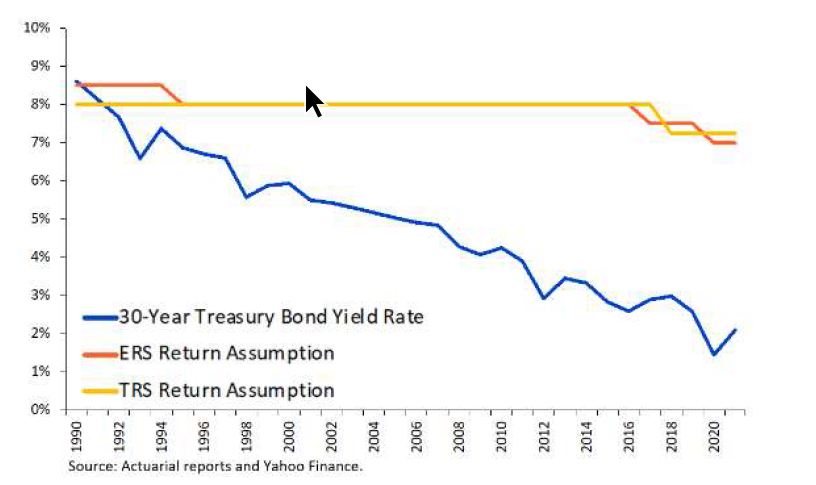
TRS currently uses a 7.25% assumed rate of return, which is on the higher end of investment return assumptions among major public systems.

The national average expected rate of return has fallen to 7.0% over the years, with major plans like CalPERS now lowering assumptions into the 6-7% range.

Despite SB12 (2019), with investment returns expected to underperform over the next decade relative to expectations, capping contribution rates in statute creates the perfect conditions for unfunded liabilities to keep accruing just as they have since 2001.

Author(s): Leonard Gilroy, Steven Gassenberger

Publication Date: 3 June 2022

Publication Site: Reason

Report: CT’s pension debt remains high despite residents’ personal wealth

Link: https://ctmirror.org/2022/08/02/report-ct-pension-debt-personal-income-high-eighth-worst-us/

Graphic:

Excerpt:

When Connecticut deposits roughly $4.1 billion into its pension funds this fall, it will mark the third consecutive year the state used its budget surplus to whittle down the massive pension debt accrued over more than seven decades.

But a recent analysis from The Pew Charitable Trusts provided a sobering reminder of just how far Connecticut still has to go — even considering its great wealth — to overcome decades of fiscal irresponsibility.

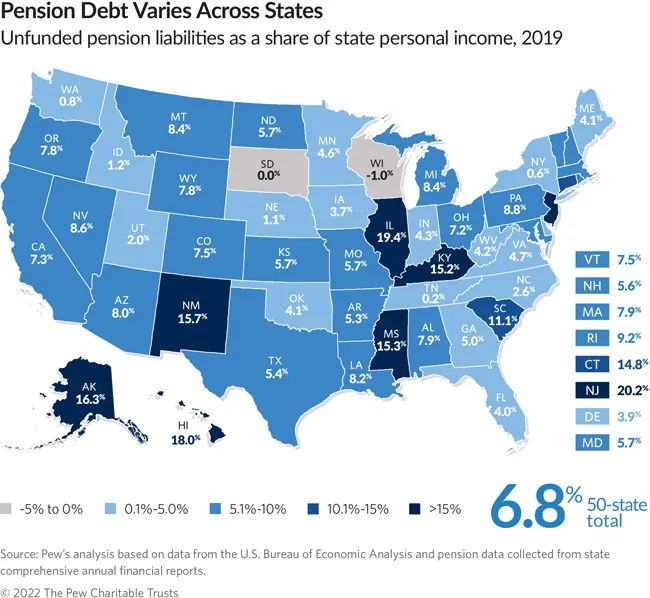
Connecticut had reported more than $41 billion in combined debt among its pensions for state employees and for teachers following the 2019 fiscal year. According to Pew, that represented 14.8% of Connecticut’s personal income at the time — more than double the national average of 6.8%.

Connecticut was one of just 10 states that topped the 10% mark, and ranked eighth-worst overall. New Jersey finished at the bottom with pension debt equal to 20.2% of statewide personal income.

Author(s): Keith Phaneuf

Publication Date: 2 Aug 2022

Publication Site: CT Mirror

Pension Plunge Puts Eric Adams in Future Financial Squeeze

Link: https://www.thecity.nyc/2022/8/1/23287828/pension-plunge-eric-adams

Excerpt:

New York City’s pension funds lost 8.65% of their value for the fiscal year that ended June 30, according to a release Friday from city Comptroller Brad Lander. 

While more detailed information won’t be released until September, the losses reduced the pension funds to about $240 billion.

While the S&P 500 stock index fell 14% in the first six months of 2022, Lander said that all is well with the pension funds “Despite market declines on a scale that hasn’t been seen in decades, the New York City retirement system outperformed our benchmarks and are well positioned to weather market volatility in the long run,” he said in a statement.

But the city budget — currently $101 billion — will still take a hit.

Author(s): Greg David

Publication Date: 1 Aug 2022

Publication Site: The City

Fortifying Main Street: The Economic Benefit of Public Pension Dollars in Small Towns and Rural America

Link: https://www.nirsonline.org/reports/mainstreet2022/

PDF: https://www.nirsonline.org/wp-content/uploads/2022/07/FINAL-compresses-fortifyingmainstreet2022_small-compressed.pdf

webinar:

Graphic:

Excerpt:

The report’s key findings are as follows:

  • Public pension benefit dollars represent between one and three percent of GDP on average in the 2,922 counties studied.
  • Rural counties have the highest percentages of their populations receiving public pension benefits.
  • Small town counties experience a greater relative impact in terms of both GDP and total personal income from pension benefit dollars than rural or metropolitan counties.
  • Rural counties see more of an impact in terms of personal income than metropolitan counties, while metropolitan counties and rural counties see an equivalent impact in terms of GDP.
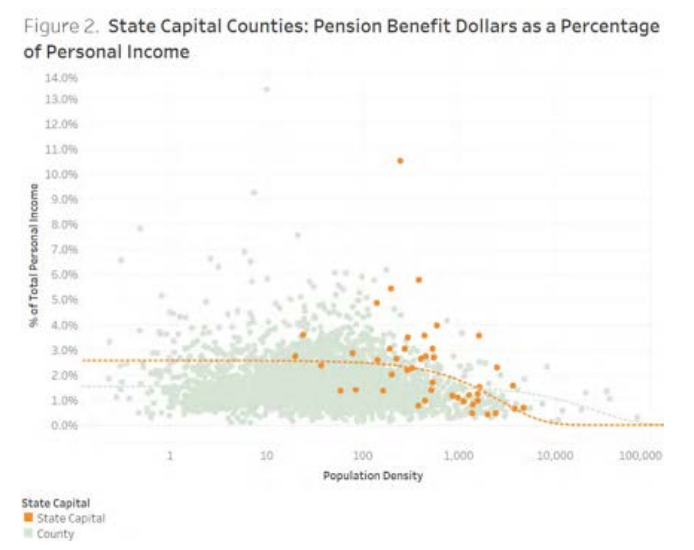
  • Counties that contain state capitals are outliers from other metropolitan counties, likely because there is a greater density of public employees in these counties, most of whom remain in these counties in retirement.
  • On average, rural counties have lost population while small town counties and metropolitan counties have gained population in the period between 2000 and 2018, but the connection between population change and the relative impact of public pension benefit dollars is weak.

Author(s): Dan Doonan and Tyler Bond from NIRS, Nathan Chobo from Linea Solutions Inc.

Publication Date: July 2022

Publication Site: National Institute on Retirement Security