Canadian Pension Giant Makes Its First Foray Into Colombian Private Equity

Link: https://www.ai-cio.com/news/canadian-pension-giant-makes-its-first-foray-into-colombian-private-equity/

Excerpt:

The C$539 billion ($431.7 billion) Canada Pension Plan Investment Board has invested $334 million to acquire a 19.3% stake in Colombia-based discount grocery store chain D1, formerly known as Koba Colombia. The deal marks the pension giant’s first direct private equity investment in the country.

D1, which first opened for business in 2009 and officially took on its new name last month, recently announced it has become Colombia’s main food retailer. Citing findings from Nielsen, the company said it had a 9.7% share in the retail market and a 74% share in the so-called “hard discount” sector at the end of 2021. D1 has over 2,000 stores and reported 2021 operating income of more than $10.9 billion, which was a 32% increase from 2020. It also said this year.

Author(s): Michael Katz

Publication Date: 14 July 2022

Publication Site: ai-CIO
CalPERS Cooks the Books While Taking an Unnecessary Loss to Exit $6 Billion of Private Equity Positions

Link: https://www.nakedcapitalism.com/2022/07/calpers-cooks-the-books-while-taking-an-unnecessary-loss-to-exit-6-billion-of-private-equity-positions.html

Excerpt:

CalPERS is up to its old crooked, value-destroying ways. Its sale of $6 billion in private equity positions, at a big discount….because CalPERS was in a hurry despite no basis for urgency, shows yet again the sort of thing the giant fund routinely does that puts it at the very bottom of financial returns for major public pension funds.

Oh, and on top of that, CalPERS admitted to Bloomberg that it is lying in its financial reports for the fiscal year just ended this June 30 by not writing down these private equity assets. As former board member Margaret Brown stated:

In Dawm Lim’s Bloomberg story, Calpers Unloads Record $6 Billion of Private Equity at Discount, CalPERS admits to cooking the books. Not recognizing the sale (the loss in value) in the same fiscal year can only be to play shenanigans with the rate of return. So if, or more likely when, CalPERS again does badly in comparison to CalSTRS and similar funds, remember it would be even worse if CalPERS was accounting honestly.

Author(s): Yves Smith

Publication Date: 8 July 2022

Publication Site: naked capitalism

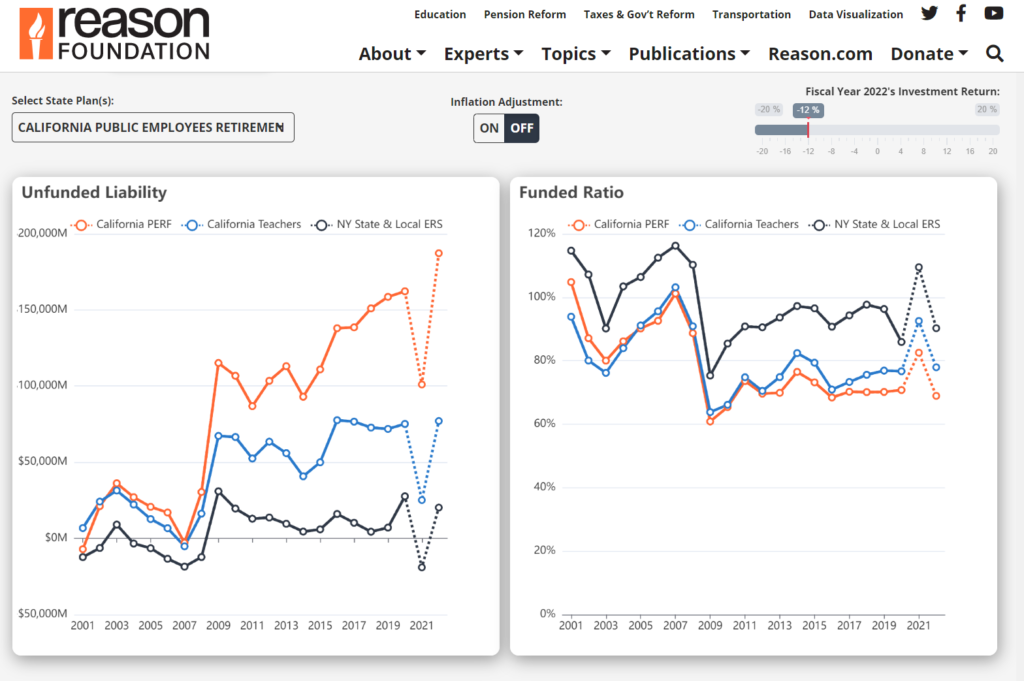
Unfunded public pension liabilities are forecast to rise to $1.3 trillion in 2022

Link: https://reason.org/data-visualization/2022-public-pension-forecaster/

Graphic:

Excerpt:

According to forecasting by Reason Foundation’s Pension Integrity Project, when the fiscal year 2022 pension financial reports roll in, the unfunded liabilities of the 118 state public pension plans are expected to again exceed $1 trillion in 2022. After a record-breaking year of investment returns in 2021, which helped reduce a lot of longstanding pension debt, the experience of public pension assets has swung drastically in the other direction over the last 12 months. Early indicators point to investment returns averaging around -6% for the 2022 fiscal year, which ended on June 30, 2022, for many public pension systems.

Based on a -6% return for fiscal 2022, the aggregate unfunded liability of state-run public pension plans will be $1.3 trillion, up from $783 billion in 2021, the Pension Integrity Project finds. With a -6% return in 2022, the aggregate funded ratio for these state pension plans would fall from 85% funded in 2021 to 75% funded in 2022. 

Author(s): Truong Bui, Jordan Campbell, Zachary Christensen

Publication Date: 14 July 2022

Publication Site: Reason

Pension Funds Plunge Into Riskier Bets—Just as Markets Are Struggling

Link: https://www.wsj.com/articles/pension-funds-plunge-into-riskier-betsjust-as-markets-are-struggling-11656274270

Graphic:

Excerpt:

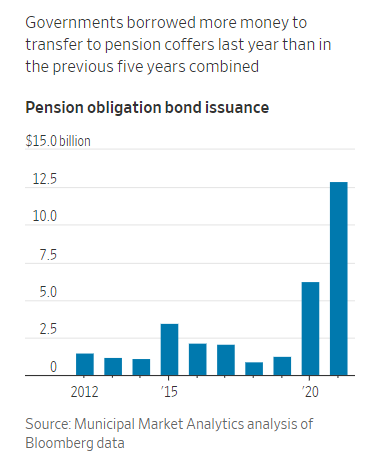
More than 100 state, city, county and other governments borrowed for their pension funds last year, twice the highest number that did so in any prior year, according to a Municipal Market Analytics analysis of Bloomberg data. Nearly $13 billion of these pension obligation bonds were sold last year, which is more than in the prior five years combined.

The Teacher Retirement System of Texas, the U.S.’s fifth-largest public pension fund, began leveraging its investment portfolio in 2019. Next month, the largest U.S. public-worker fund, the roughly $440 billion California Public Employees’ Retirement System, known as Calpers, will add leverage for the first time in its 90-year history.

While most pension funds still avoid investing borrowed money, the use of leverage is spreading faster than ever. Just four years ago, none of the five largest pension funds used leverage.

Investing with borrowed money can juice returns when markets are rising, but make losses more severe in a down market. This year’s steep slump in financial markets will test the funds’ strategy.

It’s too soon to tell how the magnified bets are playing out in the current market, as funds won’t report second-quarter returns until later in the summer. In the first quarter, public pension funds as a whole returned a median minus 4%, according to data from the Wilshire Trust Universe Comparison Service released last month. A portfolio of 60% stocks and 40% bonds—not what funds use—returned minus 5.55% in the quarter, Wilshire said.

Author(s): Dion Rabouin, Heather Gillers

Publication Date: 26 Jun 2022

Publication Site: WSJ

Pensions’ Bad Year Poised to Get Worse

Link: https://www.wsj.com/articles/pensions-bad-year-poised-to-get-worse-11652175002

Excerpt:

State and local government retirement funds started the year with their worst quarterly returns since the beginning of the pandemic. Things have only gone downhill since.

Losses across both stock and bond markets delivered a double blow to the funds that manage more than $4.5 trillion in retirement savings for America’s teachers, firefighters and other public workers. These retirement plans returned a median minus 4.01% in the first quarter, according to data from the Wilshire Trust Universe Comparison Service. Recent losses have further eroded their holdings.

“It’s a tough period,” said Jay Bowen, manager of the Tampa Firefighters and Police Officers Pension Fund. “Nobody is immune.”

The declines in stocks and bonds are inflicting pain on household and institutional investors in 2022. The S&P 500 has returned minus 13.5% year to date through Friday, while the Bloomberg U.S. Aggregate bond index — largely U.S. Treasurys, highly rated corporate bonds and mortgage-backed securities — returned minus 10.5%.

Author(s): Heather Gillers

Publication Date: 10 May 2022

Publication Site: WSJ

Pension spiking costs continue to hit Illinois taxpayers

Link: https://www.thecentersquare.com/illinois/pension-spiking-costs-continue-to-hit-illinois-taxpayers/article_b899de84-a53e-11ec-b683-6bf4098dc466.html

Excerpt:

School districts sent $8,839,754.35 to the Teachers’ Retirement System of the state of Illinois to cover the cost of excess salary and excess sick time payments given to educators at the end of their careers in years 2018-2019 and 2019-2020, according to records obtained by The Center Square. That’s on top of the more than $50 million in penalties districts have paid to TRS since the 2005 law passed, including $23.8 million since fiscal 2014. But districts only paid a fraction of what they actually owed due to exemptions built into the 2005 law.

“In the first 10 years of the program, 2005 to 2015, the excess salary contributions levied against school districts totaled $149.5 million, or an average of $14.95 million per year,” said Dave Urbanek, director of communications for the Teachers’ Retirement System of the state of Illinois. “However, because of exemptions to the 6% threshold built into the law at that time, districts paid only $39 million during that decade, or an average of $3.9 million per year.”

State Sen. Craig Wilcox, R-McHenry, said some local taxpayers probably aren’t aware of how school districts are spending tax dollars. The majority of school district funding in Illinois comes from local property taxes. Most national analyses show Illinois residents pay, on average, the second highest property taxes in the U.S., behind only New Jersey.

Author(s): Brett Rowland

Publication Date: 18 Mar 2022

Publication Site: The Center Square

TAXPAYER PENSION COSTS EXCEEDED ILLINOIS PROJECTIONS BY $13.7 BILLION SINCE 2013

Link: https://www.illinoispolicy.org/taxpayer-pension-costs-exceeded-illinois-projections-by-13-7-billion-since-2013/

Graphic:

Excerpt:

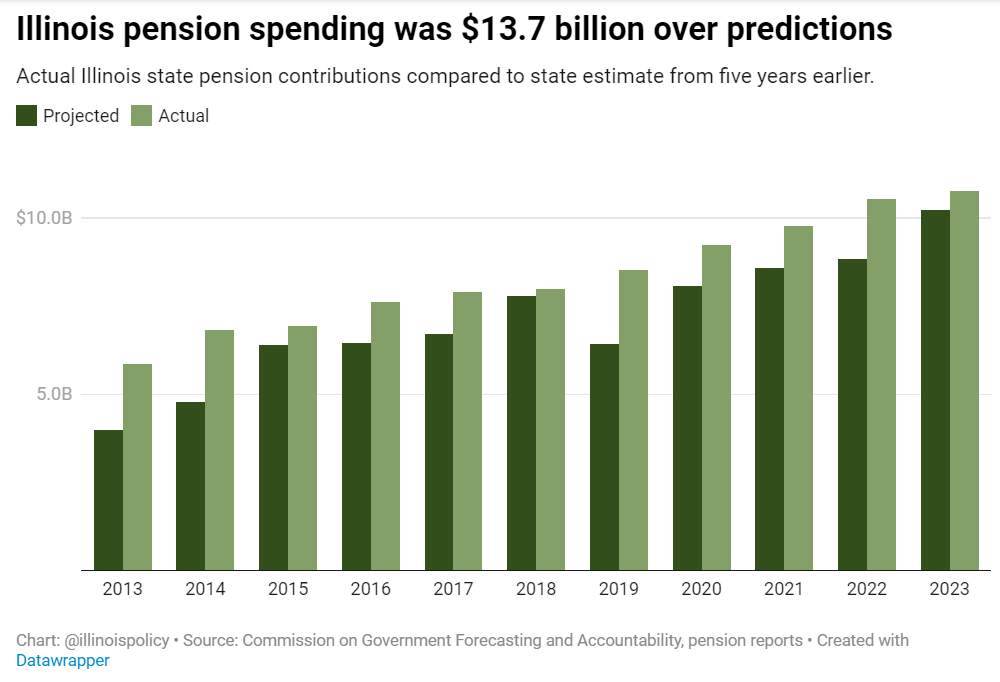
Unrealistic assumptions and missed investment returns have meant Illinois taxpayers paid $13.7 billion more for public pensions than state leaders projected five years earlier. Unless the estimates improve, taxpayers will pay an extra $21.3 billion during the next decade.

Illinois does a particularly poor job of figuring out how much money is needed to pay its public pensions: The past decade has seen the projections miss by 16%, which meant taxpayers needed to give $13.7 billion more than was estimated.

Author(s): Justin Carlson

Publication Date: 17 Jun 2022

Publication Site: Illinois Policy Institute

A chance to enter a new era of financial transparency and awareness for public pension plans

Link: https://reason.org/commentary/a-chance-to-enter-a-new-era-of-financial-transparency-and-awareness-for-public-pension-plans/

Graphic:

Excerpt:

On Feb. 11, the Actuarial Standards Board issued a revised Actuarial Standard of Practice No. 4, effective February 15, 2023. The rollout has been low-key. The announcement says:

“Notable changes made to the existing 2013 version include expanding the scope to clarify the application of the standard when the actuary selects an output smoothing method and when an assumption or method is not selected by the actuary.”

But this description obscures a significant new required disclosure, one which follows years of controversy and acrimony within and among actuaries and the public pension plan community at large.  The requirement was the overwhelming focus during the drafting and comment period.     

The new required disclosure reflects economic reality better than any currently required number.

Author(s): Larry Pollack

Publication Date: 25 Mar 2022

Publication Site: Reason

Bill de Blasio urges teachers union to divest $13 million in gun firms from pension funds

Link: https://nypost.com/2022/05/31/bill-de-blasio-tells-teachers-union-to-divest-in-gun-firms-from-pension-fund/

Graphic:

Excerpt:

Former mayor — and congressional hopeful — Bill de Blasio is calling out the state teachers union for investing $13 million of its pension funds with firms that manufacture guns and ammo following the shooting massacre of 19 students and two teachers in Uvalde, Texas.

De Blasio is urging both the New York State Teachers Retirement Fund and the NYS Common Retirement Fund representing state and local government workers and retirees — separately overseen by state Comptroller Tom DiNapoli — to divest their holdings in the weapons industry.

The holdings of the two pension funds combined in gun and manufacturing firms add up to $26 million.

The NYS Teachers Retirement Fund has assets in Sturm Ruger, Vista Outdoor Inc. Olin Corp. (Winchester Ammo) and National Presto Industries, records show.

….

The state comptroller’s office said in a statement that already divested gun companies after Sandy Hook.

Author(s): Carl Campanile

Publication Date: 31 May 2022

Publication Site: NY Post

Proxy battles are usually an inefficient use of public pension systems’ resources

Link: https://reason.org/commentary/proxy-battles-are-usually-an-inefficient-use-of-public-pension-systems-resources/

Excerpt:

Viewers of Berkshire Hathaway’s 2022 Annual Meeting recently learned that some public pension funds feel strongly about how the corporations they own stock in should be governed. At the Berkshire meeting, a group of three pension systems offered a series of shareholder resolutions, all of which were rejected. While there may be instances where it is reasonable for public pension funds to try to influence corporate decision-making, the pension funds should determine whether proxy fights can appreciably enhance the value of their assets before picking a fight.

….

Pension funds and other institutional investors sometimes withhold their support for corporate-endorsed board candidates and submit resolutions. But changing the outcome of corporate elections is typically an uphill battle. According to ProxyPulse, only 2.2% of corporate board candidates failed to obtain majorities during the 2021 proxy season. Sullivan & Cromwell found that only 9% of shareholder proposals submitted were ultimately ratified. 

In comparison, the prospects for shareholder resolutions being adopted appear to be improving. ProxyPulse found that the mean share of votes for shareholder proposals increased from 34% in 2017 to 40% in 2021. The threat of a shareholder proposal passing may also be encouraging boards to go ahead and adopt some recommended policies. 

Between January 1, 2020, and April 30, 2022, pension funds filed 81 forms with the Securities and Exchange Commission in which they disclosed shareholder solicitations, accounting for over 10% of all such disclosures filed during this period. Shareholders who send letters to other shareholders asking them to vote against recommendations of management in their proxy statements disclose the fact that they have done so on SEC Form PX14A6G

Author(s): Marc Joffe

Publication Date: 27 May 2022

Publication Site: Reason

Study Finds Pension Obligation Bonds Could Worsen T Retirement Fund’s Financial Woes

Link: https://pioneerinstitute.org/featured/study-finds-pension-obligation-bonds-could-worsen-t-retirement-funds-financial-woes/

Graphic:

Excerpt:

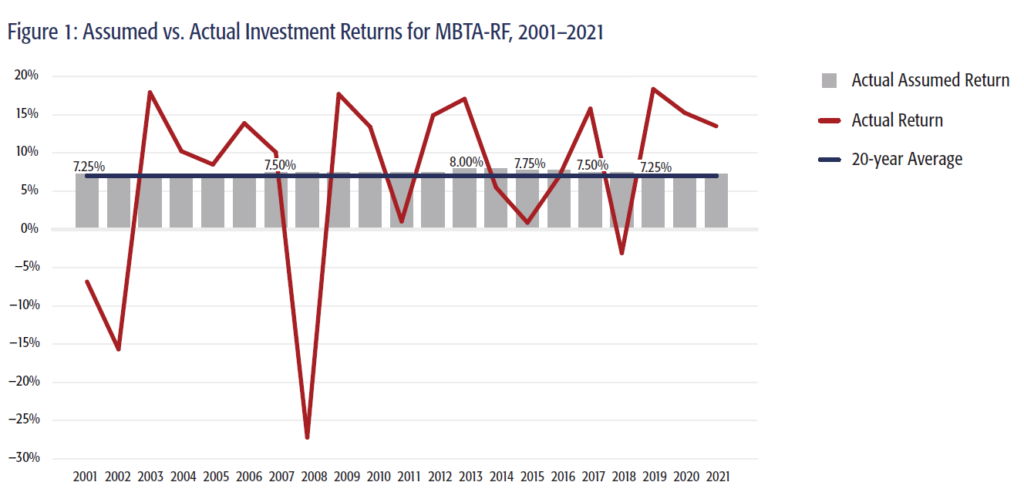
new study published by Pioneer Institute finds that issuing pension obligation bonds (POBs) to refinance $360 million of the MBTA Retirement Fund’s (MBTARF’s) $1.3 billion unfunded pension liability would only compound the T’s already serious financial risks.

With POBs, government entities deposit revenues from bond sales into their pension funds and use the money to make investments they hope will deliver returns that outpace borrowing costs.

“Virtually every study of POBs finds that timing and duration of the bond issues are critical,” said E.J. McMahon, author of “Rolling the Retirement Dice.”  “Bonds floated at the end of a bull market are the most likely to lose money, and that makes this idea a wrong turn at the worst possible time.”

If investments don’t meet a pension fund’s assumed rate of return, it could be left with debt service costs in addition to the pre-existing unfunded liability.  In 2015, the Government Finance Officers Association bluntly warned that “State and local governments should not issue POBs.”  It reaffirmed its guidance last year.

Author(s): E.J. McMahon

Publication Date: 21 Jun 2022

Publication Site: Pioneer Institute

Pension Obligation Bonds

Link: https://marypatcampbell.substack.com/p/pension-obligation-bonds#details

Graphic:

Excerpt:

2015: Why are Pension Obligation Bonds OF THE DEVIL? A Lesson from the Dollar Auction  

http://stump.marypat.org/article/191/why-are-pension-obligation-bonds-of-the-devil-a-lesson-from-the-dollar-auction

The dollar auction is a truly evil game. I used to forbid people from playing it at Mathcamp. That’s not a joke.

I had a really ugly graph on that post, and yes, I’ve gotten better with the graphs over the years. The ugliness of that graph was a partial inspiration to seek solutions. (Other ugly graphs as well).

You can barely see it, but there was a POB between 2003 and 2005. It barely made a dent in the unfunded pension liability.

And what then? In the ten years since 2005, Illinois underfunded the TRS pension fund by at least a billion dollars a year.

With regards to contributions, there was a choice on the part of the “government”.

With regards to all the other reasons for shortfalls — investment experience, experience in salary changes and longevity — the government had less direct control. But they definitely had a choice with regards to how much of the budget to apply to the pensions.

And every damn year, the Illinois government made a conscious decision to shortchange the pension. That was not an accident.

POBs are most often used by governments that were shortchanging the pensions, or goosing the benefits in insane and seemingly sane ways, to paper over said shortchanging. This farce lasts only so long.

Author(s): Mary Pat Campbell

Publication Date: 20 Jun 2022

Publication Site: STUMP at substack