An Illinois Circuit Court judge has denied a lawsuit that sought to stop the consolidation of the state’s 650 firefighter and police officer pension funds, rejecting the plaintiff’s claims that a law enacting the move violated the state’s constitution.
In 2019, the Illinois General Assembly passed a bill that allows for the consolidation of 650 police and firefighter pensions in order to pool their funds into two statewide funds for investment purposes—one for police and one for firefighters. The move is intended to help improve the financial stability of the pension funds and ease pressure on local governments to raise taxes to fund those pensions.
However, in February 2021 18 police and firefighter pension funds, including active and retired members, filed a complaint against Illinois Governor J. B. Pritzker, who signed the bill into law. The lawsuit alleged that the consolidation violates two provisions of the Illinois Constitution: the pension protection clause and the takings clause.
The plaintiffs claimed that they had a contractual and enforceable right to exclusively manage and control their investment expenditures and income, including interest dividends, capital gains and other distributions on investments, which they said the consolidation infringed upon.
The Chicago City Council approved a casino development in the River West neighborhood. The generated revenue will exclusively pay for pension debt, but only an estimated 9% of what the city needs.
The Chicago City Council approved a $1.7 billion casino in a 41-7 vote May 25. The River West development is being touted as a pension solution, but even the highest projections show only a drop in the bucket.
“This one casino project will pay for approximately 9% of our $2.3 billion pension contribution and reduce the likelihood that the city will need to raise property taxes in the future for pensions,” said Jennie Huang Bennet, chief financial officer for the city.
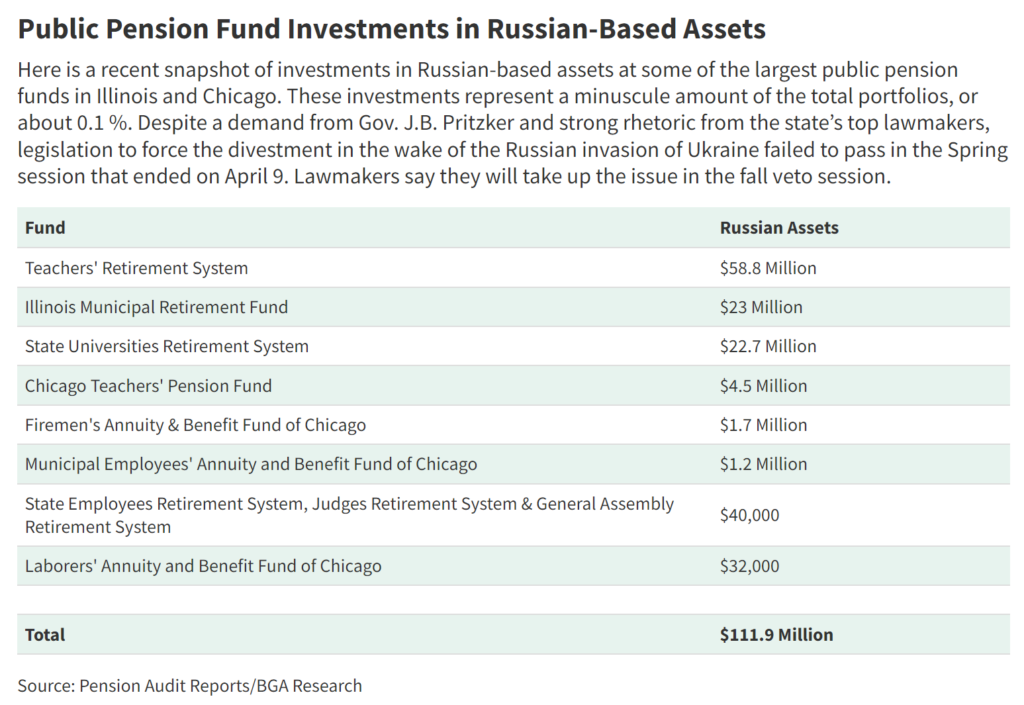
Despite strong rhetoric from Gov. J.B. Pritzker and other top state officials demanding public pension funds divest more than $100 million in Russia-based assets, state lawmakers now say they won’t act until the Fall veto session.
A key legislative proposal to force the pullout in the wake of the Russian invasion of Ukraine died in a Senate committee awaiting a vote.
Senate President Don Harmon, D-Oak Park, declined to be interviewed for this report, but his staff suggested the Senate had too little time before the session closed on April 9. The House bill — which passed by a vote of 114-0 on April 5 — was never taken up in the Senate chamber.
….
Using pension investment decisions as a way to prompt social change has long been controversial. In the past, Illinois funds have divested from companies and funds related to Sudan, Iran and businesses that boycott Israel following direction from lawmakers.
The Illinois State Board of Investments creates a prohibited list of companies for the funds to consider. The most recent list does not contain companies or funds connected to the Russian invasion.
“How, as a society, should we think about our pension systems assets?” Amanda Kass, Associate Director of the Government Finance Research Center at the University of Illinois – Chicago, asked. “I also see this kind of scrutiny of investing in Russian assets as part of this larger movement.”
Connecticut is poised to deposit an extra $3.6 billion in its cash-starved pension funds when the fiscal year closes in June, after tax revenues surged yet again on Friday.
Those supplemental payments would be on top of the $2.9 billion in required contributions Connecticut made this fiscal year to pensions for state employees and municipal teachers.
Those projections were included Friday in the latest monthly budget estimates from Gov. Ned Lamont’s administration, which also forecast a $3.8 billion surplus for the current fiscal year.
Losses across both stock and bond markets delivered a double blow to the funds that manage more than $4.5 trillion in retirement savings for America’s teachers, firefighters and other public workers. These retirement plans returned a median minus 4.01% in the first quarter, according to data from the Wilshire Trust Universe Comparison Service. Recent losses have further eroded their holdings.
“It’s a tough period,” said Jay Bowen, manager of the Tampa Firefighters and Police Officers Pension Fund. “Nobody is immune.”
The declines in stocks and bonds are inflicting pain on household and institutional investors in 2022. The S&P 500 has returned minus 13.5% year to date through Friday, while the Bloomberg U.S. Aggregate bond index — largely U.S. Treasurys, highly rated corporate bonds and mortgage-backed securities — returned minus 10.5%.
Pension funds maintain huge portfolios of stocks, bonds and other assets, wielding significant power on Wall Street, where their purchases and sales can shift prices and investment managers vie for their business. Their losses can raise costs for governments and workers, squeeze municipal budgets and drive up taxes.
New York City’s comptroller is the latest public official trying to change laws aimed at limiting risk in pension investments, as U.S. state and local pension funds try to plug shortfalls in a low-return environment.
Comptroller Brad Lander, who oversees about $260 billion in retirement money for city police, firefighters, teachers and other public workers, is asking New York lawmakers for more flexibility to invest in private markets, high-yield debt and foreign stocks. The state comptroller’s office, which supervises another $280 billion in retirement assets, views the idea favorably, with a representative saying such flexibility “is key in times of market volatility.”
Pension funds, like household investors, are facing a relatively bleak environment for stocks and bonds, the bread and butter of a traditional retirement portfolio. In the face of historic inflation and Federal Reserve efforts to contain it, these funds are finding they can no longer rely on bonds to rise when equities fall and vice versa. In the first quarter, the S&P 500 returned minus 4.6% while the Bloomberg U.S. Aggregate bond index returned minus 5.93%.
“Those two things taken together is what’s scary: the prospect of both going down at the same time,” said Steve Foresti, chief investment officer at Wilshire Associates, which advises large public pension funds. Retirement portfolio managers, he said, are asking “in that environment, do I have anything that actually goes up?”
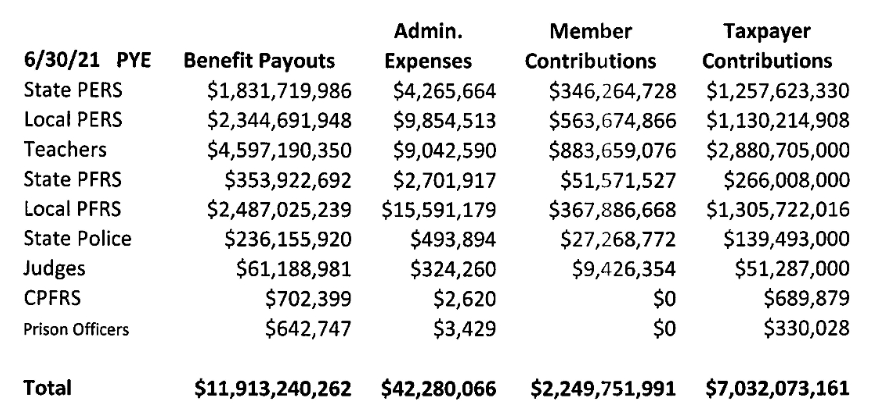
The June 30, 2021 actuarial reports for the New Jersey Retirement System are now all out and there are a few numbers therein that can be taken seriously (none involving liabilities or even the market value of assets considering all those self-valued alternative investments). The main purpose of these official actuarial reports is to determine the ‘required’ contributions which practically all parties have a vested interest in understating so we get a bunch of fanciful numbers where possible. However, these numbers you can’t pretty up:
As economic sanctions against Russia for its invasion of Ukraine spread, state and local public pension plans are looking at selling off their Russian-related assets and some are already doing so.
Lawmakers in at least a dozen states are pressuring their pension funds to divest from Russian-related investments. Divestment isn’t likely to have much impact on the funds themselves as Russian-domiciled investments make up less than 1% of most (if not all) state portfolios. But collectively, it sends a message. For example, California’s CalPERS is the largest pension fund in the world and it alone holds nearly $1 billion in Russian assets.
However, it’s likely that at least some (if not all of) these funds will be selling at a loss. Here is a snapshot of what’s happening across the U.S.
The California State Teachers’ Retirement System is now planning to formally define the term “diverse manager” and adjust their definition of “emerging manager.” Though the two categories overlap, they are not identical.
The term “emerging manager” is based on the following criteria, according to CalSTRS: “the amount of assets under management; fund lifecycle of funds; firm legal structure; non-employee ownership percentage; and other various factors including track record, private placement memorandum.”
The term “diverse manager” will refer exclusively to the diversity of the firm’s ownership. The term will be defined in a tiered way such that if a firm is 25% to 49% owned by women, ethnic minorities, and/or LGBTQ individuals, it will be labeled as “substantially diverse.” A firm would be labeled as “majority diverse” if it is more than 50% owned by women, ethnic minorities, and/or LGBTQ people. Ethnic minorities include all non-white groups listed on the census.
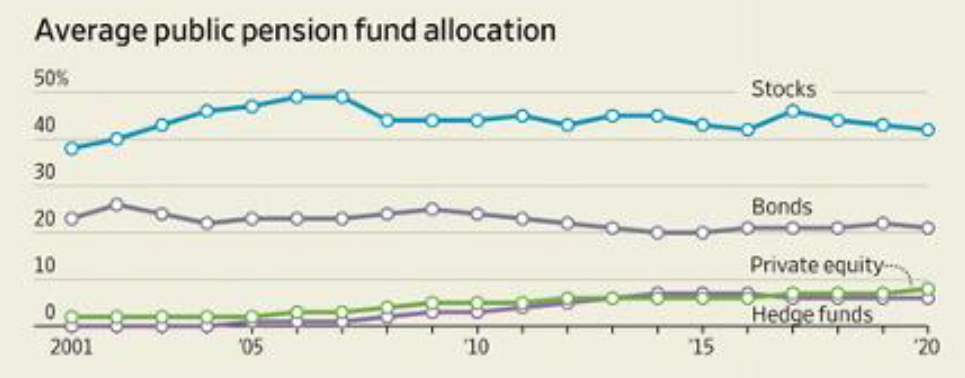
Pension funds around the U.S. are upping their allocations to private equity after a year of record-breaking returns. According to data obtained from Preqin, the average public pension’s allotment to private equity increased to 8.9% in 2021. In contrast, the average allocation was just 6.5% in 2012.
New York City’s pensions are among those that may see an increased allocation to the asset class in their portfolios should a new law pass. Currently, New York State implements a “basket clause,” which prevents public pensions from investing above 25% of their total portfolios in investments considered higher risk, including real estate, infrastructure, hedge funds, international equities, and private equity. The proposed law would increase that allocation to 35% for all pension funds in the state. If the law passed, the boards of New York City’s five public pensions would vote on whether to increase the “basket” for their own pension funds.
New York City Interim CIO Michael Haddad, who is responsible for overseeing investments in the five pension plans across the city, says that while the change in the law isn’t targeted at private equity exclusively, it’s likely that the asset class would increase.
New York employees and taxpayers are unwittingly financing Russian companies and the oligarch pals of Vladimir Putin with at least $519 million invested in assets now frozen by the war-mongering dictator, The Post has learned.
City and state pension systems have pledged to sell off the holdings in protest of Russia’s assault on Ukraine, but Moscow has prohibited foreign investors from dumping the stocks.
“Putin is a thug and he’s holding our money hostage,” said Gregory Floyd, a Teamsters union leader and trustee of the New York City Employee Retirement System, NYCERS.
New York City’s five pension systems – covering teachers, cops, firefighters and other city employees – have invested a total $284.5 million in 33 publicly traded Russian stocks, according to records released to The Post by city Comptroller Brad Lander’s office.
On Feb. 25, the market value of the Russian assets was $185.9 million, nearly $100 million less than the purchase price, the latest available records show.