So Are ESG Investments Lousy, or Not?

Link: https://www.ai-cio.com/in-focus/market-drilldown/so-are-esg-investments-lousy-or-not/?oly_enc_id=2359H8978023B3G

Excerpt:

One criticism of ESG investing is that, when it shows good returns, this might be because of temporary factors that have an outsize impact. Such superior returns are  often driven by climate-news “shocks,” declared Robert Stambaugh, a professor at the University of Pennsylvania’s Wharton School, and two other academics, in a recent paper. The reference is apparently to a spell of severe drought or destructive hurricanes. The professors expressed uncertainty as to whether any future ESG outperformance can be assumed.

Of course, with climate-oriented investing now a partisan issue, a welter of claims and counter-claims has appeared. To pro-ESG folks, science is on their side, hence the opposition is just blowing smoke to confuse people.

Anti-ESG politicians appear to be convincing the public that a “false equivalence” exists between their stance and the sustainability advocates, contended Witold Henisz, director of Wharton’s ESG Initiative, in a recent article in the Knowledge Wharton periodical. He wrote that “ideological opposition [is] cynically seeking a wedge issue for upcoming political campaigns — and, so far, it appears to be working.”

Whatever the outcome of the current debate over ESG-related bans and the like, the climate change question is not going away. Says CalSTRS’s Ailman, “It will be with us for the next 50 years.”

Author(s): Larry Light

Publication Date: 8 Sept 2022

Publication Site: ai-CIO
Examining the Experiences of Public Pension Plans Since the Great Recession

Link: https://www.nirsonline.org/reports/greatrecession/

PDF of report: https://www.nirsonline.org/wp-content/uploads/2022/09/compressedExamining-the-Experiences-of-Public-Pension-Plans-Since-the-Great-Recession-10.13.pdf

Webinar slides: https://www.nirsonline.org/wp-content/uploads/2022/09/FINAL-Great-Recession-Retro-Public-Webinar.pdf

Video:

Graphic:

Excerpt:

This report finds that state and local government retirement systems on the whole successfully navigated the 2007 to 2009 Global Financial Crisis. Moreover, public retirement systems across the nation have adapted in the years since the recession by taking actions to ensure continued long-term resiliency.

Examining the Experiences of Public Pension Plans Since the Great Recession is authored by Tyler Bond, NIRS Research Manager, Dan Doonan, NIRS Executive Director, Todd Tauzer, Segal Vice President and Actuary, and Ronald Temple, Lazard Managing Director and Co-Head of Multi-Asset and Head of U.S. Equity.

The report finds:

  • The majority of public pension plans recovered their pre- recession asset levels within six years, while continuing to pay over a trillion dollars in benefits. In recent years, public plans have reported record-high asset levels.
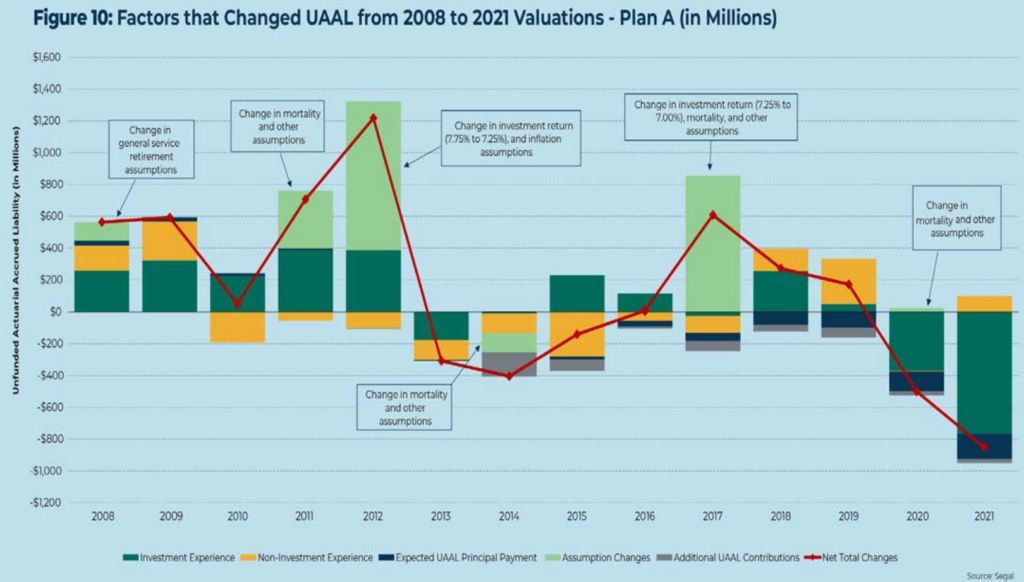
  • Discount rates, or the assumed rate of return on investments, have broadly decreased from eight to seven percent for the median public pension plan, based on actuarial and financial forecasts of future market returns.
  • Generational mortality tables, possible today with more advanced financial modeling software, have been broadly adopted by nearly all large public plans and future longevity improvements are now incorporated into standard financial projections.
  • Many public plans have shortened amortization periods, or the period of time required to pay off an unfunded actuarial accrued liability, to align with evolving actuarial best practices. Tightening amortization periods, akin to paying off a mortgage more quickly, has had the effect of increasing short- term costs. In the long run, plans and stakeholders will benefit.
  • The intense focus on public plan investment programs since the Great Recession misses the more important structural changes that generally have had a larger impact on plan finances and the resources necessary for retirement security.
  • Plans have adjusted strategic asset allocations in response to market conditions. With less exposure to public equities and fixed income, plans increased exposure to real estate, private equity, and hedge funds.
  • Professionally managed public defined benefit plans rebalance investments during volatile times and avoid the behavioral drag observed in retail investment.

Author(s): Dan Doonan, Ron Temple, Todd Tauzer, Tyler Bond

Publication Date: October 2022

Publication Site: NIRS

As Pension Goes Broke, Bankruptcy Haunts City Near Philadelphia

Link: https://news.bloomberglaw.com/bankruptcy-law/as-pension-goes-broke-bankruptcy-haunts-city-near-philadelphia

Excerpt:

Decade after decade, Chester, Pennsylvania, has fallen deeper and deeper into a downward financial spiral.

As the city’s population dwindled to half its mid-century peak, shuttered factories near the banks of the Delaware River were replaced by a prison and one of the nation’s largest trash incinerators. A Major League Soccer stadium and casino did little to turn around the predominantly Black city just outside Philadelphia, where 30% of its 33,000 residents live below the poverty line. Debt piled up. The government struggled to balance the books.

Now, with its police pension set to run out of cash in months, a state-appointed receiver is considering a last resort that cities rarely take: filing for bankruptcy.

…..

In the years after the housing-market crash, three California cities, Detroit and Puerto Rico all went bankrupt, in large part because of retirement-fund debts. Such pensions are now being tested again, with the S&P 500 Index tumbling over 20% this year and bonds pummeled by the worst losses in decades.

….

Michael Doweary, who was appointed receiver of the city in 2020, is exploring options such as eliminating retiree health care, cutting the city’s costs for active employees’ medical benefits and reducing the city’s pension and debt-service costs. 

But that’s virtually certain to draw resistance from employees, who would need to approve such changes. In February, Pennsylvania’s Department of Community and Economic Development gave Doweary the power to seek bankruptcy protection for Chester if such steps fall through. 

“The answer is not to go to people and say we promised you if you work here for 25 years we’re going to give you post-retirement medical benefits, and then take it back,” said Les Neri, a former president of the Pennsylvania Fraternal Order of Police who is currently working with Chester’s officers. “At least current officers can make a decision to accept it and stay, or reject it and leave.”

Author(s): Hadriana Lowenkron

Publication Date: 17 Oct 2022

Publication Site: Bloomberg Law

Fiscal Year 2022 Brings Outperformance for Illinois State Teachers’ Retirement System

Link: https://www.ai-cio.com/news/fiscal-year-2022-brings-outperformance-for-illinois-state-teachers-retirement-system/

Excerpt:

The Teachers’ Retirement System of the State of Illinois has avoided a significant portfolio downswing despite the equity slowdown that has burdened asset managers with thus far in 2022. Through the second quarter, the fund has returned-1.17% net of fees, a favorable rate of return compared to other public pension systems across the country in fiscal year 2022.

At the end of FY 2022, the 40-year rate of return was 9.3%. This 40-year annualized return eclipses the system’s estimated long-term investment rate of 7%.

The net investment loss will not impact the plans’ ability to pay out benefits to its more than 434,000 members. In 2022, TRS will pay more than $7 billion in benefits to more than 128,000 members and their families.

Author(s): Dusty Hagedorn

Publication Date: 6 Oct 2022

Publication Site: ai-CIO

19 GOP Attorneys General Slam BlackRock Over ESG Investments

Link: https://www.ai-cio.com/news/19-gop-attorneys-general-slam-blackrock-over-esg-investments/

Excerpt:

A group of 19 Republican state attorneys general have written a letter to BlackRock stating that the asset manager is using state pension fund assets in environmental, social and governance investments that “force the phase-out of fossil fuels, increase energy prices, drive inflation and weaken the national security of the United States.”

The eight-page letter outlines how the group believes BlackRock is using “the hard-earned money of our states’ citizens to circumvent the best possible return on investment.”

“Our states will not idly stand for our pensioners’ retirements to be sacrificed for BlackRock’s climate agenda. The time has come for BlackRock to come clean on whether it actually values our states’ most valuable stakeholders, our current and future retirees, or risk losses even more significant than those caused by BlackRock’s quixotic climate agenda,” the letter says.

The attorneys general asked BlackRock to respond by August 19.

Author(s): Amy Resnick

Publication Date: 9 Aug 2022

Publication Site: ai-CIO

Louisiana Divests Nearly $800 Million from BlackRock to Protect Fossil Fuel Industry

Link: https://www.ai-cio.com/news/louisiana-divests-nearly-800-million-from-blackrock-to-protect-fossil-fuel-industry/

Excerpt:

Louisiana Treasurer John Schroder is divesting $794 million worth of state funds from BlackRock because the world’s largest asset manager’s “blatantly anti-fossil fuel policies would destroy Louisiana’s economy.”

The divestment is in response to BlackRock’s sustainable investing philosophy, and for the firm calling on other companies to embrace net zero investment strategies that would harm the fossil fuel industry, which Schroder notes is a “vital part” of Louisiana’s economy.

“This divestment is necessary to protect Louisiana from actions and policies that would actively seek to hamstring our fossil fuel sector,” Schroder said in a letter to BlackRock CEO Larry Fink. “I refuse to invest a penny of our state’s funds with a company that would take food off tables, money out of pockets and jobs away from hardworking Louisianans.”

When asked to comment, a BlackRock spokesperson said the firm’s view is captured by a line in its Sept. 7 response to a letter it received from a group of 19 Republican state attorneys general saying environmental, social, and governance  investments weaken America’s national security.

Author(s): Michael Katz

Publication Date: 10 Oct 2022

Publication Site: ai-CIO

Louisiana Divests Nearly $800 Million from BlackRock to Protect Fossil Fuel Industry

Link: https://www.ai-cio.com/news/louisiana-divests-nearly-800-million-from-blackrock-to-protect-fossil-fuel-industry/

Excerpt:

Louisiana Treasurer John Schroder is divesting $794 million worth of state funds from BlackRock because the world’s largest asset manager’s “blatantly anti-fossil fuel policies would destroy Louisiana’s economy.”

The divestment is in response to BlackRock’s sustainable investing philosophy, and for the firm calling on other companies to embrace net zero investment strategies that would harm the fossil fuel industry, which Schroder notes is a “vital part” of Louisiana’s economy.

“This divestment is necessary to protect Louisiana from actions and policies that would actively seek to hamstring our fossil fuel sector,” Schroder said in a letter to BlackRock CEO Larry Fink. “I refuse to invest a penny of our state’s funds with a company that would take food off tables, money out of pockets and jobs away from hardworking Louisianans.”

When asked to comment, a BlackRock spokesperson said the firm’s view is captured by a line in its Sept. 7 response to a letter it received from a group of 19 Republican state attorneys general saying environmental, social, and governance  investments weaken America’s national security.

Author(s): Michael Katz

Publication Date: 10 Oct 2022

Publication Site: ai-CIO

Public Sector Pensions in the United States

Link: https://eh.net/encyclopedia/public-sector-pensions-in-the-united-states/

Excerpt:

Although employer-provided retirement plans are a relatively recent phenomenon in the private sector, dating from the late nineteenth century, public sector plans go back much further in history. From the Roman Empire to the rise of the early-modern nation state, rulers and legislatures have provided pensions for the workers who administered public programs. Military pensions, in particular, have a long history, and they have often been used as a key element to attract, retain, and motivate military personnel. In the United States, pensions for disabled and retired military personnel predate the signing of the U.S. Constitution.

Like military pensions, pensions for loyal civil servants date back centuries. Prior to the nineteenth century, however, these pensions were typically handed out on a case-by-case basis; except for the military, there were few if any retirement plans or systems with well-defined rules for qualification, contributions, funding, and so forth. Most European countries maintained some type of formal pension system for their public sector workers by the late nineteenth century. Although a few U.S. municipalities offered plans prior to 1900, most public sector workers were not offered pensions until the first decades of the twentieth century. Teachers, firefighters, and police officers were typically the first non-military workers to receive a retirement plan as part of their compensation.

By 1930, pension coverage in the public sector was relatively widespread in the United States, with all federal workers being covered by a pension and an increasing share of state and local employees included in pension plans. In contrast, pension coverage in the private sector during the first three decades of the twentieth century remained very low, perhaps as low as 10 to 12 percent of the labor force (Clark, Craig, and Wilson 2003). Even today, pension coverage is much higher in the public sector than it is in the private sector. Over 90 percent of public sector workers are covered by an employer-provided pension plan, whereas only about half of the private sector work force is covered (Employee Benefit Research Institute 1997).

Author(s): Lee A. Craig, North Carolina State University

Publication Date: 16 March 2003, accessed 8 Oct 2022

Publication Site: EH.Net Encyclopedia

Citation: Craig, Lee. “Public Sector Pensions in the United States”. EH.Net Encyclopedia, edited by Robert Whaples. March 16, 2003. URL http://eh.net/encyclopedia/public-sector-pensions-in-the-united-states/

Young Versus Old Will Define Fight Over Public Pensions

Link:https://www.washingtonpost.com/business/young-versus-old-will-define-fight-over-public-pensions/2022/10/06/d4fae69a-4566-11ed-be17-89cbe6b8c0a5_story.html

Excerpt:

Younger workers are mostly excluded from those benefits, and few believe pension funds will be around to pay them at retirement time anyway. So younger workers want salary increases rather than promises. Also, portable, employee-directed accounts like 401(k)s rather than large and ever-increasing contributions to black-hole public pension systems. The fight in 2023 may be more between younger and older public employees than between united public employees and taxpayers.I think young employees will score their first victory after many years of getting pushed down. It will be short-term inflation then that applies lethal pressure in a tight labor market, not stock prices, interest rates or even longer-term expectations of price increases. Wages will have to be raised for public employees, who will refuse burdens from past underfunding or benefit cuts that apply only to them. The alternative is unacceptable declines in public services as the best employees quit, job openings go unfilled and qualifications for new hires are lowered.The most heavily indebted states, with the worst credit ratings and biggest pension funding shortfalls, may not be able to pay these increases. While 2022 should be a good revenue year for a majority of state and local governments, heavily indebted states with big pension-funding gaps need to brace for some serious headwinds. Illinois already spends 11% of its revenue to service debt. Increased yields on its bonds could double that to 22% as debt is refinanced, even if the state runs balanced budgets.

The temptation to cut benefits for retirees may be overwhelming. While these people can (and will) yell and scream, that’s easier to accept than a teachers’ strike or a police slowdown. Current employees can be offered generous wage increases and portable pensions. Reducing actuarial pension liabilities will please creditors and rating agencies. Taxpayers will appreciate being spared. In many states, cutting benefits will require a constitutional amendment or other legal heavy lifting, but with enough incentive, that can be done.

I expect something like Social Security reforms. A cap will cut benefits for people receiving the highest pensions, and states will put tax surcharges on benefits for high-income people even if they have moved out-of-state. Copays and deductibles will be increased for health coverage.

The first state to try this will face strong legal challenges, a nationwide union counteroffensive and significant in-state political resistance. But with enough fiscal pressure it may happen. If state administrations can keep current public employees on the sidelines, via wage increases and benefit restructuring, it might succeed.

Author(s): Aaron Brown, Bloomberg

Publication Date: 6 Oct 2022

Publication Site: Washington Post

Public retirement plan assets should never be utilized for political purposes

Link: https://reason.org/commentary/public-retirement-plan-assets-should-never-be-utilized-for-political-purposes/

Excerpt:

State executives and lawmakers from both major political parties have recently threatened to use public retirement plan assets to address political grievances or push political agendas. Issues ranging from guns to oil and climate change to social media are all being suggested as political targets that should dictate investment strategies for public pension funds. When making arguments for their activist agendas, proponents of these various positions rarely mention how investment restrictions or demands will aid in the basic retirement plan objective of supporting public employees in their retirement years.  

To be clear, public retirement plan assets should never be utilized for political purposes.

Trustees of these public pension plans, and others of influence, are under a clear fiduciary obligation to make decisions with the sole purpose of best meeting the pension plans’ objectives for the benefit of that plan’s participants. There is no ambiguity about this: Activist political agendas have no place in public pensions. To be effective in meeting their objectives, public pension systems must be completely apolitical in their decision-making and in their operations. They cannot be beholden to shifting political winds.   

While this idea seems straightforward, the thought of using these massive investment portfolios to leverage certain political agendas is often too enticing for some politicians to pass up. It is incumbent upon governors, other key stakeholders, and legislative representatives in all states to step up and acknowledge that public retirement assets are out-of-bounds for activist maneuvering. This is critical regardless of where these figures fall on the political spectrum. It is equally important for retirement system trustees and leaders, as well as state treasurers, to stand firm as plan fiduciaries and vigorously oppose any attempts to use plan assets in a way that is not solely directed at benefitting the plan’s participants. 

Author(s): Richard Hiller

Publication Date: 10 June 2022

Publication Site: Reason

5 THINGS WRONG WITH ILLINOIS HOLDING 30% OF U.S. PENSION BOND DEBT

Link: https://www.illinoispolicy.org/5-things-wrong-with-illinois-holding-30-of-u-s-pension-bond-debt/

Graphic:

Excerpt:

Pension obligation bonds, like payday loans, are a sign of mismanaged finances. Illinois not only leads the nation for using that risky debt, it owes the bulk of it.

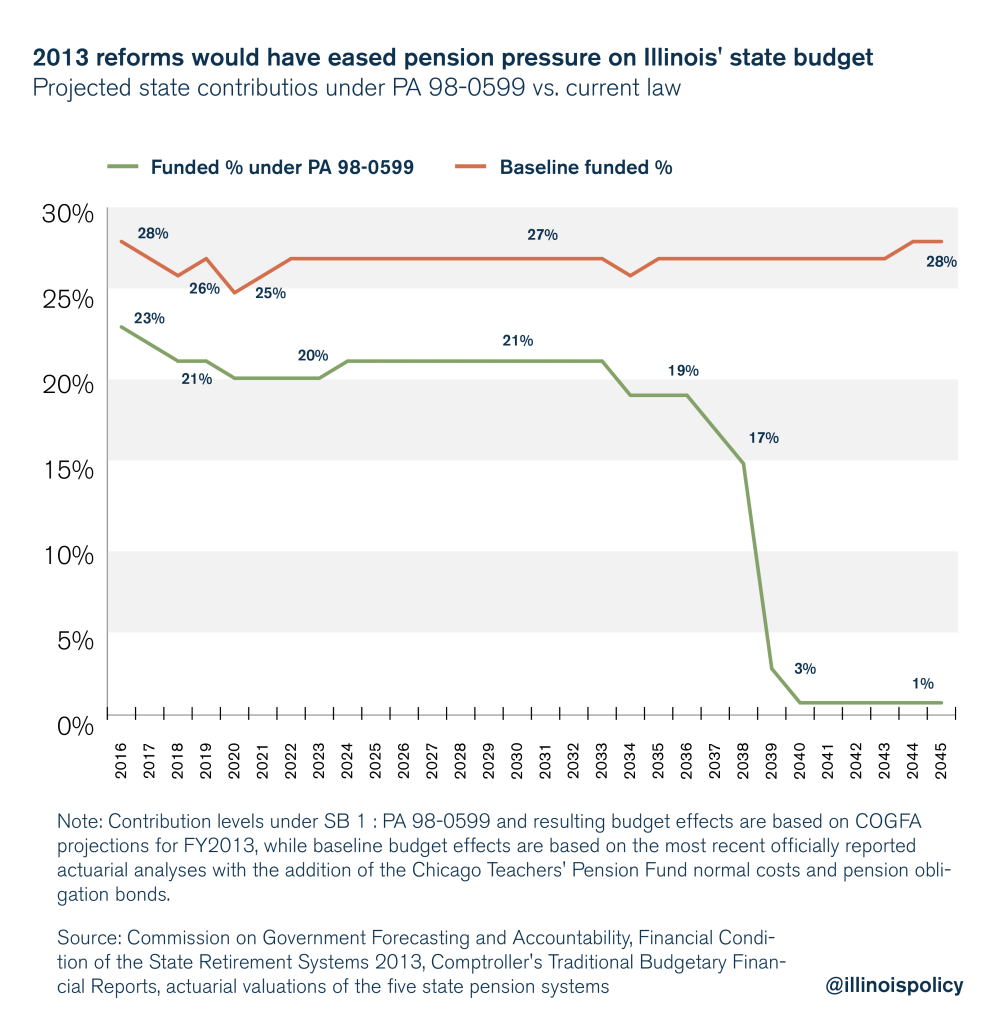
It is bad Illinois has the nation’s worst pension crisis, but state politicians have made it worse by using risky debt to delay the day of reckoning, and done so to the point that Illinois now owes 30% of the nation’s pension obligation bonds.

….

In 2013, Illinois took a significant step towards addressing the pension crisis by passing Public Act 98-0599. This bill protected any benefits that had already been earned by employees while it amended future benefits. The bill increased the retirement age, replaced 3% compounding annual raises with cost-of-living adjustments tied to inflation and capped maximum pensionable salaries. While not a solution, this bill provided a responsible roadmap addressing the financial issues in the pension system while preserving already earned benefits.

Unfortunately, the bill was declared unconstitutional by the Illinois Supreme Court in 2015 because it was interpreted as changing promised future benefits for pension recipients, even though this could potentially result in financial ruin for Illinois. As a result, a constitutional amendment is needed to allow changes to future pension benefits.

Author(s): Aneesh Bafna

Publication Date: 10 Sept 2021

Publication Site: Illinois Policy Institute

Debt Forgiveness Won’t Shield Students from Illinois’ Pension Pinch

Link: https://www.realclearpolicy.com/articles/2022/09/14/debt_forgiveness_wont_shield_students_from_illinois_pension_pinch_853360.html

Excerpt:

Families in Illinois are now burdened with the fourth most expensive in-state tuition prices in the nation, and the highest in the Midwest. 

Take U of I’s flagship Urbana-Champaign campus, with base tuition and fees now starting at $17,138 a year. In comparison, a Big-10 education for in-state students attending Indiana University-Bloomington or the University of Wisconsin-Madison costs nearly $6,000 less.

Illinois schools cost more because most other states don’t have Illinois-sized pension debt – most recently estimated at $140 billion by the Commission on Government Forecasting and Accountability. 

Illinois Policy Institute research shows state funding has declined for higher education operations by 26%  in real terms from fiscal year 2007 through fiscal year 2022, while spending on university pensions has exploded by 514%.

Another way of looking at it is the State Universities Retirement System pension payments accounted for 9% of the state’s higher education spending in 2007. Today, they account for 44% of total higher education dollars. That translates to $776 million less for colleges and universities to allocate toward services that directly benefit students in 2022.

Author(s): Amy Korte

Publication Date: 14 Sept 2022

Publication Site: Real Clear Policy