Biden Seeks to End Cheaper Obamacare Alternatives, Expect Another Supreme Court Smackdown

Link: https://mishtalk.com/economics/biden-seeks-to-end-cheaper-obamacare-alternatives-expect-another-supreme-court-smackdown/

Excerpt:

Biden’s efforts to produce more inflation are nonstop, 24×7. His latest move is a set of regulations to force people into Obamacare despite the fact a District Court already ruled against his proposed regulations.

Biden Attempts to Make Healthcare Even More Expensive

To understand what Biden wants to do, and why the Supreme Court is likely to smack it down, we need to review a District Court ruling from 2020.

On July 24, 2020, CATO reported In a Win for Consumers, a Court Ruling Affirms the Legality of Short‐​Term Health Insurance Plans

….

Jam City, Dateline July 7, 2023

The Wall Street Journal comments on Biden’s Short-Sighted New Health Rule

Behold the President’s plan to limit short-term health insurance plans in order to jam more consumers into the heavily subsidized and regulated ObamaCare exchanges. The Health and Human Services, Labor and Treasury Departments on Friday proposed rules to roll back the Trump Administration’s expansion of short-term, limited-duration insurance (STLDI) plans. Since 2018 these plans have been available in 12-month increments, and consumers have been able to renew them for up to 36 months.

These plans are especially attractive to young people whose employers don’t provide coverage. Why would a healthy 26-year-old want to pay for maternity, pediatric and other services he probably won’t use in the near future?

The Inflation Reduction Act sweetened ObamaCare’s insurance premium tax credits that are tied to income. As a result, a 60-year-old making just above four times the poverty level has to pay only 8.5% of his income toward his insurance premium while the government picks up the rest. If premiums increase, government is on the hook for more.

Author(s): Mike Shedlock

Publication Date: 9 July 2023

Publication Site: Mish Talk

Canadian legislation aimed at protecting pension plans may mean significant changes for lenders, borrowers and employees

Link: https://www.nortonrosefulbright.com/en-us/knowledge/publications/e91814ee/canadian-legislation-aimed-at-protecting-pension-plans-may-mean-significant-changes

Excerpt:

On February 3, 2022, Bill C-228 was introduced as a private members bill and has now made its way to the third reading in Canada’s Senate. The purpose of Bill C-228 is to greatly expand the pension liabilities that are afforded super priority status by amending bankruptcy and insolvency legislation. As currently drafted, the Bill will grant priority for a pension plan’s unfunded liability or solvency deficiency claims over the claims of the majority of creditors — including secured creditors — unless specifically enumerated otherwise in the statutes.

The “unfunded liability” is the amount necessary to enable the fund to continuously pay member benefits as they come due, on the assumption that the fund will operate for an indefinite period of time. The “solvency deficiency” includes the amount necessary to ensure the fund meets its obligations if wound up. As these amounts are constantly fluctuating, a fixed value cannot be ascribed to either of these requirements other than through a single point in time calculation by an actuary.

What does this mean for borrowers with pension plans?

Clearly, Bill C-228 would substantially increase the opportunity for recovery of pension entitlements within insolvency proceedings by way of super priority. The issue is whether it remains viable for lenders to provide capital to borrowers with defined benefit pension plans given the increased risk profile that may be created by Bill C-228 expanding the pension claims that take priority over a secured creditor in an insolvency case.

In all likelihood, Bill C-228 will minimally effect borrowers that have defined-contribution pension plans as the employer’s liability is restricted to predefined contributions. As this type of plan is subject only to ordinary course known contribution requirements, and given that the employer does not guarantee a certain amount of income in retirement, the liability afforded super priority in insolvency proceedings should be predictable in most circumstances.

Conversely, Bill C-228 will significantly impact defined-benefit pension plans. These types of plans commit to providing a specified level of income in retirement based on a variety of factors. As such, an employer must diligently manage the pension fund to ensure it is in a position to pay the benefit to the employee for the remainder of their life, once retired. The inherent challenge with these plans is the uncertainty of the liability of the employer at any given time and the potentially large scope of that liability based in part on external factors such as interest rate fluctuations.

Bill C-228 has therefore created a conundrum. Although the intention of the Bill is to protect pension plans, it may potentially cause a shift that results in even more employers moving from a defined-benefit pension plan to a defined-contribution pension plan. Plainly, this shift may be caused by lenders’ concerns regarding the uncertainty surrounding the amount necessary to liquidate an unfunded liability or solvency deficiency at any given time. In other words, a lender will not be able to determine prior to the lending decision, with any great certainty, the amount of the unfunded liability or solvency deficiency in a future insolvency proceeding. At a minimum, a secured creditor wants to know the quantum of obligations that will take priority over their interests. This is essential information in deciding the quantum of a loan, the terms of such loan, any reserves and whether the creditor will agree to loan any money to the borrower.

Author(s): Candace Formosa

Publication Date: 2023Q2

Publication Site: Norton Rose Fulbright
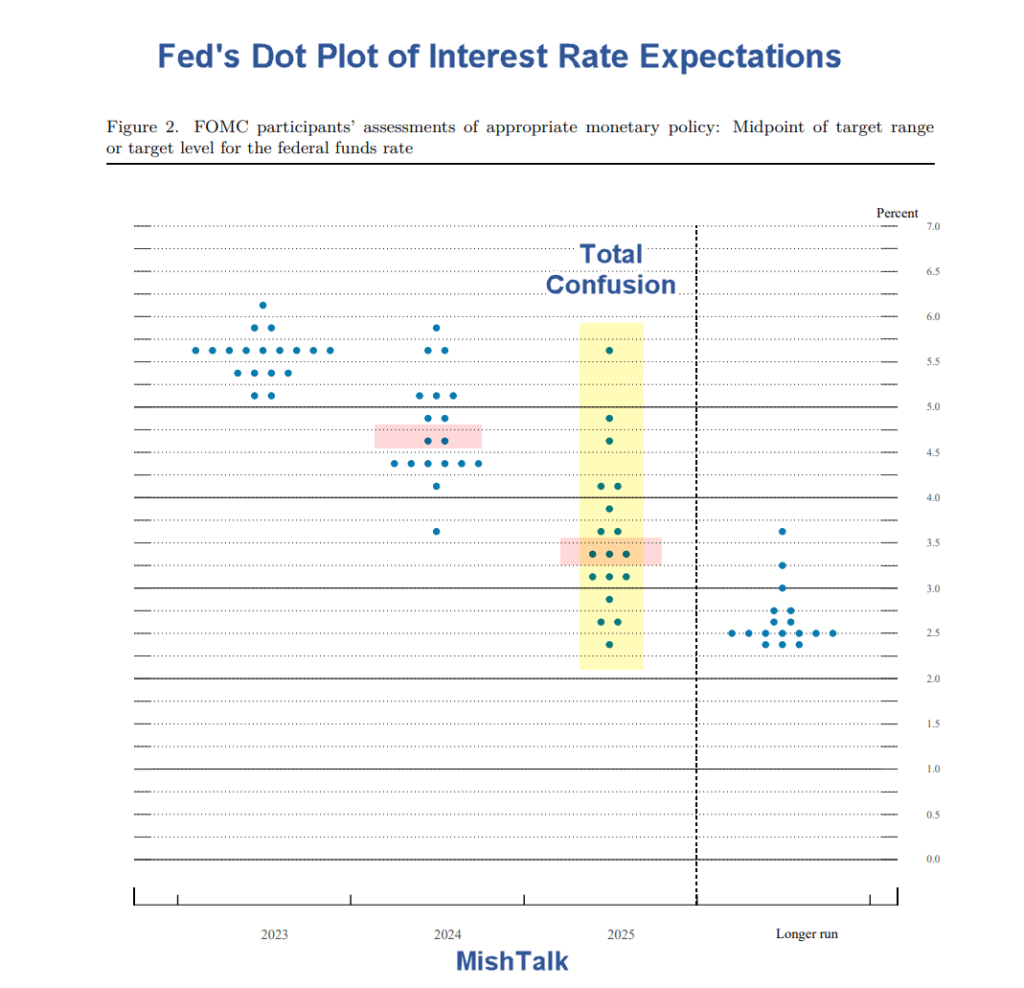
The Fed’s Dot Plot of Interest Rate Projections Show It’s Totally Confused

Link: https://mishtalk.com/economics/the-feds-dot-plot-of-interest-rate-projections-show-its-totally-confused

Graphic:

Excerpt:

The Fed’s Summary of Economic projections is far more interesting. I highlighted the median economic forecast in pink. Each dot represents the position of someone at the meeting.

Looking ahead to 2025, the Fed is clueless. 

Actually, that’s not a bad thing. Someone on the committee is likely to be correct.

Moreover, the results look like one of my favorite sayings: I don’t know and no one else does either, especially the Fed.

Author(s): Mike Shedlock

Publication Date: 14 Jun 2023

Publication Site: Mish Talk

Opinion  How much did Congress lose by defunding the IRS? Way more than we thought.

Link: https://www.washingtonpost.com/opinions/interactive/2023/irs-enforcement-costs-congress-funding/

Graphic:

Excerpt:

The White House and Congress recently agreed to claw back more than $20 billion earmarked for the Internal Revenue Service. This deal was, ostensibly, part of a grand bargain to reduce budget deficits.

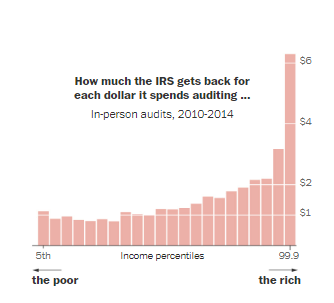
Unfortunately, it’s likely tohave the opposite effect. Every dollar available for auditing taxpayers generates many times that amount for government coffers — and the rate of return is especially astonishing for audits of the wealthiest Americans, according to new research shared exclusively with The Post.

A team of researchers at Harvard University, the University of Sydney and the Treasury Department examined internal IRS data for approximately 710,000 in-person audits from 2010 to 2014. Here’s what they found:

Wealthy people generally have more complex tax returns, so auditing them costs more. Internal government records show that the IRS employees auditing the rich earn higher wages and spend much more time per audit; overhead costs add up, too.

Now here’s the revenue collected per audit, from additional taxes, penalties and interest. The differential for low- vs. high-income taxpayers is even bigger.

This means that while the upfront costs of auditing the wealthy are usually higher — perhaps suggesting these taxpayers aren’t worth going after — the average return on investment is much better.

Author(s):

Opinion by Catherine Rampell and graphics by
Youyou Zhou

Publication Date: 14 Jun 2023

Publication Site: Washington Post