$50 Billion in Opioid Settlement Cash Is on the Way. We’re Tracking How It’s Spent.

Link: https://kffhealthnews.org/news/article/opioid-drugmakers-settlement-funds-50-billion-dollars-khn-investigation-payback/

Graphic:

Excerpt:

More than $50 billion in settlement funds is being delivered to thousands of state and local governments from companies accused of flooding their communities with opioid painkillers that have left millions addicted or dead.

….

Most of the settlements stipulate that states must spend at least 85% of the money they will receive over the next 15 years on addiction treatment and prevention. But defining those concepts depends on stakeholders’ views — and state politics. To some, it might mean opening more treatment sites. To others, buying police cruisers.

….

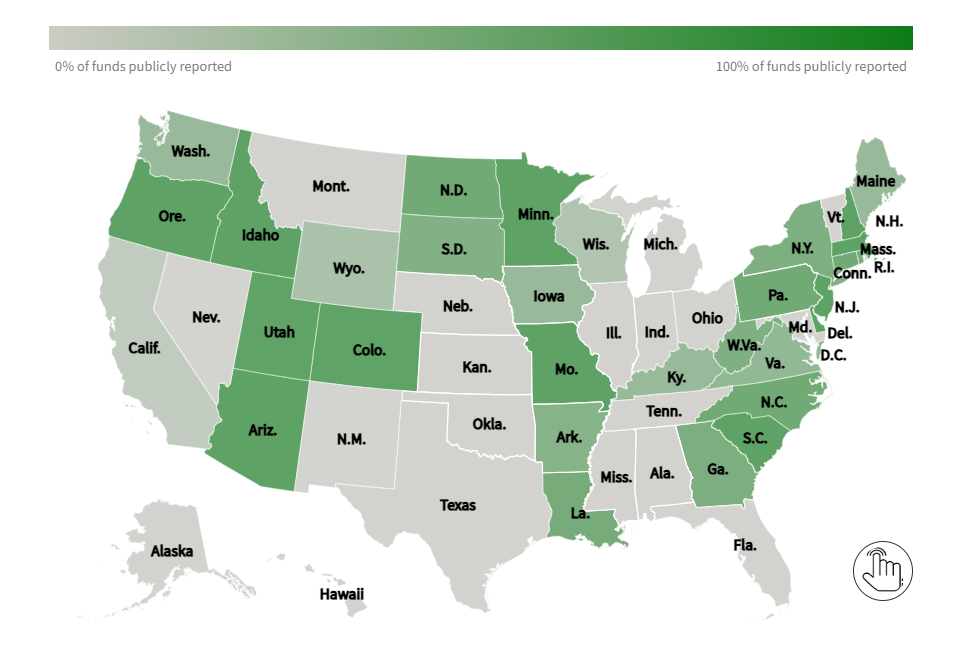
What’s more, many states are not being transparent about where the funds are going and who will benefit. An investigation by KHN and Christine Minhee, founder of OpioidSettlementTracker.com, concluded only 12 states have committed to detailed public reporting of all their spending.

The analysis involved scouring hundreds of legal documents, laws, and public statements to determine how each state is divvying up its settlement money among state agencies, city and county governments, and councils that oversee dedicated trusts. The next step was to determine the level and detail of public reporting required. The finding: Few states promise to report in ways that are accessible to the average person, and many are silent on the issue of transparency altogether.

More than $3 billion has gone out to state and local governments so far. KHN will be following how that cash — and the billions set to arrive in coming years — is used.

Author(s): Aneri Pattani

Publication Date: 30 March 2023

Publication Site: Kaiser Health News
Minority- and Women-Owned Business Enterprise: Asset Management and Financial Institution Strategy Report

Link: https://www.osc.state.ny.us/files/reports/special-topics/pdf/mwbe-fiscal-2022-23.pdf?utm_content=20230610&utm_medium=email&utm_source=weekly+news

Graphic:

Excerpt:

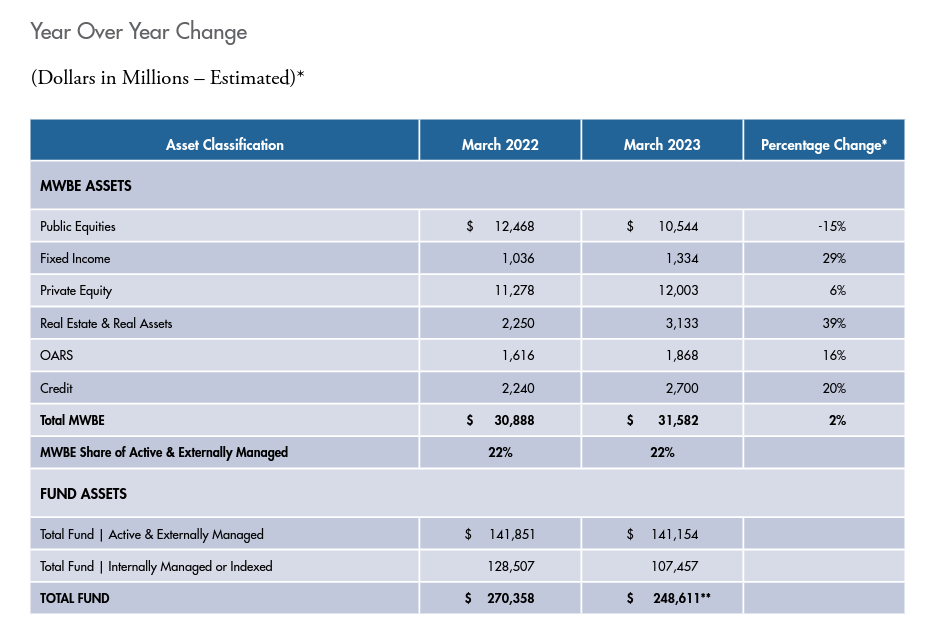
In the 2022-23 fiscal year, the Fund recorded growth in its investments with MWBE managers. Despite increased market volatility from the banking disruptions to small financial institutions and the regional banking system and the rise in interest rates, the Fund has continued its steady deployment of capital to MWBE investment managers. As detailed in the tables below, total investments and commitments of Fund capital to MWBE partners for 2022-23 was $31.5 billion.

….

While Fund management is very pleased with these results, our team is committed to retaining our long-term focus on steady, incremental growth, partnering with successful MWBE managers. The 2022-23 results illustrate another important measure of the success of the Fund’s MWBE Strategy. Of the approximate $141 billion of the Fund’s assets that are actively and externally managed, 22.3 percent is managed by MWBEs.

Author(s): Comptroller Thomas P. DiNapoli

Publication Date: May 2023

Publication Site: Office of the New York State Comptroller

Biden Admin Implores States to Slow Medicaid Cuts After More Than 1M Enrollees Dropped

Link: https://kffhealthnews.org/news/article/biden-administration-states-medicaid-cuts-million-dropped/

Excerpt:

Too many Americans are losing Medicaid coverage because of red tape, and states should do more to make sure eligible people keep their health insurance, the Biden administration said Monday.

More than a million Americans have lost coverage through the program for low-income and disabled Americans in the past several weeks, following the end of pandemic protections on April 1, according to the latest Medicaid renewal data from more than 20 states.

After a three-year pause, most states have now resumed checking which Medicaid recipients remain eligible and dropping those who no longer qualify or don’t complete required paperwork. About 4 in 5 people dropped so far either never returned the paperwork or omitted required documents, federal and state data show.

….

The Biden administration outlined several optional steps states can take to ensure everyone who still qualifies for the safety-net health insurance program stays covered. For instance, states can pause the cancellations to allow more time to reach people who haven’t responded. Health insurance companies that manage Medicaid plans can help their enrollees fill out the paperwork.

Author(s): Hannah Recht

Publication Date: 13 Jun 2023

Publication Site: Kaiser Health News
The 96 Billion Dollar Game: You Are Losing

Link:https://burypensions.wordpress.com/2023/06/12/the-96-billion-dollar-game-you-are-losing/

Excerpt:

That was back in 1993 when the book on “how personal injury litigation has become a costly game to you’ came out so these quotes may be outdated in their numbers.

….

The Insurance Information Institute estimates that 40 percent of all medical malpractice insurance is written through companies owned by doctors. (page 88)

Litigation is necessary to help the litigants acquire the information necessary to settle cases and to resolve questions of injury, liability, value and law….I estimate that no more than ten percent of the lawsuits currently filed need information that can be obtained only through the deposition process. However, once the information has been obtained, usually within a matter of a few months after the filing, most of these cases should settle. (page 114)

In the less regulated or unregulated states, the insurance rates are lower because the companies can compete freely. The problem is not the insurance companies ripping off the public but the stifling regulations. (page 123)

….

“The most blatant examples of misguided regulatory involvement in automobile insurance prices occurred in Massachusetts and New Jersey”. Jean C. Hiestand, the V.P. General Counsel of State Farm Insurance Company, in Competition And the Rating Laws: Do They Make A Difference? “They not only pay the highest rates but a large percentage are in the involuntary markets”. (page 149)

Many states do not allow insurance protection for punitive damages because punitive damages are to punish you for conduct beyond ordinary carelessness….Where punitive damages are sought, you have read that juries sometimes find against an innocent person or company for large sums. Worse yet, such debt is not dischargeable in bankruptcy. (page 189)

Author(s): John Bury

Publication Date: 12 Jun 2023

Publication Site: burypensions

Speed Limit Signs – a History of Speeding in the US

Link: https://www.roadtrafficsigns.com/speed-limit-signs-history

Graphic:

Excerpt:

The debate between those demanding the freedom to travel at high speeds in an unregulated environment and others citing the need for greater security and increased regulation (e.g. signs) was common in the 20’s and 30’s. For certain communities, “too slow speeds” were also an issue. As reported in the June, 1925 Lyle Sign Post, the chairman of the Maryland State Roads Commission, John Mackall, “advises substitution of the maximum speed limit with a minimum speed limit, to speed up traffic. Mackall also suggested slow-moving vehicles be barred from main streets during peak hours”.

Many states did not require drivers licenses. As part of the author’s own family lore, there is a wonderful story of two strong-willed daughters, Lydia and Mary, traveling from their home in North Dakota to visit their father, Senator Langer, in Washington, DC. With little experience, other than on farm machinery and certainly no license, they ended up in Washington in record time. Speed limits (and the few Speed Limit Signs) were proudly ignored.

For more discussion, see the excerpt below on fixed speed limits: “Should there be Fixed Speed Limits?“. Even in the 30’s and 40’s, speed limits were not uniform. Should speed limits change, depending upon the weather conditions, road conditions and time of day (for example, during school hours)?

Publication Date: accessed 7 Jun 2023

Publication Site: RoadTrafficSigns.com

Paying more for less

Link: https://allisonschrager.substack.com/p/paying-more-for-less

Excerpt:

Between the controversies at Disney, Bud Light, and Target, I think we need a return to shareholder primacy.

In 2019, many of the biggest American CEOs signed a manifesto declaring the end of shareholder primacy and embracing a new stakeholder model. With shareholder primacy, the main objective of a corporation is to maximize profits, both long- and short-term profits, because that is what boosts share prices and dividends, and shareholders like that. With the stakeholder model, a corporation has many other objectives: worker well-being, the environment, and the good of society. That may sound nice, but often, these stakeholders have competing objectives, and choosing who gets priority is a question of values.

When Milton Friedman argued for shareholder primacy, he said that a CEO should not forgo profits to exercise his personal values. It is not his money to spend, and not everyone shares his values, nor should they. And worse, I blame the multi-stakeholder model  for making everything feel more political.

Now, I realize even before 2019, companies were getting more political, but it got ramped up several notches in 2020. And now, everything you buy feels like a political statement. And even innocuous well-intentioned marketing campaigns that aim to give visibility to marginalized groups are taken as an explicit endorsement of a more divisive political agenda. I think shooting Bud Light cans in protest is stupid. But I get that people feel frustrated that everything is political and often not their politics.

And even if corporations mostly did pursue profits after 2019, and the stakeholder manifesto was a cynical ploy to appease young workers, get ESG capital, or avoid regulation, rhetoric matters. Before 2019, people could shrug at corporate pandering because it all seemed like a marketing ploy, and who can argue with selling lawn chairs and beer to the trans community? It is a growing demographic.

But in the context of announcing that you are doing it to make the world a better place, it strikes a different tone. And since stakeholder capitalism is about choosing between competing values, it is political. And now everything is worse for profits and society, since it adds to division and rancor.

Milton Friedman was right; shareholder primacy is better for corporations and society.

If CEOs really want to save the world, they should do the brave thing: announce an end to stakeholder capitalism and go back to just worrying about profits.

Author(s): Allison Schrager

Publication Date: 5 Jun 2023

Publication Site: Known Unknowns at substack

ESG tug-of-war leaves taxpayers shortchanged

Link: https://thehill.com/opinion/finance/4028654-esg-tug-of-war-leaves-taxpayers-shortchanged/

Excerpt:

The whole ordeal picked up steam years ago with efforts initiated by progressives in states like California, which has repeatedly imposed politically motivated restrictions on its largest pension funds, CalPERS and CalSTRS. In 2000, the state forced the funds to divest from tobacco companies, a move that cost nearly $3.6 billion in investment earnings. The pension funds have faced frequent — and occasionally successful — demands from activists and legislators on the left to divest of other progressive bogeymen, like firearms, oil and gas, and private prisons.

These politically motivated demands to place social goals above the fiduciary responsibility to pensioners persist, not just in California but also in MaineVermontMassachusetts and many other blue states. At a time when many state pension funds are facing enormous fiscal imbalances, these policies are worsening the problem and shifting massive burdens onto taxpayers, who will have to foot the bill for the progressive aims of policymakers.

Indeed, research shows that putting social policies ahead of fiduciary responsibility can come at a hefty cost. A study found that public pension funds with ESG investment mandates have investment returns that are 70 to 90 basis points lower than those that do not — meaning retirees are financially hurt by these investment strategies.

Not to be outdone, conservatives in red states have been fighting back with anti-ESG policies of their own. Unfortunately, rather than establishing an environment that ensures taxpayers are best served, many of these policies elevate conservative cultural preferences above fiscal considerations. Like the pro-ESG policies of the left, these anti-ESG policies have cost taxpayers considerably.

Author(s): Brandon Arnold

Publication Date: 1 Jun 2023

Publication Site: The Hill