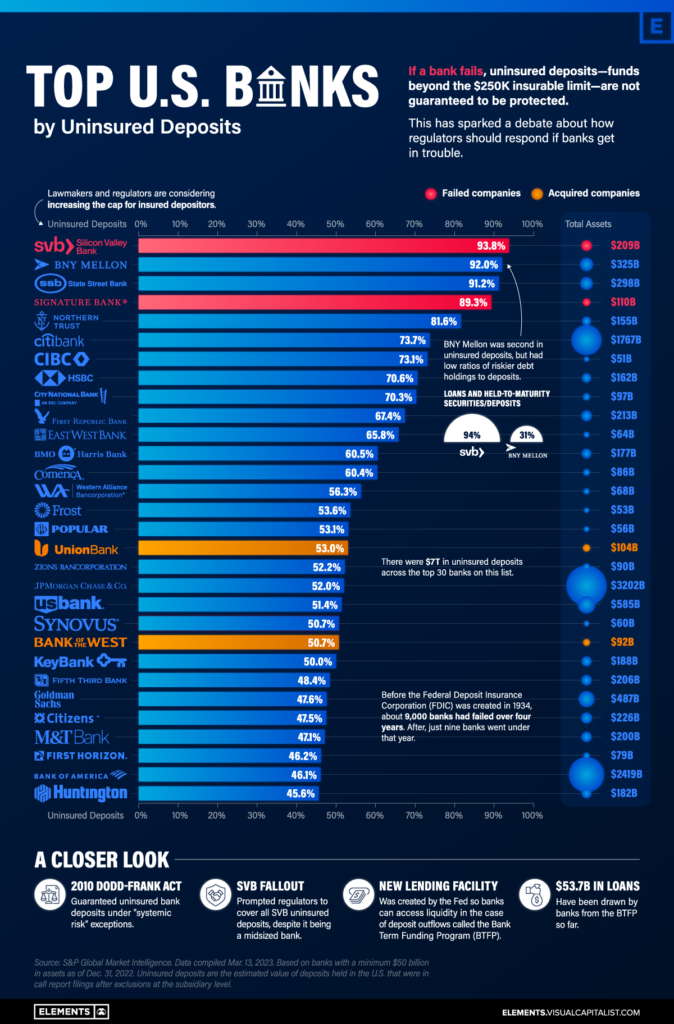
Ranked: The U.S. Banks With the Most Uninsured Deposits

Link: https://elements.visualcapitalist.com/ranked-the-u-s-banks-with-the-most-uninsured-deposits/

Graphic:

Excerpt:

Today, there is at least $7 trillion in uninsured bank deposits in America.

This dollar value is roughly three times that of Apple’s market capitalization, or about equal to 30% of U.S. GDP. Uninsured deposits are ones that exceed the $250,000 limit insured by the Federal Deposit Insurance Corporation (FDIC), which was actually increased from $100,000 after the Global Financial Crisis. They account for roughly 40% of all bank deposits.

In the wake of the Silicon Valley Bank (SVB) fallout, we look at the 30 U.S. banks with the highest percentage of uninsured deposits, using data from S&P Global.

Author(s): Dorothy Neufeld, Sabrina Lam

Publication Date: 4 April 2023

Publication Site: Visual Capitalist

NYC subway-track deaths soar, driven by social-media dares

Link: https://nypost.com/2023/04/02/nyc-subway-track-deaths-soar-driven-by-social-media-dares/

Excerpt:

The Metropolitan Transportation Authority had distressing news last week: Deaths on subway-train tracks soared in 2022, to 88.

It’s a little-remarked element of our post-2020 era of disorder and chaos.

….

But as with everything else in New York in the past three years, things went awry. Last year’s 88 track deaths were 35% above the 2018 and 2019 averages — 65 each year.

For context, 120 pedestrians died above ground last year in crashes with cars or trucks, close to the average of 121 in 2018 and 2019.

….

What’s going on? Of 1,365 known subway-track incidents in 2022 (most of which didn’t end in death), about 15% were accidental falls or medical emergencies, a new MTA analysis finds.

A thankfully surprisingly low number — fewer than 10% — was suicides or suicide attempts.

An even smaller percentage was assaults — that is, people being pushed to the tracks. (Though with pushes to the tracks comprising three of last year’s 10 subway murders, a 30-year high, a small percentage is too many.)

In most cases — well more than two-thirds — people ended up on the tracks voluntarily.

In 20% of total cases, people were clearly mentally ill (but not attempting suicide); in another 10% or so, people were drugged or drunk.

….

The worst spike in track intrusions started a little more than a year ago, in December 2021 to February 2022. (This includes January 2022, when Michelle Go was pushed to her death in Times Square by a mentally ill, violent ex-con.)

This winter, track intrusions are down 30%.

Why? Largely police enforcement.

Author(s): Nicole Gelinas

Publication Date: 2 April 2023

Publication Site: NY Post

Thousands of Retirees Can’t Withdraw Savings Invested in Firms Controlled by Indicted Financier Greg Lindberg

Link: https://www.wsj.com/articles/thousands-of-retirees-cant-withdraw-savings-invested-in-firms-controlled-by-indicted-financier-greg-lindberg-6a268369?st

Excerpt:

The 52-year-old executive [Greg Lindberg] was indicted last month on federal charges that he defrauded his insurers by lending $2 billion of their funds to companies in his private conglomerate, while allegedly siphoning off huge sums to finance his lavish lifestyle. He has pleaded not guilty and is out on bail.

Until last July, Mr. Lindberg was in federal prison on bribery charges related to the insurers. He was released after 21 months when an appeals court overturned the conviction. A retrial is scheduled for November.

The executive also is fighting a drawn-out court battle with North Carolina regulators, who seized his insurers in 2019 and now say they should be liquidated. Mr. Lindberg, who previously lived in North Carolina and was the subject of investigative articles in The Wall Street Journal in 2019, says the insurers are healthy and he has a plan to rescue them.

What rankles Mr. Zintel and others is that they believe Mr. Lindberg is using their money to fight his legal entanglements, allowing him to continue living extravagantly even as they cut back. Among the alleged extravagances: The divorced executive has spent millions of dollars on gifts for women, according to court documents, including paying some women to produce offspring for him.

Some 70,000 holders of annuities totaling $2.2 billion are unable to withdraw their money, filings show. Many are retirees or conservative investors who bought five- to seven-year annuities in 2017 and 2018. Financial advisers typically marketed them as a safe, higher-yielding alternative to bank CDs.

Author(s): Mark Maremont, Leslie Scism

Publication Date: 26 Mar 2023

Publication Site: WSJ

Why the life insurance industry did not face an “S&L-type” crisis

Link: https://econpapers.repec.org/article/fipfedhep/y_3a1993_3ai_3asep_3ap_3a12-24_3an_3av.17no.5.htm

PDF link: https://econpapers.repec.org/scripts/redir.pf?u=http%3A%2F%2Fwww.chicagofed.org%2Fdigital_assets%2Fpublications%2Feconomic_perspectives%2F1993%2Fep_sep_oct1993_part2_brewer.pdf;h=repec:fip:fedhep:y:1993:i:sep:p:12-24:n:v.17no.5

Full reference:

Elijah BrewerThomas H. Mondschean and Philip E. Strahan

Economic Perspectives, 1993, vol. 17, issue Sep, 12-24

Graphic:

Excerpt:

In most states, coverage under guaranty

funds is $300,000 in death benefits, $100,000 in

cash or withdrawal value for life insurance,

$100,000 in present value of annuity benefits,

and $100,000 in health benefits. Some states

cover all insurance policies written by an insol-

vent firm located in the state; others cover the

policies of residents only. In the case of unallo-

cated annuities such as GICs purchased by com-

panies to fund pension plans, some states cover

up to a certain amount, usually $5 million. Oth-

er states, such as California, Massachusetts, and

Missouri, do not cover GICs.

Because of variations in state guaranty

funds and in the way insolvencies are handled,

the parties bearing the costs of an insurance

failure differ across states. Surviving insurance

companies initially pay their assessments and

claim them as an expense on their federal corpo-

rate income tax return, reducing their federal

income taxes. As companies receive tax credits

in subsequent years, these credits become tax-

able income. As a result, the federal government

bears part of the cost of an insolvency since it

does not fully recover the present value of the

tax decrease granted in the assessment year. In

states with premium tax offsets, however, the

majority of the cost is paid by state taxpayers.

A study of 1990 life/health guaranty fund assess-

ments found that 73.6 percent was paid by state

taxpayers, 8.9 percent by federal taxpayers, and

17.5 percent by the equity holders of the surviv-

ing firms.
Author(s): Elijah BrewerThomas H. Mondschean and Philip E. Strahan

Publication Date: September 1993

Publication Site: Economic Perspectives, Chicago Fed

What You Can Do To Force Your State Pension To Be Transparent About Its Investments

Link: https://pensionwarriorsdwardsiedle.substack.com/p/what-you-can-do-to-force-your-state

Excerpt:

So what can you do to force your state or local government pension to be more transparent? That’s a question I asked Marc Dann, an attorney in private practice in Ohio and the former Attorney General of Ohio. (Dann is currently litigating a public records request on my behalf against the State Teachers Retirement System of Ohio.)

Say attorney Dann: “Refer to your state’s public records laws in making a request. Be as detailed and specific in the request as you can possibly be. Remember public records are only those records that may actually exist. For example, instead of asking for a list of all hedge, private equity or venture capital fund investments, ask for a prospectus, offering documents or reports provided to the pension by each investment fund (and name the investment funds—which are generally named on the state or local pension’s website).  Most states allow legal fee-shifting in public records lawsuits. So if the pension or fund resists, you may wish to consider bringing in a lawyer who agrees to be paid his fee from any recovery from the pension. Don’t forget to reach out to allied members of your state legislature or city council who can put pressure on the pensions to properly respond to the requests.”

Author(s): Edward Siedle

Publication Date: 22 Mar 2023

Publication Site: Pension Warriors on substack