What the Madoff Series Left Out

Link: https://reason.com/video/2023/02/21/what-the-madoff-series-left-out/

Excerpt:

And yet, nothing in the series leads the viewer to the conclusion that the SEC needed a bigger budget to catch Madoff. In fact, outsiders were sounding the alarm without access to government funding or regulatory muscle. In 2001, Barron’s journalist Erin Arvedlund reported that many Wall Street investors were suspicious that Madoff was engaged in foul play.

And the SEC received its first complaint that Madoff was running “an unregistered investment company” “offering ‘100%’ safe investments” in 1992. In 1999, a derivatives expert named Harry Markopolos, who worked at a competing firm, started to alert the SEC that Madoff’s investment returns were virtually impossible. In 2005, Markopolos sent the agency an infamous 25-page memo explaining why “The World’s Largest Hedge Fund is a Fraud.” The SEC opened an investigation in 2006, and then closed it the following year because the “uncovered violations” were “remedied” and “those violations were not so serious as to warrant an enforcement action.”

So how is this tale of epic failure on the part of a government agency the fault of deregulation?

Instead of making lazy allusions to the evils of free market capitalism, to better understand the lessons of the Madoff saga, director Joe Berlinger should have consulted the work of the free market economist George Stigler, who won the Nobel Prize in part for his work on “regulatory capture.”

Author(s): ZACH WEISSMUELLER AND DANIELLE THOMPSON

Publication Date: 21 Feb 2023

Publication Site: Reason
The End Is Near for Outdated Government Financial Reporting

Link: https://www.route-fifty.com/finance/2023/02/end-near-outdated-government-financial-reporting/382747/

Excerpt:

By way of a few paragraphs inserted into the recently enacted 4,000-page 2023 National Defense Authorization Act, Congress mandated that state and local governments prepare their annual financial statements in a standardized format that is electronically searchable. The provision effectively drags state and local governments kicking and screaming into the 20th century, if not the 21st.

As worthy an accomplishment as this appears to be, it was resisted mightily by the state and local government financial community. Most prominently, they argue, the measure can potentially result in a major transfer of accounting and reporting regulatory authority from states to the federal government, thereby undercutting what many consider a fundamental principle of federalism. Moreover, state and local officials see it as one more costly unfunded mandate imposed upon their governments.   

The opposition by state and local governments is understandable. But they have no one to blame but themselves. To this day they are wedded to a technological past. In a perverted way, they may be getting their just desserts. The act requires them to do little more than what they should have done years ago on their own for the benefit of their investors and other stakeholders.  

Implicit in the act is that governments will have to prepare their financial statements using XBRL (eXtensible Business Reporting Language) or some comparable reporting framework. This is the format that the Securities and Exchange Commission, which would be charged with implementing the new provision, currently demands corporations use in their financial filings. XBRL requires all entities to classify each of the elements of their financial statements (e.g., assets, liability, revenues and expenses) by identical rules and in machine readable form.    

Author(s): Michael Granof and Martin J. Luby

Publication Date: 8 Feb 2023

Publication Site: Route Fifty

How Many Rate Hikes Does the Market Now Expect of the Fed?

Link: https://mishtalk.com/economics/how-many-rate-hikes-does-the-market-now-expect-of-the-fed

Graphic:

Excerpt:

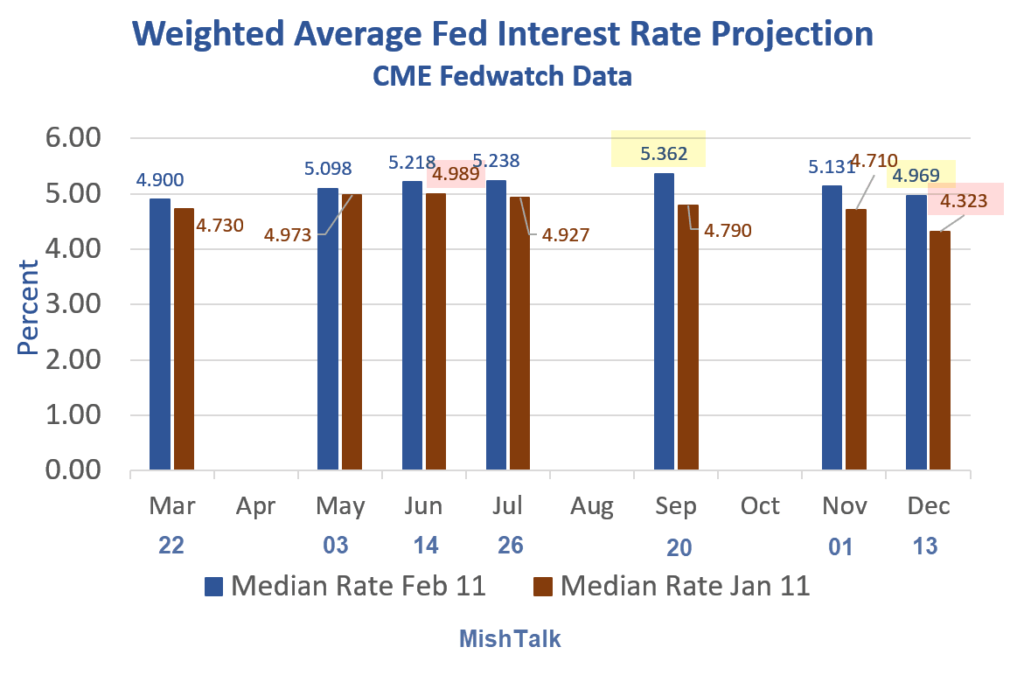
Now Vs a Month Ago

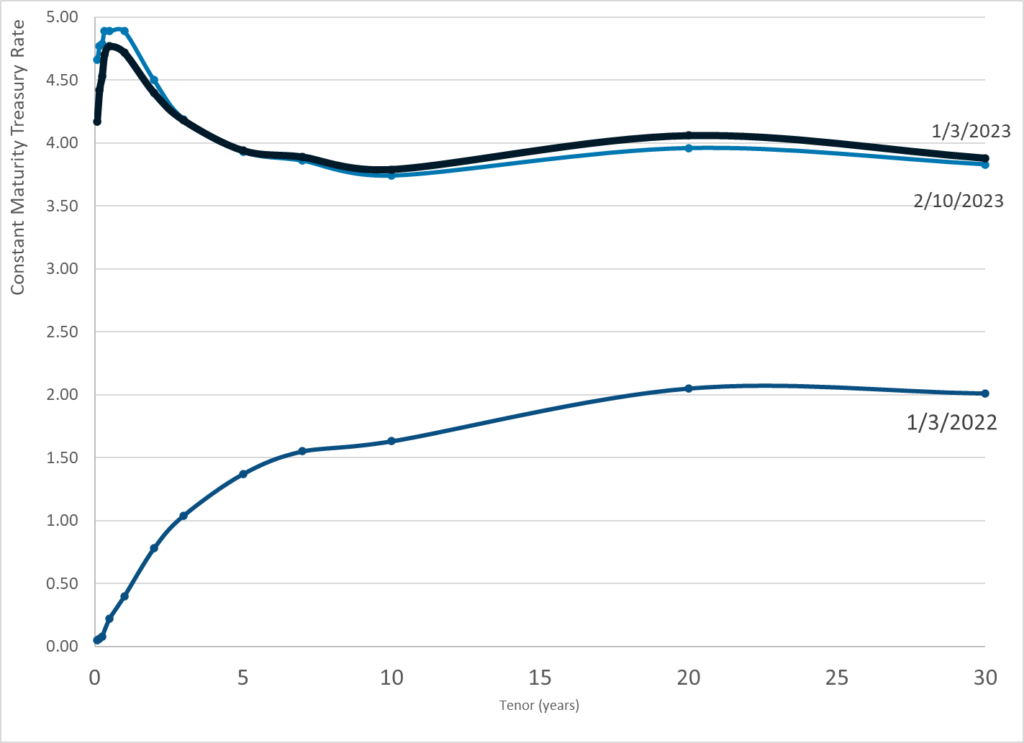
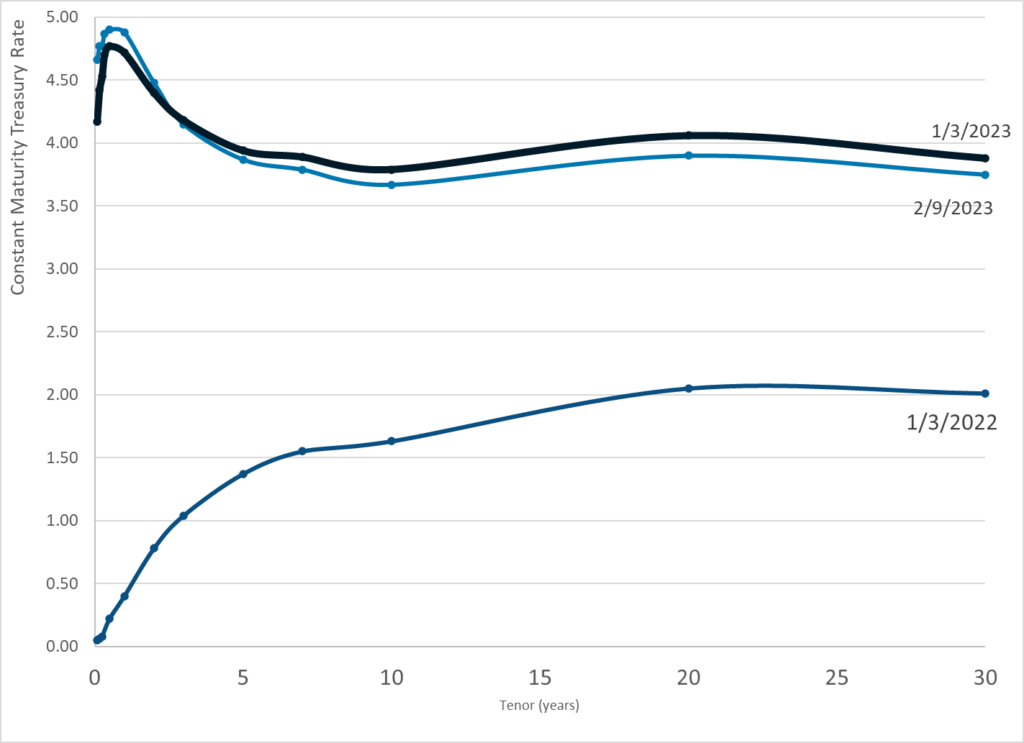
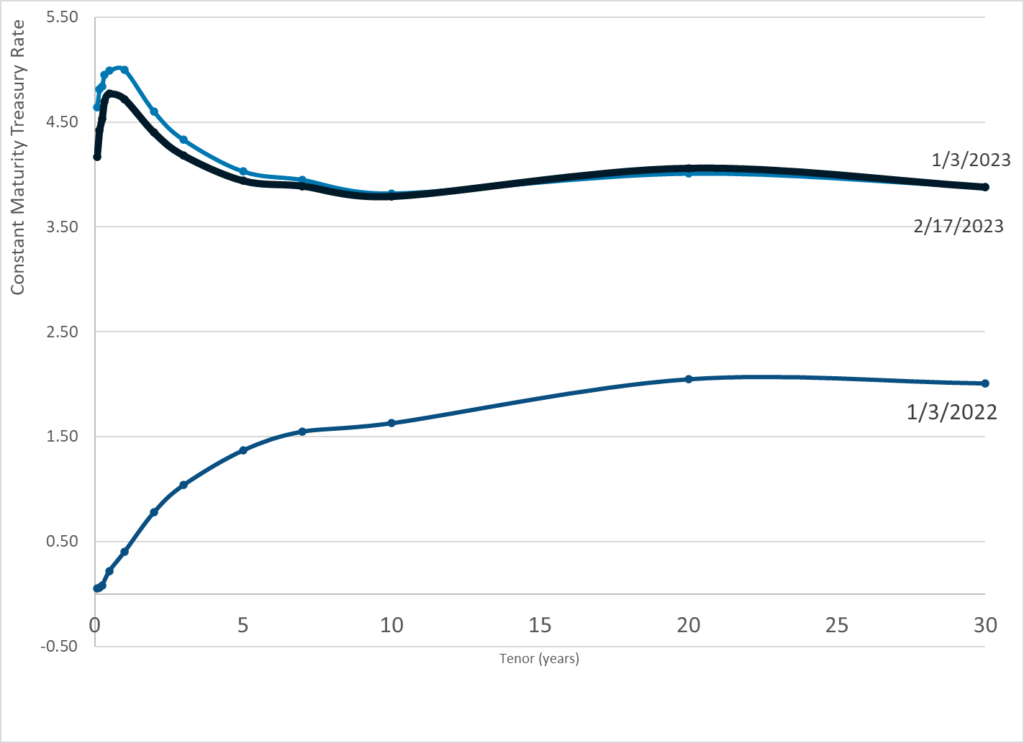
  • The market now sees a terminal rate of 5.36 percent in September, call it 5.25-5.50 percent.
  • A month ago the market thought the terminal rate was 5.00 percent in June. 
  • Previously, the market expected a peak in June followed by two or three 25-basis point cuts all the way to 4.32 percent. 
  • The market now sees a a cut from 5.36 percent to 5.0 percent.

Author(s): Mike Shedlock

Publication Date: 11 Feb 2023

Publication Site: Mish Talk

EBSA Secretary Defends ESG Rule as Legislative, Litigation Battles Continue

Link: https://www.ai-cio.com/news/ebsa-secretary-defends-esg-rule-as-legislative-litigation-battles-continue/

Graphic:

Excerpt:

The Department of Labor’s assistant secretary of labor for employee benefits security, Lisa Gomez, defended the DOL’s final rule allowing the consideration of ESG factors in retirement plan investments at a webinar hosted Monday by Ceres, a sustainability advocate.

The rule, which took effect on January 30, permits, but does not require, the use of ESG considerations in investment selection by retirement plan fiduciaries. There is a pending lawsuit in Texas challenging the legality of the rule.

Gomez explained that this rule is “not a per se requirement” to use ESG and clarifies that ESG factors may be considered as part of a fiduciary’s ordinary risk-return analysis. She also explained that this new rule does not allow fiduciaries to sacrifice the financial health of a plan to pursue other goals: A fiduciary may consider the risks and opportunities of climate change and other ESG factors.

Gomez dubbed the rule “a return to neutrality.”

According to Gomez, the previous rule, passed during the administration of President Donald Trump, which required only “pecuniary factors” to be used in investment selection, had a “chilling effect” on the consideration of ESG factors. Gomez said the word “pecuniary” neither appears in the text of the Employee Retirement Income Security Act, the governing statute for both rules, nor does it occupy a “long-standing place in employee benefits law.”

Gomez briefly discussed one of the more nebulous provisions of the new rule when she said participant preferences for investments can be considered in menu selection on the grounds that it can increase plan participation and deferral rates, thereby increasing retirement security. She did not comment on how fiduciaries should determine adequate participant interest or how much economic gain could be compromised in exchange for increased participation, if any.

Eric Pitt, a climate finance consultant at Ceres who moderated the webinar, asked Gomez how a fiduciary should consider a hypothetical ESG large-cap stock fund for a plan menu: Should the fiduciary compare it to other similar ESG funds or the entire universe of large-cap funds? Gomez answered that there is no special treatment for ESG funds, and a fiduciary should look generally at the risk and return for any and all large-cap equity funds available, whether they use ESG considerations or not.

Despite the branding of the rule as neutral, Republicans in Congress have increased their organized opposition to the use of ESG considerations in retirement-plan investing.

Representative Patrick McHenry, R-North Carolina, chairman of the House Financial Services Committee, announced the creation of a “Republican ESG working group” on Friday. The purpose of the working group is to “combat the threat to our capital markets posed by those on the far-left pushing environmental, social, and governance (ESG) proposals.”

Author(s): Paul Mullholland

Publication Date: 6 Feb 2023

Publication Site: ai-CIO

The End of the COVID-19 Public Health Emergency: Details on Health Coverage and Access

Link: https://www.kff.org/policy-watch/the-end-of-the-covid-19-public-health-emergency-details-on-health-coverage-and-access/

Excerpt:

On Jan. 30, 2023, the Biden Administration announced it will end the public health emergency (and national emergency) declarations on May 11, 2023. Here’s what major health policies will and won’t change when the public health emergency ends.

Vaccines

What’s changing: Nothing. The availability, access, and costs of COVID-19 vaccines, including boosters, are determined by the supply of federally purchased vaccines, not the public health emergency.

What’s the same: As long as federally purchased vaccines last, COVID-19 vaccines will remain free to all people, regardless of insurance coverage. Providers of federally purchased vaccines are not allowed to charge patients or deny vaccines based on the recipient’s coverage or network status.

….

At-home COVID tests

What’s changing: At-home (or over-the-counter) tests may become more costly for people with insurance. After May 11, 2023, people with traditional Medicare will no longer receive free, at-home tests. Those with private insurance and Medicare Advantage (private Medicare plans) no longer will be guaranteed free at-home tests, but some insurers may continue to voluntarily cover them.

For those on Medicaid, at-home tests will be covered at no-cost through September 2024. After that date, home test coverage will vary by state.

….

COVID Treatment

What’s changing: People with public coverage may start to face new cost-sharing for pharmaceutical COVID treatments (unless those doses were purchased by the federal government, as discussed below). Medicare beneficiaries may face cost-sharing requirements for certain COVID pharmaceutical treatments after May 11. Medicaid and CHIP programs will continue to cover all pharmaceutical treatments with no-cost sharing through September 2024. After that date, these treatments will continue to be covered; however, states may impose utilization limits and nominal cost-sharing.

….

Author(s): Cynthia Cox Follow @cynthiaccox on Twitter , Jennifer Kates Follow @jenkatesdc on Twitter , Juliette Cubanski Follow @jcubanski on Twitter , and Jennifer Tolbert

Publication Date: 3 Feb 2023

Publication Site: Kaiser Family Foundation