How Medicare Advantage Plans Dodged Auditors and Overcharged Taxpayers by Millions

Link: https://khn.org/news/article/medicare-advantage-auditors-overcharged-taxpayers/

Excerpt:

A review of 90 government audits, released exclusively to KHN in response to a Freedom of Information Act lawsuit, reveals that health insurers that issue Medicare Advantage plans have repeatedly tried to sidestep regulations requiring them to document medical conditions the government paid them to treat.

The audits, the most recent ones the agency has completed, sought to validate payments to Medicare Advantage health plans for 2011 through 2013.

As KHN reported late last month, auditors uncovered millions of dollars in improper payments — citing overcharges of more than $1,000 per patient a year on average — by nearly two dozen health plans.

Author(s): Fred Schulte and Holly K. Hacker

Publication Date: 13 Dec 2022

Publication Site: Kaiser Health News

Federal Reserve hikes rates again

Link: https://www.thecentersquare.com/national/federal-reserve-hikes-rates-again/article_da8ec844-7be2-11ed-9977-17d7d24d73fb.html

Excerpt:

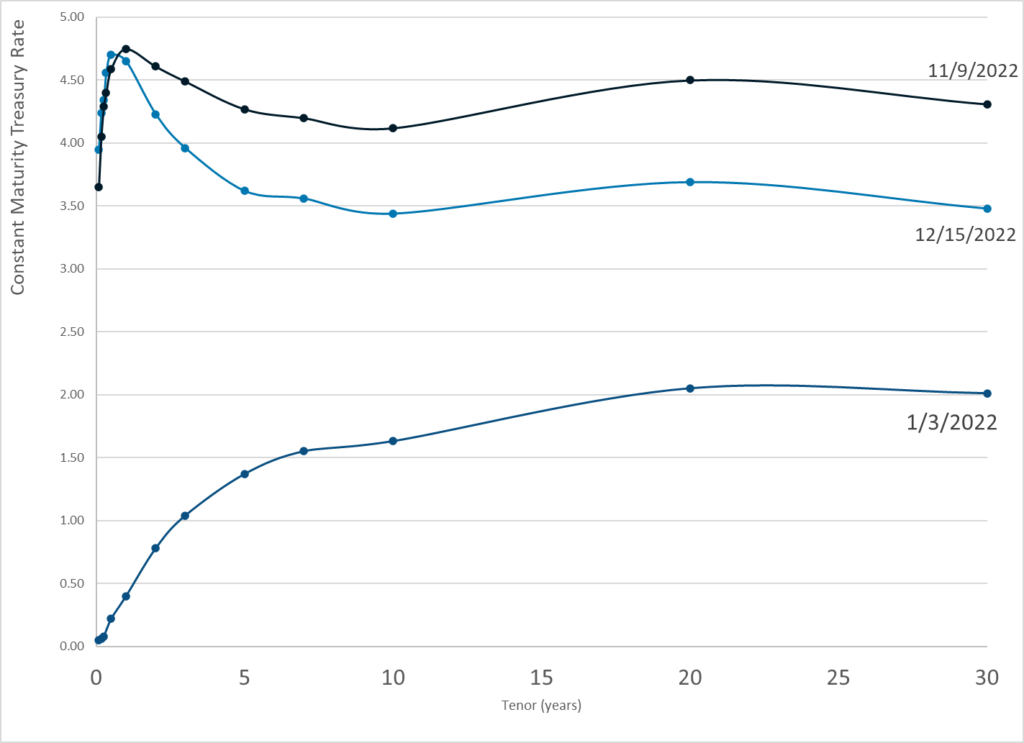
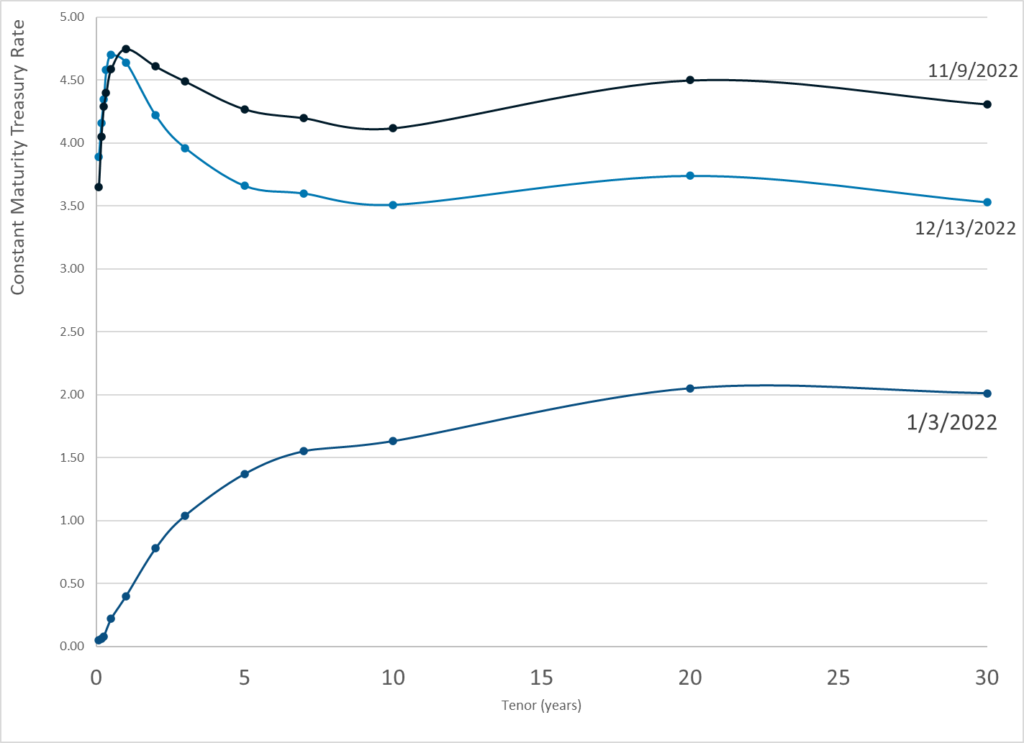
The U.S. Federal Reserve announced a new rate increase of half a percentage point Wednesday in its ongoing effort to curb inflation.

The Fed raised the rate by 50 basis points, as expected, the seventh rate hike this year. This increase is smaller than the four previous 75 basis point increases but is still a notable increase, putting the range at 4.25%-4.5%.

“Recent indicators point to modest growth in spending and production. Job gains have been robust in recent months, and the unemployment rate has remained low,” the Fed said. “Inflation remains elevated, reflecting supply and demand imbalances related to the pandemic, higher food and energy prices, and broader price pressures.”

The Fed blamed the Russian war in Ukraine for the price hikes. That war delayed the supply chain and increased costs, but the price increases began long before that war, due in part to trillions of dollars in federal debt spending since the pandemic began.

Author(s): Casey Harper

Publication Date: 14 Dec 2022

Publication Site: The Center Square

2022 Insurance Regulation Report Card

Link: https://www.rstreet.org/2022/12/12/2022-insurance-regulation-report-card/

PDF link of report: https://www.rstreet.org/wp-content/uploads/2022/12/r-street-policy-study-no-272.pdf

Graphic:

Excerpt:

KEY POINTS

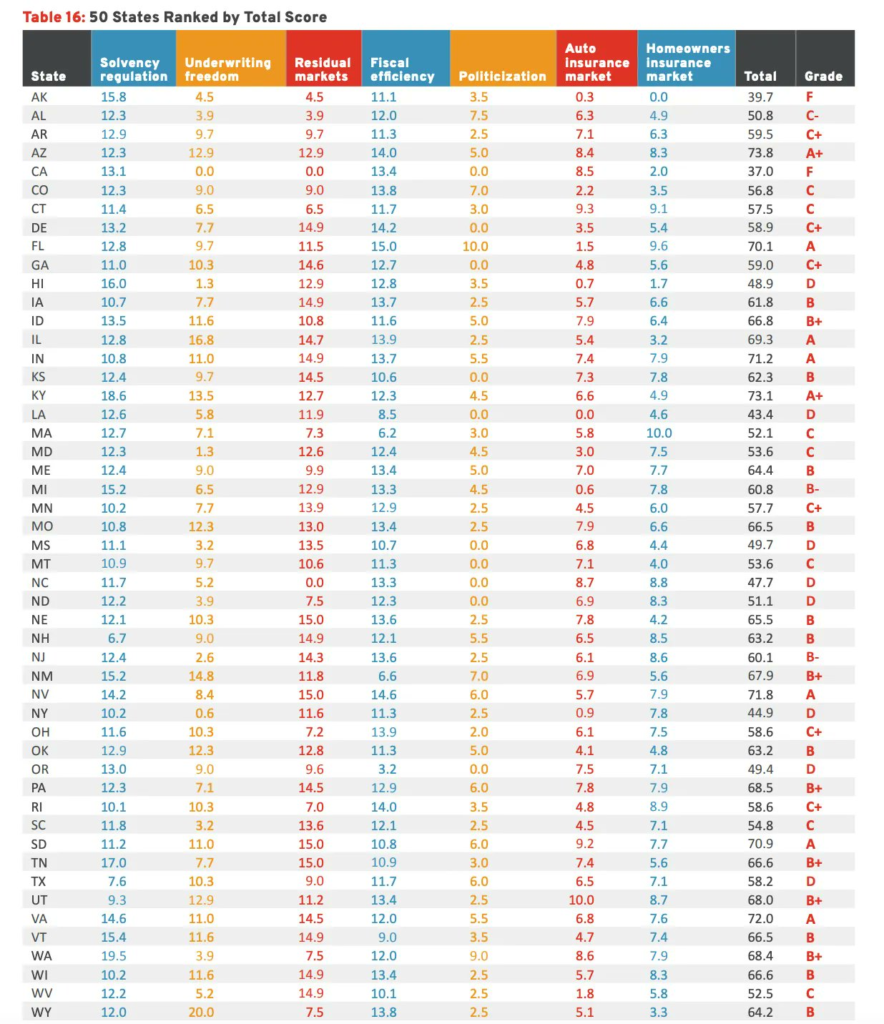
  1. The RSI Insurance Regulation Report Card analyzes and evaluates the effectiveness of state government regulation of property and casualty insurance and assigns a letter grade to all 50 states. The grade for each state was calculated by adding the weighted results from seven categories.
  2. The highest grades were for Kentucky and Arizona, both of which received an A+. At the other end of the spectrum, California and Alaska both scored an F.
  3. 20 states had a higher grade than they did in R Street’s 2020 edition of the Report Card, 23 maintained the same grade and seven had lower grades. This result is positive and means that insurance regulatory regimes have become more effective and efficient in the past two years.

Executive Summary
We are pleased to present the 10th edition of R Street’s Insurance Regulation Report Card, which analyzes and evaluates the effectiveness of U.S. insurance regulation of property and casualty insurance. The first iteration of this report was published in June 2012, and this 2022 edition largely follows the format of prior reports. It begins with a brief introduction on the current landscape of U.S. insurance regulation; reviews recent, relevant federal and state-based regulatory changes; presents a detailed evaluation of the effectiveness of each state’s regulation of insurance in seven key categories; and synthesizes those category evaluations by offering a “report card” grade for each state for analysis and comparison purposes.

This report draws on 2021 year-end statutory insurance financial statistics and the most recent datasets available for non-financial information. Sources include data and reports from the National Association of Insurance Commissioners (NAIC), S&P Global Market Intelligence, National Conference of State Legislatures, R Street analyses and others, all of which were accessed through Sept. 30, 2022.

In this report, we seek to shed light on the same three foundational issues we have focused on in past iterations of this report card:
• How free are consumers to choose the insurance products they want?
• How free are insurers to provide the insurance products consumers want?
• How effectively are states discharging their duties to monitor insurer solvency and foster competitive, private insurance markets?

Author(s): Jerry Theodorou

Publication Date: 12 Dec 2022

Publication Site: R Street

Arizona divesting funds from BlackRock over ESG push

Link: https://www.foxbusiness.com/markets/arizona-divesting-funds-from-blackrock-over-esg-push

Excerpt:

Arizona is forging ahead with its plan to pull the state’s funds from BlackRock due to concerns over the massive investment firm’s push for environmental, social, and governance (ESG) policies that have led other states to take similar actions.

Arizona Treasurer Kimberly Yee said in a statement released Thursday that the state treasury’s Investment Risk Management Committee (IRMC) began to assess the relationship between the state’s trust fund and BlackRock in late 2021. 

“Part of the review by IRMC involved reading the annual letters by CEO Larry Fink, which in recent years, began dictating to businesses in the United States to follow his personal political beliefs,” Yee wrote. “In short, BlackRock moved from a traditional asset manager to a political action committee. Our internal investment team believed this moved the firm away from its fiduciary duty in general as an asset manager.”

In response to those findings, Yee noted that Arizona began to divest over $543 million from BlackRock money market funds in February 2022 and “reduced our direct exposure to BlackRock by 97%” over the course of the year. Yee added that Arizona “will continue to reduce our remaining exposure in BlackRock over time in a phased in approach that takes into consideration safe and prudent investment strategy that protects the taxpayers.”

….

Florida’s chief financial officer announced recently that the state’s treasury is taking action to remove about $2 billion in assets from BlackRock’s stewardship before the end of this year. In October, Louisiana and Missouri announced they would reallocate state pension funds away from BlackRock, which amounted to roughly $1.3 billion in combined assets. Taken together with Arizona’s divestment, roughly $3.8 billion in state funds have been divested from BlackRock by those four states alone.

Additionally, North Carolina’s state treasurer has called for BlackRock CEO Larry Fink’s resignation and the Texas legislature has subpoenaed BlackRock for financial documents.

The investment firm has also taken heat from activists who argue BlackRock isn’t doing enough to follow through with its ESG commitments. New York City Comptroller Brad Lander wrote to Fink in September citing an “alarming” contradiction between the company’s words and its deeds. Lander wrote, “BlackRock cannot simultaneously declare that climate risk is a systemic financial risk and argue that BlackRock has no role in mitigating the risks that climate change poses to its investments by supporting decarbonization in the real economy.”

Author(s): Eric Revell

Publication Date: 11 Dec 2022

Publication Site: Fox Business

Testimony Before the Subcommittee on Oversight and Investigations of the Financial Services Committee of the U.S. House of Representatives on “An Enduring Legacy: The Role of Financial Institutions in the Horrors of Slavery and the Need for Atonement, Part Two”

Link: https://financialservices.house.gov/uploadedfiles/hhrg-117-ba09-wstate-darityw-20221207.pdf

Testimony for this hearing: https://financialservices.house.gov/events/eventsingle.aspx?EventID=409969

Excerpt:

The collective amount required to close the disparity for approximately 40 million black American
descendants of persons enslaved in the United States will come to at least $14 trillion. This is a sum that
cannot be met reasonably by private donors or other levels of government. If generous donors created a
fund to eliminate the racial wealth gap by contributing $1 billion monthly, it would take a millennium to
reach $14 trillion. The combined budgets of all state and local governments used to meet all of their
obligations amount to less than $5 trillion.

Financial institutions were key supporters and beneficiaries of American slavery. The full scope of
creditor-debtor relationships interlocked with the slave plantation system has yet to be documented
adequately. For the record details are needed about which organizations were the financiers for the
New England textile industry, which bank or banks had Brooks Brothers, producers of “plantation wear”
for both the enslaved and the enslavers, as a client, and who were the lenders to the southern planters
themselves. This will require thick archival research that has yet to be undertaken.


It is now well established that a number of existing insurance companies participated significantly in
providing slaveowners with contracts to protect them for financial loss in the event of death or damage
of their human property, particularly their highly skilled property These include New York Life, known as
the Nautilus Insurance Company in the antebellum period, Aetna, Baltimore Life, Southern Mutual
Insurance Company, the Loews Corporation, and AIG.


Lloyd’s of London and RSA Insurance Group the point before the overseas slave trade was declared
illegal, insurance companies routinely protected voyages to procure captive Africans. British insurers
figured prominently, especially Lloyd’s of London and the RSA Insurance Group , in the form of one of its
ancestor business, London Assurance.

….

During the course of approximately 100 white terrorist assaults on black communities from the Civil War
to the 1940s, black lives were taken and black owned property was seized or destroyed by the white
mobsters. Black property owners who lived through the massacres rarely received any form of
compensation, particularly from insurance companies with whom they held policies.


An estimated present value of $611 million dollars of black-owned property was lost during the 1921
Tulsa massacre. What can best be described as a “Negro clause” in the policies gave insurance
companies the basis for denying the massacre victims’ claims. The “…insurance companies fell back on
an exclusionary clause…that…said insurers wouldn’t be held liable for loss ‘caused directly or indirectly
by invasion, insurrection, riot, civil or commotion, or military or usurped power’” (Council 2021).

Author(s): William Darity Jr., the Samuel DuBois Cook Professor of Public Policy, African and African American Studies, Economics, and Business at Duke University

Publication Date: 7 Dec 2022

Publication Site: House of Representatives, Financial Services Committee
Lawmakers Discuss How Financial Institutions Should Address Ties to Slavery

Link: https://www.thinkadvisor.com/2022/12/12/lawmakers-discuss-how-financial-institutions-should-address-ties-to-slavery/

Excerpt:

Rep. Al Green, D-Texas, wants to develop legislation that could affect how insurers and other financial institutions address their historical involvement in slavery.

Green and other lawmakers talked about ideas for legislation related to slavery during a  recent hearing of the House Financial Services oversight subcommittee on the role of financial institutions in the horrors of slavery.

….

Berkshire Hathaway, for example, descends partly from The Valley Falls Company, a textile manufacturer owned by members of an abolitionist family, Rockman said.

But members of the abolitionist family “rarely paused to ask where their cotton came from,” Rockman said. “Virtually every cotton fiber they spun and wove would have been slave-grown and slave-picked.”

William Darity Jr., a public policy professor at Duke University, talked about the role of insurers in slavery. He noted that Aetna, AIG, Baltimore Life, Loews Corp., New York Life and Southern Mutual Insurance Company all descend from companies that protected slaveowners against the deaths of slaves.

Author(s): Allison Bell

Publication Date: 12 Dec 2022

Publication Site: Think Advisor