Backlash Against ESG Investment Of Taxpayer Money Grows, But Illinois And Chicago Carry On – Wirepoints

Link: https://wirepoints.org/backlash-against-esg-investment-of-taxpayer-money-grows-but-illinois-and-chicago-carry-on-wirepoints/

Excerpt:

But those scorned sectors have been the better investments this year, and tech companies have been hammered. Only 31% of actively managed ESG equity funds beat their benchmarks in the first half of 2022, compared to 41% of conventional funds, according to Refinitiv Lipper, as Reuters recently reported. So far this year, 19 of the 20 best-performing companies in the S&P 500 are either fossil-fuel producers or otherwise connected with fossil fuels.

Consequently, ESG funds “have been hit by unprecedented outflows in the market downturn, as investors prioritize capital preservation over goals such as tackling climate change,” wrote Reuters.

Predictably, the issue has become political since state and local officials invest trillions of dollars owned by taxpayers. Republican candidates generally oppose ESG investment of public funds, and five positions — in Kansas, Iowa, Missouri, Nevada and Wisconsin — flipped from Democratic to Republican in recent races for state auditor, controller or treasurer. Of the 50 directly elected positions, Republicans won 29 and Democrats won 19, according to a recent Roll Call report.

Illinois Treasurer Michael Frerichs, however, is among the Democratic officials not backing off on ESG. “We are in it for the long term” is the title of an open letter he recently signed along with 13 other Democratic state financial officers criticizing efforts to stop ESG use of taxpayer money. The letter is astonishingly hypocritical. It says those who want to ban ESG investment of public money are “blacklisting financial firms that don’t agree with their political views.” That, of course, is precisely what ESG does.

Author(s): Mark Glennon

Publication Date:19 Nov 2022

Publication Site: Wirepoints
Maternal Mortality Rates in the United States, 2020

Link: https://stacks.cdc.gov/view/cdc/113967

Graphic:

Excerpt:

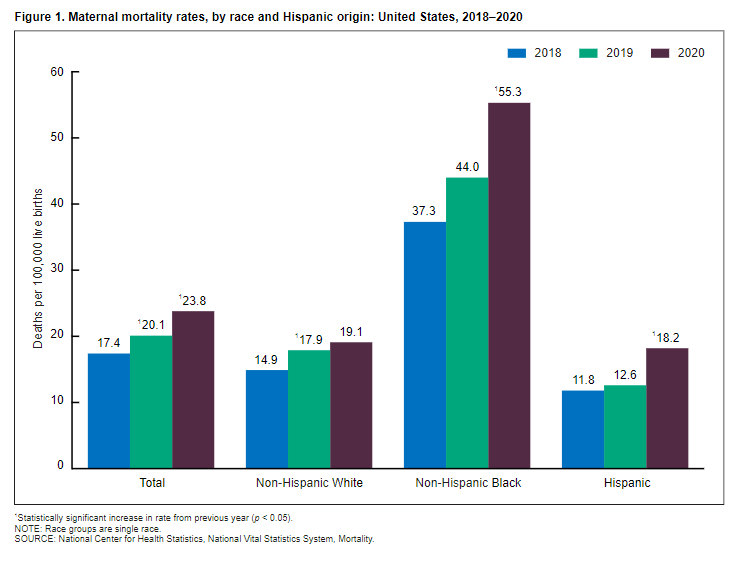
This report updates a previous one that showed maternal mortality rates for 2018 and 2019 (2).
In 2020, 861 women were identified as having died of maternal causes in the United States,
compared with 754 in 2019 (3). The maternal mortality rate for 2020 was 23.8 deaths per
100,000 live births compared with a rate of 20.1 in 2019 (Table).
In 2020, the maternal mortality rate for non-Hispanic Black women was 55.3 deaths per 100,000
live births, 2.9 times the rate for non-Hispanic White women (19.1) (Figure 1 and Table). Rates
for non-Hispanic Black women were significantly higher than rates for non-Hispanic White and
Hispanic women. The increases from 2019 to 2020 for non-Hispanic Black and Hispanic women
were significant. The observed increase from 2019 to 2020 for non-Hispanic White women was
not significant.

Author(s): Donna L. Hoyert

Publication Date: 23 Feb 2022

Publication Site: CDC Stacks

DOI: https://dx.doi.org/10.15620/cdc:113967

A Woke Panic on Maternal Mortality

Link: https://www.city-journal.org/a-woke-panic-on-black-maternal-mortality

Excerpt:

The Centers for Disease Control and Prevention has created the public concern about black maternal mortality. In February, the CDC released data showing that the maternal mortality rate for black women is 2.9 times higher than the rate for white women. It’s a worrisome statistic, yet the CDC’s own data, as well as a study from the CDC Foundation, provide crucial (and generally unreported) context.

To be clear, even a single death of a pregnant woman is one too many. But the overwhelming majority of women survive motherhood: in 2020, according to the CDC, 861 women in the United States died related to pregnancy, out of a total of about 3.6 million births—a rate of 0.02 percent. Just over 350 were white, while just under 300 were black. Scientifically speaking, it’s hard to draw society-wide conclusions from such a small sample. It’s even harder when you recognize that the CDC statistics include deaths that occurred up to a year after delivery, as well as those caused by underlying and preexisting medical conditions that pregnancy may have aggravated. And the CDC admits that the systems for identifying mortality rates are prone to error.

….

The panel found that less than about a third of the preventable deaths, across all races, were attributable to individual providers. It did not cite racial bias as the reason. Yet the academic and media narrative leads to the assumption that black mothers are dying because doctors and nurses are racist. This leads to a corresponding claim that black mothers would die less often if they saw black doctors, which some call “racial concordance.” These are strange assertions, since Hispanic maternal mortality is lower than the rate for whites, which wouldn’t be true if medical professionals were racist. Yet these claims are still being used to justify discriminatory and dangerous policies across health care.

Author(s): Stanley Goldfarb, Benita Cotton-Orr

Publication Date: 18 Nov 2022

Publication Site:

Ontario Teachers Pension Could Lose $95 Million on FTX Investment

Link: https://www.ai-cio.com/news/ontario-teachers-pension-could-lose-95-million-on-ftx-investment/

Excerpt:

Canada’s Ontario Teachers Pension Plan could lose as much as $95 million that it had invested in now bankrupt cryptocurrency exchange FTX.

In October of last year, the C$242.5 billion ($182.9 billion) pension fund announced that it had participated along with 68 other investors in a $420 million funding round for FTX Trading Ltd., which is the owner and operator of FTX.COM. The investment was made through OTPP’s C$8.2 billion Teachers’ Venture Growth platform.

The pension fund says TVG, which was established in 2019 to invest in emerging technology companies raising late-stage venture and growth capital, seeks out innovative companies “that are using technology to shape a better future.”

Although the pension fund didn’t say how much of the $420 million it accounted for at the time of the announcement, it recently disclosed that it invested a total of $75 million during that round of funding in both FTX International and its U.S. entity FTX.US. It also revealed that it made a follow-on investment of $20 million in FTX .US three months later in January.

Author(s): Michael Katz

Publication Date: 11 Nov 2022

Publication Site: ai-CIO

2023 Tax Brackets

Link: https://taxfoundation.org/2023-tax-brackets/

Graphic:

Excerpt:

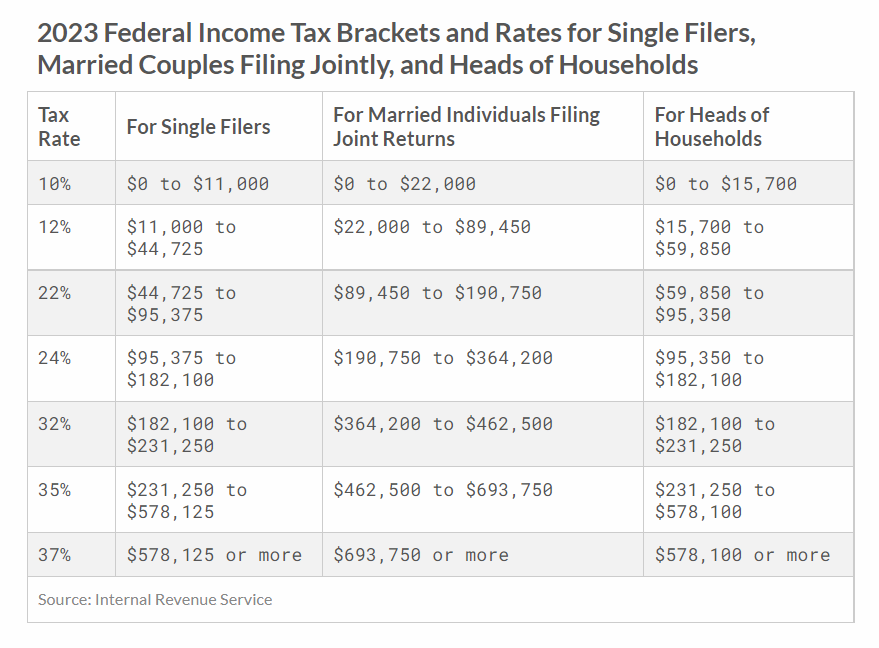
On a yearly basis the Internal Revenue Service (IRS) adjusts more than 60 tax provisions for inflation to prevent what is called “bracket creep.” Bracket creep occurs when people are pushed into higher income tax brackets or have reduced value from credits and deductions due to inflation, instead of any increase in real income.

The IRS used to use the Consumer Price Index (CPI) as a measure of inflation prior to 2018. However, with the Tax Cuts and Jobs Act of 2017 (TCJA), the IRS now uses the Chained Consumer Price Index (C-CPI) to adjust income thresholds, deduction amounts, and credit values accordingly.

The new inflation adjustments are for tax year 2023, for which taxpayers will file tax returns in early 2024. Note that the Tax Foundation is a 501(c)(3) educational nonprofit and cannot answer specific questions about your tax situation or assist in the tax filing process.

Author(s): Alex Durante

Publication Date: 18 Oct 2022

Publication Site: Tax Foundation

The best climate news you may not have heard about

Link: https://yaleclimateconnections.org/2022/11/the-best-climate-news-you-may-not-have-heard-about/

Excerpt:

A treaty adopted 35 years ago and meant to solve an entirely different problem is also protecting the climate. And with bipartisan support from the Senate and President Joe Biden’s Oct. 26 signature, the U.S. became the world’s 139th nation to adopt a key amendment to that agreement — the first time the U.S. has joined a legally binding global measure specifically to combat climate change.

Global warming was on the back burner in 1985 when scientists from the British Antarctic Survey found a gaping hole in the planet’s stratospheric ozone layer. A natural feature of the atmosphere, the ozone layer is located between about 10 to 25 miles above Earth’s surface. It shields the planet from the sun’s ultraviolet radiation, which is harmful in large doses to our skin and to myriad other aspects of plant and animal life.

Researchers rapidly pinned down the cause of the ozone destruction: chlorofluorocarbons, known as CFCs, which are chemicals used as refrigerants and to manufacture aerosol sprays and other materials. CFCs had been recognized for years as a threat to the ozone layer, but the ozone hole found in the mid-1980s was far worse than anything expected by that point.

By 1987, diplomats had crafted a treaty known as the Montreal Protocol to fix the problem. It was an immense success, ratified by every member state of the United Nations.

There was a major catch, though.

Both CFCs and their leading replacements – hydrofluorocarbons, or HFCs – trap heat in the atmosphere, causing global warming.  

….

Enter the Kigali Amendment. 

Adopted at a United Nations meeting held in the Rwanda capital in October 2016, it uses a variety of policy approaches to throttle back on both the production and consumption of HFCs. The amendment has put the world on track to eliminate more than 80% of HFCs by midcentury. 

One reason the Kigali Amendment passed the Senate with bipartisan support (69-27, including 21 of the chamber’s 50 Republicans) is that national action on HFCs along the lines of Kigali was already in gear. The pandemic stimulus bill of late 2020 specified an 85% cut in HFC production by 2030. Many lawmakers, especially those from states with major chemical manufacturing, had recognized that cutting HFCs made sense. For one thing, nations that have not ratified the amendment cannot trade HFCs with those that have. 

Author(s): Bob Henson

Publication Date: 3 Nov 2022

Publication Site: Yale Climate Connections