Beware of Private Equity Gobbling Up Life Insurance and Annuity Companies

Link: https://cepr.net/report/beware-of-private-equity-gobbling-up-life-insurance-and-annuity-companies/

Graphic:
Excerpt:

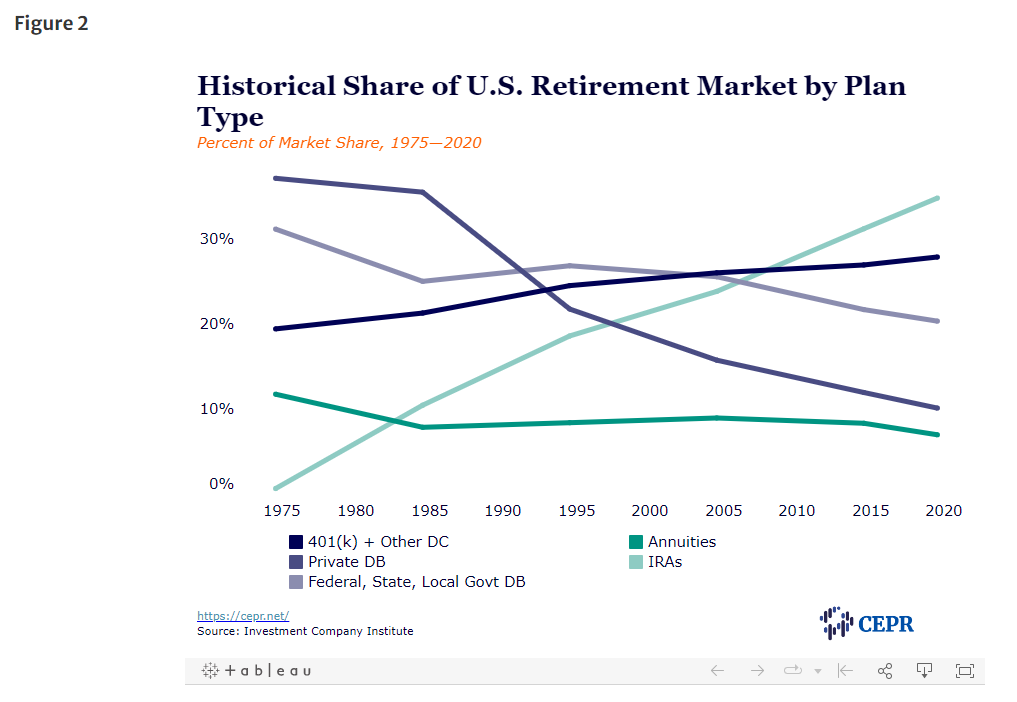
Private equity (PE) firms have had their eye on individual retirement savings since 2013 when they were first allowed to market directly to individuals. Pension funds already allocate workers’ retirement savings to PE firms, which use these assets to fund a range of risky equity and debt investments. Access to personal retirement savings, including IRAs and 401(k)s, would open up a huge new source of capital for PE.

PE firms’ first attempts to get a piece of these very sizable direct contribution assets were largely unsuccessful. More recently, however, they have turned to acquiring and/or managing life insurance and annuity assets. Some PE firms buy out life insurance and annuity companies, acquiring their assets. Others take a minority stake in a life insurance or annuity company in exchange for the right to manage all of the company’s assets. In both cases, the PE firm substantially increases assets under its management. They have also stepped-up efforts to recruit near-wealthy as well as wealthy investors, so-called retail investors, to allow PE firms to manage their assets. These activities have been a game changer for the largest PE firms. As Blackstone CEO Stephen Schwarzman put it as he lauded the firm’s third quarter 2021 performance, this quarter has been “the most consequential quarter [in history] . . . a defining moment in terms of our expansion into the vast retail and insurance markets.”1

Meanwhile, policyholders find that a PE firm now manages their retirement savings. This raises a major concern for individuals and government regulators: Given PE firms’ track record of failing to observe their duty of care as owners of Main Street companies as well as their poor fund performance in recent years,2 can they be trusted to protect the retirement savings of millions of Americans?

Author(s): EILEEN APPELBAUM

Publication Date: 13 January 2022

Publication Site: CEPR (Center for Economic and Policy Research)

Bank of England Bought Only Small Amounts of Bonds even Today, Warns Pension Funds They Have “Only Three Days Left” to Unwind Derivatives with BOE Support

Link: https://wolfstreet.com/2022/10/11/bank-of-england-bought-only-small-amounts-of-bonds-even-today-warns-pension-funds-they-have-only-three-days-left-to-unwind-derivatives-with-boe-support/

Graphic:

Excerpt:

The relatively puny amounts of actual purchases show that the BOE is trying to calm the waters around the gilts market enough to give the pension funds some time to unwind in a more or less orderly manner whatever portion of the £1 trillion in “liability driven investment” (LDI) funds they cannot maintain.

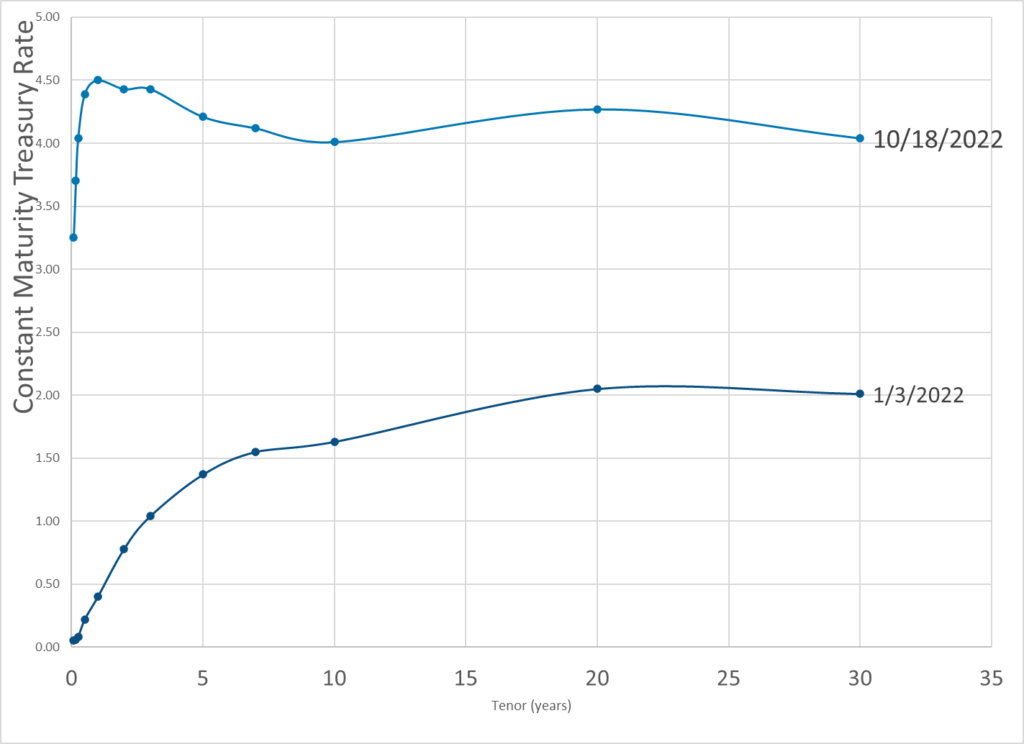
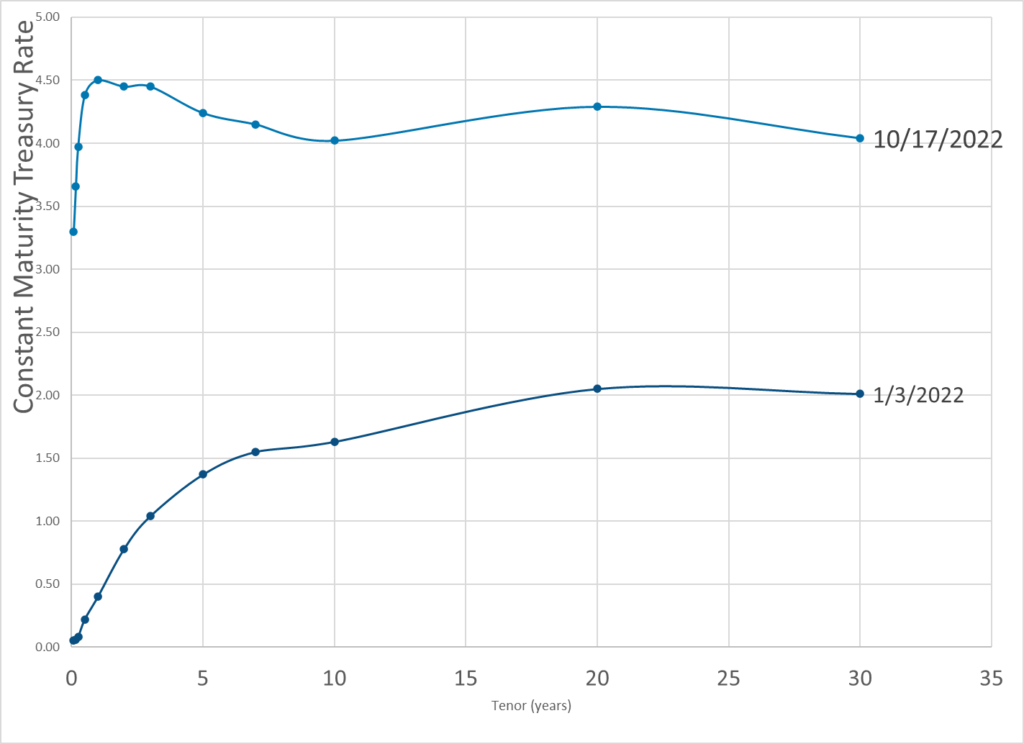
The small scale of the intervention also shows that the BOE is not too upset with the gilts yields that rose sharply in the run-up to the crisis, triggering the pension crisis, and have roughly remained at those levels. The 10-year gilt yield today at 4.44% was roughly unchanged from yesterday and just below the September 27 spike peak.

And it makes sense to have these kinds of yields in the UK, and it would make sense for these yields to be much higher, given that inflation has spiked to 10%, and yields have not kept up with it, nor have they caught up with it. And to fight this raging inflation, the BOE will need to maneuver those yields far higher still:

So today, BOE Governor Andrew Bailey, speaking at the Institute of International Finance annual meeting in Washington D.C., warned these pension fund managers that the BOE will only provide this level of support, however little it may be, through the end of the week, to smoothen the gilt market and give the pension funds a chance to unwind in a more or less orderly manner the portions of their LDI funds that they cannot maintain.

Author(s): Wolf Richter

Publication Date: 11 Oct 2022

Publication Site: Wolf Street

What the 1970s Can Teach Us About Today’s Inflationary Politics

Link: https://reason.com/2022/10/13/inflation-remixed/

Graphic:

Excerpt:

American politicians had tried to control inflation before. The presidents and power brokers of the 1970s had tried price controls, public campaigns, pressure programs, blame games, and attempts to redefine basic economic terminology. The parties differed on the specifics, but both seemed to agree that the voting public and the private sector were to blame, not the bureaucrats and politicians in charge.

Inflation, in short, was a political problem, in the sense that it caused problems for politicians. But it wasn’t one America’s politicians knew how to solve.

On the contrary, America’s political class had spent the ’70s failing to fix inflation, or actively making it worse, often with policies designed to address other political and economic problems. That decade’s price hikes were prolonged and exacerbated by political decisions born of short-term thinking, outright cowardice, and technocratic hubris about policy makers’ ability to enact sweeping changes and manage the macroeconomy.

Author(s): Peter Suderman

Publication Date: November 2022

Publication Site: Reason

19 GOP Attorneys General Slam BlackRock Over ESG Investments

Link: https://www.ai-cio.com/news/19-gop-attorneys-general-slam-blackrock-over-esg-investments/

Excerpt:

A group of 19 Republican state attorneys general have written a letter to BlackRock stating that the asset manager is using state pension fund assets in environmental, social and governance investments that “force the phase-out of fossil fuels, increase energy prices, drive inflation and weaken the national security of the United States.”

The eight-page letter outlines how the group believes BlackRock is using “the hard-earned money of our states’ citizens to circumvent the best possible return on investment.”

“Our states will not idly stand for our pensioners’ retirements to be sacrificed for BlackRock’s climate agenda. The time has come for BlackRock to come clean on whether it actually values our states’ most valuable stakeholders, our current and future retirees, or risk losses even more significant than those caused by BlackRock’s quixotic climate agenda,” the letter says.

The attorneys general asked BlackRock to respond by August 19.

Author(s): Amy Resnick

Publication Date: 9 Aug 2022

Publication Site: ai-CIO

Louisiana Divests Nearly $800 Million from BlackRock to Protect Fossil Fuel Industry

Link: https://www.ai-cio.com/news/louisiana-divests-nearly-800-million-from-blackrock-to-protect-fossil-fuel-industry/

Excerpt:

Louisiana Treasurer John Schroder is divesting $794 million worth of state funds from BlackRock because the world’s largest asset manager’s “blatantly anti-fossil fuel policies would destroy Louisiana’s economy.”

The divestment is in response to BlackRock’s sustainable investing philosophy, and for the firm calling on other companies to embrace net zero investment strategies that would harm the fossil fuel industry, which Schroder notes is a “vital part” of Louisiana’s economy.

“This divestment is necessary to protect Louisiana from actions and policies that would actively seek to hamstring our fossil fuel sector,” Schroder said in a letter to BlackRock CEO Larry Fink. “I refuse to invest a penny of our state’s funds with a company that would take food off tables, money out of pockets and jobs away from hardworking Louisianans.”

When asked to comment, a BlackRock spokesperson said the firm’s view is captured by a line in its Sept. 7 response to a letter it received from a group of 19 Republican state attorneys general saying environmental, social, and governance  investments weaken America’s national security.

Author(s): Michael Katz

Publication Date: 10 Oct 2022

Publication Site: ai-CIO

Old Age Mortality Experience Study Report

Link: https://www.soa.org/resources/experience-studies/2022/old-age-mortality/

Graphic:

Excerpt:

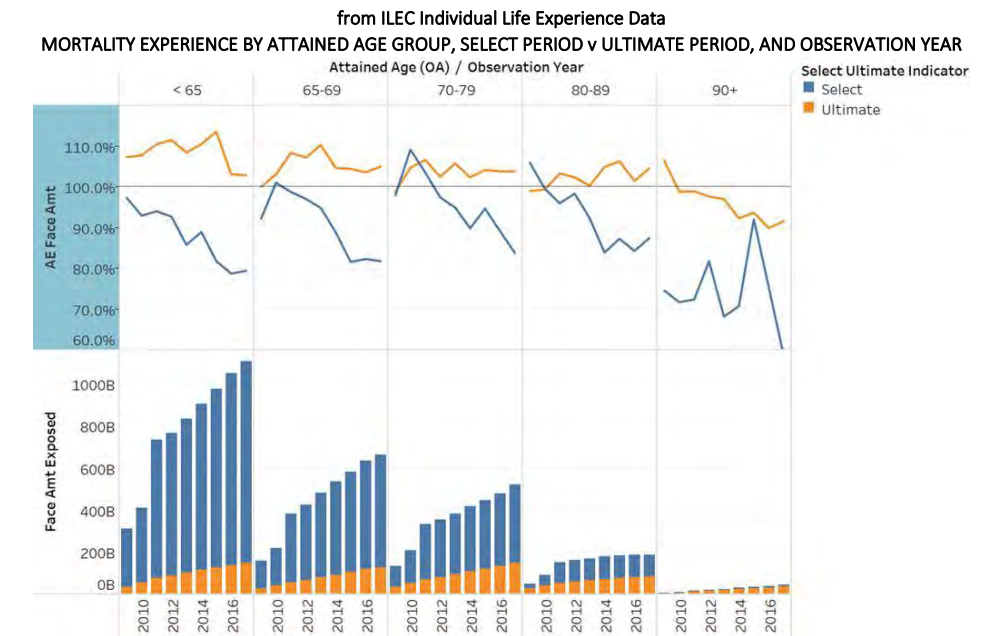
The Society of Actuaries (SOA) Research Institute released a report that examines older age mortality (OAM) with a focus on attained ages 70 and above. The report helps determine whether refinements were needed in the 2015 Valuation Basic Tables. Analysis was performed by sex, issue age and attained age, issue year cohorts, smoking risk classification, benefit band, select vs ultimate period, and interactions.

Author(s):

Old Age Mortality Subgroup of the Individual Life Experience Committee

Publication Date: October 2022

Publication Site: Society of Actuaries

The Economic Cost of Gun Violence

Link: https://everytownresearch.org/report/the-economic-cost-of-gun-violence/

Graphic:

Excerpt:

  • Taxpayers, survivors, families, and employers pay an average of $7.79 million daily in health care costs, including immediate and long-term medical and mental health care, plus patient transportation/ambulance costs related to gun violence, and lose an estimated $147.32 million per day related to work missed due to injury or death. 
  • American taxpayers pay $30.16 million every day in police and criminal justice costs for investigation, prosecution, and incarceration. 
  • Employers lose an average of $1.47 million on a daily basis in productivity, revenue, and costs required to recruit and train replacements for victims of gun violence.
  • Society loses $1.34 billion daily in quality-of-life costs from the suffering and lost well-being of gun violence victims and their families.

Author(s):

Publication Date: 19 July 2022

Publication Site: Everytown Research

The Lending Hole at the Bottom of the Homeownership Market

Link: https://www.newamerica.org/future-land-housing/reports/the-lending-hole-at-the-bottom-of-the-homeownership-market/

Graphic:

Abstract:

While conventional wisdom maintains that high home prices are to blame for declining homeownership rates, there is another elusive barrier stopping millions of would-be homeowners: banks are increasingly unwilling to write small dollar mortgages. One fifth of owner-occupied homes in the United States cost less than $100,000, but due to unintended consequences of the Dodd-Frank Act, among other factors, banks are opting out of writing small dollar loans. Instead, more than three quarters of small dollar homes are purchased in cash, often by investors or well-off individuals. This lending gap locks millions of low-and-moderate income families out of homeownership, and exacerbates the racial homeownership gap as these small dollar homes are a critical source of homeownership for many first-time buyers in Black and Hispanic communities.

In this report, the Future of Land and Housing program at New America and the Center for the Study of Economic Mobility (CSEM) at Winston-Salem State University (WSSU) focus on three dimensions of this problem: 1) the unavailability of financing for small dollar loans; 2) the catch-22 of “mortgage standards”; and 3) competition with all-cash buyers at a national level and through a local case study of Winston-Salem and Forsyth County, North Carolina.

Author(s): Sabiha Zainulbhai, Zachary D. Blizard, Craig J. Richardson, Yuliya Panfil

Publication Date: 9 Nov 2021

Publication Site: New America

From the Archives: “How Dodd-Frank Locks Out the Least Affluent Homebuyers”

Link: https://vpostrel.substack.com/p/from-the-archives-how-dodd-frank?utm_source=substack

Excerpt:

This Axios report on a JPMorgan Chase program giving black and Latino borrowers $5,000 toward down payments or home loan closing costs reminded me of a column I wrote in November [2021].  It’s about one of the most infuriating public policy fiascos I’ve run into in a very long time. Hardly anyone knows about this regulatory devastation of household wealth amog people whose inexpensive homes represented years of thrift and hard work. (The only reason I learned of it is that I happened to meet Craig Richardson at an unrelated conference.) It is absolutely heartbreaking. It reminds me of the famous quote from The Great Gatsby: “They were careless people, Tom and Daisy—they smashed up things and creatures and then retreated back into their money or their vast carelessness or whatever it was that kept them together, and let other people clean up the mess they had made.”

….

About one in five U.S. homes are valued at $100,000 or less. And despite their low prices, they’ve gotten extremely hard to sell. When they move at all, these small-dollar properties tend to go for cash. Lenders increasingly won’t write mortgages for them.

“Over the last decade, origination for mortgage loans between $10,000 and $70,000 and between $70,000 and $150,000 has dropped by 38 percent and 26 percent, respectively, while origination for loans exceeding $150,000 rose by a staggering 65 percent,” reports a new study on small-dollar mortgages from the Center for the Study of Economic Mobility at Winston-Salem State University and the Future of Land and Housing program at the New America think tank. The study is scheduled for release on Tuesday [Nov 9, 2021].

The culprits behind the disappearance of small-dollar mortgages are lending restrictions enacted with good intentions and warped by economic blind spots. Designed to protect borrowers and the financial system, the Dodd-Frank Act regulations passed in the wake of the 2008 financial crisis “increased the fixed costs and the per-loan costs of extending a mortgage,” says the study. The regulation-imposed costs made small-dollar mortgages a lousy proposition for lenders.

Compounding the problem, the Consumer Financial Protection Bureau then limited the fees that lenders could charge as closing costs. For profit-oriented lenders, small-dollar mortgages are no longer worth the trouble. At best, they squeeze out the tiniest of margins. At worst, they don’t even cover the fixed cost of processing the loan.

Author(s): Virginia Postrel

Publication Date: 25 June 2022

Publication Site: Virginia’s Newsletter at substack

Interest Rate Hikes vs. Inflation Rate, by Country

Link: https://www.visualcapitalist.com/interest-rate-hikes-vs-inflation-rate-by-country/

Graphic:

Excerpt:

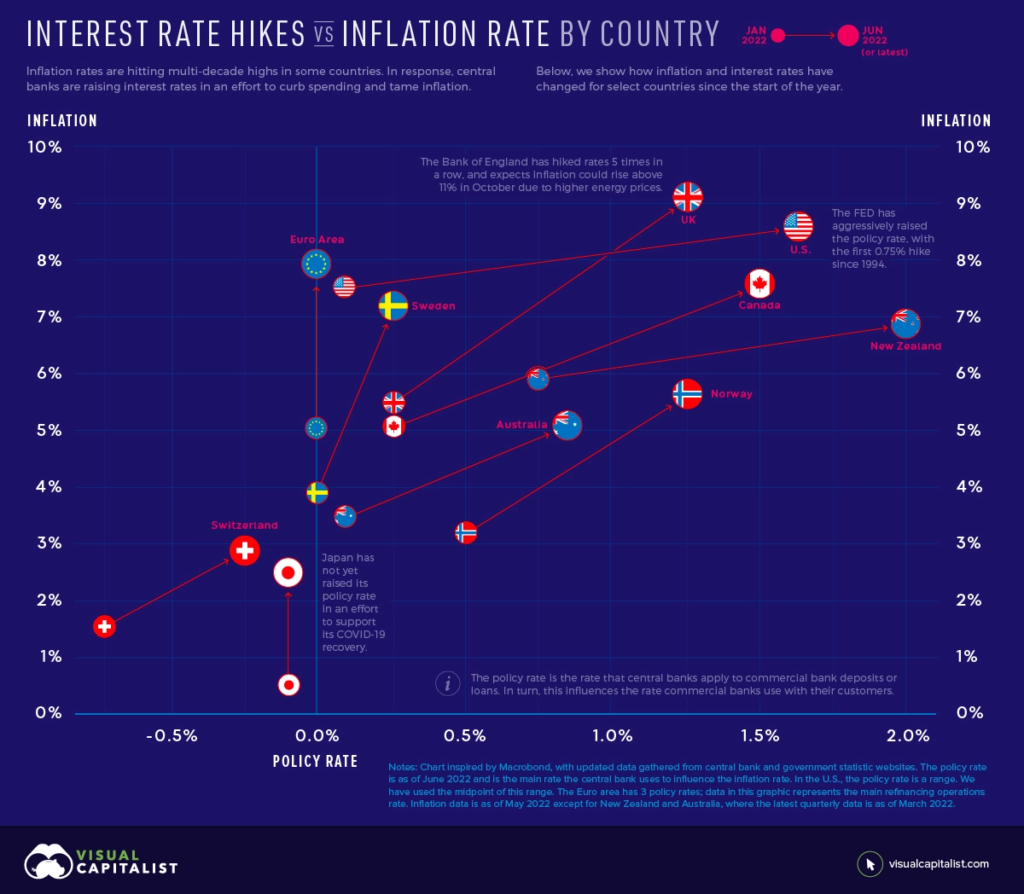
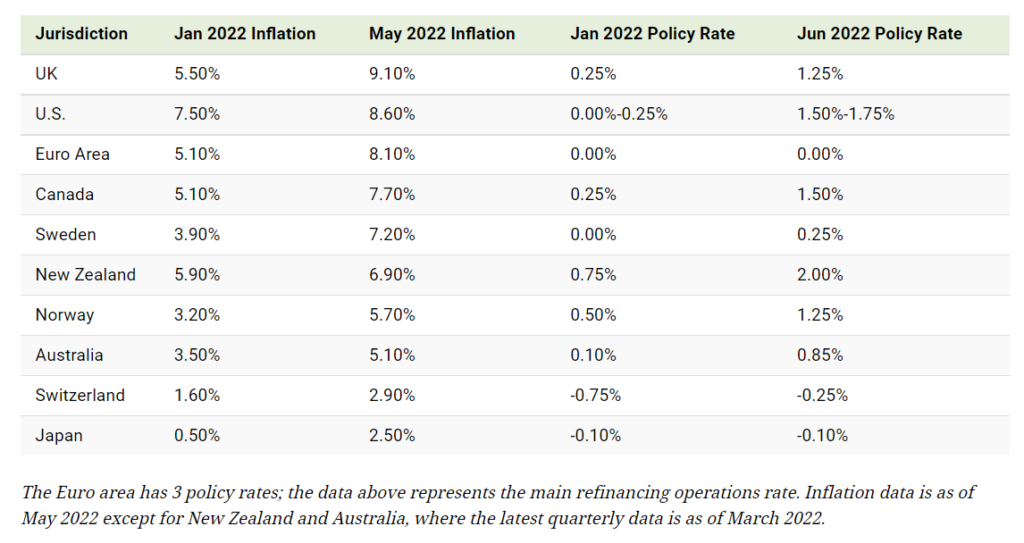
To understand how interest rates influence inflation, we need to understand how inflation works. Inflation is the result of too much money chasing too few goods. Over the last several months, this has occurred amid a surge in demand and supply chain disruptions worsened by Russia’s invasion of Ukraine.

In an effort to combat inflation, central banks will raise their policy rate. This is the rate they charge commercial banks for loans or pay commercial banks for deposits. Commercial banks pass on a portion of these higher rates to their customers, which reduces the purchasing power of businesses and consumers. For example, it becomes more expensive to borrow money for a house or car.

Ultimately, interest rate hikes act to slow spending and encourage saving. This motivates companies to increase prices at a slower rate, or lower prices, to stimulate demand.

Author(s): Jenna Ross, Nick Routley

Publication Date: 24 June 2022

Publication Site: Visual Capitalist