Public retirement plan assets should never be utilized for political purposes

Link: https://reason.org/commentary/public-retirement-plan-assets-should-never-be-utilized-for-political-purposes/

Excerpt:

State executives and lawmakers from both major political parties have recently threatened to use public retirement plan assets to address political grievances or push political agendas. Issues ranging from guns to oil and climate change to social media are all being suggested as political targets that should dictate investment strategies for public pension funds. When making arguments for their activist agendas, proponents of these various positions rarely mention how investment restrictions or demands will aid in the basic retirement plan objective of supporting public employees in their retirement years.  

To be clear, public retirement plan assets should never be utilized for political purposes.

Trustees of these public pension plans, and others of influence, are under a clear fiduciary obligation to make decisions with the sole purpose of best meeting the pension plans’ objectives for the benefit of that plan’s participants. There is no ambiguity about this: Activist political agendas have no place in public pensions. To be effective in meeting their objectives, public pension systems must be completely apolitical in their decision-making and in their operations. They cannot be beholden to shifting political winds.   

While this idea seems straightforward, the thought of using these massive investment portfolios to leverage certain political agendas is often too enticing for some politicians to pass up. It is incumbent upon governors, other key stakeholders, and legislative representatives in all states to step up and acknowledge that public retirement assets are out-of-bounds for activist maneuvering. This is critical regardless of where these figures fall on the political spectrum. It is equally important for retirement system trustees and leaders, as well as state treasurers, to stand firm as plan fiduciaries and vigorously oppose any attempts to use plan assets in a way that is not solely directed at benefitting the plan’s participants. 

Author(s): Richard Hiller

Publication Date: 10 June 2022

Publication Site: Reason
NAIC 2021 Annual/2022 Quarterly Financial Analysis Handbook

Link: https://content.naic.org/sites/default/files/publication-fah-zu-financial-analysis-handbook.pdf

Graphic:

Excerpt:

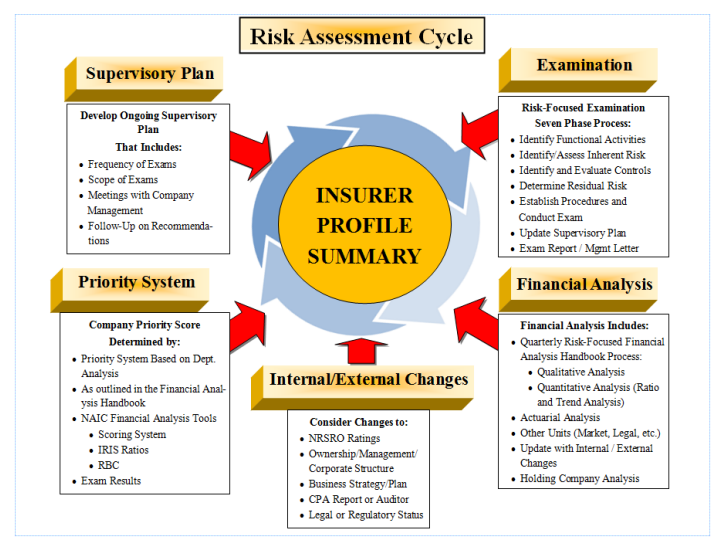
The risk-focused surveillance framework is designed to provide continuous regulatory oversight. The risk-focused approach requires fully coordinated efforts between the financial examination function and the financial analysis function. There should be a continuous exchange of information between the field examination function and the financial analysis function to ensure that all members of the state insurance department are properly informed of solvency issues related to the state’s domestic insurers.

The regulatory Risk-Focused Surveillance Cycle involves five functions, most of which are performed under the current financial solvency oversight role. The enhancements coordinate all of these functions in a more integrated manner that should be consistently applied by state insurance regulators. The five functions of the risk assessment process are illustrated within the Risk-Focused Surveillance Cycle.


As illustrated in the Risk-Focused Surveillance Cycle diagram, elements from the five identified functions
contribute to the development of an IPS. Each state will maintain an IPS for its domestic companies. State
insurance regulators that wish to review an IPS for a non-domestic company will be able to request the IPS from the domestic or lead state. The documentation contained in the IPS is considered proprietary, confidential information that is not intended to be distributed to individuals other than state insurance regulators.

Please note that once the Risk-Focused Surveillance Cycle has begun, any of the inputs to the IPS can be changed at any time to reflect the changing environment of an insurer’s operation and financial condition.

Author(s): NAIC staff

Publication Date: 1 Jan 2022

Publication Site: NAIC

Congressional Hearing Considers Private Equity-Controlled Insurers

Link: https://communications.willkie.com/110/1827/uploads-(icalendars-pdf-documents)/congressional-hearing-considers-private-equity-controlled-insurers.pdf

Excerpt:

On September 8, 2022, the U.S. Senate Committee on Banking, Housing and Urban Affairs (“Senate Banking Committee”) held a hearing to consider “Current Issues in Insurance.” One of the items discussed at the hearing was Senator Sherrod Brown’s (D-OH) March 2022 letter to the National Association of Insurance Commissioners (the “NAIC”) and U.S. Department of the Treasury’s Federal Insurance Office (“FIO”) regarding private equity-controlled insurers.1

In his letter, Senator Brown requested that FIO, in consultation with the NAIC, prepare a report for Congress that evaluates the investment strategies pursued by private equity-controlled insurers, the impact on protections for pension plan beneficiaries following pension risk transfer arrangements, and whether state regulatory regimes are capable of assessing and managing risks related to private equity-controlled insurers. In the early summer, the NAIC and the U.S. Department of the Treasury (on behalf of FIO) each provided substantive responses to Senator Brown.2

Author(s): Kara Baysinger | Leah Campbell | Jane Callanan | Matthew J. Gaul
Donald B. Henderson, Jr. | David G. Nadig | Allison J. Tam

Publication Date: 27 Sept 2022

Publication Site: Willkie Farr & Gallagher

Guns Aren’t a Public Health Issue

Link: https://reason.com/video/2022/09/30/guns-arent-a-public-health-issue/

Graphic:

Excerpt:

The takeaway from the story of Dickey, Rosenberg, and the 1993 gun study at the center of the piece is that the congressman was correct to begin with. The CDC shouldn’t be studying gun violence.

Titled “Gun Ownership as a Risk Factor for Homicide in the Home” and published in The New England Journal of Medicine, the 1993 study looked at 388 people who had been killed in their homes and matched them to 388 neighbors of similar age, sex, and race. One hundred and seventy-four of the victims lived in houses where at least one gun was present versus only 139 of the matched controls.

With scary music and breathless claims, the video tells viewers that if you had a gun in your house, you were 200 percent more likely to be killed with a gun in your home and 400 percent more likely to kill yourself. 

These are both exaggerations and misstatements of the study results. It didn’t address suicide risk at all, nor gun homicides. It found households in which a resident had been murdered at home by any means had a 25 percent greater frequency of having a gun, not 200 percent. But this doesn’t mean owning a gun increases your risk of being killed by 25 percent. 

This is a classic statistical error known as the “base rate fallacy” and is particularly important when studying rare events, like people murdered in their homes. Suppose 10 people are murdered in their homes, and five of those homes had guns. A matched set of 10 people who were not murdered in their homes found only four homes had guns. So there are 25 percent more guns in the homes of murder victims than matched nonmurder victims (Five vs. four).

But what if you put those 20 people in the context of another million, none of whom were murdered in their homes, half of whom had guns in their homes and half of whom didn’t. The rate for gun owners to be murdered at home becomes five out of 500,009, while the rate for non-gun owners becomes five out of 500,011. So now we find that the risk is 0.0004 percent higher.

In other words, being murdered in your home means you have a 25 percent higher chance of having a gun, but having a gun means you have only a 0.0004 percent greater chance of being murdered in your home. Those are not the same thing.

The finding that owning a gun made study subjects less safe was also a conclusion selected from much stronger statistical results that didn’t fit the authors’ political views and, thus, weren’t mentioned in the study. Yes, 25 percent more victims’ homes had guns than control homes, but 38 percent more victims had controlled security access to their property. Why not lobby against gates as a public health matter? Twenty times as many victims had gotten in trouble at work because of drinking, so why worry about guns when drinking at work is two orders of magnitude more dangerous? Renting and living alone were far more dangerous than having a gun. Victims were less likely than controls to own a rifle or a shotgun, so why not a government program to trade in handguns for long guns?

Author(s): JOHN OSTERHOUDT AND AARON BROWN

Publication Date: 30 Sept 2022

Publication Site: Reason

Texas Maternal Death Data to Be Published Post-Midterms

Link: https://www.governing.com/now/texas-maternal-death-data-to-be-published-post-midterms

Excerpt:

Texas health officials have missed a key window to complete the state’s first major updated count of pregnancy related deaths in nearly a decade, saying the findings will now be released next summer, most likely after the Legislature’s biennial session.

The delay, disclosed earlier this month by the Department of State Health Services, means lawmakers won’t likely be able to use the analysis, covering deaths from 2019, until the 2025 legislative cycle. The most recent state-level data available is nine years old.

In a hearing this month with the state’s Maternal Mortality and Morbidity Review Committee, DSHS commissioner Dr. John Hellerstedt said the agency wanted to better align its methodology with that of other states, and that there hadn’t been enough staff and money to finish the review for a scheduled Sept. 1 release.

….

Ortique said the state has already identified 149 potential maternal deaths in 2019, of which 118 have been analyzed by the committee to see if they were pregnancy-related. Six newly identified deaths may be added to that group, she said. The numbers cover deaths during the pregnancy through one year after giving birth.

The state has published a maternal death report every other year since 2014, often based on preliminary data updated later. For example, the maternal death report in 2018 identified 29 deaths in 2012 that were not included in the previous report. The committee also released updating findings from its most recent report, studying deaths from 2013, at the Sept. 2 meeting.

Out of 175 potential maternal deaths in 2013, 70 have since been determined to be pregnancy-related.

Author(s): Julian Gill and Jeremy Blackman, San Antonio Express-News

Publication Date: 14 Sept 2022

Publication Site: Governing

Appeals Court Rules In City’s Favor Following Challenge From The Houston Fire Firefighters’ Relief And Retirement Fund

Link: https://cityofhouston.news/appeals-court-rules-in-citys-favor-following-challenge-from-the-houston-fire-firefighters-relief-and-retirement-fund/

Excerpt:

Today, the Court of Appeals for the First District of Texas reversed and rendered a decision in favor of the City of Houston against the Houston Firefighters’ Relief and Retirement Fund (HFRRF).

HFRRF had challenged the constitutionality of a Texas statute designed to reform the City’s firefighter pension system that ensures that the actuarial assumptions for determining the City’s contribution rates are based on sound actuarial principles and establishes a process for setting the contribution rate when the City’s and HFRRF’s proposed contribution rates differ by more than two percentage points.

“The City of Houston has consistently maintained the constitutionality of the historic pension reform and welcomes the appeals court ruling,” said Mayor Sylvester Turner. “The firefighters’ pension is now 93 percent funded – compared to just 80 percent funded pre-pension reform – and is actuarially sound. It is important to note that the three pension systems – municipal, police, and fire – are healthier today because of the pension reform we have put in place.”

The latest ruling is the second time the Court of Appeals has upheld the constitutionality of the statute reforming the firefighter pension system, making the pension system more secure for Houston’s firefighters, both now and in the future.

The estimated unfunded pension liability reached as high as $8.2 billion before the 2017 reforms. Today, the unfunded liability of the City’s three pension plans is less than $1.5 billion.

Author(s): MAYOR’S OFFICE FILED UNDER: MYR – OFFICE OF THE MAYOR

Publication Date: 30 Aug 2022 (updated 14 Sept 2022?)

Publication Site: City of Houston, Texas

Bill Would Tighten Pension Rules for Convicted Public Workers

Link: https://www.governing.com/finance/bill-would-tighten-pension-rules-for-convicted-public-workers

Excerpt:

New Jersey would make it harder for public employees who commit crimes to collect their pensions under a bill legislators are fast-tracking through the state Assembly.

The proposed reforms to the state’s pension law were recommended without discussion Thursday, Sept. 29, by the Assembly Judiciary Committee, just one week after they were introduced. That allows the measure to move to the Assembly floor for a vote expected on Monday.

The legislation would tighten the criteria under which pension boards decide whether former government workers convicted of on-the-job misconduct should lose some or all of their pensions. It would also expand the list of offenses that automatically disqualify public employees from receiving those benefits.

….

That change would take more pension decisions out of the hands of the state’s retirement boards, which are often reluctant to strip officials of their full pensions, under a process in which they weigh offenders’ misconduct against the good they did throughout their careers. The proposal would also revamp how boards consider those factors, making it easier for them to refuse to grant benefits.

To become law, the bill would have to pass the Assembly and Senate and be signed by Gov. Phil Murphy. So far, no Senate version has been introduced, and its potential fate in the upper chamber remains unclear.

Author(s): Riley Yates, NJ.com

Publication Date: 30 Sept 2022

Publication Site: Governing

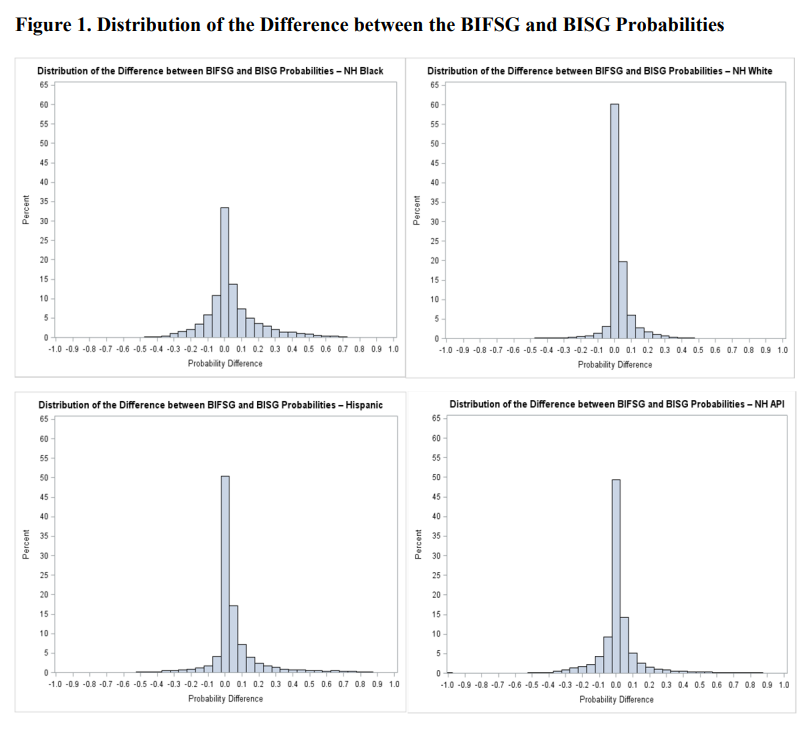
Using First Name Information to Improve Race and Ethnicity Classification

Link: https://papers.ssrn.com/sol3/papers.cfm?abstract_id=2763826

Graphic:

Abstract:

This paper uses a recent first name list to improve on a previous Bayesian classifier, the Bayesian Improved Surname Geocoding (BISG) method, which combines surname and geography information to impute missing race and ethnicity. The proposed approach is validated using a large mortgage lending dataset for whom race and ethnicity are reported. The new approach results in improvements in accuracy and in coverage over BISG for all major ethno-racial categories. The largest improvements occur for non-Hispanic Blacks, a group for which the BISG performance is weakest. Additionally, when estimating disparities in mortgage pricing and underwriting among ethno-racial groups with regression models, the disparity estimates based on either BIFSG or BISG proxies are remarkably close to those based on actual race and ethnicity. Following evaluation, I demonstrate the application of BIFSG to the imputation of missing race and ethnicity in the Home Mortgage Disclosure Act (HMDA) data, and in the process, offer novel evidence that race and ethnicity are somewhat correlated with the incidence of missing race/ethnicity information.

Author(s):

Ioan Voicu
Office of the Comptroller of the Currency (OCC)

Publication Date: February 22, 2016

Publication Site: SSRN

Suggested Citation:

Voicu, Ioan, Using First Name Information to Improve Race and Ethnicity Classification (February 22, 2016). Available at SSRN: https://ssrn.com/abstract=2763826 or http://dx.doi.org/10.2139/ssrn.2763826

The Inevitable Financial Crisis

Link: https://www.nakedcapitalism.com/2022/10/the-inevitable-financial-crisis.html

Excerpt:

For months, I have been confident that Europe would suffer a financial crisis and a depression, as in a real economy catastrophe accompanied by a market crash. It might not be as severe and lasting as 1929, but the breadth would mean there would not be 1987 quick bounceback nor a 2008 derivatives crisis concentrated at the heart of the banking system. Even though that looked like financial near-death experience, the same factors that made it more acute in many respects also made it easier for the officialdom to identify and shore up the key institutions that took hits below the water line.

….

That view was based simply on the level of damage Europe seemed determined to suffer via the effect of sanctions blowback on supplies of Russian gas. There are additional de facto and self restrictions on Russian commodities via sanctions on Russian banks and warniness about dealing with Russian ships and counterparties. For instance, Russian fertilizer is not sanctioned; indeed, the US made a point of clearing its throat a couple of months back to say so. Yet that does not solve the problem African (and likely other) buyers suffer They had accounts with now-sanctioned Russian banks and have been unable to come up with good replacement arrangements.

Another major stressor is the dollar’s moon shot. It increased the cost of oil in local currency terms, making inflation even worse. It also will produce pressure, and potentially defaults, in any foreign dollar debtor because he local currency cost of interest payments will rise. Given the generally high state of nervousness in financial markets, anyone who had been expected to roll maturing debt will be in a world of hurt (Satyajit Das in a recent post pointed out that investors typically don’t expect emerging market borrowers to repay).

….

Yet another big concern is hidden leverage, particularly from derivatives. A sudden rise in short term interest rates and increased volatility can blow up derivative counterparties. It’s already happening with European utility companies, many of whom are so badly impaired as to need bailouts.

And the failure of regulators to get tough with banks in the post-crisis period is coming home to roost. Nick Corbishley wrote about how Credit Suisse went from being a supposedly savvy risk manage to more wobbly than Deutsche Bank due to getting itself overly-enmeshed in the Archegos “family office” meltdown and then the Greensill “supply chain finance” scam. Archegos demonstrated a lack of regulatory interest in “total return swaps” which in simple terms allow speculators to create highly leveraged equity exposures. Highly leveraged equity exposures was what gave the world the 1929 crash. The very existence of this product shows the degree to which the officialdom has unlearned big and costly lessons.

Author(s): Yves Smith

Publication Date: 3 Oct 2022

Publication Site: naked capitalism

IFRS 17—The Time Is Now

Link: https://contingencies.org/ifrs-17-the-time-is-now/

Excerpt:

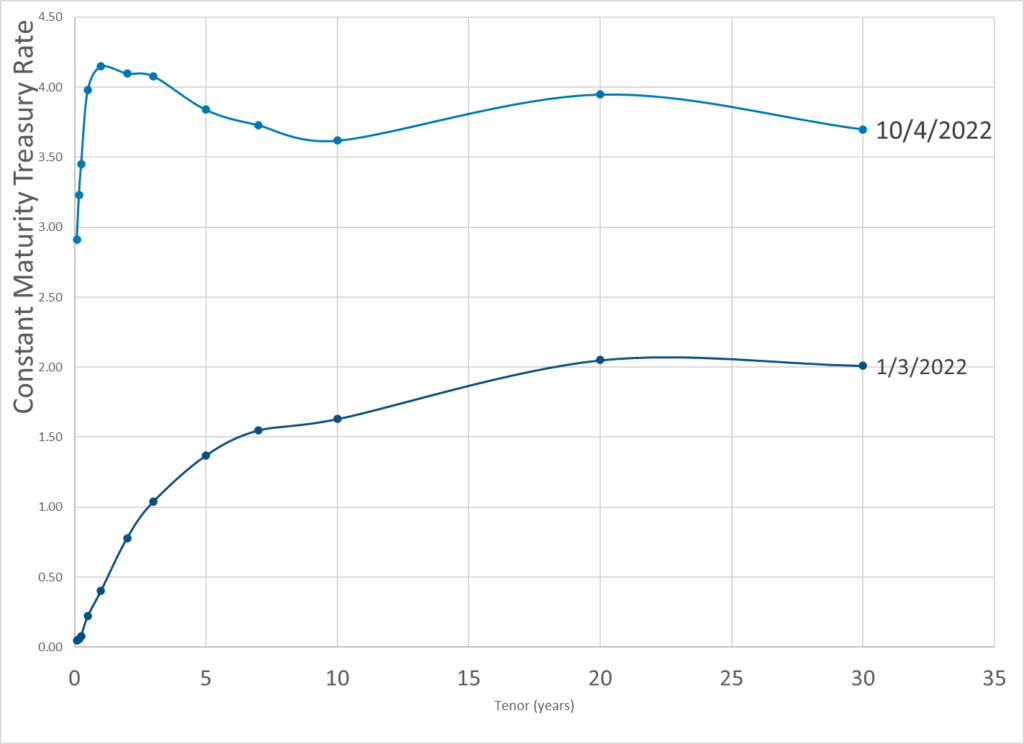
The more fundamental changes affect the measurement of future services (previously termed as “Reserves”). Many insurance accounting regimes have tried to stabilize their financial statements over the years; therefore, they calculated their reserves based on historic information—locked-in assumptions for insurance parameters as well as historic interest rates. The latter, however, are not in line with the use of market values for the asset side of the balance sheet, which is now perceived as the only fair-value representation for the different stakeholders. Therefore, the measurement of the liabilities in IFRS 17 will always be based on current assumptions.

Due to the compound effect over many projected years, the regular update of assumptions (particularly interest rate or discounting assumptions) can make long-term liabilities much more volatile.

Author(s): Michael Winkler and Sunil Kansal

Publication Date: October 2022

Publication Site: Contingencies