A Fresh Look at Accounting for Reinsurance of Universal Life

Link: https://www.soa.org/sections/financial-reporting/financial-reporting-newsletter/2022/september/fr-2022-09-malerich/

Excerpt:

Under LDTI, DAC amortization will no longer obscure the relationship between direct and ceded accounting. It is now possible to align ceded accounting with direct, without any noise from DAC amortization. With poor alignment, distortions within the results reported to management and financial statement users will be different, sometimes greater than before. Whether the goal is to improve reporting or to avoid making it worse, a fresh look can help.

Most of the approaches that have been used to account for UL reinsurance can still be used. One exception is the implicit approach where, in lieu of explicit accounting for reinsurance, the gross profits used to amortize DAC were adjusted to be net of reinsurance. With the elimination of gross profits as an amortization base, this approach no longer has meaning.

For surviving approaches, it is now easier to evaluate their effectiveness in presenting the economic protection provided by reinsurance.

In this article, I begin an evaluation by examining the fundamentals of accounting for the insurance element of universal life. After that, I consider the economic protection provided by reinsurance and look for an ideal—a way to effectively account for that protection.

In a second article to be published later this year, I’ll evaluate several reinsurance approaches in terms of noise from missing the ideal, then end with some thoughts on what might be done to eliminate noise.

The focus of both articles is on the insurance element. Accounting for the deposit element, embedded derivatives, and market risk benefits is beyond the scope of these articles. Also outside of scope is the requirement, in Accounting Standards Codification (ASC) Topic 326, to recognize a current estimate of credit losses from the failure of a reinsurer to reimburse reinsured benefits.

Author(s): Steve Malerich

Publication Date: Sept 2022

Publication Site: Financial Reporting newsletter, SOA
Transition to a High Interest Rate Environment: Preparing for Uncertainty

Link: https://www.soa.org/globalassets/assets/Files/Research/Projects/research-2015-rising-interest-rate.pdf

Graphic:

Excerpt:

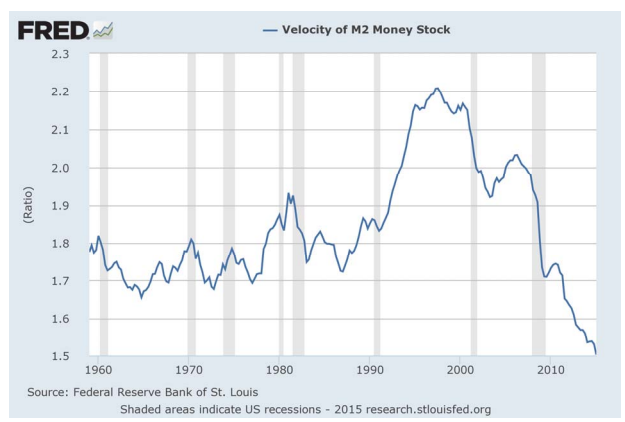
Interest rates cycle over long periods of time. The journey tends to be unpredictable, full of
unexpected twists and turns. This project focuses on the impact of interest rate volatility on life
insurance products. As usual, it brought up more questions than it answered. It points out the
importance of stress testing for a specific block of business and the risk of relying on industry
rules of thumb. Understanding the nuances of models could make the difference between safe
navigation of a stressed environment and a default. Proactive and resilient practices should
increase the odds of success.


Hyman Minsky had it right—stability leads to instability. We live in an era where monetary
policies of central banks steer free markets in an effort to soften the business cycle. Rates have
been low for over 20 years in Japan, reshaping the global economy.

The primary goal of this paper is to explore rising interest rates, but that is not possible without
considering that some rates could stabilize at low levels or even decrease. Following this path,
the paper will look at implications of interest rate changes for the life insurance industry, current
stress testing practices, and how a risk manager can proactively prepare for an uncertain future.
A paper published in 2014 focused on why rates could stay low, and some aspects of this paper
are similar (e.g., description of insurance products). This paper also uses a sample model office
to help practitioners look at their own exposures. It includes typical interest-sensitive insurance
products and how they might perform across various scenarios, as well as a survey to establish
current practices for how insurers are testing interest rate risk currently.

Author(s): Max Rudolph, Randy Jorgensen, Karen Rudolph

Publication Date: July 2015

Publication Site: SOA Research Institute

Letter to FIO and NAIC from Senate Banking Committee

Link: https://www.banking.senate.gov/imo/media/doc/brown_letter_on_insurance_031622.pdf

Excerpt:

  1. What risks do the more aggressive investment strategies pursued by private equity-controlled insurers present to policyholders?
  2. What risks do lending and other shadow-bank activities pursued by companies that also
    own or control significant amounts of life insurance-related assets pose to policyholders?
  3. Are there risks to the broader economy related to investment strategies, lending, and
    other shadow-bank activities pursued by these companies?
  4. In cases of pension risk transfer arrangements, what is the impact on protections for
    pension plan beneficiaries if plans are terminated and replaced with lump-sum payouts or
    annuity contracts? Specifically, how are protections related to ERISA and PBGC
    insurance affected in these cases?
  5. Given that many private equity firms and asset managers are not public companies, what
    risks to transparency arise from the transfer of insurance obligations to these firms? Will
    retirees and the public have visibility into the investment strategies of the firms they are
    relying on for their retirements?
  6. Are state regulatory regimes capable of assessing and managing the risks related to the
    more complex structures and investment strategies of private equity-controlled insurance
    companies or obligations? If not, how can FIO work with state regulators to aid in the
    assessment and management of these risks?

Author(s): Sen. Sherrod Brown

Publication Date: 16 March 2022

Publication Site: U.S. Senate Banking Committee

COVID-19: Audit Cites ‘Distortion, Suppression Of Facts’ In Nursing Home Reporting Under Cuomo

Link: https://dailyvoice.com/new-york/northsalem/news/covid-19-audit-cites-distortion-suppression-of-facts-in-nursing-home-reporting-under-cuomo/828102/

Excerpt:

The state Health Department intentionally “misled the public” regarding the number of COVID-19 deaths in nursing homes under former New York Gov. Andrew Cuomo’s administration, according to a scathing audit from the Comptroller Thomas P. DiNapoli.

When the COVID-19 pandemic swept through New York, the Department of Health was not prepared to respond to the infectious disease outbreaks in nursing homes, according to the audit, which helped lead to the inaccurate virus-related death count in facilities.

Auditors found that health officials undercounted the death toll in nursing homes by at least 4,100 residents and at times more than 50 percent, despite claims from the former governor, who said the state was doing well in protecting seniors.

Author(s): Zak Failla

Publication Date: 17 March 2022

Publication Site: New York Daily Voice

A State Tax War

Link: https://www.city-journal.org/remote-work-and-the-state-tax-war

Excerpt:

The Supreme Court’s unwillingness to intervene in a fight among states over taxing income from remote work may spark a jurisdictional revenue war. In August, the Court refused to take up a lawsuit by New Hampshire against Massachusetts’ practice of levying income taxes on Granite State residents employed by Bay State companies but working from home during the Covid lockdowns. Now New Jersey officials, who filed an amicus brief in the case because the state’s telecommuting residents are similarly taxed by New York, have proposed a law that would let the state tax telecommuters, including possibly tens of thousands of Empire State residents now working from home but employed by Garden State companies. The in-your-face legislation also provides incentives for Jersey residents to challenge New York’s law in tax court—one of the only venues left to residents after the Supreme Court decision. Given that several hundred thousand New Yorkers once commuted to other states to work and may now be staying home to telecommute, Albany risks losing revenues. 

Beginning in March 2020, Covid restrictions brought a sharp rise in telecommuting, or working remotely from home. Studies have suggested that, during the pandemic’s initial phases, up to 36 percent of all private-sector employees, or about 43 million people, worked at home at least one day a week, and 15 percent, or about 18 million, telecommuted full-time. Census data before the pandemic found that as many as 6 million workers regularly cross state lines to go to their jobs. So it’s likely that several million current telecommuters have jobs with firms in another state. In New Hampshire, about 15 percent of residents with jobs—some 84,000 workers—commuted to Massachusetts pre-pandemic.

Author(s): Steven Malanga

Publication Date: 26 Sept 2022

Publication Site: City Journal

Wharton professor Jeremy Siegel says Jerome Powell is making one of the biggest policy mistakes in the Fed’s 110-year history, and it could lead to a major recession

Link: https://finance.yahoo.com/news/wharton-professor-jeremy-siegel-says-191800487.html

Excerpt:

The Wharton professor Jeremy Siegel has a big issue with the Federal Reserve’s aggressive interest-rate hikes in its bid to tame inflation, and he’s worried that the central bank is making the biggest mistake in its history and may provoke a steep recession.

Siegel said inflation is starting to come down significantly, but the Fed is still moving forward with its rate hikes.

He said it could be “one of the biggest policy mistakes in the 110-year history of the Fed, by staying so easy when everything was booming.”

…..

“I think the Fed is just way too tight. They’re making exactly the same mistake on the other side that they made a year ago,” Siegel added.

To Siegel’s point, the Fed has had a lousy record of accurately forecasting where it expects interest rates to be just a few months into the future.

….

“I am very upset. It’s like a pendulum. They were way too easy through 2020 and 2021, and now ‘we’re going to be real tough guys until we crush the economy,'” Siegel said of the Fed.

Siegel expects the Fed to “eventually see the light” as none of their recent predictions are likely to come true.

“I think they’re going to be forced to lower the rates much more rapidly than they think,” Siegel said, a move that could set up stocks for a potential recovery from their ongoing decline.

Author(s): Matthew Fox

Publication Date: 25 Sept 2022

Publication Site: Yahoo Finance

A Workplan to Identify & Remove Unnecessary Barriers to Producer Licensure

Link: https://www.acli.com/-/media/acli/public/files/news-release-pdfs/workplan_barrierstoproducerlicensure09192022_final.pdf

Graphic:

Excerpt:

There have been recent efforts by the NAIC to report on the steps exam vendors have taken to mitigate
cultural bias in producer licensing exams; however, based on state-level data, this issue deserves closer
attention.


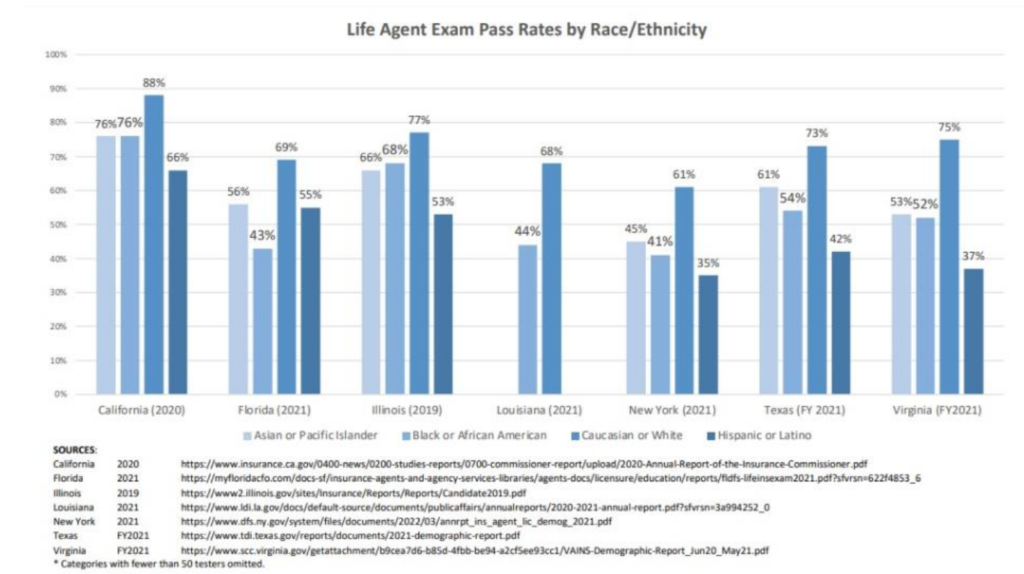
There are only seven states that annually prepare and publish licensing exam pass rates by
demographic, including race/ethnicity. For more than a decade, these reports have routinely shown
Caucasian/white candidates scoring higher than other demographic groups across nearly all lines.


When comparing Life Insurance Exam Pass Rates by Race/Ethnicity, an alarming trend appears. It’s clear
that non-Caucasians or non-white demographics are not efficiently making it through the licensing
process. This clearly suggests licensing exams warrant more scrutiny, particularly to ensure these tests
are not screening diversity from the industry.

Author(s): ACLI, NAIFA, Finseca

Publication Date: Sept 2022

Publication Site: ACLI

Life Groups Calls on States to Review Agent Exam Difficulty

Link: https://www.thinkadvisor.com/2022/09/22/life-groups-calls-on-states-to-review-agent-exam-difficulty/

Excerpt:

The American Council of Life Insurers has joined with two rival producer groups, the National Association of Insurance and Financial Advisors and Finseca, to send state lawmakers, insurance commissioners and other policymakers a new 10-page position paper, “A Workplan to Identify & Remove Unnecessary Barriers to Producer Licensure.”

The groups contend that better licensing rules would expand the supply of agents, brokers and other insurance producers, as well as increase producer diversity.

Author(s): Allison Bell

Publication Date: 22 Sept 2022

Publication Site: Think Advisor

An Actuarial View of Correlation and Causation—From Interpretation to Practice to Implications

Link: https://www.actuary.org/sites/default/files/2022-07/Correlation.IB_.6.22_final.pdf

Graphic:

Excerpt:

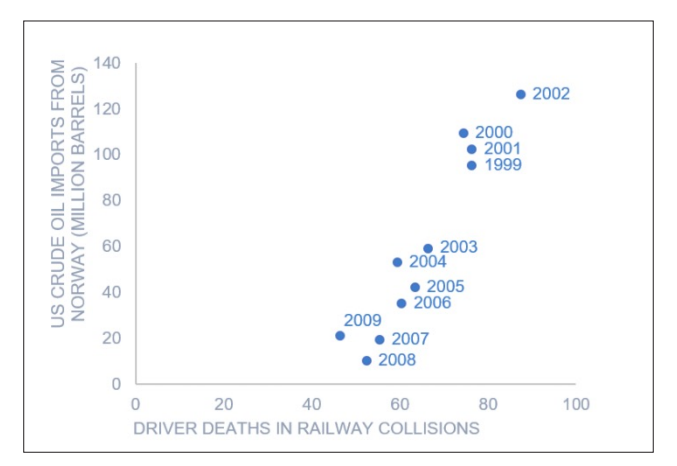
Examine the quality of the theory behind the correlated variables. Is there good
reason to believe, as validated by research, the variables would occur together? If such
validation does not exist, then the relationship may be spurious. For example, is there
any validation to the relationship between the number of driver deaths in railway
collisions by year (the horizontal axis), and the annual imports of Norwegian crude
oil by the U.S., as depicted below?36 This is an example of a spurious correlation. It is
not clear what a rational explanation would be for this relationship.

Author(s): Data Science and Analytics Committee

Publication Date: July 2022

Publication Site: American Academy of Actuaries

BIG DATA AND ALGORITHMS IN ACTUARIAL MODELING AND CONSUMER IMPACTS

Link: https://www.actuary.org/sites/default/files/2022-08/IABAAug2022_Sandberg_Presentation.pdf

Graphic:

Excerpt:

Systemic Influences and Socioeconomics
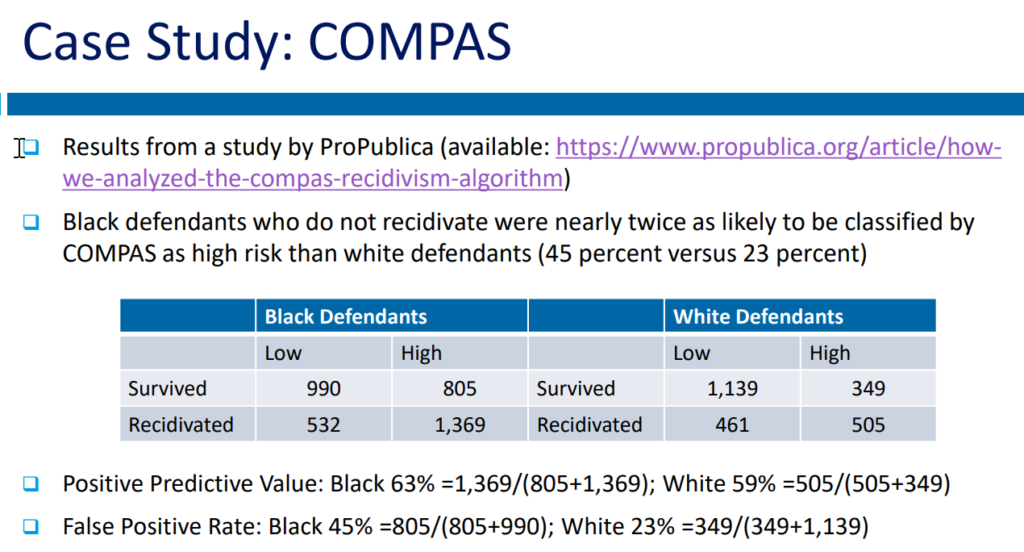
❑ Checking for and removing of systemic biases is difficult.
❑ Systemic biases can creep in at every step of the modeling process: data,
algorithms, and validation of results.
❑ Human involvement in designing and coding algorithms, where there is a lack of diversity
among coders
❑ Biases embedded in training datasets
❑ Use of variables that proxy for membership in a protected class
❑ Statistical discrimination profiling shopping behavior, such as price optimization
❑ Technology-facilitated advertising algorithms used in ad targeting and ad delivery

Author(s): David Sandberg, Data Science and Analytics Committee, AAA

Publication Date: August 2022

Publication Site: American Academy of Actuaries

Senate Finance Chair Broadens Inquiry Into Private Placement Life Insurance

Link: https://www.thinkadvisor.com/2022/09/21/senate-finance-chair-broadens-inquiry-into-private-placement-life-insurance/

Graphic:

Excerpt:

A lawmaker who helps shape federal tax legislation has indicated that he wants to keep wealthy families from using private placement life insurance to replace any federal tax loopholes that Congress closes.

Sen. Ron Wyden, D-Ore., the chair of the Senate Finance Committee, today announced that he has written to Prudential Financial, Zurich Insurance Group and the American Council of Life Insurers to get more information about the PPLI market, and the possibility that many PPLI policies may serve only to reduce the income taxes of families that rank in the wealthiest 1% of American families, not to provide genuine insurance.

“Is investment in PPLI products marketed to new or existing clients as a means to minimize or eliminate ordinary income, capital gains or estate taxes?” Wyden asks in the letters to Prudential and Zurich. “If so, please explain the legal basis for why these products help minimize or eliminate taxes.”

Author(s): Allison Bell

Publication Date: 21 Sept 2022

Publication Site: Think Advisor