A chance to enter a new era of financial transparency and awareness for public pension plans

Link: https://reason.org/commentary/a-chance-to-enter-a-new-era-of-financial-transparency-and-awareness-for-public-pension-plans/

Graphic:

Excerpt:

On Feb. 11, the Actuarial Standards Board issued a revised Actuarial Standard of Practice No. 4, effective February 15, 2023. The rollout has been low-key. The announcement says:

“Notable changes made to the existing 2013 version include expanding the scope to clarify the application of the standard when the actuary selects an output smoothing method and when an assumption or method is not selected by the actuary.”

But this description obscures a significant new required disclosure, one which follows years of controversy and acrimony within and among actuaries and the public pension plan community at large.  The requirement was the overwhelming focus during the drafting and comment period.     

The new required disclosure reflects economic reality better than any currently required number.

Author(s): Larry Pollack

Publication Date: 25 Mar 2022

Publication Site: Reason
Wall Street Is Fleecing a Bunch of Teachers

Link: https://jacobin.com/2022/04/katie-muth-pennpsers-pensions-retirement-fund-teachers-sec-pennsylvania

Excerpt:

A new era in the decade-long battle by retirees and whistleblowers to halt massive transfers of wealth out of retirement funds and into Wall Street firms could be at hand, thanks to the case of Katie Muth.

Muth, a Democratic Pennsylvania state senator, is one of fifteen trustees who oversees Pennsylvania’s largest public pension fund, the Pennsylvania Public School Employees’ Retirement System (PennPSERS). Not long after her February 2021 appointment to the board, Muth began questioning the fund’s investments in areas like private equity, hedge funds, and real estate.

Over the past thirty years, public pension funds have moved $1.4 trillion of retiree savings into such high-risk, high-fee “alternative investments,” enriching finance industry moguls like Stephen Schwarzman of the Blackstone Group and Robert Mercer of Renaissance Technologies while often shortchanging retired public employees and teachers.

But Muth says that when she asked the fund’s investment staff for more information about its high-risk investments, she was rebuffed — so in June 2021, she sued the fund for basic information about its investments.

Author(s):MATTHEW CUNNINGHAM-COOK

Publication Date: 6 April 2022

Publication Site: Jacobin

Deutsche Bank raided by authorities over ESG ‘greenwashing’ claims: ‘We’ve found evidence that that could support allegations of prospectus fraud’

Link: https://fortune.com/2022/05/31/deutsche-bank-dws-esg-greenwashing-raid-evidence-seized-whistleblower-fixler/

Excerpt:

German law enforcement officials raided the offices of Deutsche Bank on suspicion of the fraudulent advertising of sustainable investment funds at its DWS unit, dealing yet another setback to CEO Christian Sewing’s attempts to move on from years of corruption scandals.

The investigation revolves around allegations—leveled by a former DWS manager—that the retail money management business engaged in “greenwashing,” in which environmental, social and governance (ESG) investments are sold under false claims.

Roughly 50 officials from the Frankfurt public prosecutor, German securities regulator BaFin, and the federal criminal police office BKA were deployed to the headquarters of the two financial institutions to seize evidence on Tuesday.

“The allegations are that DWS has been advertising so-called ESG financial products for sale as being particularly green and sustainable when they actually weren’t,” a spokesman for the public prosecutor told Fortune, which has been looking into the claims since January. “In the course of our investigations we’ve found evidence that could support allegations of prospectus fraud.”

Author(s): CHRISTIAAN HETZNER

Publication Date: 31 May 2022

Publication Site: Fortune

Where Does CalSavers Stand?

Link: https://www.asppa-net.org/news/where-does-calsavers-stand

Graphic:

Excerpt:

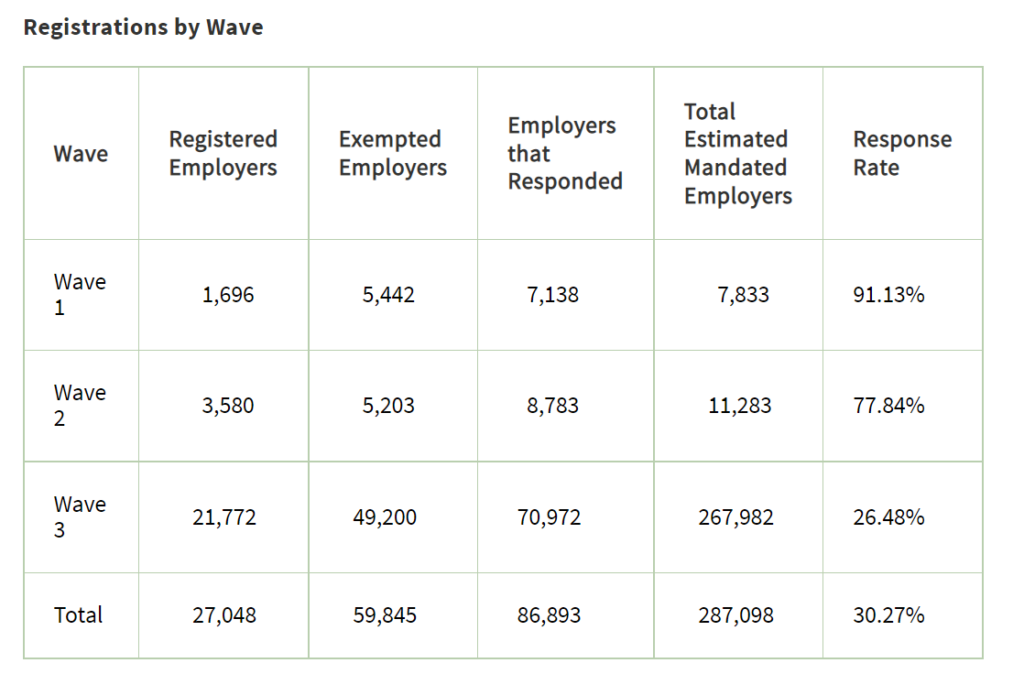
CalSavers, the state-provided retirement plan for employees whose employers do not provide one, was launched on July 1, 2019. Now, more than two and a half years later, where does it stand? 

Registration

Registration was set to take place in three waves: 

  • Wave 1: Employers with more than 100 employees had to register by Sept. 30, 2020. 
  • Wave 2: Employers with 51-100 or more employers had to register by June 30, 2021.
  • Wave 3: Employers with five or more employees must register by June 30, 2022. 

CalSavers has reported that the number of registered employers more than tripled in 2021

Author(s): JOHN IEKEL

Publication Date: 24 Feb 2022

Publication Site: ASPPA

New York pension fund wants to remove Twitter’s entire board

Link: https://www.protocol.com/bulletins/new-york-pension-twitter-removal

Excerpt:

The New York State Common Retirement Fund, one of the nation’s largest pension funds, announced that it will vote to remove all of Twitter’s directors at this week’s annual shareholder meeting. The vote against the directors is unlikely to result in change, but it shows mounting institutional pressure for Twitter to resist Elon Musk’s vision for relaxed content moderation policies.

Thomas DiNapoli, the New York state comptroller and trustee to the estimated $279.7 billion fund, said the Twitter board of directors had repeatedly failed to enforce the company’s own content moderation policies.

“Allowing this content on social media platforms facilitates the radicalization of individuals through repeated exposure to violent rhetoric, hate speech and examples of previous violence,” DiNapoli wrote in the public letter to Twitter’s directors. DiNapoli placed particular emphasis on Twitter’s failure to remove footage from a livestreamed mass shooting that took place in Buffalo, New York, last weekend. The alleged shooter espoused white supremacy ideology and pointed to social media sites including 4chan as the source of his radicalization.

Author(s): Hirsh Chitkara

Publication Date: 23 May 2022

Publication Site: protocol

Pensions watchdog warns about climate risk in rebuke of HSBC banker who downplayed danger

Link: https://www.reuters.com/world/uk/uk-pensions-regulator-says-pension-schemes-should-not-ignore-climate-change-2022-05-23/

Excerpt:

UK pension schemes should not ignore climate change, a senior executive at The Pensions Regulator said on Monday, the first watchdog to weigh in after a top HSBC banker was suspended after playing down the financial risks of climate change.

Regulators across the world have been putting pressure on the financial services industry to take climate change into account when calculating risks to their business models.

Stuart Kirk, a senior HSBC banker in charge of sustainable investments, had said at an industry event last week that central bank policymakers and other global authorities were exaggerating the financial risks of climate change. read more

The bank has since suspended him pending an internal investigation, sources familiar with the matter told Reuters on Monday.

Publication Date: 23 May 2022

Publication Site: Reuters

Ohio Teachers Pension Touts Past Transparency Awards, Fails To Disclose Special Investigation By State Auditor

Link: https://www.forbes.com/sites/edwardsiedle/2022/05/23/ohio-teachers-pension-touts-past–transparency-awards-fails-to-disclose-special-investigation-by-state-auditor/

Excerpt:

The nearly $100 billion State Teachers Retirement System of Ohio never tires of telling its members of past transparency awards it has received from Ohio State Auditor Keith Faber. The fact that Faber’s office is currently conducting a special investigation into the pension’s transparency practices, prompted by public records lawsuits and numerous member complaints—the results of which could, says the auditor, affect the retirement system’s rating in the future—is not disclosed by the pension.

In April 2022 Board News under the heading, “STRS Ohio earns auditor of state’s top rating from transparency for second year,” the State Teachers Retirement System of Ohio’s website boasts:

…..

Perhaps not surprising, this self-professed paragon of transparency is not touting the following ugly facts provided to me by the auditor’s office in a recent email:

“In October 2021, Auditor of State Keith Faber informed STRS that his office was launching a special audit after receiving numerous complaints, following the release of a report issued by Benchmark Financial Services Inc. titled “The High Cost of Secrecy: Preliminary Findings of Forensic Investigation of State Teachers Retirement System of Ohio,” commissioned by Ohio Retired Teachers Association.

….

In other words, it appears the Auditor of State’s transparency rating system merely asks whether a public agency has policies and procedures addressing transparency, not whether the agency is, in fact, being transparent in its dealings with the public in compliance with applicable laws. Such a rating system is of limited value to stakeholders, in my opinion, and presents the very real risk of being misinterpreted, as well as unduly relied upon, by the public.

Author(s): Edward Siedle

Publication Date: 23 May 2022

Publication Site: Forbes

The ECB Has a Huge Dilemma: Price stability or Bail Out Nations

Link: https://mishtalk.com/economics/the-ecb-has-a-huge-dilemma-price-stability-or-bail-out-nations

Graphic:

Excerpt:

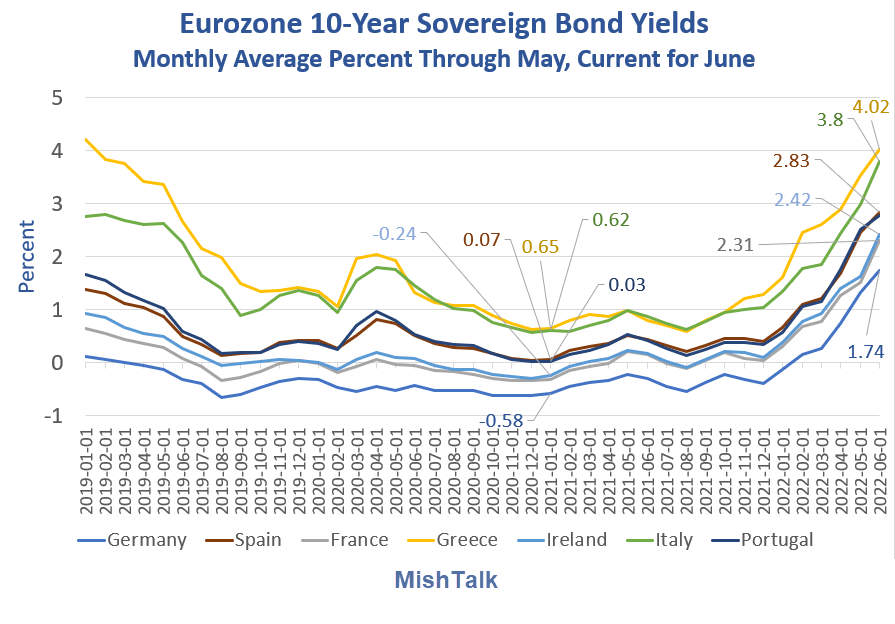
The spreads between German government bonds and those of the PIGS (Portugal, Italy, Greece, and Spain) have skyrocketed in recent weeks. 

This comes while Eurozone inflation is at a record high 8.1 percent. 

….

On June 16, Bloomberg reported Lagarde Tells Ministers ECB Plans for Limit on Bond Spreads

….

There is no single interest rate that makes any sense for Germany, Greece, Spain, Italy, and Portugal. 

The Fed is struggling to find the neutral rate, and I believe will overshoot, but at least there is a neutral rate. 

Lagarde is on Mission Impossible with 19 countries in the Eurozone, all with a different neutral. 

In theory, the sovereign bonds of Germany and Greece are the same. Default risks are the same.

In practice this is total nonsense, and for the third time the idea is being tested. 

Author(s): Mike Shedlock

Publication Date: 20 Jun 2022

Publication Site: Mish Talk

States Help Business Owners Save Big on Federal Taxes With SALT-Cap Workarounds

Link: https://www.wsj.com/articles/states-help-business-owners-save-big-on-federal-taxes-with-salt-cap-workarounds-11653989400

Graphic:

Excerpt:

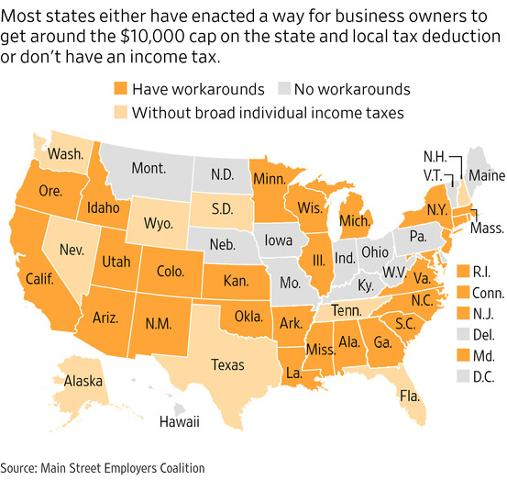
Business owners are likely saving more than $10 billion annually in federal taxes through state laws that circumvent the $10,000 cap on state and local tax deductions, according to a Wall Street Journal analysis of state data.

The state laws blunt the cap’s effect on owners of closely held businesses such as law firms, hedge funds, manufacturers and car dealerships, while workers earning wages generally can’t take advantage. The strategy, now available in 27 states, converts business owners’ personal income taxes into deductible business taxes that escape what is known as the SALT cap on state and local tax deductions.

Much of the money flows to high-income people in California, New York and New Jersey, while those in Illinois, Massachusetts, Minnesota and Connecticut are likely saving hundreds of millions of dollars as well. It isn’t just a phenomenon in high-tax Democratic states. The proliferating workarounds mark a rare case where a state-tax policy trend has been swift, national and bipartisan, and Utah, Georgia, Arizona, South Carolina and Kansas now have similar laws.

For states, approving the workarounds has been easy, because their residents benefit and state tax collections are barely altered. For business owners, the chance to lower federal tax bills is attractive, and industry groups are lobbying in the states that haven’t yet enacted workarounds.

Author(s): Richard Rubin

Publication Date: 31 May 2022

Publication Site: WSJ

Was ‘The Staircase’ murder really about life insurance?

Link: https://www.policygenius.com/life-insurance/news/staircase-michael-peterson/

Excerpt:

It’s been 21 years since novelist Michael Peterson was on trial for the murder of his wife, Kathleen, but the case is still capturing the public’s attention—most recently in an HBO Max series, “The Staircase.”

….

The case also involved the potential for a large life insurance payout. Kathleen had a $1.4 million life insurance policy, which was due to be paid to Michael in the event of her death. Prosecutors said Peterson was hoping to use the payout to address his debt [1] , including $143,000 in credit card debt.

…..

Peterson signed away any claim to the life insurance proceeds during the trial. However, because of the slayer rule, Peterson wouldn’t have been able to collect any money. Under the slayer rule, anyone suspected of murder or plotting a murder is prevented from benefiting from the dead person’s life insurance policy. Instead, Kathleen’s biological daughter, Caitlin Atwater, and her daughter’s father, Fred Atwater, received the money. [2]

In the scope of insurance fraud, life insurance murders aren’t a huge occurrence but they do happen, says Matthew J. Smith, executive director of the Coalition Against Insurance Fraud. For instance, in 2017, Joaquin Shadow Rams Sr., was convicted of killing his 15-month-old son for insurance money. Rams had taken out a $500,000 life insurance policy on the boy soon after he was born, which Smith says, should have been a red flag. 

Author(s): Lisa Rabasca Roepe

Publication Date: accessed 18 June 2022

Publication Site: Policygenius

Evaluating Unintentional Bias in Private Passenger Automobile Insurance

Link: https://disb.dc.gov/page/evaluating-unintentional-bias-private-passenger-automobile-insurance

Public Hearing Notice: Evaluating Unintentional Bias in Private Passenger Automobile Insurance, June 29, 2022, 3 pm

Excerpt:

In 2020, Commissioner Karima Woods, Commissioner for the District of Columbia Department of Insurance, Securities and Banking (DISB) directed the creation of the Department’s first Diversity Equity and Inclusion Committee to engage in a wide-ranging review of financial equity and inclusion and to make recommendations to remove barriers to accessing financial services. Department staff developed draft initiatives, including an initiative related to insurers’ use of factors such as credit scores, education, occupation, home ownership and marital status in underwriting and ratemaking. Stakeholder feedback on this draft initiative resulted in the Department concluding that data was necessary to properly address this initiative. Department staff conducted research and contacted subject matter experts before determining that relevant data was not generally available.

The Department is undertaking this project to collect the relevant data. We determined this initiative will be deliberative and transparent to ensure the resultant data would address the issue of unintentional bias. We also decided to initially focus on private passenger automobile insurance as that is a line of insurance that affects many District consumers and has previously had questions raised about the use of non-driving factors. The collected data will build on previous work done by the Department through the 2018 and 2019 public hearings and examinations that looked at private passenger automobile insurance ratemaking methodologies.

For this project to look at the potential for unintentional bias in auto insurance, DISB will conduct a review of auto insurers’ rating and underwriting methodologies. As a first step, DISB will hold a public hearing on Wednesday, June 29, 2022 at 3 pm to gather stakeholder input on the review plan, which is outlined below. The Department has engaged the services of O’Neil Risk Consulting and Algorithmic Auditing (ORCAA) to assist the Department and provide subject matter expertise. Additionally, the Department will hold one or more meetings to follow up on any items raised during the public hearing.

Publication Date: accessed 18 Jun 2022

Publication Site: District of Columbia Department of Insurance, Securities & Banking

By Design, the Fed May Be Tightening Too Much

Link: https://www.wsj.com/amp/articles/by-design-the-fed-may-be-tightening-too-much-11655370001

Excerpt:

The Fed has often moved interest rates by 0.75 percentage point or more in recent decades. But until this week, it had always done so in a downward direction. Indeed, it was a hallmark of Fed policy that it always cut interest rates faster, with less prompting, than it raised them.

…..

This asymmetry reflected the Fed’s perception of risks. If it cut rates too little, the economy might spiral down and the financial system implode. If it cut them too much, inflation might, some years later, rise. Throughout this prepandemic period, inflation was low and, at times, too low, but that wasn’t a big deal. Moreover, during that low-inflation, low-interest-rate era, rates couldn’t fall very much — the Fed called this the “zero lower bound” — so best to act quickly to forestall a downward spiral. If inflation was a problem, there was no limit to how high rates could go.

This philosophy got taken too far. The Fed kept rates too low for too long last year (and the Biden administration enacted too much fiscal stimulus) out of a mistaken belief that inflation was a remote threat compared with prolonged high unemployment.

The result is that risks are now asymmetric in the other direction. Inflation is too high and a self-sustaining wage-price spiral is a real threat. Asked why, after carefully laying the groundwork for a half-point increase, the Fed raised rates by 0.75 point Wednesday, Mr. Powell pointed to an “eye-catching” report that showed long-term inflation expectations rising ominously.

Author(s): Greg Ip

Publication Date: 16 Jun 2022

Publication Site: WSJ