Flood-Prone Homes Could Lose Federal Insurance Under FEMA Plan

Link: https://www.wsj.com/articles/fema-urges-congress-to-drop-flood-insurance-for-highest-risk-areas-11655384400

Excerpt:

Mr. Toomey asked Jerry Theodorou of the R Street Institute, a conservative-leaning Washington-based think tank, how seriously Congress should look at paying repetitive loss claims. “Indeed, this is a very serious problem,” Mr. Theodorou said. “The numbers speak for themselves, to have such a small percentage of policyholders accounting for close to 40% of the claims dollars paid.”

The flood insurance program — which is the main provider of flood coverage in the U.S. and has issued more than five million policies — has paid out more money to property owners and other expenses than it has collected in premiums from policyholders since Congress created it in 1968. It collects about $4.6 billion in annual revenue from policyholders in premiums, fees and other charges, according to the Congressional Research Service.

Flooding ranks as the country’s most common natural disaster. Scientists predict floods will happen more frequently in neighborhoods that face new risk from rising sea levels and extreme rainstorms due to climate change.

Author(s): Katy Stech Ferek

Publication Date: 16 June 2022

Publication Site: Wall Street Journal
Fed Hikes Rates 75 Basis Points; Powell Says 75 or 50 Likely in July

Link: https://www.thinkadvisor.com/2022/06/15/fed-hikes-rates-75-bps-intensifying-inflation-fight/

Graphic:

Excerpt:

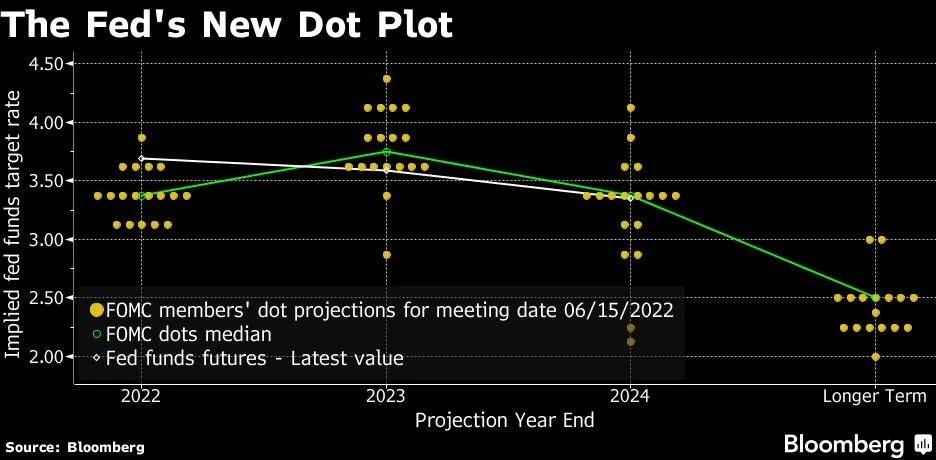
The Federal Reserve raised interest rates by 75 basis points — the biggest increase since 1994 — and Chair Jerome Powell said officials could move by that much again next month or make a smaller half-point increase to get inflation under control.

Slammed by critics for not anticipating the fastest price gains in four decades and then for being too slow to respond to them, Chairman Jerome Powell and colleagues on Wednesday intensified their effort to cool prices by lifting the target range for the federal funds rate to 1.5% to 1.75%.

“I do not expect moves of this size to be common,” he said at a press conference in Washington after the decision, referring to the larger increase. “Either a 50 basis point or a 75 basis-point increase seems most likely at our next meeting. We will, however, make our decisions meeting by meeting.”

Author(s): Craig Torres

Publication Date: 15 June 2022

Publication Site: Think Advisor

Biden Administration Sues a City Over “Rampant Overspending on Teacher Salaries”

Link: https://www.educationnext.org/biden-administration-sues-a-city-over-rampant-overspending-on-teacher-salaries/

Excerpt:

The Biden administration’s Securities and Exchange Commission is suing the city of Rochester, New York, contending that “rampant overspending on teacher salaries” plunged the Rochester school district into “extreme financial distress,” misleading investors who bought municipal bonds.

The legal action is unusual. Sure, the federal government’s interaction with K-12 education has often extended beyond the bounds of the U.S. Department of Education. The Department of Agriculture administers the school lunch program, and the Department of Defense operates schools serving military-connected children. Under George W. Bush, the Justice Department toyed with the idea of using antitrust law to support charter schools. And in the waning days of the Trump administration, President Trump issued an executive order authorizing “emergency learning scholarships” to be provided via the Secretary of Health and Human Services.

But, notwithstanding Bloomberg columnist Matt Levine’s theory that
everything is securities fraud,” in practice, the K-12 education beat hasn’t intersected greatly with the fraud provisions of federal securities laws. At least until now.

….

How much has Rochester been “overspending?” The website Seethroughny.com, a project of the Empire Center for Public Policy, lists 717 Rochester City School District Employees who earned more than $100,000 in 2019. The district has about 25,000 K-12 public school students, according to the state of New York. Spending runs about $20,000, a little below the statewide average. Whether that amounts to “overspending” probably depends on one’s view of how much the children are learning, and also one’s view of whether the students could learn more, and how much more, if more money were spent.

….

In practice, the legal aspects of the case will probably turn more on considerations about disclosure to potential bond buyers than about the details of the spending on teacher salaries.

Even so, the mere mention of securities law and bondholders as potential tools to curb school district “overspending” is intriguing, especially when the action comes under a president who campaigned promising to increase school spending so as to pay teachers “competitive salaries.” For years, reformers have complained that teachers unions capture school boards and run school systems for the benefit of adults rather than children. Now a different set of influential adults—bondholders—is, in a way, asserting, via the SEC, its own claim that could be a countervailing force.

Author(s): Ira Stoll

Publication Date: 15 June 2022

Publication Site: Education Next

R Street Institute Testifies Before Senate Banking Committee on National Flood Insurance Program

Link: https://www.rstreet.org/2022/06/16/r-street-institute-testifies-before-senate-banking-committee-on-national-flood-insurance-program/

Video:

Additional link: https://www.rstreet.org/2022/06/16/five-solutions-to-help-fix-the-national-flood-insurance-program-from-r-street-testimony-to-the-u-s-senate-banking-housing-and-urban-affairs-committee/

Excerpt:

Regarding the second objective, there is no equitable sharing of costs between the public and private sectors. The private sector is only peripherally involved in bearing flood risk. The involvement of the private insurance sector is restricted to administration of the program, for which insurers are remunerated by the NFIP. The participation of private insurers in flood insurance as a risk-bearer is de minimis, writing less than a tenth the premium collected by the NFIP.

Instead of attaining the overarching goal of reducing economic losses caused by flooding, flood-
related economic losses have increased. In the past decade, U.S. economic losses caused by flooding were $943 billion, close to five times more than the $211 billion cumulative flood-related losses in the prior decade. In this testimony, we highlight five issues standing in the way of the NFIP falling short of achieving its mission, and propose solutions to remedy those problem areas.

Author(s): Jerry Theodorou

Publication Date: 16 June 2022

Publication Site: R Street Institute

Big Data, Big Discussions

Link: https://theactuarymagazine.org/big-data-big-discussions/

Excerpt:

Why is the insurance industry now facing increased scrutiny on certain underwriting methods?

Insurers increasingly are turning to nontraditional data sets, sources and scores. The methods used to obtain traditional data—that were at one time costly and time-consuming—can now be done quickly and cheaply.

As insurers continue to innovate their underwriting techniques, increased scrutiny should be expected. It is not unreasonable for consumer advocates to push for increased transparency and explainability when insurers employ these advanced methods.

What is the latest regulatory activity on this topic in the various states and at the NAIC?

Activity in the states has been minimal. In 2021, Colorado became the first (and so far, only) state to enact legislation requiring insurers to test their algorithms for bias. Legislation nearly identical to the Colorado law was introduced in Oklahoma and Rhode Island in 2022, and it is likely other states will consider similar legislation. Connecticut is finalizing guidance that would require insurers to attest that their use of data is nondiscriminatory. Other states have targeted specific factors, but most have adopted a wait-and-see approach.

The NAIC created a new high-level committee to focus on innovation and AI, but it has become clear that a national standard is not likely at this time.

Author(s): INTERVIEW BY STEPHEN ABROKWAH, Interview with Neil Sprackling, president of Swiss Re Life & Health America Inc.

Publication Date: March 2022

Publication Site: The Actuary

CAS Releases Two Additional Papers in Race and Insurance Pricing Series

Link: https://www.casact.org/article/cas-releases-two-additional-papers-race-and-insurance-pricing-series

Excerpt:

Arlington, VA – Two new research reports designed to guide the insurance industry toward proactive, quantitative solutions to identify, measure and address potential racial bias in insurance pricing were published by the Casualty Actuarial Society (CAS) today.

“These two new reports in our CAS Research Series on Race and Insurance Pricing continue to provide additional insight into industry discussions on this topic,” said Victor Carter-Bey, DM, CAS chief executive officer. “We hope with this series to serve as a thought leader and role model for other insurance organizations and corporations in promoting fairness and progress.”

As the professional society of actuaries specializing in property and casualty insurance, the CAS is committed to diversity, equity and inclusion in actuarial work. To this end, the Society is releasing a series of four CAS Research Papers, which support the CAS’s Approach to Race and Insurance Pricing. This approach was adopted by the CAS Board of Directors in December 2020 and includes four key areas of focus and goals: basic and continuing education, research, leadership and influence, and collaboration. Each paper in the series addresses a different aspect of race and insurance pricing as viewed through the lens of property and casualty insurance.

Two of the four reports in the CAS Research Paper Series on Race and Insurance PricingUnderstanding Potential Influences of Racial Bias on P&C Insurance: Four Rating Factors Explored and Defining Discrimination in Insurance, are being released today. Here is a more detailed description of the two reports published today:

Defining Discrimination in InsuranceThis report examines terms that are being used in discussions around potential discrimination in insurance, including protected class, unfair discrimination, proxy discrimination, disparate impact, disparate treatment, and disproportionate impact. The paper provides historical and practical context for these terms and illustrates the inconsistencies in how different stakeholders define them. It also describes the potential impacts of these definitions on actuarial work.

Understanding Potential Influences of Racial Bias on P&C Insurance: Four Rating Factors ExploredThe paper examines four commonly used rating factors to understand how the data underlying insurance pricing models may be impacted by racially biased policies and practices outside of insurance. The goal is to highlight the multi-dimensional impacts of systemic racial bias, as it may relate to insurance pricing. The four factors included in the report are: Credit-Based Insurance Score (CBIS), geographic location, homeownership and Motor Vehicle Records.

The other two reports, Methods for Quantifying Discriminatory Effects on Protected Classes in Insuranceand Approaches to Address Racial Bias in Financial Services: Lessons for the Insurance Industry, were released March 10, 2022 during a virtual briefing.  

These four research reports are just one way the CAS supports evolving actuarial practices and strengthens the knowledge of its members. The papers demonstrate the Society’s recognition that actuaries—who are responsible for setting insurance rates—must be a voice in an ever-evolving dialogue. The CAS understands that this work is critical to maintaining the Society and its members’ public trust.

Publication Date: 31 Mar 2022

Publication Site: CAS

South Carolina Withdraws From Interstate Insurance Compact

Link: https://www.thinkadvisor.com/2022/06/13/south-carolina-withdraws-from-interstate-insurance-compact/

Excerpt:

South Carolina — one of the leaders in the effort to create the Interstate Insurance Product Regulation Compact — has withdrawn from the compact because of a conflict over long-term care insurance rate increase application reviews.

Members of the Interstate Insurance Product Regulation Commission, the body that oversees the compact, voted in December 2021 to keep a rule that lets the compact review and approve requests for LTCI rate increases under 15%.

The rule conflicts with a new South Carolina law that requires the director of the South Carolina Department of Insurance or a director designee to review and rule on all LTCI rate filings.

Author(s): Allison Bell

Publication Date: 13 June 2022

Publication Site: Think Advisor

To Fight Inflation, The Fed Declares War On Workers

Link: https://www.levernews.com/the-fed-declares-war-on-workers/

Excerpt:

New inflation data released Friday offered dismal news: Historic price increases aren’t showing any signs of abating, and in fact may be accelerating.

What can be done? Federal Reserve Chairman Jerome Powell has an idea: throw cold water on the hot labor market — perhaps the one bright spot in the current economy.

In fact, Powell recently screamed the quiet part out loud, making clear the largest central bank in the world is in fact an adversary to workers, when he declared that his goal is to “get wages down.”

At a May 4 press conference in which he announced a .5 percent interest rate hike, the largest since the year 2000, Powell said he thought higher interest rates would limit business’ hiring demand and lead to suppressed wages. As he put it, by reducing hiring demand, “that would give us a chance to get inflation down, get wages down, and then get inflation down without having to slow the economy and have a recession and have unemployment rise materially.”

Author(s): Julia Rock

Publication Date: 13 Jun 2022

Publication Site: The Lever

EXECUTIVE EXCESS 2022

Link: https://ips-dc.org/report-executive-excess-2022/

Graphic:

Excerpt:

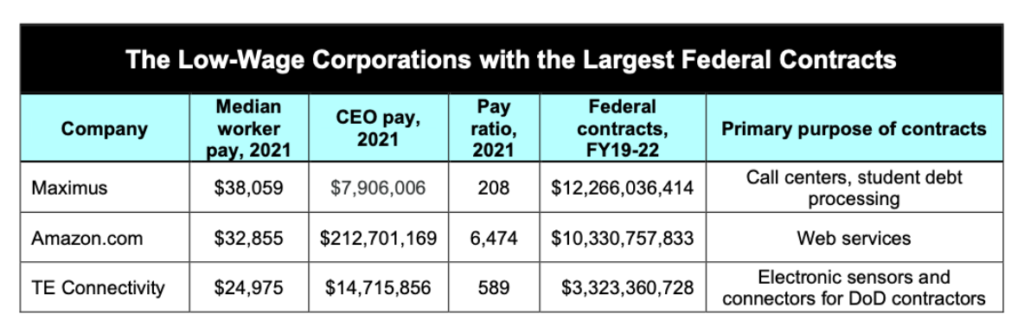
  • Taxpayer dollars are fueling corporations with extreme CEO-worker pay gaps.
    • Of the 300 companies in our sample, 40 percent received federal contracts between October 1, 2019 and May 1, 2022. The combined value of these contracts was $37.2 billion.
    • At these low-wage contractors, the average CEO-worker pay ratio hit 571 to 1 in 2021. Only 6 of the 119 contractors had pay gaps of less than 100 to 1.
  • Policy solutions for runaway CEO pay do exist — and enjoy broad support.
    • Some 62 percent of Republicans and 75 percent of Democrats support an outright cap on CEO pay relative to worker pay.
    • While a hard cap is unlikely, other CEO pay reforms have also gained traction in recent years. These reforms focus on three key areas:
      • CEO pay ratio incentives for federal contractors
      • Excessive CEO pay taxes
      • Stock buyback restrictions and taxes

Author(s): SARAH ANDERSON | SAM PIZZIGATI | BRIAN WAKAMO

Publication Date: Accessed 10 June 2022

Publication Site: Institute for Policy Studies

Top 10 Medicare Bills Introduced in 2022

Link: https://www.thinkadvisor.com/2022/04/28/top-10-medicare-bills-introduced-in-2022/

Excerpt:

Here’s a look at the top-performing Medicare bills introduced since Jan. 1.

We searched Congress.gov for new Medicare bills, then ranked the bills based on co-sponsorship bipartisanship and numbers.

Some of these bills could pass on their own. Others could surface as provisions in much larger bills, such as a Ukraine aid bill or a COVID-19 pandemic response funding bill.

What It Means

These measures seem to have the legislative mojo to go places.

Each sponsor has managed to overcome the current hostility between Republicans and Democrats and persuade at least one member of the opposite party to sign on as a co-sponsor.

Author(s): Allison Bell

Publication Date: 28 April 2022

Publication Site: Think Advisor

Geico ordered to pay $5.2M to woman who got HPV in a car

Link: https://www.autoblog.com/2022/06/08/insurance-company-payout-hpv-car-sex/

Excerpt:

Per The Kansas City Star, the woman initiated a claim with Geico in February 2021 after learning that she’d contracted the sexually transmitted infection from a partner who knew but did not disclose his status. Since the incident in question happened in her partner’s car, she argued that his liability insurance was responsible for damages. A settlement was reportedly offered to Geico, whose lawyers declined. As anybody who’s had legal entanglements with an insurance company can probably guess, the case went to arbitration.

In what we’re certain was a surprise to Geico’s legal team, arbitration did not go their way. The woman’s partner was found liable and the arbitrator approved an award of $5.2 million in damages to be paid out by the insurer despite requests by Geico for a new hearing. The insurance company appealed to the courts on several grounds, claiming that the process denied it the ability to have its day in court. The company’s appeal was denied on all points.

Author(s): Byron Hurd

Publication Date: 8 June 2022

Publication Site: Autoblog