APPROACHES TO ADDRESS RACIAL BIAS IN FINANCIAL SERVICES: LESSONS FOR THE INSURANCE INDUSTRY

Link: https://www.casact.org/sites/default/files/2022-03/Research-Paper_Approaches-to-Address-Racial-Bias_0.pdf?utm_source=Landing+Page&utm_medium=Website&utm_campaign=RIP+Series

Graphic:

Excerpt:

The goal of this paper is to equip actuaries to proactively participate in
discussions and actions related to potential racial biases in insurance
practices. This paper uses the following definition of racial bias:
Racial bias refers to a system that is inherently skewed along racial lines.
Racial bias can be intentional or unintentional and can be present in the
inputs, design, implementation, interpretation or outcomes of any system.
To support actuaries and the insurance industry in these efforts, this paper
examines issues of racial bias that have impacted four areas of noninsurance financial services — mortgage lending, personal lending,
commercial lending and the underlying credit-scoring systems — as well
as the solutions that have been implemented in these sectors to address
this bias. Actuaries are encouraged to combine this information on
solutions and gaps in other industries with expertise in their practice areas
to determine how, if at all, this information could be applied to identify
potential racial biases impacting insurance or other industries in which
actuaries work.
Parallels can be drawn between the issues noted here in financial services
and those being discussed within the insurance industry. While many
states have long considered race to be a protected class which cannot be
used for insurance business decisions, regulators and consumer groups
have brought forth concerns about potential racial bias implicit in existing
practices or apparent in insurance outcomes. State regulators are taking
individual actions to address potential issues through prohibition of
certain rating factors, and even some insurers are proactively calling for
the industry to move away from using information thought to be
correlated with race. However, this research suggests that government
prohibition of specific practices may not be a silver-bullet solution.
Actuaries can play a key role as the insurance industry develops
approaches to test for, measure and address potential racial bias, and
increase fairness and equality in insurance, while still maintaining riskbased pricing, company competitiveness and solvency.

Author(s): Members of the 2021 CAS Race and Insurance Research Task Force

Publication Date: March 2022

Publication Site: CAS
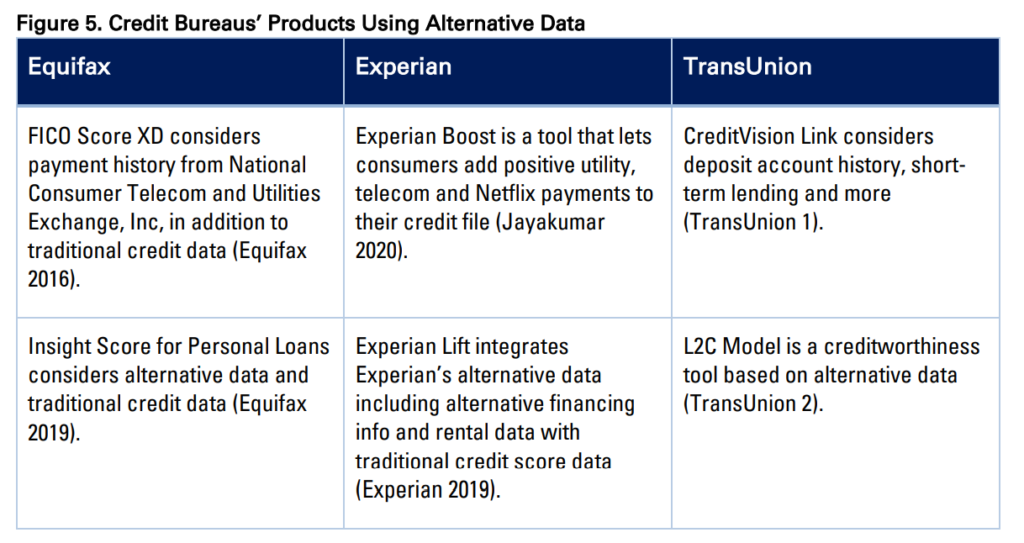
UNDERSTANDING POTENTIAL INFLUENCES OF RACIAL BIAS ON P&C INSURANCE: FOUR RATING FACTORS EXPLORED

Link: https://www.casact.org/sites/default/files/2022-03/Research-Paper_Understanding_Potential_Influences.pdf?utm_source=III&utm_medium=Issue+Brief&utm_campaign=RIP

Graphic:

Excerpt:

Insurance rating characteristics have come under scrutiny by legislators and
regulators in their efforts to identify and address racial bias in insurance
practices. The goal of this paper is to equip actuaries with the information
needed to proactively participate in industry discussions and actions related
to racial bias and insurance rating factors. This paper uses the following
definition of racial bias:
Racial bias refers to a system that is inherently skewed along racial lines.
Racial bias can be intentional or unintentional and can be present in the
inputs, design, implementation, interpretation, or outcomes of any system.
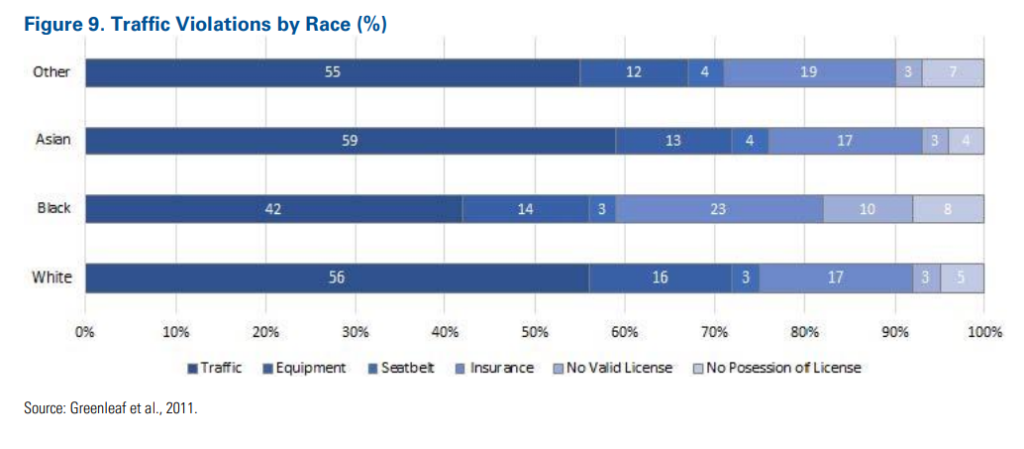
This paper will examine four commonly used rating factors in personal
lines insurance — credit-based insurance score, geographic location, home
ownership, and motor vehicle records — to understand how the data
underlying insurance pricing models may be impacted by racially biased
policies and practices outside of the system of insurance. Historical issues
like redlining and racial segregation, as well as inconsistent enforcement of
policies and practices contribute to this potential bias. These historical
issues do not necessarily change the validity of the actuarial approach of
evaluating statistical correlation of rating factors to insurance loss overall.
Differences in the way individual insurers build rating models may produce
very different end results for customers. More data and analyses are
needed to understand if and to what extent these specific issues of racial
bias impact insurance outcomes. Actuaries and other readers can combine
this information with their own subject matter expertise to determine if and
how this could impact the systems for which they are responsible, and what
actions, if any, could be taken as a result.

Author(s): Members of the 2021 CAS Race and Insurance Research Task Force

Publication Date: March 2022

Publication Site: CAS
DEFINING DISCRIMINATION IN INSURANCE

Link: https://www.casact.org/sites/default/files/2022-03/Research-Paper_Defining_Discrimination_In_Insurance.pdf?utm_source=III&utm_medium=Issue+Brief&utm_campaign=RIP+Series

Graphic:

Excerpt:

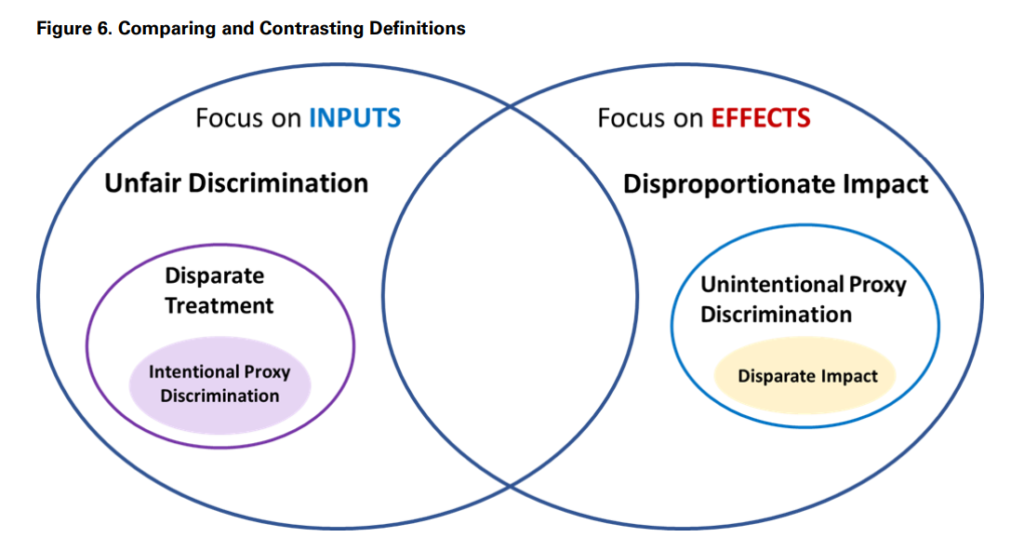
This research paper is designed to introduce various terms used in defining
discrimination by stakeholders in the insurance industry (regulators, consumer
advocacy groups, actuaries and insurers, etc.). The paper defines protected class,
unfair discrimination, proxy discrimination, disproportionate impact, disparate
treatment and disparate impact.
Stakeholders are not always consistent in their definitions of these terms, and
these inconsistencies are highlighted and illustrated in this paper. It is essential to
elucidate key elements and attributes of certain terms as well as conflicting
approaches to defining discrimination in insurance in order to move the industry
discussion forward.
While this paper does not make a judgment on the appropriateness of the
definitions put forth, nor does it promulgate what the definitions should be,
readers will be empowered to understand the components of discrimination terms
used in insurance, as well as be introduced to the potential implications for
insurers.
Actuaries who have a strong foundational knowledge of these terms are likely to
play a key role in informing those who define and refine these terms for insurance
purposes in the future. This paper is not a legal review, and thus discusses terms
and concepts as they are used by insurance stakeholders, rather than what their
ultimate legal definition will be. However, it is important for actuaries to
understand the point of view of various stakeholders, and the potential impact it
could have on actuarial work. As the regulatory and legislative landscape
continues to shift, this brief should be considered a living document, that will
periodically require update.

Author(s): Kudakwashe F. Chibanda, FCAS

Publication Date: March 2022

Publication Site: CAS
Actuarial Group Takes Steps to Identify Racial Bias in Insurance Rates

Link: https://www.investopedia.com/race-and-insurance-5224764

Excerpt:

Two new papers from property casualty actuaries delve into issues of historical and ongoing bias in insurance pricing.

These papers are on potential Influences among four rating factors and attempts to actually define discrimination in insurance.

Factors such as geography, credit scoring, home ownership, and motor vehicle records affect homeowners and auto insurance rates and can cause Black consumers to pay higher premiums.

Actuaries and regulators are trying to untangle factors from societal prejudice for fairer pricing

AI or machine learning can augment or amplify these biases with their vast inputs, and data scientists will be analyzing outcomes for discriminatory pricing effects.

States have been taking action through regulation or pending legislation to extinguish some factors that can lead to racial bias or to examine data modeling to check for discriminatory effects.

Author(s): ELIZABETH FESTA

Publication Date: 5 April 2022

Publication Site: Investopedia

Biological and Psychobehavioral Correlates of Credit Scores and Automobile Insurance Losses: Toward an Explication of Why Credit Scoring Works

Link: https://www.jstor.org/stable/4138424

Graphic:

Abstract:

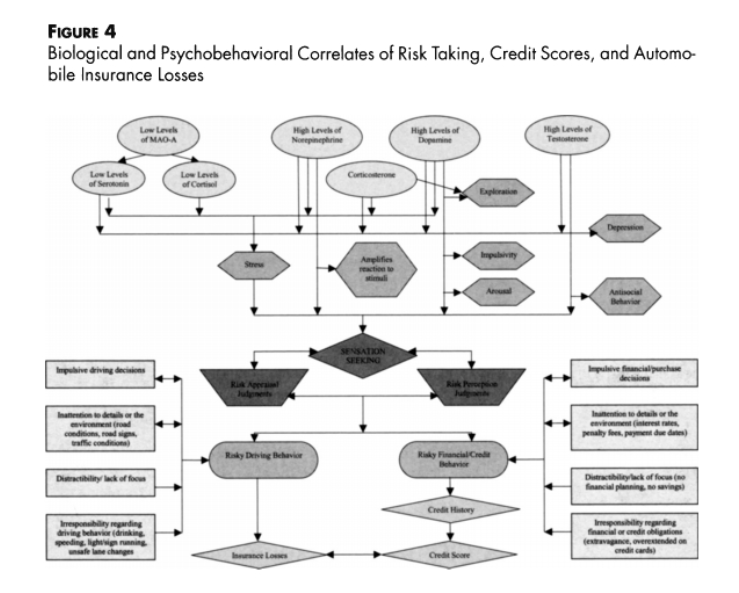
The most important new development in the past two decades in the personal lines of insurance may well be the use of an individual’s credit history as a classification and rating variable to predict losses. However, in spite of its obvious success as an underwriting tool, and the clear actuarial substantiation of a strong association between credit score and insured losses over multiple methods and multiple studies, the use of credit scoring is under attack because there is not an understanding of why there is an association. Through a detailed literature review concerning the biological, psychological, and behavioral attributes of risky automobile drivers and insured losses, and a similar review of the biological, psychological, and behavioral attributes of financial risk takers, we delineate that basic chemical and psychobehavioral characteristics (e.g., a sensation-seeking personality type) are common to individuals exhibiting both higher insured automobile loss costs and poorer credit scores, and thus provide a connection which can be used to understand why credit scoring works. Credit scoring can give information distinct from standard actuarial variables concerning an individual’s biopsychological makeup, which then yields useful underwriting information about how they will react in creating risk of insured automobile losses.

Author(s): Patrick L. Brockett and Linda L. Golden

Publication Date: originally 2007

Publication Site: jstor, The Journal of Risk and Insurance

Cite: Brockett, Patrick L., and Linda L. Golden. “Biological and Psychobehavioral Correlates of Credit Scores and Automobile Insurance Losses: Toward an Explication of Why Credit Scoring Works.” The Journal of Risk and Insurance, vol. 74, no. 1, 2007, pp. 23–63. JSTOR, http://www.jstor.org/stable/4138424. Accessed 22 May 2022.

Decentralized Finance for Actuaries

Link: https://www.soa.org/resources/research-reports/2022/decentralized-finance/

Graphic:

Excerpt:

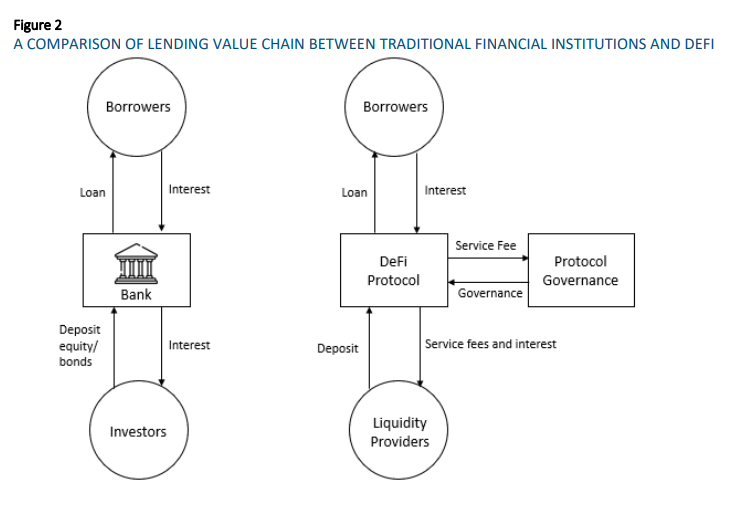
Decentralized finance, or DeFi, is an emerging financial system powered by blockchain technology. This research report aims to introduce actuaries to DeFi and help them develop a solid understanding of DeFi. It will begin with addressing “what is DeFi?” by providing an introduction on blockchains and DeFi. It will then discuss in further detail the key characteristics, applications, opportunities, and risks of DeFi. After providing the foundation, this report will discuss the potential adoption of DeFi and its interaction with the current financial system (sometime referred to as traditional finance for contrast with DeFi), and the implications for practicing and aspiring actuaries. In addition, a glossary of terms used in DeFi and a brief history of the development of DeFi have been included in the appendix.

Author(s):

Jen Houng (Erik) Lie, FSA, ZooFi Labs
Gwen Yun Weng, FSA, CFA, ZooFi Labs
Wai Chak Tse, ZooFi Labs

Publication Date: March 2022

Publication Site: SOA

Diversity At the Fed and ECB? There is None, It’s a Big Self-Serving Lie

Link: https://mishtalk.com/economics/diversity-at-the-fed-and-ecb-there-is-none-its-a-big-self-serving-lie

Graphic:

Tweet link:

Excerpt:

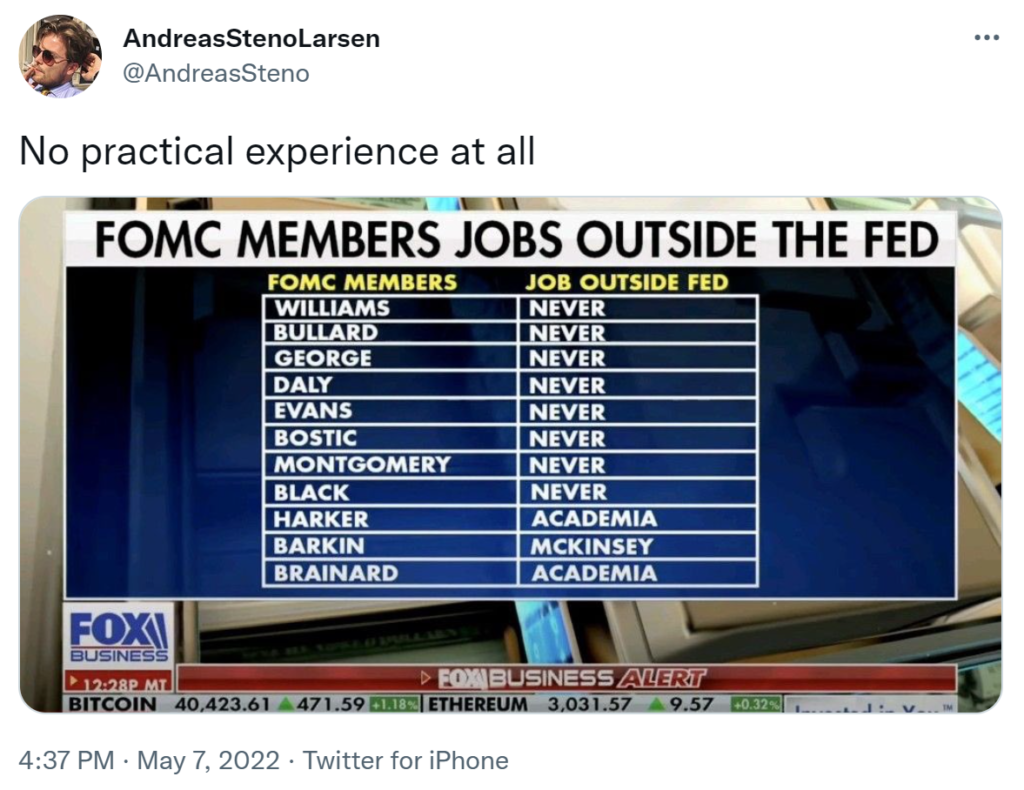
At the ECB, you better be gung-ho pro-EU. You better believe negative interest rates are a good idea. And you must back the idea that targeting 2% inflation makes sense.

Finally, if somehow you find yourself at the ECB disagreeing with any of those things, you are expected to shut your mouth so the consensus view never shows any dissent.

….

At FRBNY, I recall the people who ran Treasury markets, money markets, etc. literally had no relevant experience or expertise. The job of staff was to make them appear competent, but it didn’t really matter what they did because Fed can’t fail and they can’t get fired.  

This creates a culture where anyone with talent or ambition GTFO ASAP. There are exceptions, but those who rise tend to be those who have no where else go. It’s a weird structure where the higher you go, the more incompetent you are.

So it’s no surprise Fed is failing

Author(s): Mike Shedlock

Publication Date: 13 May 2022

Publication Site: Mish Talk

When Harry Fired Sally: The Double Standard in Punishing Misconduct

Link: https://www.journals.uchicago.edu/doi/abs/10.1086/718964

Abstract:

We examine gender differences in misconduct punishment in the financial advisory industry. There is a “gender punishment gap”: following an incident of misconduct, female advisers are 20% more likely to lose their jobs and 30% less likely to find new jobs, relative to male advisers. The gender punishment gap is not driven by gender differences in occupation, productivity, nature of misconduct, or recidivism. The gap in hiring and firing dissipates at firms with a greater percentage of female managers and executives. We also explore the differential treatment of ethnic minority men and find similar patterns of “in-group” tolerance.

Author(s): Mark Egan, Gregor Matvos, and Amit Seru

Publication Date: May 2022

Publication Site: Journal of Political Economy; Volume 130, Number 5

Looking Beyond Sex

Link: https://theactuarymagazine.org/looking-beyond-sex/

Graphic:

Excerpt:

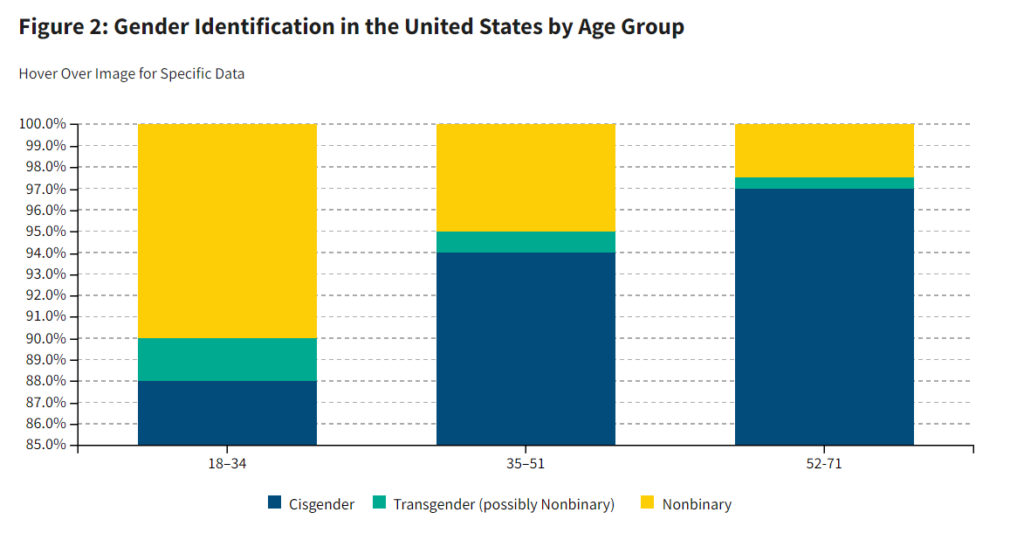
With nonbinary genders recognized on legal documents, customers are beginning to ask for forms and applications to include nonbinary options as well—so they’re not forced into a false selection. Even so, a person still could make an inaccurate selection. A customer falsely selecting a nonbinary gender is slightly less risky for the insurance company than selecting a false binary gender, as nonbinary rates are likely to fall somewhere between male and female to ensure they’re not discriminatory.

In the end, providing false information on an insurance application is fraudulent activity regardless of the question. Many of the states that include nonbinary gender markers on birth certificates and/or driver’s licenses already require the individual to sign an affidavit stating that they are not changing their gender marker for a fraudulent purpose. The benefits of including options for nonbinary customers and the potential for more accurate risk evaluations hopefully will outweigh a possible increase in fraudulent activity.

Author(s): Erin Sheriff

Publication Date: July 2020

Publication Site: The Actuary, SOA

CalSTRS Plans to Redefine ‘Diverse Managers’ and ‘Emerging Managers,’ in Accordance With New California Law

Link: https://www.ai-cio.com/news/calstrs-plans-to-redefine-diverse-managers-and-emerging-managers-in-accordance-with-new-california-law/

Excerpt:

The California State Teachers’ Retirement System is now planning to formally define the term “diverse manager” and adjust their definition of “emerging manager.” Though the two categories overlap, they are not identical.

The term “emerging manager” is based on the following criteria, according to CalSTRS: “the amount of assets under management; fund lifecycle of funds; firm legal structure; non-employee ownership percentage; and other various factors including track record, private placement memorandum.”

The term “diverse manager” will refer exclusively to the diversity of the firm’s ownership. The term will be defined in a tiered way such that if a firm is 25% to 49% owned by women, ethnic minorities, and/or LGBTQ individuals, it will be labeled as “substantially diverse.” A firm would be labeled as “majority diverse” if it is more than 50% owned by women, ethnic minorities, and/or LGBTQ people. Ethnic minorities include all non-white groups listed on the census.

Author(s): Anna Gordon

Publication Date: 4 May 2022

Publication Site: ai-CIO

New York pension money ‘held hostage’ by Vladimir Putin, Russia

Link: https://nypost.com/2022/05/14/ny-pension-money-held-hostage-by-vladimir-putin-russia/

Excerpt:

New York employees and taxpayers are unwittingly financing Russian companies and the oligarch pals of Vladimir Putin with at least $519 million invested in assets now frozen by the war-mongering dictator, The Post has learned.

City and state pension systems have pledged to sell off the holdings in protest of Russia’s assault on Ukraine, but Moscow has prohibited foreign investors from dumping the stocks.

“Putin is a thug and he’s holding our money hostage,” said Gregory Floyd, a Teamsters union leader and trustee of the New York City Employee Retirement System, NYCERS.

New York City’s five pension systems – covering teachers, cops, firefighters and other city employees – have invested a total $284.5 million in 33 publicly traded Russian stocks, according to records released to The Post by city Comptroller Brad Lander’s office. 

On Feb. 25, the market value of the Russian assets was $185.9 million, nearly $100 million less than the purchase price, the latest available records show.

Author(s): Susan Edelman, Thomas Barrabi

Publication Date: 14 May 2022

Publication Site: NY Post

PSERS Considers Suing Aon for Miscalculating Returns

Link: https://www.ai-cio.com/news/psers-considers-suing-aon-for-miscalculating-returns/

Excerpt:

At their board meeting last week, Pennsylvania’s Public School Employees’ Retirement System voted to hire law firm Blank Rome to help determine if it should sue Aon, an investment consultant the pension fund hired.

The potential suit concerns a calculation error Aon made that caused PSERS to inaccurately report its returns in December 2020. While initially the nine-year performance figure was reported to be 6.38%, a correction showed that it was in fact lower, and thus below the threshold needed to prevent increased contributions. When the miscalculation was revealed in March 2021, the pension fund’s beneficiaries were forced to increase their payments.

PSERS paid Aon $7.2 million for investment advice over the course of almost a decade. Currently, Aon is still employed by PSERS. Both the FBI and the SEC are investigating the miscalculation. PSERS is also under investigation for gifts given by Wall Street firms to PSERS employees.

Author(s): Anna Gordon

Publication Date: 16 May 2022

Publication Site: ai-CIO