Public Pensions’ New Quandary: Coping With Geopolitical Turmoil

Link: https://www.governing.com/finance/public-pensions-new-quandary-coping-with-geopolitical-turmoil

Excerpt:

Arguably, trustees and investment teams need a serious conversation with portfolio managers who are overweight in companies and countries that could foreseeably lose favor and stock exchange value. To ground that dialog, some form of risk analysis is required. One protocol could be as primitive as routinely identifying which major corporate equity and debt holdings in a system’s portfolio have cost and revenue exposure of more than 10 or 15 percent in such potentially at-risk regimes, and prodding managers to trim down those geopolitically vulnerable positions unless there is a clearly compelling undervaluation thesis. Another sensible approach would be to require underweighting of major companies relative to a benchmark index, based on their percentages of autocrat-nation revenues.

Ultimately at a fiduciary level, if a pension fund’s total worst-case exposure to all earnings and income derived from autocratic nations is an insignificant fraction of its total portfolio, the composite risk is probably not worth losing sleep over, on purely financial grounds. But politics could still enter the theater stage for pension boards that ignore this issue.

Pension consultants and risk advisers have a new role to play in this dialog. ESG investing is now under fire, so a healthy ESG+G discussion is especially timely. If nothing else, informed advisers can help investment teams and trustees identify where their portfolios might contain a blind-side risk that hasn’t received enough attention.

Author(s): Girard Miller

Publication Date: 10 May 2022

Publication Site: Governing
Breaking News: Central States Filed

Link: https://burypensions.wordpress.com/2022/04/29/breaking-news-central-states-filed/

Graphic:

Excerpt:

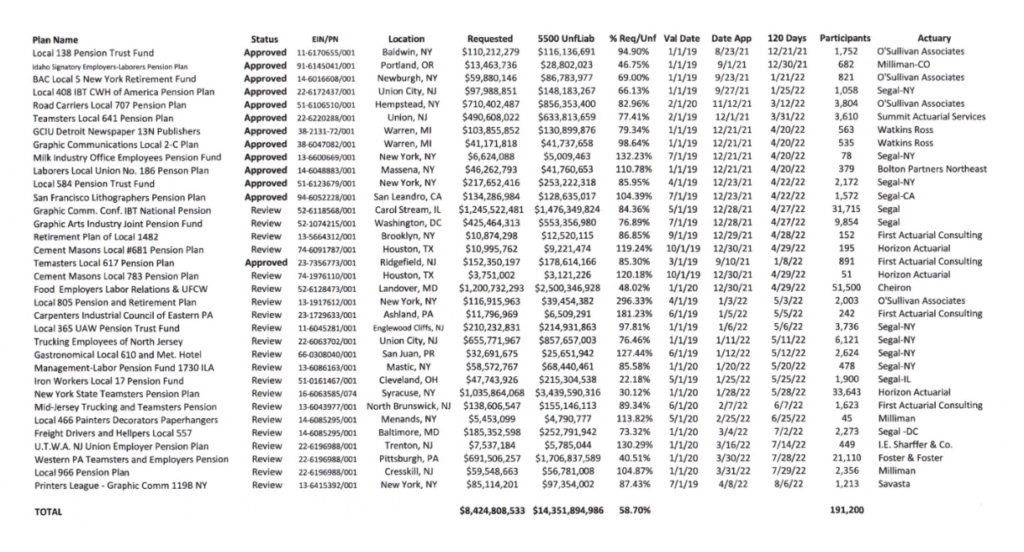
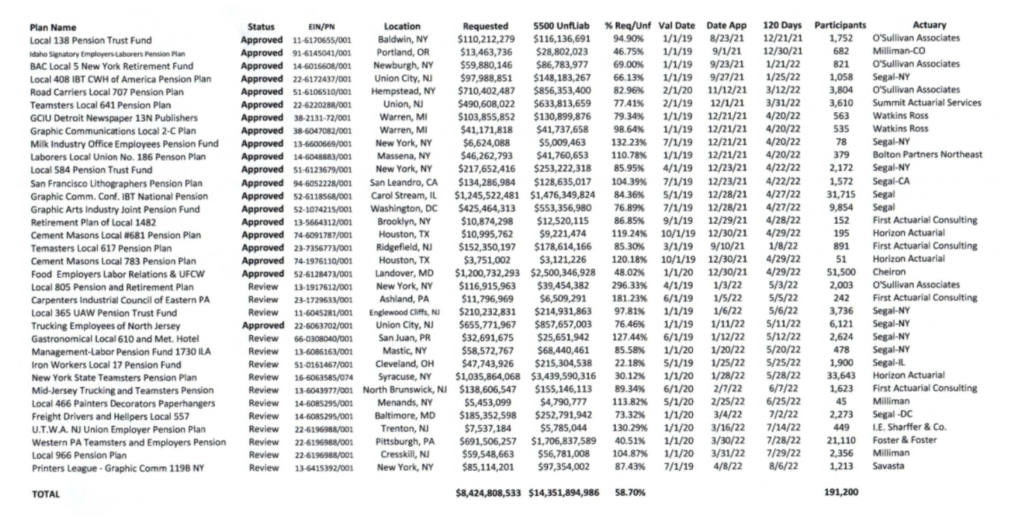
The first 34 plans that filed requested a total $8.4 billion in bailout money from the PBGC Special Financial Assistance program for troubled multiemployer plans. No press release but the PBGC weekend update showed one new plan – the Central States, Southeast & Southwest Areas Pension Plan with 364,908 participants which is asking for $35 billion dollars.

Author(s): John Bury

Publication Date: 29 Apr 2022

Publication Site: burypensions

I Finance The Current Thing

Link: https://allenfarrington.medium.com/i-finance-the-current-thing-7ea204230315

Excerpt:

Passive investing is most often celebrated as a marvel of risk/reward packaging for the retail investor, who surely doesn’t have the time or energy to do the job of a professional capital allocator. It’s a fair assumption that they have their own job doing something productive in the real economy. Is this arrangement worth sacrificing? Would sacrificing it be ESG-friendly? Yes, absolutely it would, but we will return to this further down.

Passive investing relies on the notion of an index, or, a numerical weighting of every publicly listed company in a given geography, above a certain size, etc. which is determined by relative size and expressed as a percentage of the whole. If the value of all shares outstanding multiplied by their current market price (or, “market capitalization”) of Company A is 1% of the total of all the companies in an index, then it makes up 1% of that index, and its shares are 1% of those held by a passive investment instrument.

The existence of indices is the bane of the lived experience of investment professionals who take Schumpeter a little more seriously and do not allocate by algorithm but by analysis of business fundamentals. “Performance” is measured relative to an index, on the understandable but perverse realization that index investing, which relies only on an algorithm, is much cheaper for the client. If your non-passive (or “active”) manager returned you 50%, you might think that is fantastic, but if the index went up 60% then you paid for nothing. In fact, technically they underperformed by 10%. No performance fees — even on 50%! — and probably also fired.

….

When SEC Commissioner Hester Peirce voiced the lone dissent against the inclusion of “climate risks” in company prospectuses recently, her argument was basically my own above: these are risks. Although the concept is incredibly technically involved, real investors know how to deal with risks and do not need to be condescended to about which deserve their attention more than others. “We are not the securities and environment commission,” Peirce warned, adding, “at least not yet.” Quite right. I would hope not ever if the rule of law is to be taken seriously, and exactly this kind of regulatory capture via backdoor-compliance enforcement of virtue signaling is to stop.

But could we probe deeper still? ESG is an attack vector, but what is the attack surface? Without intending to be flippant, I think it is centralization. Capital markets are centralized institutions and they are being attacked. So far, so bleak. Can we do anything about it? And what was that Thiel talk actually about, again?

Author(s): Allen Farrington

Publication Date: 21 April 2022

Publication Site: Medium

Inside Nebraska’s Surprisingly Effective Covid Strategy

Link: https://www.politico.com/news/magazine/2022/04/22/nebraska-covid-response-pete-ricketts-00026993

Graphic:

Excerpt:

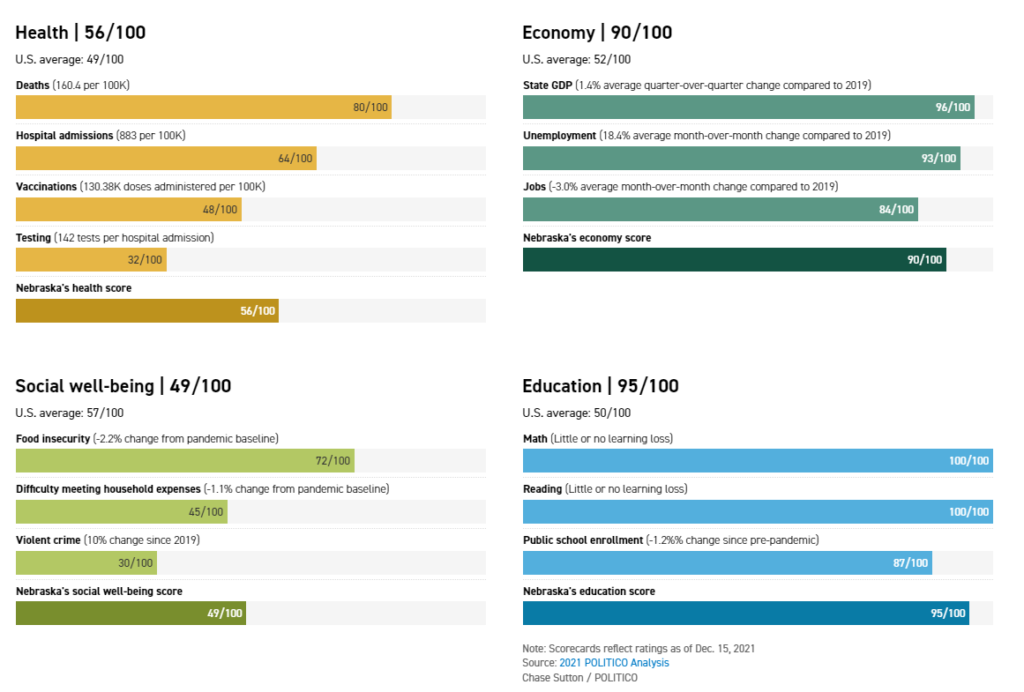
This conversation about protecting hospitals, back in the era when New Yorkers were still being encouraged to go to restaurants, well before the coasts’ contagion began closing in on the Midwest in earnest, helped define what became, by some measures, one of the most effective and balanced Covid responses in the United States. Ricketts is a mandate-shunning Republican who runs a heavily Republican and rural state with a middling vaccination rate — factors that have been linked to worse pandemic health outcomes in other states. He never ordered a statewide shutdown when 43 other governors, Democrats and Republicans, did so; he has stood against, or even supported lawsuits over, local mask requirements; he has told state agencies not to comply with federal vaccine mandates and gotten scolded by the U.S. secretary of defense for objecting to such requirements for the National Guard. And yet by the fall of last year, when POLITICO crunched the data of state pandemic responses on a combination of health, economic, social and educational factors, one state came out with the best average: Nebraska.

The state had the best economic performance of any in the pandemic up to that point, and its students, according to available data, appear to have suffered little to no learning loss. Whereas many states saw a trade-off between health and wealth in the pandemic — often corresponding to more-restrictive Democratic leadership and less-restrictive Republican leadership, respectively — Nebraska also scored above the national average for health outcomes POLITICO evaluated last year (20th of 50 states). Nebraska was the first state to accumulate a 120-day stockpile of PPE in the nationwide scramble for supplies; was a national leader in opening schools; and was among the quickest getting federal aid to small businesses. As of now, its cumulative pandemic death toll per capita is near the lowest of all 50 states, according to the Kaiser Family Foundation. This, however, is grading on a hideous curve in a country that hasn’t managed the pandemic well in general: More than 4,000 Nebraskans have lost their lives to Covid. Lawler of the University of Nebraska Medical Center, who helped design the state’s early Covid response but has since grown critical of Nebraska’s approach, notes that South Korea has 14 times lower per capita Covid mortality than Nebraska. “Nobody,” he told me via text, “should be patting themselves on the back for doing 14 [times] worse.”

Author(s): Kathy Gilsinan

Publication Date: 22 April 2022

Publication Site: Politico

Bermuda: Living life (insurance) in paradise

Link: https://www.milliman.com/en/insight/bermuda-living-life-insurance-in-paradise/?utm_source=linkedin&utm_medium=social-global-company-page&utm_campaign=life

PDF: https://www.milliman.com/-/media/milliman/pdfs/2022-articles/3-28-22-bermuda.ashx

Graphic:

Description:

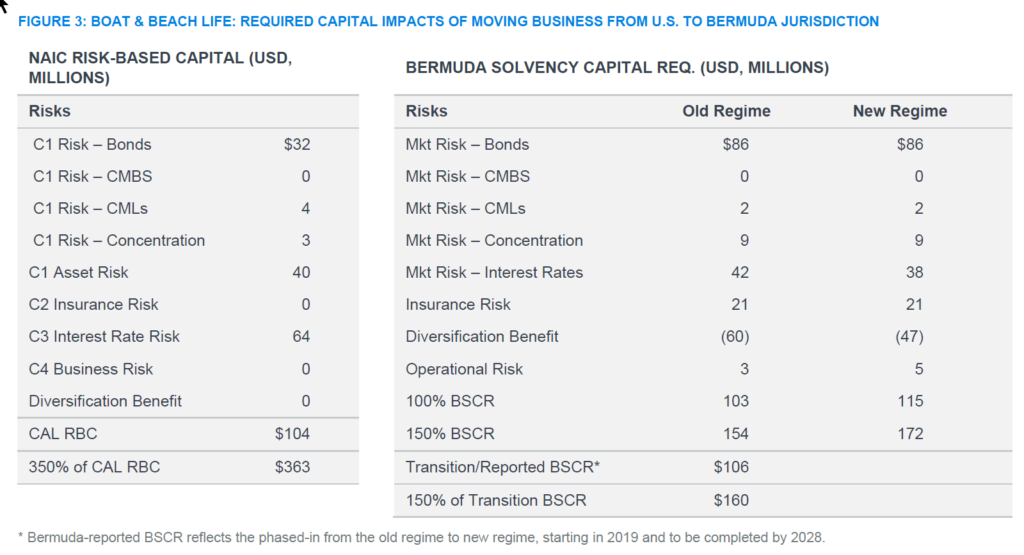
We review the history of life insurance in Bermuda, reflect on how we have gotten to where we are today, and look forward to what may be ahead. We present a hypothetical—yet realistic—case study to illustrate some of the factors that can lead to a strategic decision do business Bermuda. From an embedded-value perspective, we highlight potentially considerable benefits from a move from a U.S. statutory basis to a Bermudian economic balance sheet.

Author(s): Tony Dardis, William C. Hines, and Su Meng Lee

Publication Date: 28 March 2022

Publication Site: Milliman

U.S. Insurer Exposure to Russia, Ukraine, and Oil/Gas Companies Declines from 2020 to 2021

Link: https://content.naic.org/sites/default/files/capital-markets-special-reports-Russia-Ukraine-Oil-Gas-YE2021.pdf

Graphic:

Excerpt:

Total Russian and Ukraine sovereign and corporate debt was $813.3 million at year-end 2021,
representing 97% of total exposure; the remainder comprised $28.8 million in stocks (see Table 2).
While life companies accounted for the majority of the bond exposure at $683.9 million (or 84% of total
Russia and Ukraine bonds), property/casualty (P/C) companies accounted for almost all the Russia and
Ukraine stock exposure at $28 million. About 90% of U.S. insurers’ exposure to Russia and Ukraine
bonds and stocks was held by large companies, or those with more than $10 billion assets under
management.

Author(s): Jennifer Johnson, Michele Wong, Jean-Baptiste Carelus

Publication Date: 14 Apr 2022

Publication Site: NAIC Capital Markets Special Reports

Risk-Based Rating in Personal Lines Insurance

Link: https://www.youtube.com/watch?v=IPYSSZkP-Oo&ab_channel=RStreetInstitute

Video:

Description:

The insurance industry is unique in that the cost of its products—insurance policies—is unknown at the time of sale. Insurers calculate the price of their policies with “risk-based rating,” wherein risk factors known to be correlated with the probability of future loss are incorporated into premium calculations. One of these risk factors employed in the rating process for personal automobile and homeowner’s insurance is a credit-based insurance score.

Credit-based insurance scores draw on some elements of the insurance buyer’s credit history. Actuaries have found this score to be strongly correlated with the potential for an insurance claim. The use of credit-based insurance scores by insurers has generated controversy, as some consumer organizations claim incorporating such scores into rating models is inherently discriminatory. R Street’s webinar explores the facts and the history of this issue with two of the most knowledgeable experts on the topic.

Featuring:

[Moderator] Jerry Theodorou, Director, Finance, Insurance & Trade Program, R Street Institute
Roosevelt Mosley, Principal and Consulting Actuary, Pinnacle Actuarial Services
Mory Katz, Legacy Practice Leader, BMS Group

R Street Institute is a nonprofit, nonpartisan, public policy research organization. Our mission is to engage in policy research and outreach to promote free markets and limited, effective government.

We believe free markets work better than the alternatives. We also recognize that the legislative process calls for practical responses to current problems. To that end, our motto is “Free markets. Real solutions.”

We offer research and analysis that advance the goals of a more market-oriented society and an effective, efficient government, with the full realization that progress on the ground tends to be made one inch at a time. In other words, we look for free-market victories on the margin.

Learn more at https://www.rstreet.org/
Follow us on Twitter at @RSI

Author(s): Jerry Theodorou, Roosevelt Mosley, Mory Katz

Publication Date: 4 April 2022

Publication Site: R Street at YouTube

The Labor Guide to Retirement Plans (I)

Link: https://burypensions.wordpress.com/2022/03/22/the-labor-guide-to-retirement-plans-i/

Excerpt:

book to educate labor people to argue for keeping their underfunded defined benefit plans with sprinklings of propaganda.

Yet pension plans cost governments less than 401(k)s for the same benefit amount. Most public pension plans are in sound financial shape despite media focus on the few that are not. (page 10)

At one point, I commented to a pension attorney that I didn’t think there were more than twenty-five people in the state who understood how the state employee pension plan worked. He agreed and then added that there were a lot more people who thought they did, especially politicians who were proposing reforms to it. (page 16)

Unless your doctor has told you you’re about to die, receiving a lump sum payment is almost always a terrible idea. (page 110)

Author(s): John Bury

Publication Date: 23 Mar 2022

Publication Site: Burypensions

What’s New in Financial Reporting

Link: https://cfany.gallery.video/fullconference/detail/videos/most-recent/video/6299420346001/what%E2%80%99s-new-in-financial-reporting?autoStart=true

Graphic:

Description:

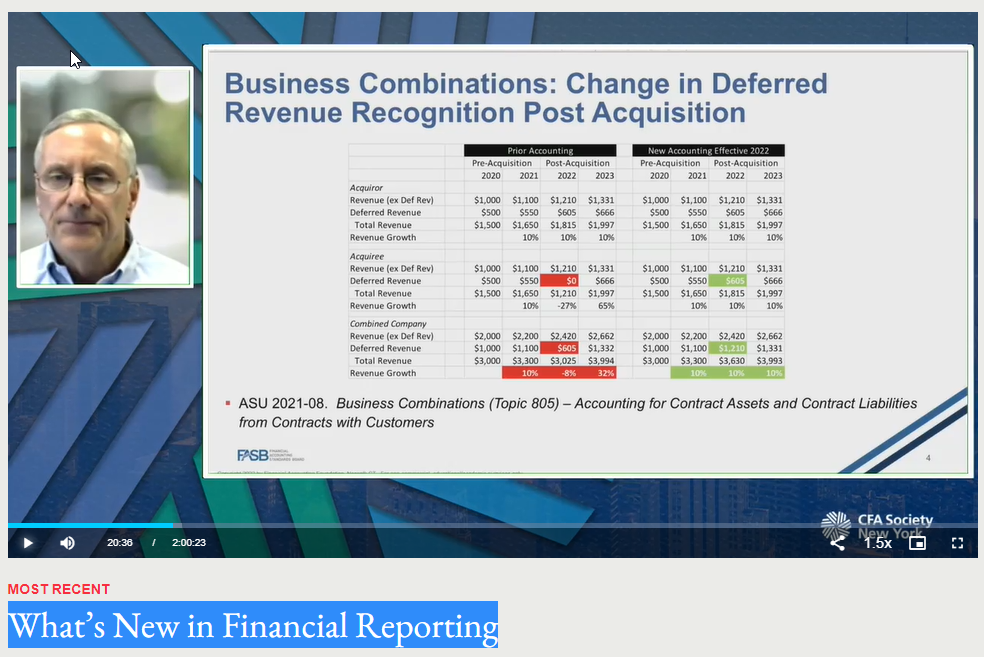
Program will bring you up to date with most recent and coming important financial reporting developments for 2022 from FASB. Speakers include two FASB Board members and SEC’s Senior Associate Chief Accountant.

Author(s): multiple presenters

Publication Date: 1 Mar 2022 originally presented, recording accessed 16 Mar 2022

Publication Site: CFA Society of New York

Big Four Accounting Firms Come Under Regulator’s Scrutiny

Link: https://www.wsj.com/articles/big-four-accounting-firms-come-under-regulators-scrutiny-11647364574?st=e3o5412th5mqg7m&reflink=desktopwebshare_linkedin

Graphic:

Excerpt:

Regulators are carrying out a sweeping investigation of conflicts of interest at the nation’s largest accounting firms, asking whether consulting and other nonaudit services they sell undermine their ability to conduct independent reviews of public companies’ financials, according to people familiar with the matter.

The Securities and Exchange Commission probe highlights the agency’s new focus on financial-market gatekeepers such as accountants, bankers and lawyers. These firms help companies raise capital and communicate with shareholders, but also have duties under federal investor-protection laws. Auditors are a shareholder’s first line of defense against sloppy or dodgy accounting.

….

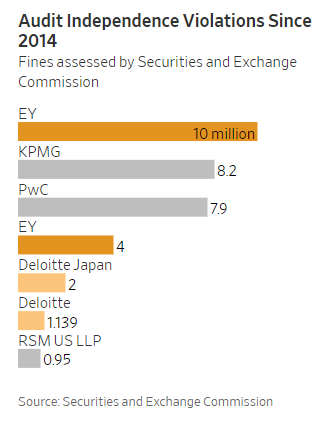
The Big Four audit 66% of all public companies with a market capitalization over $75 million, according to Audit Analytics. All four have paid fines to the SEC since 2014 to settle prior regulatory investigations of audit independence violations.

Author(s): Dave Michaels

Publication Date: 15 Mar 2022

Publication Site: WSJ