Comptroller Mendoza claims Illinois paying its bills but needs more federal bailout to avoid a big one – Wirepoints Quickpoint

Link: https://wirepoints.org/comptroller-mendoza-claims-illinois-paying-its-bills-but-needs-more-federal-bailout-to-avoid-a-big-one-wirepoints-quickpoint/

Excerpt:

Most states have either repaid what they borrowed for their unemployment funds or never borrowed in the first place. Illinois is one of ten states with loans still outstanding. The other states that joined Mendoza’s request to the Treasury are, like Illinois, heavily Democratic — New York, Colorado, Pennsylvania, Connecticut, New Jersey, Massachusetts and Minnesota. A recent research report detailed how federal pandemic bailout money, in general, has gone disproportionately to Democratic states.

As for Mendoza’s claim that Illinois is paying its bill, that’s simply not true. The state entirely ignored the hole in its unemployment fund in its current budget and future budget forecasts. In reality, the state will not just have to repay the loan but must also restore the fund to a sound balance, which will probably take another $1.5 billion at least, which was the balance before the pandemic. Nor does Illinois pay its full bill for the 800-pound gorilla, pensions. Year after year it contributes far less to its pension funds than actuaries say is required to prevent unfunded liabilities from growing.

Author(s): Mark Glennon

Publication Date: 3 Jan 2022

Publication Site: Wirepoints
The Fed’s Doomsday Prophet Has a Dire Warning About Where We’re Headed

Link:https://www.politico.com/amp/news/magazine/2021/12/28/inflation-interest-rates-thomas-hoenig-federal-reserve-526177

Excerpt:

In May of 2020, Hoenig published a paper that spelled out his grim verdict on the age of easy money, from 2010 until now. He compared two periods of economic growth: The period between 1992 and 2000 and the one between 2010 and 2018. These periods were comparable because they were both long periods of economic stability after a recession, he argued. The biggest difference was the Federal Reserve’s extraordinary experiments in money printing during the latter period, during which time productivity, earnings and growth were weak. During the 1990s, labor productivity increased at an annual average rate of 2.3 percent, about twice as much as during the age of easy money. Real median weekly earnings for wage and salary employees rose by 0.7 percent on average annually during the 1990s, compared to only 0.26 percent during the 2010s. Average real gross domestic product growth — a measure of the overall economy — rose an average of 3.8 percent annually during the 1990s, but by only 2.3 percent during the recent decade.

The only part of the economy that seemed to benefit under quantitative easing and zero-percent interest rates was the market for assets. The stock market more than doubled in value during the 2010s. Even after the crash of 2020, the markets continued their stellar growth and returns. Corporate debt was another super-hot market, stoked by the Fed, rising from about $6 trillion in 2010 to a record $10 trillion at the end of 2019.

Author(s): Christopher Leonard

Publication Date: 28 Dec 2021

Publication Site: Politico

Omicron Is an Economic Threat, but Inflation Is Worse, Central Bankers Say

Link:https://www.nytimes.com/2021/12/16/business/economy/omicron-inflation.html

Excerpt:

Facing surging inflation, three of the world’s most influential central banks — the Federal Reserve, Bank of England and European Central Bank — took decisive steps within 24 hours of each other to look past Omicron’s economic uncertainty.

On Thursday, Britain’s central bank unexpectedly raised interest rates for the first time in more than three years as a way to curb inflation that has reached a 10-year high. The eurozone’s central bank confirmed it would stop purchases under a bond-buying program in March. The day before, the Fed projected three interest rate increases next year and said it would accelerate the wind down of its own bond-buying program.

….

Aside from Omicron, the central banks were running out of reasons to continue emergency levels of monetary stimulus designed to keep money flowing through financial markets and to keep lending to businesses and households robust throughout the pandemic. The drastic measures of the past two years had done the job — and then some: Inflation is at a nearly 40-year high in the United States; in the eurozone it is the highest since records began in 1997; and price rises in Britain have consistently exceeded expectations.

….

The Federal Reserve and Bank of England are worried about the persistence of high inflation. For the European Central Bank, inflation in the medium term is too low, not too high. It is still forecasting inflation to be below its 2 percent target in 2023 and 2024. To help reach that target in coming years, the central bank will increase the size of an older bond-buying program beginning in April, after purchases end in the larger, pandemic-era program. This is to avoid “a brutal transition,” Ms. Lagarde said.

Author(s): Eshe Nelson

Publication Date: 16 Dec 2021

Publication Site: New York Times

Major Divergences: ECB Says No Hikes in 2022, Fed Sees 3 Hikes, BOE Hiked Today

Link:https://mishtalk.com/economics/major-divergences-ecb-says-no-hikes-in-2022-fed-sees-3-hikes-boe-hiked-today

Graphic:

Excerpt:

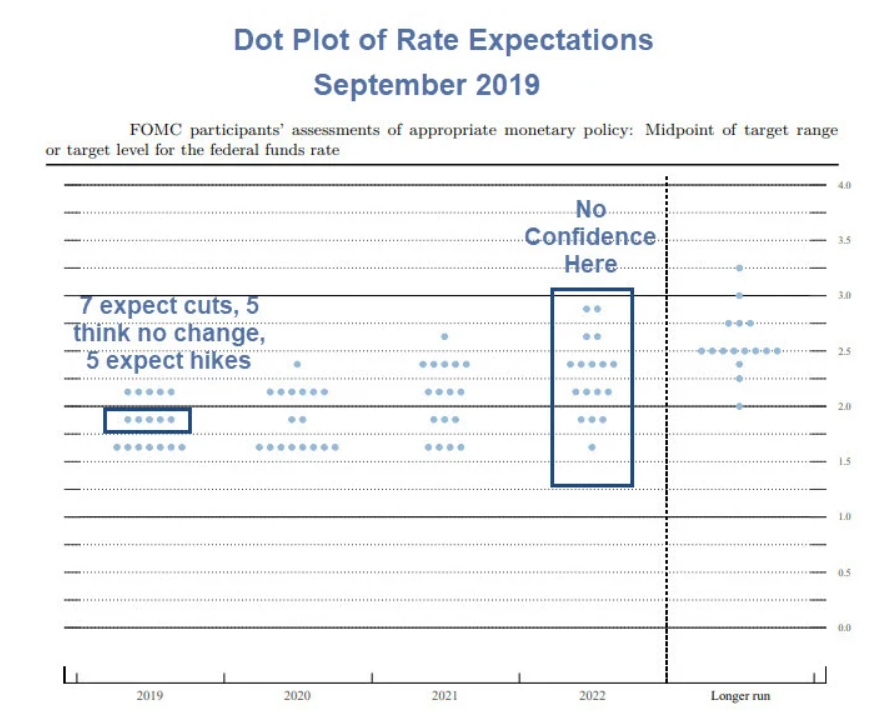
How many rate hikes are coming? The Fed thinks 6 by the end of 2023. I am unconvinced the Fed gets in any hikes in 2022 and certainly not 6 by the end of 2023.

These ridiculous predictions assume there will not be another recession in “the longer run”. 

Central banks like to pretend they will hike, but by the time comes, they have delayed so long they find an excuse to no do so. 

Possible excuses: A recession, stock market plunge, another pandemic, global warming, global cooling, or an asteroid crash. 

Central banks will find some excuse to delay hikes. But the most likely excuse is a recession or stock market crash. 

Author(s): Mike Shedlock

Publication Date: 16 Dec 2021

Publication Site: Mish Talk

Do We Really Need States to Be Bankers?

Link:https://www.governing.com/finance/do-we-really-need-states-to-be-bankers

Excerpt:

In 1919, the state of North Dakota established its own bank as a public institution. It’s the only one of its kind in the nation, having operated successfully for a full century through the Great Depression and a dozen recessions. Nine other states tried to follow suit in the following decades, only to fail and close their banks’ doors. Founded to provide capital in a farm-centric economy that was underserved by large regional financial institutions that charged double-digit interest rates for ag loans, the Bank of North Dakota has served as an inspiration and touchstone to political populists, anti-bank politicians and easy-money advocates.

…..

Even beyond what we call the “global superabundance of capital,” however, what the advocates and professional literature overlook is the spectacular disruptive growth of “fintech” — financial technology — that is bringing capital to previously underserved communities and businesses. It turns out that the capital markets, big data, artificial intelligence and techno-wizardry are filling in many of the niches that supposedly cry out for public banks. But first, there are two other strategic public policy alternatives of note: “linked deposits” and using pension-fund capital for nonbank lending, or “shadow banking” as it’s termed by its critics.

As a young municipal finance officer, while moonlighting in grad econ classes in the late 1970s, I became enamored of the concept of linked deposits. The idea was that municipalities should invest in time deposits with banks that pledge to make local loans promoting economic development. I’ll never forget speaking on a panel at the state finance officers’ conference and watching the state’s most prominent public funds banker scowl and shake his head in disgust at what struck him as a pie-in-the-sky concept. At the time, that idea went nowhere.

…..

Meanwhile, with interest rates at record low levels, public pension funds have been searching everywhere for ways to get a better return on their fixed-income capital allocations. One of the vehicles that emerged in the past decade has been direct lending through professionally managed portfolios that provide loans to businesses at attractive interest rates.

Author(s): Girard Miller

Publication Date: 7 Dec 2021

Publication Site: Governing

How Many People in NYC Are At Risk of Losing Their Job Over the Mayor’s Vaccine Mandate?

Link:https://mishtalk.com/economics/how-many-people-in-nyc-are-at-risk-of-losing-their-job-over-the-mayors-vaccine-mandate

Graphic:

Excerpt:

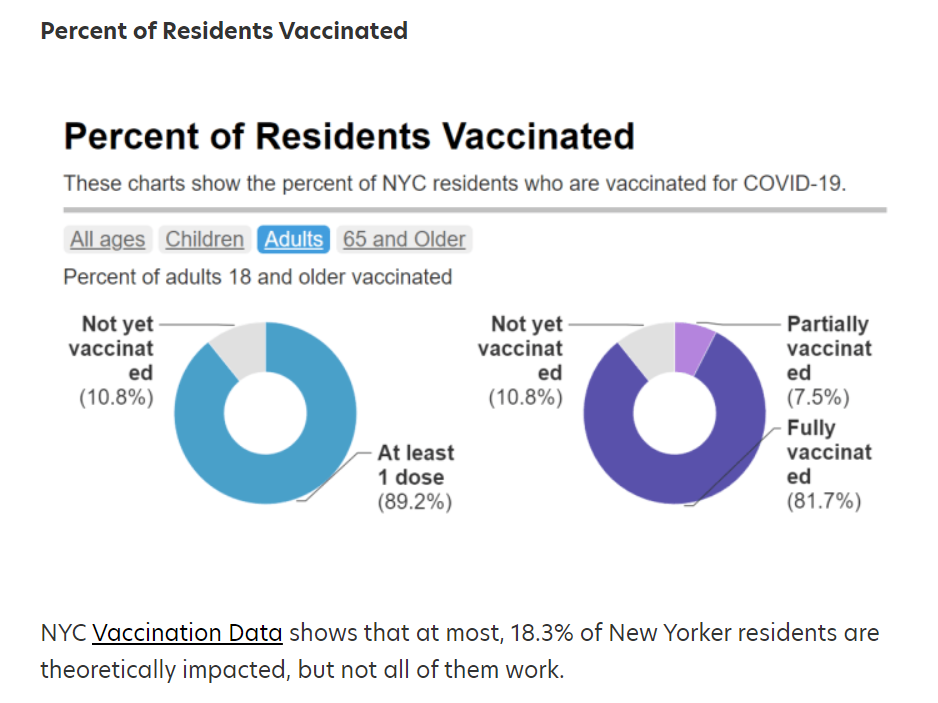
NYC Vaccination Data shows that at most, 18.3% of New Yorker residents are theoretically impacted, but not all of them work.

….

That is less than half of the population of the city. Factoring in the vaccination rate, about 9% of the entire city is at risk of losing their jobs.

Thus Borelli is wildly off on his percentages.

I am not at all defending mayor de Blasio. Indeed, I heavily blasted him in New York City Mandates Vaccinations, Please Be Ready With Your Vaccine Card.

I am just in search of more accurate numbers.

Author(s): Mike Shedlock

Publication Date: 8 Dec 2021

Publication Site: MishTalk

State Comptroller DiNapoli and Orange County District Attorney Hoovler Announce Guilty Plea in Bethel Tax Collector Pension Fraud Case

Link:https://www.osc.state.ny.us/press/releases/2021/11/state-comptroller-dinapoli-and-orange-county-district-attorney-hoovler-announce-guilty-plea-bethel

Excerpt:

State Comptroller Thomas P. DiNapoli and Orange County District Attorney David M. Hoovler today announced that former Town of Bethel Tax Collector Debra Gabriel, of Bethel, pleaded guilty before Judge Peter Feinberg in the Town of Rockland Justice Court to Offering a False Instrument for Filing in the Second Degree, in connection with a scheme to defraud the New York State and Local Retirement System. Gabriel, 62, had resigned her public office and retired in August 2020.

At the time that she pleaded guilty, Gabriel admitted having submitted a false “Record of Activity” with the Town of Bethel for filing with the State Comptroller. Records of Activity are documents in which certain appointed or elected officials must record a daily detail of their hours worked and duties and certify their accuracy. The information is used to calculate their service time for retirement benefits.

An investigation of Gabriel’s Records of Activity conducted by the New York State Comptroller’s Office and the New York State Police revealed that from April 1, 2009 to Aug. 31, 2019, she falsely claimed credit for full-time work for the Town of Bethel when her actual hours were far less. For example, in 2018 and 2019, she had a full-time job with a private healthcare company, while claiming to also have worked full-time as a Tax Collector for Bethel. Her false claims increased her service credit toward retirement by more than seven years, according to Comptroller DiNapoli. Gabriel turned over a certified check in the amount of $6,377.46 to prosecutors from the Orange County District Attorney’s Office as restitution to the State of New York for the amount of pension benefits that she was overpaid.

Author(s): Thomas DiNapoli

Publication Date: 5 Nov 2021

Publication Site: NY Office of the Comptroller

Illinois Effort to Fix Ailing Local Pensions Faces Legal Hurdle

Link:https://www.bloombergquint.com/onweb/illinois-effort-to-fix-ailing-local-pensions-faces-legal-hurdle

Excerpt:

A court ruling as soon as this month will help determine the fate of one of Illinois Governor J.B. Pritzker’s key plans to ease the massive shortfall in local pension funds across the state. A 2019 law championed by Pritzker would merge about 650 local police and firefighter pensions with assets topping $16 billion into two funds to cut costs and improve returns.

….

The law set a June 30 deadline for the consolidation of the funds, but many of the local pensions are hesitating or even refusing to merge until they learn the outcome of litigation to block the combining. Three dozen current employees and retirees, along with 18 local retirement plans, filed a lawsuit in February in Illinois circuit court saying the consolidation violates the state constitution.

….

So far, however, the new Illinois Police Officers’ Pension Investment Fund hasn’t received any assets and expects to begin getting funds around March, said executive director Richard White. About 44% of the 357 downstate and suburban police funds that were supposed to be merged into the bigger pension plan haven’t even responded to requests for information, White said. 

Author(s): Shruti Singh

Publication Date: 2 Dec 2021

Publication Site: Bloomberg Quint

FTC orders Walmart, Amazon, Kroger and more to turn over information on empty shelves, high prices

Link:https://www.usatoday.com/story/money/shopping/2021/11/29/supply-chain-ftc-investigation-walmart-amazon-prices/8799724002/

Excerpt:

The Federal Trade Commission said Monday that it is investigating the causes behind ongoing supply chain disruptions and how they are “causing serious and ongoing hardships for consumers and harming competition in the U.S. economy.”

The FTC said it is ordering Walmart, Amazon, Kroger, other large wholesalers and suppliers including Procter & Gamble Co., Tyson Foods and Kraft Heinz Co. “to turn over information to help study causes of empty shelves and sky-high prices.”

Orders also are being sent to C&S Wholesale Grocers, Inc., Associated Wholesale Grocers, Inc. and McLane Co, Inc.

Author(s): Kelly Tyko

Publication Date: 29 Nov 2021

Publication Site: USA Today

15 States Threaten To Pull $600 Billion From Banks That Won’t Give Equal Service To Energy Industry

Link:https://thefederalist.com/2021/11/30/15-states-threaten-to-pull-600-billion-from-banks-that-wont-give-equal-service-to-energy-industry/

Excerpt:

Fifteen state financial officers sent a letter to U.S. banks last week noting $600 billion in assets they pledge to take elsewhere if the financial institutions embrace corporate wokeism and prohibit financing to the fossil fuel industry.

Led by West Virginia Republican Treasurer Riley Moore, the group promised “collective action” in the form of an “economic boycott.”

…..

Signatories to the letter putting banks on notice include chief financial officers from Arizona, Arkansas, Idaho, Louisiana, Missouri, Nebraska, North Dakota, South Carolina, South Dakota, Utah, Wyoming, Alabama, Texas and Kentucky, in addition to West Virginia.

Author(s): Tristan Justice

Publication Date: 30 Nov 2021

Publication Site: The Federalist

Finance Group Fails To Deliver at COP26

Link:https://www.nakedcapitalism.com/2021/11/finance-group-fails-to-deliver-at-cop26.html

Excerpt:

Not One of 60 Major Commercial Banks Has ‘Leadership Position on Decarbonizing’

Yet the trend line of bank finance for fossil fuels is rising not declining, and not a single big commercial bank has released a plan to stop financing new fossil fuels.

It’s striking that unlike any of other sectors implicated in speeding global warming, not a single one of the 60 major commercial banks has staked out a leadership position on decarbonizing.

On the other labelled days of COP, there were all kinds of interesting mash-ups of governments, private sector actors, and think tanks offering a web of creative announcements about their determination to set ambition on one thing or another. By contrast, on Private Finance Day, the one and only announcement was relating to GFANZ. Banks and investors didn’t even try to push out additional good ideas. Everyone covered themselves in the GFANZ penumbra and then went quiet.

Author(s): Michael Northrop

Publication Date: 30 Nov 2021

Publication Site: naked capitalism

Two Top Pennsylvania Pension Fund Officials to Retire Amid Federal Probe

Link:https://www.wsj.com/articles/pennsylvania-pension-cio-jim-grossman-to-resign-amid-federal-probe-11637243641

Excerpt:

Two top officials at Pennsylvania’s largest pension fund are retiring amid a federal investigation and calls by some board members for their ouster.

The board of Pennsylvania’s $64 billion Public School Employees’ Retirement System voted Thursday to approve resolutions accepting the retirement of Glen Grell, the executive director, and Jim Grossman, the chief investment officer. Board members approved plans for both men to stay on in temporary advisory positions and authorized the board chair to begin a search for their replacements.

The fund has been racked by turmoil since board members learned in March that a report of investment returns was too high. The accurate figure was low enough to trigger an increase in payments from employees that the plan serves. Investigations conducted by the fund haven’t found wrongdoing on the part of investment staff.

The board said in April that it had hired law firms to investigate the miscalculation and to respond to a federal grand jury subpoena requesting documents. The pension declined to comment on what information the grand jury is seeking.

Author(s): Heather Gillers

Publication Date: 18 Nov 2021

Publication Site: Wall Street Journal