Singing River retirees file new lawsuit over failed pension. ‘It’s not fair,’ nurse says

Link: https://www.sunherald.com/news/local/counties/jackson-county/article250528304.html

Excerpt:

Singing River Health System retirees are learning to live on lower pensions than they expected as attorneys continue to press for financial damages from companies they believe are responsible.

A new lawsuit has been filed over the 2014 failure of the SRHS retirement plan, which caught hundreds of retirees and employees by surprise. Biloxi attorney Jim Reeves is suing accounting firm KPMG LLC and Transamerica Retirement Solutions on behalf of 272 members of the retirement plan.

Reeves said in a news release that the companies were paid “hundreds of thousands of dollars to help manage and audit the pension plan and to accurately communicate the status of the plan to members.”

Author(s): Anita Lee

Publication Date: 12 April 2021

Publication Site: SunHerald
Expose at Pennsylvania’s Biggest Public Pension Fund Reveals Lavish Private Equity Travel, But Misses How It Serves as a Bribe

Graphic:

Excerpt:

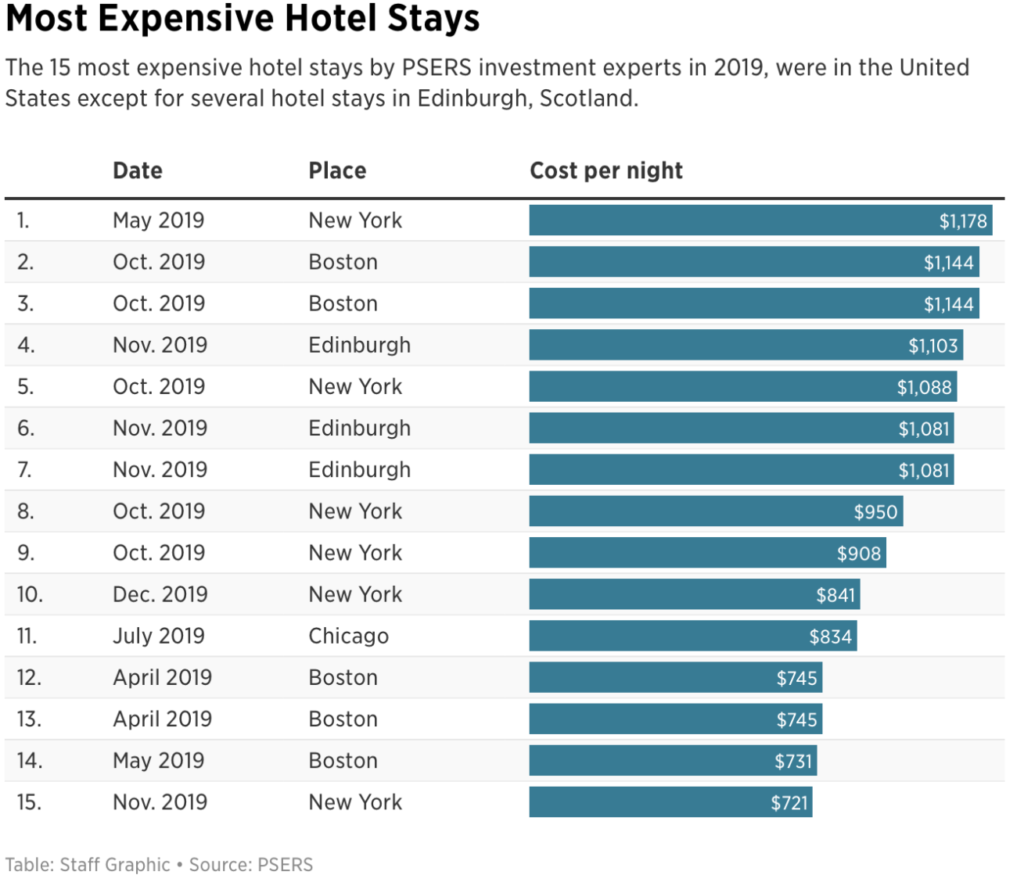
The article points out that the PSERS investment office regularly violates state travel policies, which require employees on Commonwealth business to hew to Federal guidelines for airfare and lodging. Eight PSERS officers have been granted waivers from this policy.

PSERS defends the travel costs by saying staff traveled business class and the fares were typically refundable and sometimes bought at the last minute.

My issue isn’t with the cost of the flights but their necessity, and with the hotel costs. Public servants should be staying in Westin/Marriott level rooms. These prices are consistent with five star hotels, like the Four Seasons or St. Regis in New York City.

Author(s): Yves Smith

Publication Date: 12 April 2021

Publication Site: naked capitalism

Private Equity and Hedge Funds Survived the 2008 Crisis. Now They’re Making a Killing Off COVID-19.

Link: https://jacobinmag.com/2021/04/private-equity-hedge-funds-covid-profits

Excerpt:

What is a shadow bank?

The term shadow bank refers to things like hedge funds, venture capital firms, and private equity, which all have relatively less oversight than traditional financial institutions. These are all lending intermediaries, or institutions that lend money that fall outside of the mainstream regulatory structure of finance. They’re either situated outside of investment banks, or they exist in less regulated arenas of investment banks, perhaps in offshore settings. One example you might be familiar with is the big private equity firm Blackstone. Another is the big hedge fund Bridgewater.

The “shadow” label implies a degree of opacity, because frequently they make investments that are harder to understand, often in private markets rather than public markets. But it also refers to the fact that they’re lending in the shadow of larger institutions. This partially because they’re deemed to have sophisticated investors by the Securities and Exchange Commission and are therefore designated as subject to less oversight.

Author(s): Megan Tobias Neely interviewed by Meagan Day

Publication Date: 8 April 2021

Publication Site: Jacobin Magazine

Vaccine Passports: Here’s How Excelsior Pass Works

Link: https://www.governing.com/now/Vaccine-Passports-Heres-How-Excelsior-Pass-Works.html

Excerpt:

The U.S. has its first official vaccine passport.

New York’s Excelsior Pass, developed by IBM, is essentially a simple digital wallet that can be accessed on mobile devices, which holds three items: your name, a QR code and a green check mark.

The idea is that people can use the app to prove to somebody — say, a ticket-taker at the door of a sports stadium, an airline or the staff at a large event — that they’ve received a vaccine against COVID-19. In actuality, the app can also prove that somebody’s received a negative test for the disease.

Author(s): Ben Miller

Publication Date: 8 April 2021

Publication Site: Governing

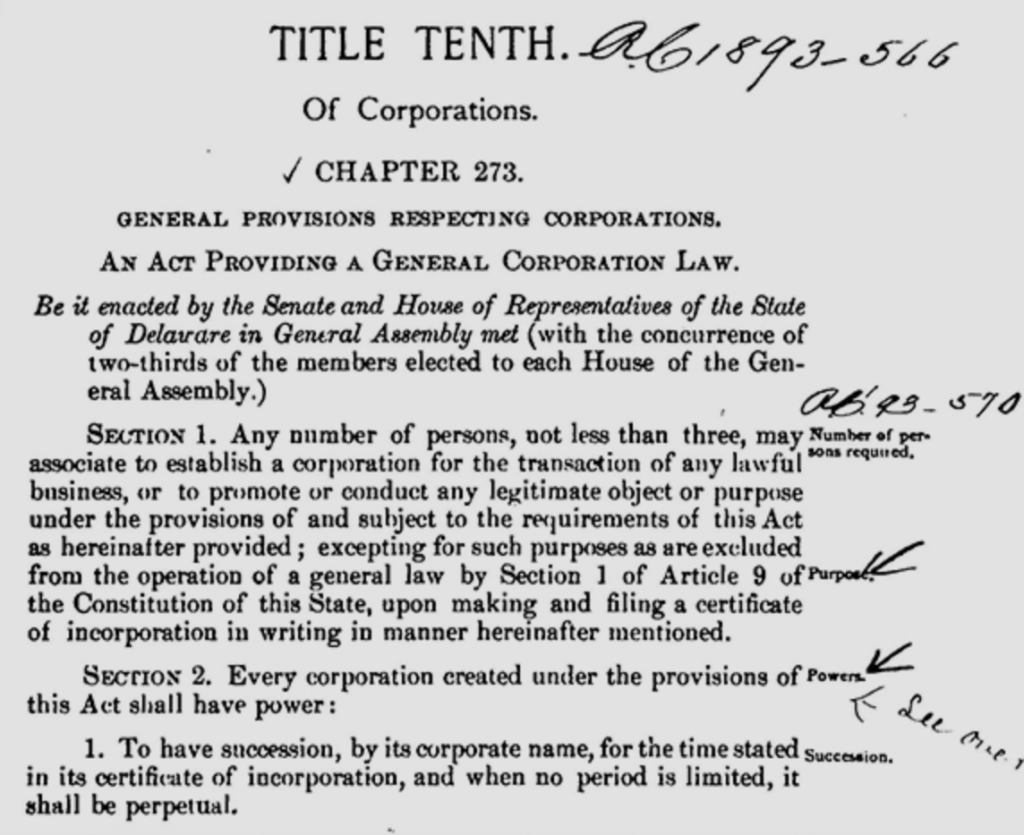
Why Delaware is the sexiest place in America to incorporate a company

Graphic:

Excerpt:

Let’s say you run a tennis ball company in California that rakes in $100m/year in net income.

In California, you’ll pay a state income tax (8.84% of net income) — and possibly an alternative minimum tax (6.65%) — in addition to the federal corporate tax rate of 21%.

By incorporating in Delaware, though, you can likely save millions in taxes with something called the “Delaware loophole.”

In Delaware, intangible assets — think trademarks, copyrights, and leases — are free from taxation. Companies will often transfer these assets to a Delaware subsidiary and pay their own subsidiary for the rights to use said assets.

Author(s): Zachary Crockett

Publication Date: 10 April 2021

Publication Site: The Hustle

GASB critics want more transparency for public pensions and other retirement benefits

Link: https://fixedincome.fidelity.com/ftgw/fi/FINewsArticle?id=202104091435SM______BNDBUYER_00000178-b7cb-d786-af7b-b7efd3e10001_110.1#new_tab

Excerpt:

The question of whether pensions and other retirement benefits should be more prominently reported by state and local governments is a burning controversy for the Governmental Accounting Standards Board.

What?s at stake is whether the public is being misled by when a governmental general fund is listed in financial statements as balanced while omitting those long-term debts.

GASB requires long-term obligations to be reported in governmentwide reports, but critics say lawmakers too often look only at cash flow funds.

?I implore GASB to stop this confusion and bewilderment,? wrote Sheila Weinberg, founder & CEO of Truth in Accounting in a comment letter. ?Our representative form of government is being harmed.?

Illinois is among the states that critics say have downplayed their tens of billions of dollars of unfunded long-term debts and should be forced by new GASB rules to become more transparent.

GASB officials, on the other hand, say that state and local governments have been required to disclose their long-term debts since the publication of GASB 34 about 20 years ago.

Author(s): Brian Tumulty

Publication Date: 9 April 2021

Publication Site: Fidelity Fixed Income

Pennsylvania pension system officials disclose federal probe

Excerpt:

Officials atop Pennsylvania’s largest public pension system have received subpoenas from federal investigators, although the $64 billion Public School Employees’ Retirement System has yet to publicly discuss the nature or scope of the newly disclosed inquiry.

In addition to giving few details, pension system officials and board members — which includes state lawmakers, two members of Gov. Tom Wolf’s Cabinet and state Treasurer Stacy Garrity — have declined to answer questions publicly about what information federal investigators are seeking.

Garrity told lawmakers at a Senate Appropriations Committee hearing Tuesday that “federal subpoenas have been served on several PSERS management officials.”

Author(s): Marc Levy, Associated Press

Publication Date: 8 April 2021

Publication Site: WHYY PBS

CalPERS Shoots Itself in the Foot: Undermines Its Position in Insolent Letter Demanding JJ Jelincic Drop His Case Against Secrecy Abuses

Excerpt:

As you can see below, CalPERS issued more ultimatums: drop the suit and provide what amounts to a document retention request to the board member that provided his notes to Jelincic.

And why should Jelincic withdraw his case? The argument is the legal version of a pratfall. Jelincic told he is liable for “aiding and abetting” an alleged breach of fiduciary duty by a a board member and interfering with CalPERS’ contract with said board member.

First “aiding and abetting” exists only in a criminal context. Even if there were actually a there there, please tell me what universe a prosecutor is going to saddle up to go after a CalPERS board member over a dispute over a clearly improperly noticed board meeting….and charge Jelincic too?

Second, the only fiduciary duty the board has is to beneficiaries. The reason California has such strong transparency laws is that its default is that secrecy is bad for the public and is not allowed unless there are compelling arguments on the other side.

Author(s): Yves Smith

Publication Date: 25 March 2021

Publication Site: naked capitalism

Cuomo admin. kept COVID tests from nursing homes as gov’s kin got them

Link: https://nypost.com/2021/03/28/cuomo-admin-kept-covid-tests-from-nursing-homes-as-govs-kin-got-them/

Excerpt:

Troubled by reports of COVID-19 running roughshod through nursing homes early in the pandemic, Jack Wheeler, the manager of upstate Steuben County, requested in April 2020 that the state Department of Health provide enough tests for every resident and staff member of three facilities in his jurisdiction.

The DOH, however, only came through with enough supplies for one of the three facilities, Hornell Gardens, with the precious diagnostic tests then hard to find, Wheeler told The Post.

That lackluster response came, as The Albany Times-Union reported last week, as Gov. Andrew Cuomo allegedly pulled strings to secure tests for bigwigs connected to his administration, as well as relatives including his brother, CNN host Chris Cuomo, and their elderly mother, Matilda.

Author(s): Bernadette Hogan, Aaron Feis

Publication Date: 28 March 2021

Publication Site: NY Post

Federal Reserve to End Emergency Capital Relief for Big Banks

Link: https://www.wsj.com/articles/federal-reserve-to-end-emergency-capital-relief-for-big-banks-11616158811

Excerpt:

The Federal Reserve said it was ending a yearlong reprieve that had eased capital requirements for big banks, disappointing Wall Street firms that had lobbied for an extension.

Friday’s decision means banks will lose the temporary ability to exclude Treasurys and deposits held at the central bank from lenders’ so-called supplementary leverage ratio. The ratio measures capital — funds that banks raise from investors, earn through profits and use to absorb losses — as a percentage of loans and other assets. Without the exclusion, Treasurys and deposits count as assets. That will likely force banks to hold more capital or reduce their holdings of those assets, both of which could ripple through markets.

Analysts have been keying on the issue, which is widely viewed on Wall Street as carrying potential implications for markets from bonds to stocks to commodities.

Author(s): Andrew Ackerman, David Benoit

Publication Date: 19 March 2021

Publication Site: Wall Street Journal

COVID: German doctors call for 2-week hard lockdown

Link: https://www.dw.com/en/covid-german-doctors-call-for-2-week-hard-lockdown/a-57023394

Excerpt:

Germany’s intensive care doctors have called for a two-week hard lockdown in order to avoid overwhelming the health care system.

A mix of hard lockdown, vaccinations and testing is necessary to “prevent intensive care units from being overflowed,” the head of the German Interdisciplinary Association for Intensive Care and Emergency Medicine, Christian Karagiannidis, told the Rheinische Post newspaper.

His comments come as Germany battles a third wave of coronavirus infections.

Publication Date: 17 March 2021

Publication Site: Deutsche Welle

Coronavirus: Germany’s Merkel reverses plans for Easter lockdown

Link: https://www.bbc.com/news/world-europe-56513366

Graphic:

Excerpt:

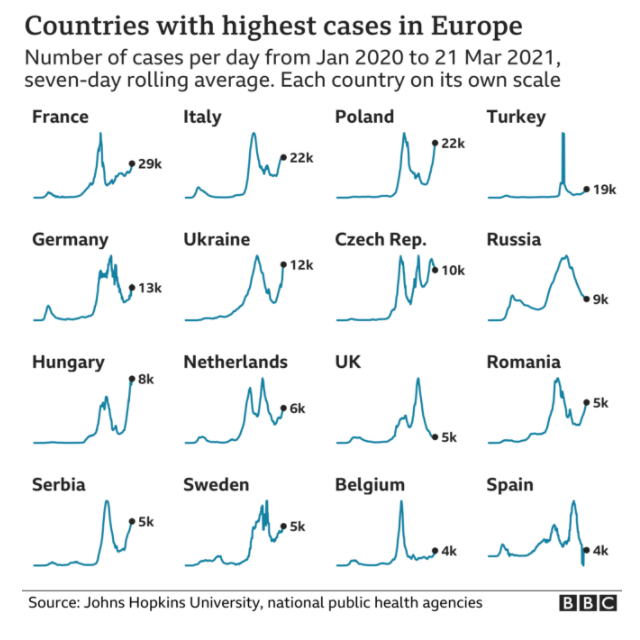
German Chancellor Angela Merkel has cancelled plans for a strict lockdown over Easter, just a day after the measures were announced.

Calling the plan a “mistake”, Mrs Merkel said she took “ultimate responsibility” for the U-turn.

The proposed lockdown was agreed with regional leaders in talks overnight on Monday, with restrictions set to be tightened between 1-5 April.

But the plan was reversed following a crisis meeting on Wednesday.

Author(s): Jenny Hill

Publication Date: 25 March 2021

Publication Site: BBC News