The Policy Triangle

Link: https://netinterest.substack.com/p/the-policy-triangle

Graphic:
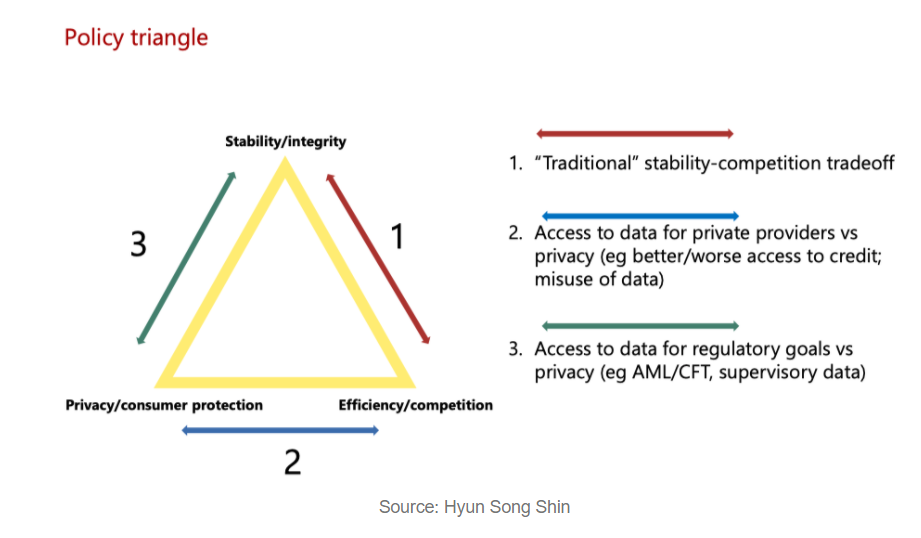
Excerpt:

Policymakers are increasingly confronting a new problem, though: the entry of technology companies into financial services throws their trade-off framework off-kilter. There are two issues. 

First, financial regulators don’t have jurisdiction over technology companies. They have jurisdiction over their financial activities but not over the companies themselves. At the entry level, this works fine. When a company wants to do payments, they need to get a payments license and when they want to do credit underwriting, they need a credit license.

Sometimes, new entrants skate round these rules. Afterpay in Australia is not regulated as a credit provider since it doesn’t impose a charge for the ability to pay; nor as a payment system since it conducts relationships bilaterally between consumers on the one hand and merchants on the other. In response to impending regulatory scrutiny, the company points out that the major card providers got away with it for 20 years. “The dominant international card payment systems…were launched in Australia in 1984 and were not subject to RBA [Reserve Bank of Australia] regulation until 2004.”

Author(s): Marc Rubinstein

Publication Date: 12 February 2021

Publication Site: Net Interest on Substack

Elizabeth Warren and the SEC Should Let the GameStop Lulz Go On

Excerpt:

Of course, if there’s one thing America’s national political class does not like or understand, it is lulz. Lulz are inherently chaotic and disorderly, and that tends to cause headaches for most anyone with a bureaucratic bent. But it also produces reactions like one we saw yesterday, in which Sen. Elizabeth Warren (D–Mass.) used the GameStop episode to call for intervention by the Securities and Exchange Commission (SEC). 

It’s not at all clear what the SEC could do to stop what is essentially a financial market flash mob, aside from ensure that no large institutional investors are secretly in on the WallStreetBets side of the trade. If that’s the case (and it may well be, though who knows), then the SEC will probably end up taking some sort of action based on existing rules designed to prohibit fraudulent pump-and-dump schemes, where stocks are artificially boosted and sold off. 

Author(s): Peter Suderman

Publication Date: 28 January 2021

Publication Site: Reason

Buy or sell: GameStop frenzy has Washington teasing action on Reddit vs. Wall Street

Link: https://www.nbcnews.com/politics/politics-news/buy-or-sell-gamestop-frenzy-has-washington-teasing-action-reddit-n1256142

Excerpt:

A number of Democrats and Republicans united in opposition this week to the strict limits imposed by Robinhood and other online stock brokerages on the purchasing of GameStop and other stocks swept up in a Reddit-fueled trading frenzy.

Disparate members of Congress like Alexandria Ocasio-Cortez, D-N.Y., Ro Khanna, D-Calif., Ted Lieu, D-Calif., Ken Buck, R-Colo., and Sens. Pat Toomey, R-Pa. and Ted Cruz, R-Texas, were among those who criticized the move, with many calling for hearings that Democratic leaders say will soon take place in both the House and Senate as what began as an internet movement continues to roil Wall Street.

Lawmakers trained attention on the volatility surrounding GameStop’s stock as several others this week. The stock climbed from $4 only a few months ago to more than $400 this week, juiced by an online movement not dissimilar to others that have broadly altered the political landscape in recent years. At the same time, hedge funds that made large bets on GameStop’s stock cratering — known as “shorting” — began to pile up big losses. Then the brokerages instituted limits, leading to charges of collusion with the larger financial entities facing big losses.

Author(s): Allan Smith

Publication Date: 29 January 2021

Publication Site: NBC News

Your Regulator Overseers

Link: http://pointsandfigures.com/2021/01/31/your-regulator-overseers/

Excerpt:

As you know, Congress oversees the bureaucracy.  It’s agencies, the unelected bureaucrats that make a lot of the regulations that affect our lives.  Colloquially, you might know this as a part of The Deep State.  The Senate Banking Committee and the House Financial Services Committee oversee the Securities and Exchange Commission (SEC).

The GameStop saga has laid a lot of things bare.  But one thing that needs pointing out is that most of the people on those committees have no clue how the entire financial system as it pertains to exchanges and markets works.  I am not impugning the personal characters of the Senators and House members on the committees.  In 99.9% of the cases they are decent and intelligent people. What I am saying is most of them have no clue when it comes to understanding the industry they are charged with overseeing.   It is rare when you find an elected official that really and truly understands.  Not rare like a four leaf clover rare. Rare like seeing a tiger in the wild rare.

I am not talking about trading markets either as plenty of elected congresspeople seem to know how a brokerage account works. I am talking about understanding the mechanics and plumbing, and truly understanding.

Author(s): Jeffrey Carter

Publication Date: 31 January 2021

Publication Site: Points and Figures

NY Hedge Fund Founder Admits To Fraud In Connection With Neiman Marcus Bankruptcy

Link: https://dailyvoice.com/new-york/northsalem/news/ny-hedge-fund-founder-admits-to-fraud-in-connection-with-neiman-marcus-bankruptcy/802716/

Excerpt:

A hedge fund founder admitted to bankruptcy fraud for abusing his position on a Neiman Marcus Group Inc. bankruptcy committee to purchase securities at a deflated price.

Nassau County resident Daniel Kamensky, of Roslyn, the founder of the New York-based hedge fund Marble Ridge Capital pleaded guilty to pressuring a rival bidder to abandon its higher bid for assets in connection with Neiman Marcus’s bankruptcy proceedings.

U.S. Attorney Audrey Strauss said that Kamensky was the principal of Marble Ridgewhich had assets under management of more than $1 billion that invested in securities in distressed situations, including bankruptcies. Prior to opening Marble Ridge, Kamensky worked for many years as a bankruptcy attorney at a well-known international law firm, and as a distressed debt investor at prominent financial institutions.

Author(s): Zak Failla

Publication Date: 7 February 2021

Publication Site: Daily Voice

MassMutual Under Investigation Over ‘Roaring Kitty’

Link: https://www.thinkadvisor.com/2021/02/04/state-regulator-probing-roaring-kitty-massmutual/

Excerpt:

Massachusetts’ top securities regulator, William Galvin, is looking into the actions of Keith Patrick Gill, the former MassMutual broker who played a key role in the trading frenzy surrounding video game retailer GameStop and other stock last week.

Gill is the person behind the Roaring Kitty YouTube streams that, combined with a string of posts by Reddit user DeepF***ingValue, drove a sudden increase in GameStop stock trading, slamming hedge funds that had bet against the struggling retailer.

“I can confirm our Securities Division sent an inquiry to MassMutual last Friday asking about Mr. Gill’s status,” a spokesperson for Galvin told ThinkAdvisor on Thursday.

Author(s): Jeff Berman

Publication Date: 4 February 2021

Publication Site: Think Advisor

New York Lawmakers Float Crackdown on Hedge Funds’ Sovereign-Debt Tactics

Link: https://www.wsj.com/articles/new-york-lawmakers-float-crackdown-on-hedge-funds-sovereign-debt-tactics-11612780201

Excerpt:

Some New York lawmakers are planning legislation designed to blunt hedge funds’ ability to resist sovereign-debt restructurings, while easing financial settlements for government borrowers in distress.

New York state Sen. Gustavo Rivera and Assemblywoman Maritza Davila, both Democrats, plan to introduce legislation as soon as this week to allow a supermajority of a nation’s creditors to amend or restructure its debt contracts and bind any dissenters that could otherwise hold out.

Many sovereign bonds in Latin America, Africa, and other emerging markets contain collective-action clauses that require all creditors to honor agreements that a majority of them make with the borrower. But others lack such mechanisms, leaving no ready way for settlements made with majority support to become binding on all members of a creditor class.

…..

A risk of the legislation is that investors would sue to challenge it because it could retroactively change certain contracts already in place. Changing contract rights can be justified under certain circumstances, if doing so advances a compelling state interest.

Author(s): Alexander Gladstone

Publication Date: 9 February 2021

Publication Site: Wall Street Journal

Twitter thread on Robinhood halting GME trading

Link: https://threadreaderapp.com/thread/1354952686165225478.html

Excerpt:

Robinhood (RH) is a broker. They don’t execute stock orders themselves. They sign up customers, route their orders to executing brokers, and keep track of who owns what. RH is also its own clearing broker, so they directly settle and custody their clients’ securities. 

Yes, RH is paid by Citadel to handle executing some of its order flow. This isn’t as nefarious as it sounds – Citadel Equity Securities is paying to execute retail orders because they aren’t pernicious (like having 500x the size behind them). 

…..

RH offered to open up stock market investing more broadly. They succeeded, clearly. But the regulations didn’t change – there are still pro-Wall St, pro-incumbent rules and capital requirements. It’s one of the most highly regulated industries in our nation. 

So @AOC is right to ask how it can be that Robinhood stopped its clients from buying certain securities. And what she’ll find is that the reason is that Dodd-Frank requires brokers like RH to post collateral to cover their clients’ trading risk pre-settlement. 

Author(s): Silent Cal

Publication Date: 28 January 2021

Publication Site: Twitter

GameStop Frenzy Is Tough Call for Regulators Focused on Transparency

Link: https://www.wsj.com/articles/gamestop-frenzy-is-tough-call-for-regulators-focused-on-transparency-11612693802

Excerpt:

One reason regulators might be stymied is a lack of political will to limit trading by small investors. When Robinhood temporarily blocked its customers from trading GameStop shares during the frenzy, a cry went up about market access. The big losses those little guys inflicted on some hedge funds by bidding up the stock was seen as a democratization of the market. Any effort to derail that could be criticized as protection for Wall Street.

“Most people believe that middle-class people, working people, should be able to take their chances on the stock market,” Rep. Maxine Waters (D., Calif.), who leads the House Financial Services Committee, said in an interview.

The consensus among regulators so far is that the episode didn’t expose major problems with the market’s plumbing. The Treasury Department said Thursday that regulators believe the market’s “core infrastructure was resilient.” The department said the SEC is reviewing “whether trading practices are consistent with investor protection and fair and efficient markets,” and is expected to release a report on the factors that influenced it.

Author(s): Paul Kiernan and Dave Michaels

Publication Date: 7 February 2021

Publication Site: Wall Street Journal

Critics Decry GASB Standards That Allow Governments to Hide Debt

Link: https://townhall.com/columnists/johnnykampis/2021/02/05/critics-decry-gasb-standards-that-allow-governments-to-hide-debt-n2584229

Excerpt:

The Chicago-based Truth in Accounting (TIA), a financial watchdog, is fighting the efforts of the Government Accounting Standards Board (GASB) to enshrine a system of accounting into place the group says allows governments to paint a misleading picture of taxpayer debt.

GASB’s “Project 3-20: Recognition of Financial Statement Elements,” has seen its share of blowback from concerned parties. The concept would allow governments to continue their standard of cash-based accounting, which allows bureaucrats to prepare financial reports that show expenses only when the money is paid, not when the debt is incurred. TIA argues that this allows governments to show a rosier picture of taxpayer debt than what’s reality, helping government officials to kick the can down the road.

Author(s): Johnny Kampis

Publication Date: 5 February 2021

Publication Site: Townhall

Incentivizing Financial Regulators

Link: https://papers.ssrn.com/sol3/papers.cfm?abstract_id=3072695

Abstract:

I study how promotion incentives within the public sector affect financial regulation. I assemble individual data for all SEC enforcement attorneys between 2002 and 2017, including enforcement cases, salaries, and ranks. Consistent with tournament model, attorneys with stronger promotion incentives are involved in more enforcement, especially against severe financial misconduct, and in tougher settlement terms. For identification, I rely on cross-sectional tests within offices and ranks and on exogenous variation in salaries resulting from a rule-based conversion to a new pay system. The findings highlight a novel link between incentives and regulation and show that the regulator’s organizational design affects securities markets.

Author: Joseph Kalmenovitz

Publication Date: 28 March 2019

Date Accessed: 30 January 2021

Publication Site: SSRN