Two Years In, Golden Gate Bridge Suicide Prevention Nets Have Almost Completely Eliminated Bridge Suicides

Link: https://sfist.com/2026/01/20/two-years-in-golden-gate-bridge-suicide-prevention-nets-have-almost-completely-eliminated-bridge-suicides/

Excerpt:

In their second year since completion, the Golden Gate Bridge suicide prevention barriers allowed only four suicides in the first half of 2025. In the second half of 2025, the bridge saw zero suicides.

For decades, it was an irresistable magnet for those at the end of their ropes. There was an average of 30 successful suicide attempts each year from people jumping off the Golden Gate Bridge, and an estimated 2,000 such deaths since the bridge opened in 1937.

Back in 2014, the Golden Gate Bridge, Highway and Transportation District approved installing suicide prevention nets on the bridge in hopes of ending this dark phenomenon. And while the installation of those suicide nets took years longer than planned and went about $150 million over budget, the barriers were finally completed almost exactly two years ago, and are proving their worth.

We now have our statistical results for 2025, which would be the first full year of the barriers being in place. And the New York Times reports there were only four Golden Gate Bridge suicides in the first half of 2025, and then zero suicides between June and December 2025. The Times adds that “seven months might be the longest stretch without a suicide at the bridge, though early records are sparse.”

We must throw some cold water on this assessment and admit there has reportedly been one successful suicide at the bridge in the first 20 days of 2026. But given this historical average of 40 suicides annually, and only four in the entire year of 2025, the barriers certainly appear to be doing their job.

Author(s): Joe Kukura

Publication Date: 20 Jan 2026

Publication Site: SFist

This Feather Could Save Your Life

Link: https://static1.squarespace.com/static/5a3a9b9a017db2980fad5f01/t/665720beb5a29c6723e58

Graphic:

Excerpt:

The first thing to understand about bird-on-plane collisions? They’re not the animals’ fault. Swaths of open green space and very few people around make airstrips and their surroundings ideal places for the feathered to, well, flock. As a result, most bird strikes occur during takeoffs and landings. Even off-airport strikes—such as the one involving Sully’s plane—usually happen within five miles of an airport, and at an altitude of 3,000 feet or less.

With 45,000 flights crisscrossing the US every day, odds are good that a handful of airplanes will run into birds. In 1905, Wilbur Wright recorded the first-ever bird strike, over an Ohio cornfield. In 2023, planes hit more than 18,000 birds. The strikes cost the commercial aviation industry roughly $600 million annually in repairs—and if you add in military flights, the total is closer to $650 million.

….

That’s where airports come in. Over the last three decades, the Federal Aviation Administration has recorded every reported midair encounter between bird and plane— roughly 285,000—in the National Wildlife Strike Database. Somewhat amazingly, just 651 bird species have ever been involved. Knowing the specific types of birds that are in their skies helps airports keep them from the flight paths of jumbo jets.

Author(s): Andrew Zaleski

Publication Date: June 2024

Publication Site: Washingtonian

Fecal Immunochemical Test Screening and Risk of Colorectal Cancer Death

Link: https://jamanetwork.com/journals/jamanetworkopen/fullarticle/2821348

Graphic:

Excerpt:

Key Points

Question  What is the colorectal cancer mortality benefit of screening with fecal immunochemical tests (FITs)?

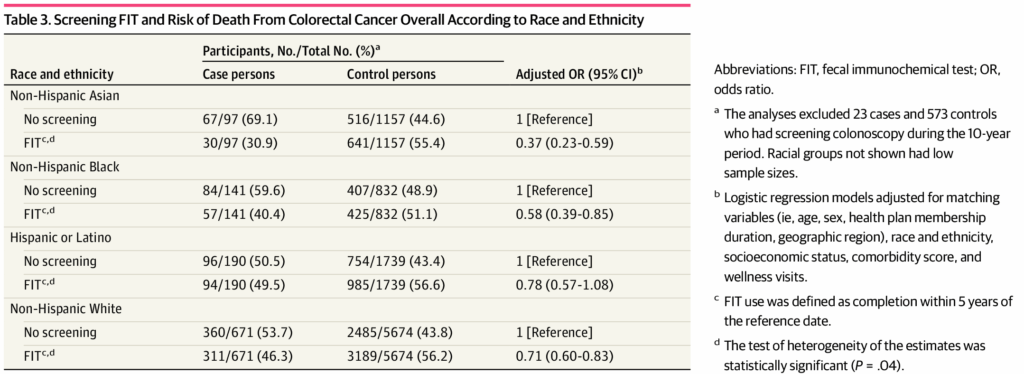
Findings  In this nested case control study of 10 711 individuals, completing a FIT to screen for colorectal cancer was associated with a reduction in risk of dying from colorectal cancer of approximately 33% overall, and there was a 42% lower risk for left colon and rectum cancers. FIT screening was also associated with lower risk of colorectal cancer death among non-Hispanic Asian, non-Hispanic Black, and non-Hispanic White people.

Meaning  This study provides US community-based evidence that suggests FIT screening lowers the risk of dying from colorectal cancer and supports the strategy of population-based screening using FIT.

Author(s): Chyke A. Doubeni, MD, MPH1,2Douglas A. Corley, MD, PhD3Christopher D. Jensen, PhD3et al

Publication Date: July 19, 2024

Publication Site: JAMA Netw Open. 

2024;7(7):e2423671.

doi:10.1001/jamanetworkopen.2024.23671

TD Was Convenient for Criminals

Link: https://www.bloomberg.com/opinion/articles/2024-10-14/td-was-convenient-for-criminals?srnd=undefined

Excerpt:

But TD Bank’s problem — which led to the largest AML-failures penalty ever — was not just about ignoring red flags. The more fundamental problem is that TD Bank tried to do its anti-money-laundering compliance on the cheap, and the prosecutors and regulators hate that. The Justice Department says:

[The TD Bank Global Anti-Money Laundering (GAML) group]’s budget was a primary driver of its decisions about projects, hiring, staffing, and technology enhancements throughout the relevant period. GAML executives strove to maintain what TD Bank Group referred to as a “flat cost paradigm” or “zero expense growth paradigm,” meaning that each department’s budget, including GAML’s, was expected to remain flat year-over-year, despite consistent growth in TD Bank Group’s revenue over the relevant period. This budgetary pressure originated with senior bank executives and was achieved within GAML and US-AML by [its chief AML officer] and [its Bank Secrecy Act officer], both of whom touted their abilities to operate within the “flat cost paradigm without compromising risk appetite” in their self-assessments. GAML’s base and project expenditures on USAML were less in fiscal year 2021 than they were in fiscal year 2018 and were not sufficient to address AML deficiencies including substantial backlogs of alerts across multiple workstreams, despite TDBNA’s profits increasing approximately 26% during the same period. In 2019, [the chief AML officer] referred to the Bank’s “historical underspend” on compliance in an email to the Group senior executive responsible for the enterprise AML budget, yet the US-AML budget essentially stayed flat. GAML and US-AML employees explained to the Offices that budgetary restrictions led to systemic deficiencies in the Bank’s transaction monitoring program and exposed the Bank to potential legal and regulatory consequences.

That, I think, is why the fine was so big. The message that this case is meant to send to banks is “if your compliance team wants more money to build a better AML program, you’d better give it to them, because otherwise we will fine you orders of magnitude more money than you would have spent.” The attorney general said:

TD Bank chose profits over compliance, in order to keep its costs down.

That decision is now costing the bank billions of dollars in criminal and civil penalties.

The deputy attorney general added:

We are putting down a clear marker on what we expect from financial institutions — and the consequences for failure.

When it comes to compliance, there are really only two options: invest now – or face severe consequences later.

As I’ve said before, a corporate strategy that pursues profits at the expense of compliance isn’t a path to riches; it’s a path to federal prosecution.

One job of a bank is to stop crime, which means that banks employ thousands of people who essentially work for the US Department of Justice. But the Department of Justice has no direct control over how many of those people there are, how much they get paid or what resources they have. Law enforcement agencies cannot directly set the banks’ budgets for anti-money-laundering programs, even though those budgets really are part of law enforcement. It is, perhaps, a frustrating situation: The Justice Department would like banks to spend more money catching criminals, and it can’t quite make them.

Except obviously it can. The Justice Department can’t directly set banks’ AML budgets, but it can do it indirectly, and it just did. If you are a bank compliance officer and you want to hire 2,000 people and get some shiny new computers, you can go to your regulators and say “do we need to spend this money on AML,” and they will say “that would be better,” and you will go to your chief executive officer with a transcript of the TD Bank press conference, and you will get whatever you want. 

Author(s): Matt Levine

Publication Date: 14 Oct 2024

Publication Site: Bloomberg

Longevity Illustrator: Find Out How Long You Might Live

Link: https://www.kiplinger.com/retirement/longevity-illustrator-find-out-how-long-you-might-live

Excerpt:

When planning for retirement, it’s important to consider all the risks, and one consideration that individuals often overlook is “longevity risk.” Longevity risk refers to the chance a person could outlive their savings. Understanding longevity and reasonably estimating the probabilities of living to various advanced ages and the risk of outliving resources are important for planning a secure retirement.

As a result of healthy lifestyles, medical advancements and scientific discoveries, it has become much more common for people these days to live into their 80s and 90s — or even their 100s! In fact, Pew Research Center writes that, according to estimates by the U.S. Census Bureau, there are about 101,000 centenarians in the U.S. in 2024, and this population could quadruple to about 422,000 in 2054.

While a long life is something most people desire, it requires planning for a longer retirement than in the past. For example, if a worker retires at 67, planning for a 20-year retirement may not be enough, and if they live to be in their 90s, or even past 100, they could outlive their savings or end up with fewer assets to leave their heirs.

Author(s):  Lisa A. Schilling, FSA, EA, FCA, MAAA

Publication Date: 22 Sept 2024

Publication Site: Kiplinger Personal Finance

Actuarial ChatBots

Link: https://riskviews.wordpress.com/actuarial-chatbots/

Graphic:

Excerpt:

Here are several examples of ChatBots and other AI applications for actuaries to try.

Answers that you might get from a general AI LLM such as ChatGPT may or may not correctly represent the latest thinking in actuarial science. These chatBots make an effort to educate the LLM with actuarial or other pertinent literature so that you can get better informed answers.

But, you need to be a critical user. Please be careful with the responses that you get from these ChatBots and let us know if you find any issues. This is still early days for the use of AI in actuarial practice and we need to learn from our experiences and move forward.

Note from meep: there are multiple Apps/Bots linked from the main site.

Author(s): David Ingram

Publication Date: accessed 28 Aug 2024

Publication Site: Risk Views

Adele vs. Taylor Swift, Covid, and Entertainment Industry Pandemic Insurance

Link: https://www.nakedcapitalism.com/2024/02/adele-vs-taylor-swift-covid-and-entertainment-industry-pandemic-insurance.html

Graphic:

Excerpt:

Making those timelines — 2020, 2021, 2022, 2023, 2024 — really brought home to me how long this pandemic has been going on; I lost track in the daily grind (though the daily grind is also my form of coping). And it’s a bit discouraging to see the most solidarity our society seems capable of fizzle out after 2020, followed by a struggle to return to business as usual, a struggle that failed by 2024, in that a once-essential part of touring — contact with the fans — has now gone missing.

We can, of course, moralize about what how these artists have gone about their business:

To be fair, though, when CDC Director Mandy Cohen is swanning about with no mask, modeling how to infect everybody she breathes on, what’s a poor celebrity to do? Restoring social norms that support non-pharmaceutical interventions will probably take a whole-of-society approach (which could happen when those Tiktokers start doing their research).

Here, however, are two small steps artists like Adele and Taylor Swift could do to improve the Covid pandemic situation.

First, big acts could really help out smaller acts by supporting organizations like this one: [Clean Air Club]

Second, sell N95s at your concerts and on your websites as branded merch. K-Pop powerhouse Twice already does this (though KN94s, not N95s):

And if, by some happy chance, some intern from either organization reads this post, please champion these ideas!

Oh, and champion clean air, too. Who could be against that? Miasma delenda est!

Author(s): Lambert Strether

Publication Date: 28 Feb 2024

Publication Site: naked capitalism

Few Nursing Facility Residents and Staff Have Received the Latest COVID-19 Vaccine

Link: https://www.kff.org/medicaid/issue-brief/few-nursing-facility-residents-and-staff-have-received-the-latest-covid-19-vaccine/

Graphic:

Excerpt:

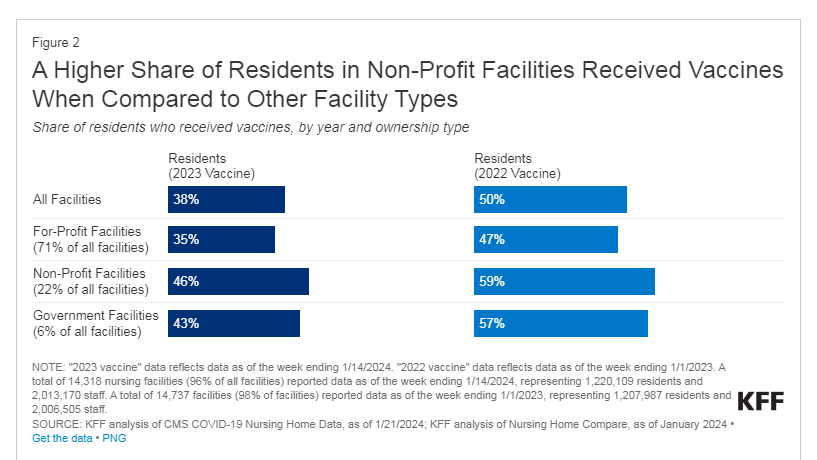
Uptake of the current COVID-19 vaccine is higher in non-profit facilities than in for-profit or government facilities (Figure 2). The percentage of nursing facility residents who received the updated vaccine is 46% in non-profit facilities compared with 35% in for-profit facilities and 43% in government facilities. Uptake of the fall 2022 vaccine was also highest in non-profit facilities and lowest in for-profit facilities. Rates of vaccine uptake for nursing facility staff were low in all types of facilities with minimal variation across facility types (data not shown).

Author(s): Priya Chidambaram and Alice Burns

Publication Date: 13 Feb 2024

Publication Site: KFF, Medicaid

Lessons Learned During the Pandemic Can Help Improve Care in Nursing Homes

Link: https://oig.hhs.gov/documents/evaluation/9808/OEI-02-20-00492.pdf

Graphic:

Excerpt:

OIG recommends that the Centers for Medicare & Medicaid Services (CMS):

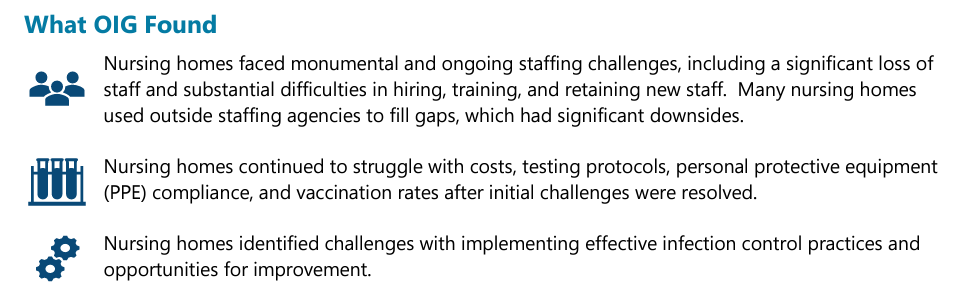
1. Implement and expand upon its policies and programs to strengthen the nursing home workforce.

2. Reassess nurse aide training and certification requirements.

3. Update the nursing home requirements for infection control to incorporate lessons learned from the pandemic.

4. Provide effective guidance and assistance to nursing homes on how to comply with updated infection control requirements.

5. Facilitate sharing of strategies and information to help nursing homes overcome challenges and improve care.

CMS did not explicitly state its concurrence or nonconcurrence for the five recommendations.

Author: Christi A. Grimm

Publication Date: February 2024

Publication Site: Office of the Inspector General, HHS

Eyes on the road: Automated speed cameras get a fresh look as traffic deaths mount

Link:https://www.npr.org/2024/02/16/1231362802/automated-speed-cameras-traffic-fatalities

Excerpt:

Richmond joins a growing list of cities turning to speed cameras. New laws in California and Pennsylvania will allow them in major cities where they’ve long been blocked.

Traffic fatalities have risen sharply over the past decade, and safety advocates around the country are desperately searching for anything that will get drivers to slow down. But critics say speed cameras can be a financial burden on those who are least able to pay.

Still, they’ve earned the endorsement of prominent safety advocates, including Jonathan Adkins, the CEO of the Governors Highway Safety Association.

“Automated enforcement works,” Adkins said. “For lack of a better term, it sucks to get a ticket. It changes your behavior.”

….

No one likes getting a speeding ticket. But the objections to automated traffic enforcement go deeper than that.

“We are very skeptical that safety is the real goal,” says Jay Beeber, with the National Motorists Association, a driver advocacy group.

There are other ways to get drivers to slow down, Beeber argues, including speed feedback signs that show drivers how fast they’re going in real time.

Author(s): Joel Rose

Publication Date: 16 Feb 2024

Publication Site: NPR, All Things Considered

Insurance Fraud on the March

Link: https://www.insurancejournal.com/blogs/right-street/2024/02/12/760360.htm

Graphic:

Excerpt:

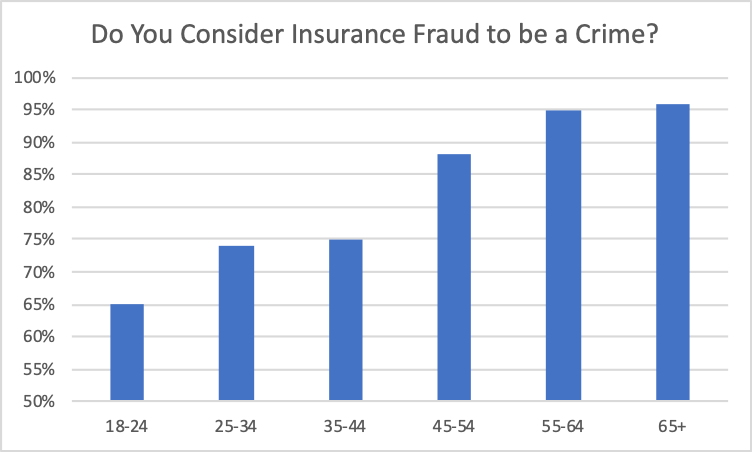
Some of the most chilling examples of insurance fraud are grisly affairs revealing the darkest of humanity’s dark side:

  • John Gilbert Graham placed a time-release bomb on a plane in which his mother was traveling, for the life insurance payment. The bomb exploded. In addition to Graham’s mother all 43 other passengers and crew perished.
  • Utah physician Farid Fata administered chemotherapy to hundreds of women who did not have cancer. Fata submitted $34 million in fraudulent claims to Medicare and private insurance companies.
  • Ali Elmezayen staged a freak car accident which took the lives of his two autistic children and nearly drowned his wife. He collected a $260,000 insurance payout, but his crime was discovered. He was sentenced to 212 years in prison.
  • A Chicago federal grand jury charged 23 defendants with participating in a fraud scheme swindling $26 million from ten life insurers. The scheme featured submission of fraudulent applications to obtain policies, and misrepresenting the identity of the deceased.

There are thousands of other equally horrific insurance fraud stories. The annual Dirty Dozen Hall of Shame report describes some of the most egregious, and contributes to an understanding of how far fraudsters will go to cheat insurance companies.

….

Improvements in predictive modeling and the introduction of artificial intelligence (AI) have strengthened insurers abilities to identify, and ultimately investigate, submitted claims that may be fraudulent. At the same time, however, AI is also being used as a weapon to penetrate insurers’ fraud detection systems. Techniques being used include AI-created fake photographs of cars of a particular make and model showing damage that is not real, but used to extract a claims payment. Some insurers are no longer accepting photos because they may be doctored, and are returning to adjustors physically visiting the allegedly damaged car. A nefarious life insurance scam includes AI-enabled manipulation of ones voice so that a criminal third party gets past insurers’ voice recognition technology, and initiates a policy being surrendered to a non-policyholder, non-beneficiary. It seems that for every additional layer of protection insurers introduce, the criminals are keeping up, if not forging ahead.

Author(s): Jerry Theodorou, R Street

Publication Date: 12 Feb 2024

Publication Site: Insurance Journal

Regulatory Capital Adequacy for Life Insurance Companies

Link: https://www.soa.org/4a194f/globalassets/assets/files/resources/research-report/2023/erm-191-reg-capital-with-final-visuals.pdf

Graphic:

Excerpt:

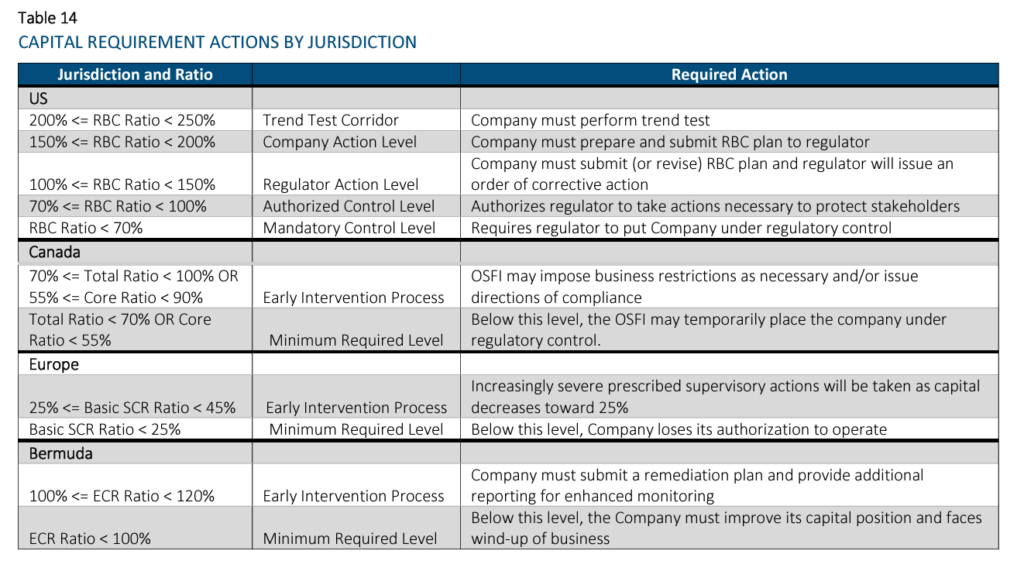
The purpose of this paper is to introduce the concept of capital and key related terms, as well as to compare and contrast four key regulatory capital regimes. Not only is each regime’s methodology explained with key terms defined and formulas provided, but illustrative applications of each approach are provided via an example with a baseline scenario. Comparison among these capital regimes is also provided using this same model with two alternative scenarios.

The four regulatory required capital approaches discussed in this paper are National Association of Insurance Commissioners’ (NAIC) Risk-Based Capital (RBC; the United States), Life Insurer Capital Adequacy Test (LICAT; Canada), Solvency II (European Union), and the Bermuda Insurance Solvency (BIS) Framework which describes the Bermuda Solvency Capital Requirement (BSCR). These terms may be used interchangeably. These standards apply to a large portion of the global life insurance market and were chosen to give the reader a better understanding of how required capital varies by jurisdiction, and the impact of the measurement method on life insurance company capital.

All of these approaches are similar in that they identify key risks for which capital should be held (e.g., asset default and market risks, insurance risks, etc.). However, they differ in significant ways too, including their defined risk taxonomy and risk diversification / aggregation methodologies, as well as required minimum capital thresholds and corresponding implications. Another key difference is that the US’s RBC methodology is largely factor-based, while the other methodologies are model-based approaches. For the model-based approaches, Solvency II and BIS allow for the use of internal models when certain conditions are satisfied. Another difference is that the RBC methodology is largely derived using book values, while the others use economic-based measurements.

As mentioned above, this paper provides a model that calculates the capital requirements for each jurisdiction. The model is used to compare regulatory solvency capital using identical portfolios for both assets and liabilities. For simplicity, we have assumed that all liabilities originated in the same jurisdiction as the calculation. As the objective of the model is to illustrate required capital calculation methodology differences, a number of modeling simplifications were employed and detailed later in the paper. The model considers two products – term insurance and payout annuities, approximately equally weighted in terms of reserves. The assets consist of two non-callable bonds of differing durations, mortgages, real estate, and equities. Two alternative scenarios have been considered, one where the company invests in riskier assets than assumed in the base case and one where the liability mix is more heavily weighted to annuities as compared to the base case.

Author(s): Ben Leiser, FSA, MAAA; Janine Bender, ASA, MAAA; Brian Kaul

Publication Date: July 2023

Publication Site: Society of Actuaries