Illinois Pension Funds Are Slow To Pull Out of Russian Assets

Link: https://www.bettergov.org/news/illinois-pension-funds-are-slow-to-pull-out-of-russian-assets?eType=EmailBlastContent&eId=55511662-b854-49ee-8d24-b2010db00a33

Graphic:

Excerpt:

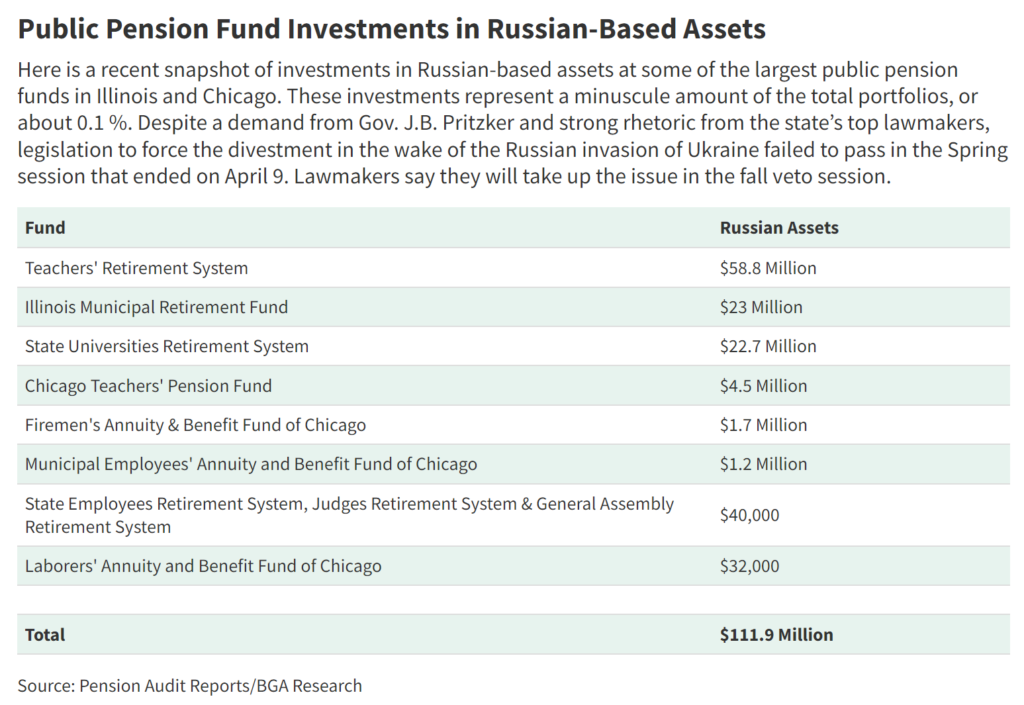
Despite strong rhetoric from Gov. J.B. Pritzker and other top state officials demanding public pension funds divest more than $100 million in Russia-based assets, state lawmakers now say they won’t act until the Fall veto session.

A key legislative proposal to force the pullout in the wake of the Russian invasion of Ukraine died in a Senate committee awaiting a vote.

Senate President Don Harmon, D-Oak Park, declined to be interviewed for this report, but his staff suggested the Senate had too little time before the session closed on April 9. The House bill — which passed by a vote of 114-0 on April 5 — was never taken up in the Senate chamber.

….

Using pension investment decisions as a way to prompt social change has long been controversial. In the past, Illinois funds have divested from companies and funds related to Sudan, Iran and businesses that boycott Israel following direction from lawmakers.

The Illinois State Board of Investments creates a prohibited list of companies for the funds to consider. The most recent list does not contain companies or funds connected to the Russian invasion.

“How, as a society, should we think about our pension systems assets?” Amanda Kass, Associate Director of the Government Finance Research Center at the University of Illinois – Chicago, asked. “I also see this kind of scrutiny of investing in Russian assets as part of this larger movement.”

Author(s): Jared Rutecki

Publication Date: 5 May 2022

Publication Site: Better Government Association
A Guide To The Public Pension Funds Divesting From Russia

Link: https://www.forbes.com/sites/lizfarmer/2022/03/11/the-pension-plans-divesting-from-russia/

Excerpt:

As economic sanctions against Russia for its invasion of Ukraine spread, state and local public pension plans are looking at selling off their Russian-related assets and some are already doing so.

Lawmakers in at least a dozen states are pressuring their pension funds to divest from Russian-related investments. Divestment isn’t likely to have much impact on the funds themselves as Russian-domiciled investments make up less than 1% of most (if not all) state portfolios. But collectively, it sends a message. For example, California’s CalPERS is the largest pension fund in the world and it alone holds nearly $1 billion in Russian assets.

However, it’s likely that at least some (if not all of) these funds will be selling at a loss. Here is a snapshot of what’s happening across the U.S.

Author(s): Liz Farmer

Publication Date: 11 March 2022

Publication Site: Forbes

Public Pensions’ New Quandary: Coping With Geopolitical Turmoil

Link: https://www.governing.com/finance/public-pensions-new-quandary-coping-with-geopolitical-turmoil

Excerpt:

Arguably, trustees and investment teams need a serious conversation with portfolio managers who are overweight in companies and countries that could foreseeably lose favor and stock exchange value. To ground that dialog, some form of risk analysis is required. One protocol could be as primitive as routinely identifying which major corporate equity and debt holdings in a system’s portfolio have cost and revenue exposure of more than 10 or 15 percent in such potentially at-risk regimes, and prodding managers to trim down those geopolitically vulnerable positions unless there is a clearly compelling undervaluation thesis. Another sensible approach would be to require underweighting of major companies relative to a benchmark index, based on their percentages of autocrat-nation revenues.

Ultimately at a fiduciary level, if a pension fund’s total worst-case exposure to all earnings and income derived from autocratic nations is an insignificant fraction of its total portfolio, the composite risk is probably not worth losing sleep over, on purely financial grounds. But politics could still enter the theater stage for pension boards that ignore this issue.

Pension consultants and risk advisers have a new role to play in this dialog. ESG investing is now under fire, so a healthy ESG+G discussion is especially timely. If nothing else, informed advisers can help investment teams and trustees identify where their portfolios might contain a blind-side risk that hasn’t received enough attention.

Author(s): Girard Miller

Publication Date: 10 May 2022

Publication Site: Governing

I Finance The Current Thing

Link: https://allenfarrington.medium.com/i-finance-the-current-thing-7ea204230315

Excerpt:

Passive investing is most often celebrated as a marvel of risk/reward packaging for the retail investor, who surely doesn’t have the time or energy to do the job of a professional capital allocator. It’s a fair assumption that they have their own job doing something productive in the real economy. Is this arrangement worth sacrificing? Would sacrificing it be ESG-friendly? Yes, absolutely it would, but we will return to this further down.

Passive investing relies on the notion of an index, or, a numerical weighting of every publicly listed company in a given geography, above a certain size, etc. which is determined by relative size and expressed as a percentage of the whole. If the value of all shares outstanding multiplied by their current market price (or, “market capitalization”) of Company A is 1% of the total of all the companies in an index, then it makes up 1% of that index, and its shares are 1% of those held by a passive investment instrument.

The existence of indices is the bane of the lived experience of investment professionals who take Schumpeter a little more seriously and do not allocate by algorithm but by analysis of business fundamentals. “Performance” is measured relative to an index, on the understandable but perverse realization that index investing, which relies only on an algorithm, is much cheaper for the client. If your non-passive (or “active”) manager returned you 50%, you might think that is fantastic, but if the index went up 60% then you paid for nothing. In fact, technically they underperformed by 10%. No performance fees — even on 50%! — and probably also fired.

….

When SEC Commissioner Hester Peirce voiced the lone dissent against the inclusion of “climate risks” in company prospectuses recently, her argument was basically my own above: these are risks. Although the concept is incredibly technically involved, real investors know how to deal with risks and do not need to be condescended to about which deserve their attention more than others. “We are not the securities and environment commission,” Peirce warned, adding, “at least not yet.” Quite right. I would hope not ever if the rule of law is to be taken seriously, and exactly this kind of regulatory capture via backdoor-compliance enforcement of virtue signaling is to stop.

But could we probe deeper still? ESG is an attack vector, but what is the attack surface? Without intending to be flippant, I think it is centralization. Capital markets are centralized institutions and they are being attacked. So far, so bleak. Can we do anything about it? And what was that Thiel talk actually about, again?

Author(s): Allen Farrington

Publication Date: 21 April 2022

Publication Site: Medium

Influential fund manager Green Century tells insurers to drop Big Oil

Link: https://www.marketwatch.com/amp/story/influential-fund-manager-green-century-tells-big-insurers-to-drop-big-oil-11645049047?twclid=11498308136175906819

Excerpt:

Green Century Capital Management tried to use shareholder muscle to persuade at least a trio of insurance companies to drop fossil-fuel clients.

So far, the insurance firms aren’t biting; all three have filed no-action requests with the Securities and Exchange Commission.

The resolutions, in advance of proxy season this spring, call on Chubb CB Travelers TRV and The Hartford HIG to take this bold step as private-sector efforts to curb global warming from the burning of coal, oil CL00 and gas NG00 pick up, alongside global government action.

The insurance resolutions represent the first time that shareholders have laid down this sizable challenge to this industry for what the activists say are its contributions to the climate crisis

Author(s): Rachel Koning Beals

Publication Date: 17 Feb 2022

Publication Site: MarketWatch

City Of Chicago Shunning Fossil Fuel Investments. Who Benefits? Russia. – Wirepoints

Link: https://wirepoints.org/chicago-shunning-fossil-fuel-investments-as-nation-struggles-with-higher-energy-costs-wirepoints/

Graphic:

Excerpt:

The timing on Wednesday was impeccable. I was looking at the price of oil, which was up four percent that day and about to pass $100/barrel. Energy stocks were up over one percent despite a horrible day for the rest of the market.

That’s when an email popped up with a story in Crain’s headlined “Chicago moving to divest from fossil fuels.”

….

So, with inflation raging, gasoline moving towards $4.00/gallon and Russia murdering Ukrainians with the help of American oil purchases, Chicagoans can take comfort knowing that the city will refuse to invest in oil and other fossil fuel production and thereby “will be sending a message that Chicago is permanently leaving dirty energy in the past and welcoming a clean energy future for generations to come.”

That’s from Chicago Treasurer Melissa Conyears-Ervin. She and members of the City Council, with Mayor Lori Lightfoot’s support, are pushing for an ordinance to mandate that the city divest its funds from fossil fuel companies, as Crain’s reported.

In fact Conyears-Ervin had already made oil and gas divestment office policy. The new ordinance would make the change permanent going forward. Her office has already removed $70 million in fossil fuel-associated bonds from the city’s portfolio, she says.

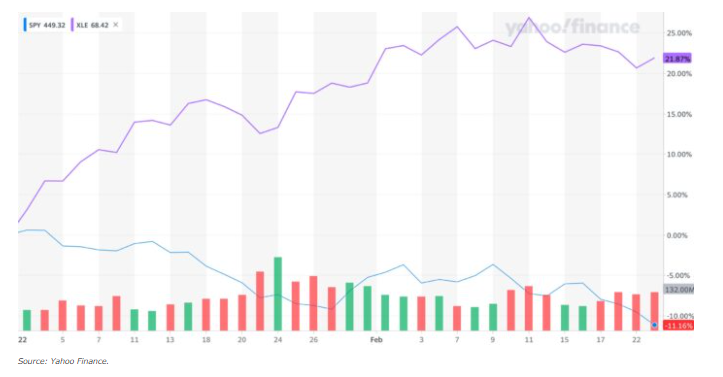
How wise has it been lately to be shunning fossil fuel investments? Here’s a chart comparing performance year-to-date of the S&P 500 to XLE, an ETF basket of mostly oil and gas companies. While the market in general is down some 10% the oil and gas stocks are up over 21%.

Author(s): Mark Glennon

Publication Date: 25 Feb 2022

Publication Site: Wirepoints

2021 Academy Legislative/Regulatory Review

Link: https://www.actuary.org/sites/default/files/members/alerts/pdf/2022/2022-CP-1.pdf

Excerpt:

The American Academy of Actuaries presents this summary of select significant regulatory and
legislative developments in 2021 at the state, federal, and international levels of interest to the U.S.
actuarial profession as a service to its members.

Introduction

The Academy focused on key policy debates in 2021 regarding pensions and retirement, health, life,
and property and casualty insurance, and risk management and financial reporting.


Responding to the COVID-19 pandemic, addressing ever-changing cyber risk concerns, and analyzing
the implications and actuarial impacts of data science modeling continued to be a focus in 2021.


Practice councils monitored and responded to numerous legislative developments at the state, federal,
and international level. The Academy also increased its focus on the varied impacts of climate risk and
public policy initiatives related to racial equity and unfair discrimination in 2021.


The Academy continues to track the progress of legislative and regulatory developments on actuarially
relevant issues that have carried over into the 2022 calendar year.

Publication Date: 15 Feb 2022

Publication Site: American Academy of Actuaries

Oregon public pension fund gave blessing to NSO Group deal, sources suggest

Link: https://www.theguardian.com/world/2022/jan/17/oregon-public-pension-fund-gave-blessing-to-nso-group-deal-sources-suggest

Excerpt:

Oregon’s public pension fund, which manages tens of billions of dollars in retirement savings, appears to have privately given its blessing to a 2019 deal by an investment fund to acquire NSO Group, the controversial spyware company.

A source with close knowledge of the matter and emails seen by the Guardian suggest that a senior official at the pension fund signalled his strong support for the takeover of NSO as early as 2018, months before the deal was announced.

Last month, Oregon officials said they were “deeply disturbed” by reports that NSO Group “enabled widespread human rights violations”.

Author(s): Stephanie Kirchgaessner

Publication Date: 17 Jan 2022

Publication Site: The Guardian

Your New Woke 401(k)

Link:https://www.wsj.com/articles/your-new-woke-401-k-retirement-savings-esg-erisa-biden-administration-department-of-labor-proposal-11634753095

Excerpt:

While Democrats in Congress negotiate over trillions of dollars in new spending, the Biden Administration is quietly advancing its agenda through regulation. Witness a little-noticed proposed rule last week by the Labor Department that will add new political directives to your retirement savings.

The Administration says the rule will make it easier for retirement plans to offer 401(k) funds focused on ESG (environmental, social and governance) objectives. In fact, the rule will coerce workers and businesses into supporting progressive policies.

An important Trump Labor rule last fall reinforced that the Employee Retirement Income Security Act (Erisa) requires retirement plan fiduciaries to act “solely in the interest” of participants. The rule prevented pension plans and asset managers from considering ESG factors like climate, workforce diversity and political donations unless they had a “material effect on the return and risk of an investment.”

The Biden DOL plans to scrap the Trump rule while putting retirement sponsors and asset managers on notice that they have a fiduciary duty to include ESG in investment decisions. The proposed rule “makes clear that climate change and other ESG factors are often material” and thus in many instances should be considered “in the assessment of investment risks and returns.”

Author(s): WSJ editorial board

Publication Date: 20 Oct 2021

Publication Site: WSJ

Wall Street’s Shift South Runs Into Texas, Florida Culture Wars

Link: https://www.bloomberg.com/news/articles/2021-10-05/wall-street-s-shift-south-runs-into-texas-florida-culture-wars

Excerpt:

Wall Street’s three biggest municipal-bond underwriters have seen business grind to a halt in Texas after the state blocked governments from working with banks that have curtailed gun-industry ties. In June, as Goldman Sachs Group Inc. was on the hunt for a new campus in Dallas, Republican Governor Greg Abbott took a shot at ESG initiatives by banning state investments in businesses that cut ties with oil and gas companies.

That’s not to mention the brawls over Covid vaccines and mask mandates, deadly Texas blackouts along the country’s most isolated power grid and new state laws that restrict voting and all but ban abortion. It’s all happening just as Wall Street’s shareholders push the industry to fight climate change, racism and the gender gap.

….

So far, most big banks haven’t taken public positions on the new abortion restrictions. They’re being cautious about requiring Covid-19 vaccinations for employees in places where officials have assailed mandates. But the new Texas gun law is running into both the industry’s efforts to advance social causes and its ability to work with the second-largest state for muni-bond issuance. 

JPMorgan Chase & Co. — which has 25,500 Texas employees, its most in any state outside New York — has said it can’t bid on most business with public entities in Texas because of ambiguities around the law. The biggest U.S. bank is assessing its potential next steps, said a person with knowledge of the company’s thinking. 

Author(s): Max Abelson, Amanda Albright

Publication Date: 5 October 2021

Publication Site: Bloomberg

As Comptroller, Lander Would Use ‘Environmental, Social and Governance’ Factors to Inform Pension Investment

Link: https://www.gothamgazette.com/city/10773-comptroller-lander-environmental-social-governance-esg-pension-investment?mc_cid=234d7207fb&mc_eid=1a5d3a1f3d

Excerpt:

The New York City Comptroller is an investment advisor and fiduciary for New York City’s $266 billion public pension system that serves 700,000 current and former teachers, firefighters, health care workers, police officers, and other retired city employees.

Brad Lander, the Democratic nominee for Comptroller, is all but certain to win the general election this fall in the overwhelmingly Democratic city after prevailing in a competitive primary earlier this year. If successful, Lander would be inaugurated in January and soon be able to make recommendations to the Boards of Trustees of the city’s five public pension funds on how their many billions should be invested, while also voting directly on four of the five pension boards, making him the key figure in almost all investment decisions.

The implications are significant given that city workers’ pensions are on the line, and because the city guarantees those pensions, billions are spent each year to make up for what the pensions themselves don’t produce in returns. Better returns from pension fund investments can save city government a significant amount of money that could be used for other priorities or put aside for a crisis.

Those investment decisions can also be made to further other goals than simply the funds’ bottom lines, though the returns and overall financial health of the pension funds are the comptroller’s main city charter-mandated responsibility.

Author(s): Carmen Vintro

Publication Date: 17 Sept 2021

Publication Site: Gotham Gazette

GOP senators press TSP managers on fiduciary duty vs. ESG

Link: https://www.pionline.com/washington/gop-senators-press-tsp-managers-fiduciary-duty-vs-esg?utm_source=p-i-editor-s-pick&utm_medium=email&utm_campaign=20210702&utm_content=article3-headline&CSAuthResp=1625616942174%3A0%3A73393%3A0%3A24%3Asuccess%3AFEA86842B20E7441526766BAA1004F10#cci_r=

Excerpt:

Two Republican senators expressed concern that Thrift Savings Plan asset managers BlackRock and State Street Global Advisors are putting ESG and their CEOs’ “left-leaning” priorities ahead of their fiduciary duties when it comes to proxy voting.

In a letter Thursday to Federal Retirement Thrift Investment Board Acting Chairman David A. Jones, Sens. Pat Toomey of Pennsylvania and Ron Johnson of Wisconsin questioned the priorities of BlackRock and State Street Global Advisors, who between them manage nearly $500 billion for the $762.3 billion Thrift Savings Plan’s 6.2 million federal employees and members of the uniformed services. Of that, roughly $57 billion is managed by SSGA.

“We are concerned that BlackRock and SSGA may be prioritizing their CEOs’ personal policy views over retirees’ financial security,” the letter said.

Author(s): Hazel Bradford

Publication Date: 1 July 2021

Publication Site: Pensions & Investments