Most U.S. Treasury Yields Close Lower

Link: https://www.wsj.com/articles/u-s-treasury-yields-fall-after-notching-big-gains-last-week-11614619970

Excerpt:

Yields on most U.S. government bonds fell Monday, showing further signs of stabilizing after soaring to multi-month highs last week.

The yield on the benchmark 10-year Treasury note settled at 1.444%, according to Tradeweb, down from 1.459% Friday.

Shorter-dated yields also headed lower, in a reversal from last week when investors bet that the Federal Reserve will start raising interest rates earlier than previously anticipated in response to an expected burst of economic growth and inflation.

The five-year yield settled at 0.708%, from 0.775% Friday. Yields fall when bond prices rise.

Author(s): Sebastian Pellejero and Sam Goldfarb

Publication Date: 1 March 2021

Publication Site: Wall Street Journal

The constraint on public debt when r < g but g < m

Link: https://personal.lse.ac.uk/reisr/papers/99-mpkrg.pdf

Graphic:

Excerpt:

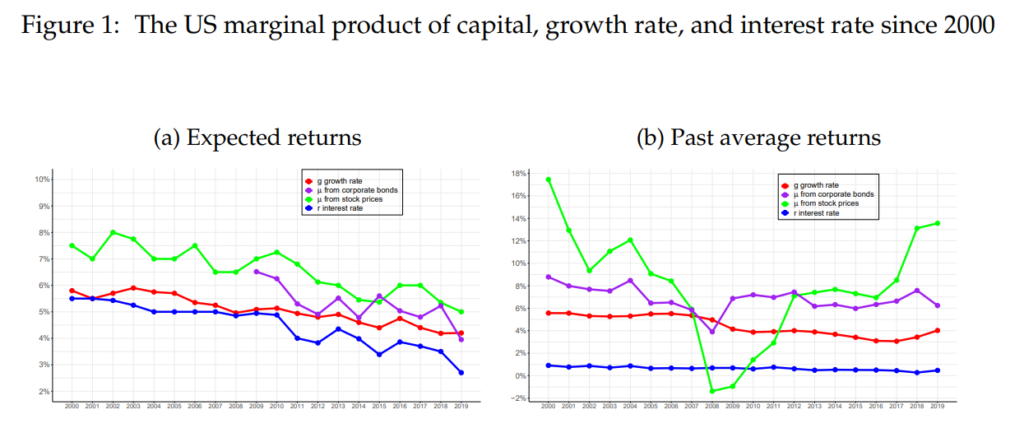
Since real interest rates have been well below the growth rate of the economy, but the marginal product of capital has remained above, modern economies are dynamically efficient, yet there is a bubble component in public debt. Thus, the present value of primary surpluses can be lower than the outstanding debt and governments can run perpetual deficits by collecting the bubble premia. Yet, there is an upper bound on the size of the deficits that depends on how safe and liquid government debt is and on financial development. Higher spending lowers the interest rate and increases inequality, while redistributive policies shrink the feasible amount of persistent public spending, income tax cuts pay for themselves, inflation volatility reduces fiscal space available for spending, and financial repression increases it.

Author(s): Ricardo Reis

Publication Date: December 2020

Publication Site: London School of Economics

Resiliency vs. efficiency

Link: https://tinyletter.com/acs171/letters/known-unknowns-43

Excerpt:

I expect some big institutional changes to be coming our way soon. One favorite debate, at least according to the editorial page of the Financial Times, is the trade-off between efficiency and resilience. Buying all your goods from China, including PPE, may be efficient—but if you have a global pandemic, then it means that you’re not so resilient. Or, if you live in Texas, cheap energy is great when you blast your air-conditioning every August when it’s 110 degrees outside, but if there’s a crazy cold snap and your power gets shut off, you see that your system is actually not that resilient at all.
 
We already see the Biden administration taking on resiliency, as he is trying to revive domestic manufacturing. And we can expect some soul searching in Texas as well. But I’m not convinced that we’ll get the big overhaul, because the problem with resiliency is that it can be extremely expensive, and once we forget about the shock, we don’t want to pay for it anymore. It’s expensive if you define resiliency as the ability to seamlessly handle a once-in-a-lifetime tail risk that you never saw coming. People like cheap power and goods, and those things help the economy grow.

Author(s): Allison Schrager

Publication Date: 1 March 2021

Publication Site: Known Unknowns

Bond-Market Tumult Puts ‘Lower for Longer’ in the Crosshairs

Link: https://www.wsj.com/articles/bond-market-tumult-puts-lower-for-longer-in-the-crosshairs-11614517200

Excerpt:

A wave of selling during the past two weeks drove the yield on the benchmark 10-year Treasury note, which helps set borrowing costs on everything from corporate debt to mortgages, to above 1.5%, its highest level since the pandemic began and up from 0.7% in October.

….

Traders said concerning dynamics were evident in a Treasury auction late last week. Demand for five- and seven-year Treasurys was weak Thursday heading into a $62 billion auction of seven-year notes and nearly evaporated in the minutes following the auction, which was one of the most poorly received that analysts could remember.

The seven-year note was sold at a 1.195% yield, or 0.043 percentage point higher than traders had expected — a record gap for a seven-year note auction, according to Jefferies LLC analysts. Primary dealers, large financial firms that can trade directly with the Fed and are required to bid at auctions, were left with about 40% of the new notes, about twice the recent average.

Author(s): Julia-Ambra Verlaine, Sam Goldfarb

Publication Date: 28 February 2021

Publication Site: Wall Street Journal

With lower returns on the horizon, public pensions will turn to riskier assets, Moody’s says

Link: https://www.marketwatch.com/amp/story/with-lower-returns-on-the-horizon-public-pensions-will-turn-to-riskier-assets-moodys-says-11614289692?mod=dist_amp_social

Excerpt:

State and local government pension systems are increasingly dependent on investment returns, and at risk of increasingly volatile results, as funding levels remain depressed and systems increasingly start to pay out more than they take in, according to a new report from Moody’s.

The credit-ratings agency anticipates higher volatility and lower returns across asset classes in 2021 compared to 2020, even as many pension sponsors have spent the past few years lowering their assumed returns from previous loftier targets that they rarely hit.

“With persistently low interest rates for high-grade fixed-income securities, public pension systems continue to rely on highly volatile equities and alternatives to meet return targets, posing a material credit risk for some governments,” the Moody’s analysts wrote.

Author(s): Andrea Riquier

Publication Date: 25 February 2021

Publication Site: MarketWatch

Monetary policy and the corporate bond market: How important is the Fed information effect?

Link: https://www.federalreserve.gov/econres/feds/monetary-policy-and-the-corporate-bond-market-how-important-is-the-fed-information-effect.htm

Abstract:

Does expansionary monetary policy drive up prices of risky assets? Or, do investors interpret monetary policy easing as a signal that economic fundamentals are weaker than they previously believed, prompting riskier asset prices to fall? We test these competing hypotheses within the U.S. corporate bond market and find evidence strongly in favor of the second explanation—known as the “Fed information effect”. Following an unanticipated monetary policy tightening (easing), returns on corporate bonds with higher credit risk outperform (underperform). We conclude that monetary policy surprises are predominantly interpreted by market participants as signaling information about the state of the economy.

DOI: https://doi.org/10.17016/FEDS.2021.010

PDF: Full Paper

Author(s): Michael Smolyansky and Gustavo Suarez

Publication Date: 16 February 2021

Publication Site: Federal Reserve Board

Municipal bond yields rise, swept up in Treasuries surge

Link: https://www.reuters.com/article/usa-municipals-treasuries/muni-bond-yields-rise-swept-up-in-treasuries-surge-idUSL1N2KV2H1

Excerpt:

Earlier this year, the $3.9 trillion market where states, cities, schools and other issuers sell debt had been resisting a steep sell off in Treasuries that lifted yields, putting the historically close correlation between the two markets out of whack.

Now, munis are catching up, with the 10-year yield on Municipal Market Data’s (MMD) benchmark triple-A scale, which started 2021 at 0.720%, climbing 45 basis points since Feb. 12. It closed up 5 basis points at 1.14% on Thursday.

The iShares National Municipal Bond exchange-traded fund (ETF) fell on Thursday to its lowest level since November at 115.14. The largest muni ETF, which reached an 11-month high of 117.95 on Feb. 11, was last down 0.43% at 115.30.

Author(s): Karen Pierog

Publication Date: 25 February 2021

Publication Site: Reuters

Forget Bitcoin or Tesla. Muni Bonds Are the King of Costly.

Link: https://www.bloomberg.com/opinion/articles/2021-02-22/forget-bitcoin-or-tesla-muni-bonds-are-the-king-of-costly

Graphic:

Excerpt:

A flood of money pouring in? Check: Muni bond funds added about $2 billion in the week ended Feb. 17, according to Refinitiv Lipper US Fund Flows data, building upon a $2.6 billion inflow in the prior period that was the fourth-largest on record. Scarce supply? You bet: Some analysts estimate that states and cities in 2021 will bring to market the smallest amount of tax-exempt bonds in 21 years. Fiscal stimulus supporting its case? Indeed: The prospect of $350 billion in aid to state and local governments should help stave off any widespread credit stress.

Perhaps most remarkably, though, muni investors appear to have fully embraced the “HODL” mentality of the crypto crowd. In typical times, February’s sharp selloff in U.S. Treasuries, which has sent the benchmark 10-year yield up almost 30 basis points to 1.35% (for a monthly loss of almost 2%), would have reverberated by now across the market for state and local bonds. Instead, tax-exempt yields have been borderline immovable; they only finally started to budge toward the end of last week. 

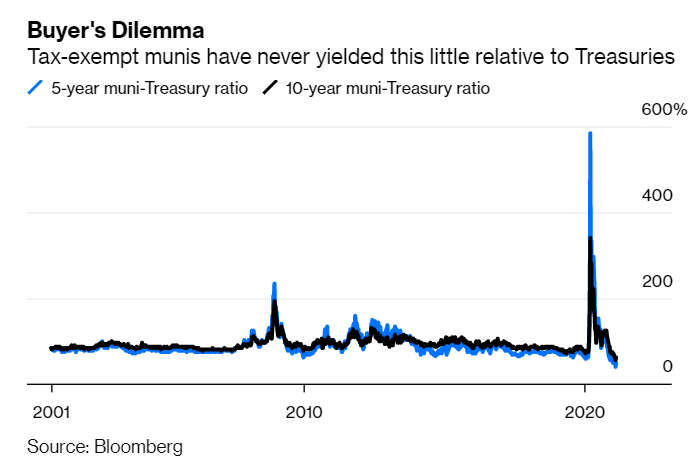
By that time, municipal bonds became arguably the most expensive asset class anywhere. As Bloomberg News’s Danielle Moran noted, yields had fallen so low on top-rated tax-free debt that even after accounting for the exemption from federal taxes, it still made more sense for investors to purchase Treasuries instead. It’s certainly fair to argue that Bitcoin isn’t worth more than $50,000, or that shares of Tesla Inc. shouldn’t be trading at more than 1,000 times earnings. But it’s at least possible to make the case that they should. It’s not every day that a corner of the bond market rallies to such an extent that it’s objectively a bad deal. 

Author(s): Brian Chappatta

Publication Date: 22 February 2021

Publication Site: Bloomberg

Junk Has Never Been So Valued

Link: https://www.wsj.com/articles/junk-has-never-been-so-valued-11612915150

Excerpt:

If you’re an over-leveraged company at risk of default, now’s your moment to load up on more debt. The average yield on U.S. junk bonds dropped below 4% for the first time on Monday amid a market scavenger hunt for higher returns.

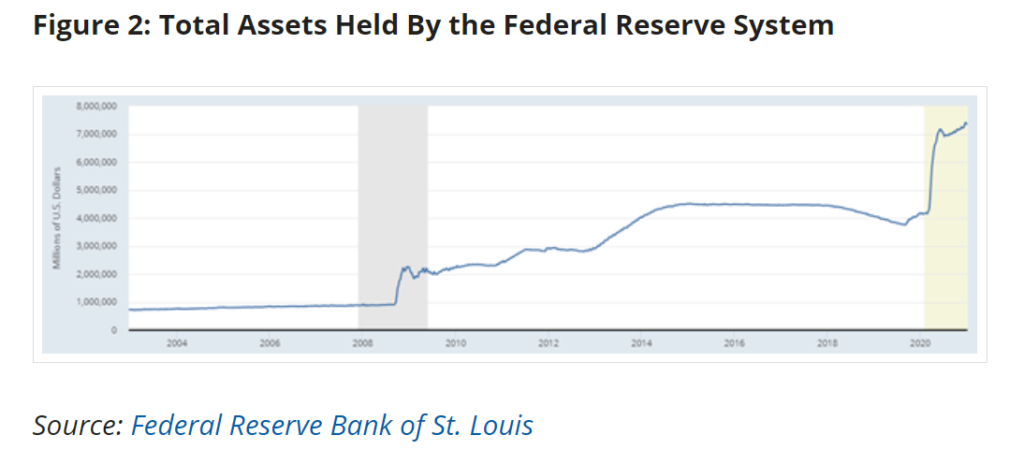
The Federal Reserve has pushed down long-term interest rates by buying bonds and committed to keep short-term interest rates at near zero through 2023. While the central bank’s interventions were needed in March, it continued to buy corporate bonds well into the summer when markets didn’t need the support.

Author(s): WSJ Editorial Board

Publication Date: 9 February 2021

Publication Site: Wall Street Journal

How the Federal Reserve’s Actions and Low Interest Rates Impact Public and Private Retirement Savings

Graphic:

Excerpt:

The extended period of low interest rates we’re in is not only creating challenges for public pension systems across the nation, but it is also negatively impacting people who are relying on their own savings to fund their retirements.

A common strategy for generating retirement income is to invest savings from an individual retirement account (IRA) or 401(k) into income-producing assets such as corporate bonds. But interest rates on corporate bonds have been falling in recent decades, reaching multi-decade lows in 2020.

Author(s): Marc Joffe

Publication Date: 20 January 2021

Publication Site: Reason

The Yield Curve Is the Steepest It Has Been in Years. Here’s What That Means for Investors.

Link: https://www.barrons.com/articles/the-yield-curve-is-the-steepest-it-has-been-in-years-heres-what-that-means-for-investors-51612462158?mod=hp_columnists

Excerpt:

Long-term Treasury yields have been rising much faster than shorter-term yields, a sign that investors are betting on further acceleration in the U.S.’s economic recovery.

The steepness (or flatness) of the yield curve—the change in yields across different Treasury maturities—is seen as an indicator of economic growth. When the curve “inverts,” or long-term yields fall below short term yields, it is seen as a recession warning. Now the curve is getting steeper, a sign that investors expect stronger U.S. growth and inflation…

Author: Alexandra Scaggs

Publication Date: 4 February 2021

Publication Site: Barron’s

THE CONSEQUENCES OF CURRENT BENEFIT ADJUSTMENTS FOR EARLY AND DELAYED CLAIMING

Link: https://crr.bc.edu/wp-content/uploads/2021/01/wp_2021-3_.pdf

Abstract
Workers have the option of claiming Social Security retirement benefits at any age between 62 and 70, with later claiming resulting in higher monthly benefits. These higher monthly benefits reflect an actuarial adjustment designed to keep lifetime benefits equal, for an individual with average life expectancy, regardless of when benefits are claimed. The actuarial
adjustments, however, are decades old. Since then, interest rates have declined; life expectancy has increased; and longevity improvements have been much greater for high earners than low earners. This paper explores how changes in longevity and interest rates have affected the
fairness of the actuarial adjustment over time and how the disparity in life expectancy affects the equity across the income distribution. It also looks at the impact of these developments on the costs of the program and the progressivity of benefits.


The paper found that:
• The increases in life expectancy and the decline in interest rates argue for smaller reductions for early claiming and a smaller delayed retirement credit for later claiming.
• Specifically, the benefit at 62 should equal 77.5 percent, as opposed to 70.0 percent, of the full age-67 benefit, and the benefit at 70 should equal 119.9 percent, instead of 124.0 percent, of the full benefit.
• The outdated actuarial adjustments are a modest moneymaker for the program – about $1.9 billion in 2018, with most of the gains coming from those claiming at 62, who are typically lower earners. Surprisingly, the correlations between earnings and life expectancy and between earnings and claiming behavior have only modest implications for both the cost and progressivity of Social Security benefits.
• Finally, the cost and distributional effects of earnings-related life expectancy and claiming cannot be addressed through the actuarial adjustments for early and late claiming. They reflect the fact that high earners get their large benefits for a long time and low earners get their more modest benefits for a shorter time.

Authors: Andrew G. Biggs, Anqi Chen, and Alicia H. Munnell

Publication Date: January 2021

Publication Site: Center for Retirement Research at Boston College