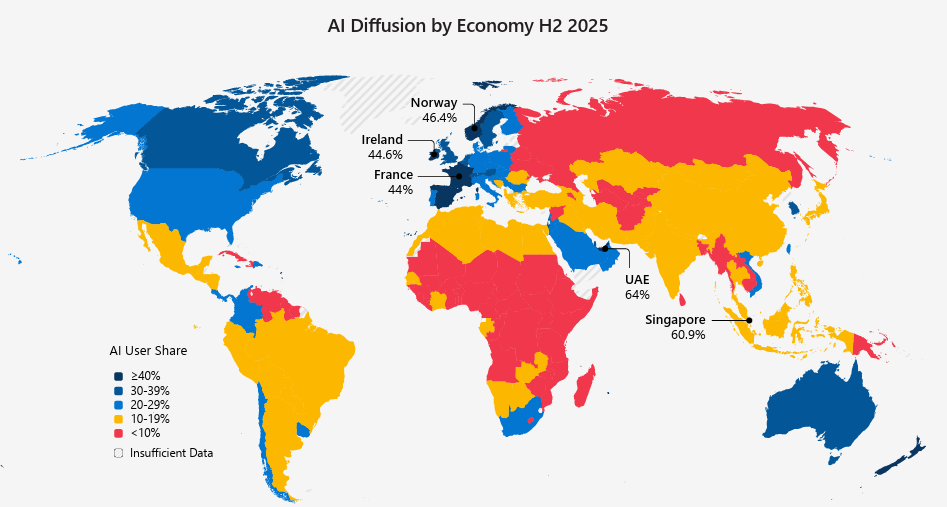
Global AI Adoption in 2025 A Widening Digital Divide

Link: https://www.microsoft.com/en-us/research/wp-content/uploads/2026/01/Microsoft-AI-Diffusion-Report-2025-H2.pdf

Graphic:

Excerpt:

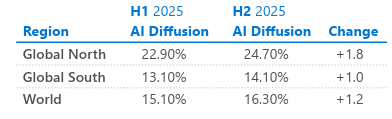
To track this trend, we measure AI diffusion as the share of people worldwide who have used a generative AI product during the reported period. This measure is derived from aggregated and anonymized Microsoft telemetry and then adjusted to reflect differences in OS and device-market share, internet penetration, and country population. Additional details on the methodology are available in our AI Diffusion technical paper. [1]

No single metric is perfect, and this one is no exception. Through the Microsoft AI Economy Institute, we continue to refine how we measure AI diffusion globally, including how adoption varies across countries in ways that best advance priorities such as scientific discovery and productivity gains. For this report, we rely on the strongest cross-country measure available today, and we expect to complement it over time with additional indicators as they emerge and mature.

Author(s): AI Economy Institute

Publication Date: January 2026

Publication Site: Microsoft
Mapped: AI Adoption Rates by Country

Link: https://www.visualcapitalist.com/ai-adoption-rates-by-country/

Graphic:

Excerpt:

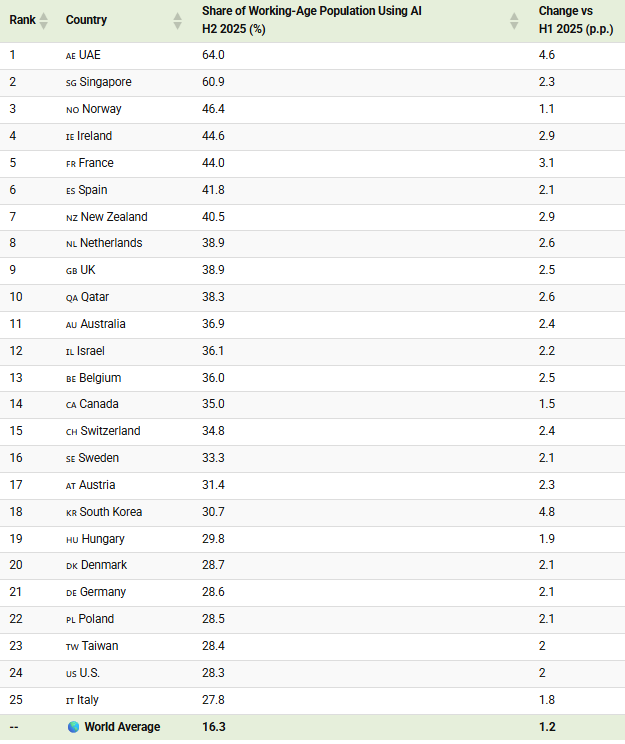
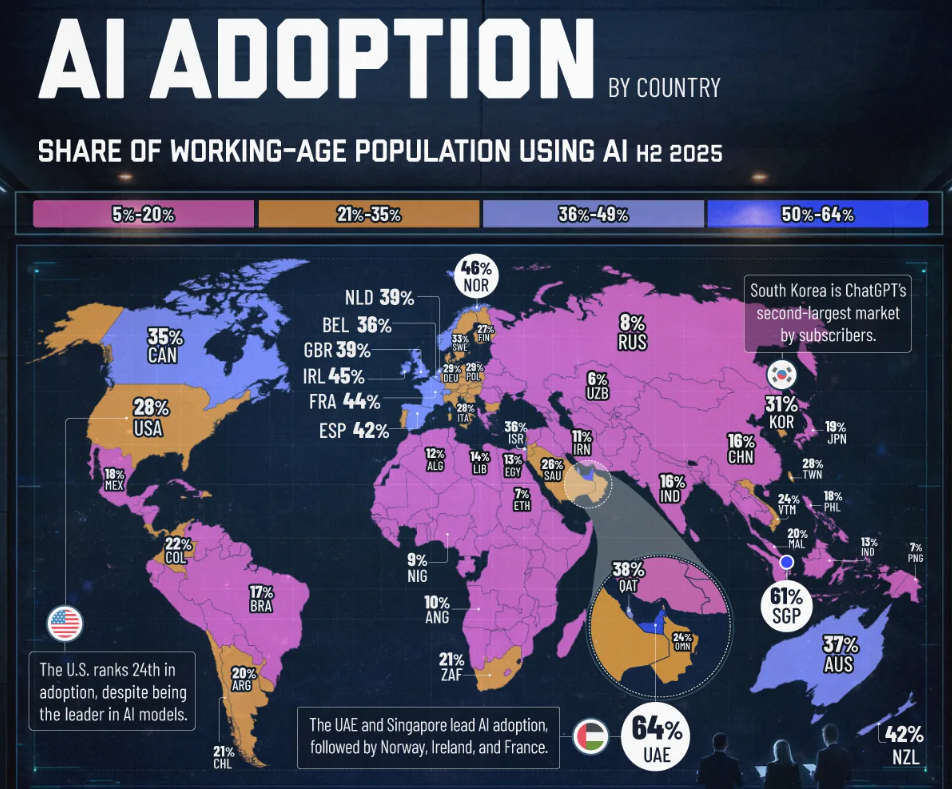
In the second half of 2025, 16.1% of the global working-age population used AI, indicating substantial room for further adoption.

At the same time, usage varies widely across countries. Adoption rates average 24.7% in the Global North, while they are 14.1% in the Global South. Key countries stand as clear regional outliers including the UAE and Singapore.

This graphic shows AI adoption by country, based on data from the Global AI Adoption in 2025 report from Microsoft.

Author(s): Dorothy Neufeld

Graphics by: Sam Parker

Publication Date: 22 Jan 2026

Publication Site: Visual Capitalist

Top Excel experts will battle it out in an esports-like competition this weekend

Link:https://www.pcworld.com/article/559001/the-future-of-esports-is-microsoft-excel-and-its-on-espn.html

Graphic:

Excerpt:

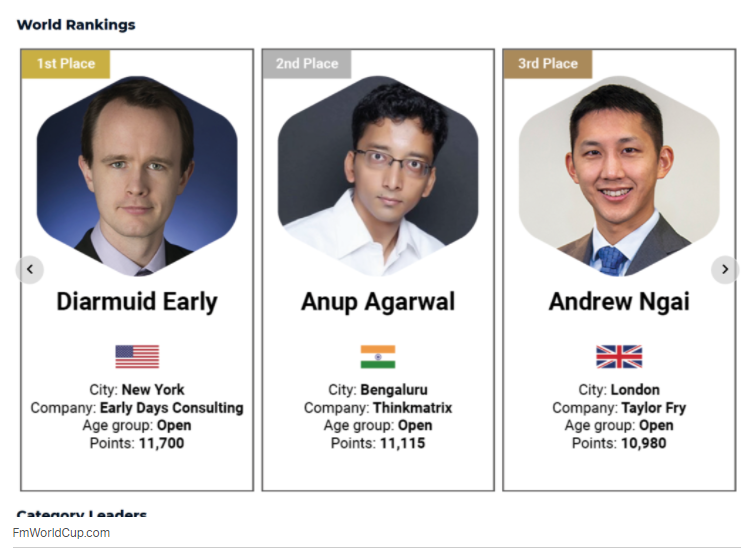
Move over, League of Legends. Does anyone even care about Overwatch? No, the real future of esports is spreadsheets and Microsoft Excel. Don’t believe us? Then tune in to ESPN3 or YouTube this weekend to find out.

No, this isn’t a joke. The Financial Modeling World Cup will be held this weekend entirely in Microsoft Excel. And the finals (the quarterfinals, semifinals, and the final match) will all be broadcast live as they happen at 9 AM PT. Everyone’s playing for a total prize of $10,000 — funded by Microsoft, of course.

Author(s):Mark Hachman

Publication Date: 10 Dec 2021

Publication Site: PC World

Excel Never Dies: The Spreadsheet That Launched A Million Companies

Link: https://www.notboring.co/p/excel-never-dies

Graphic:

Excerpt:

Excel may be the most influential software ever built. It is a canonical example of Steve Job’s bicycle of the mind, endowing its users with computational superpowers normally reserved for professional software engineers. Armed with those superpowers, users can create fully functional software programs in the form of a humble spreadsheet to solve problems in a seemingly limitless number of domains. These programs often serve as high-fidelity prototypes of domain specific applications just begging to be brought to market in a more polished form. 

If you want to see the future of B2B software, look at what Excel users are hacking together in spreadsheets today. Excel’s success has inspired the creation of software whose combined enterprise value dwarfs that of Excel alone.

Author(s): Packy McCormick

Publication Date: 8 March 2021

Publication Site: Not Boring

How China’s attack on Microsoft escalated into a “reckless” hacking spree

Link: https://www.technologyreview.com/2021/03/10/1020596/how-chinas-attack-on-microsoft-escalated-into-a-reckless-hacking-spree

Excerpt:

At first the Chinese hackers ran a careful campaign. For two months, they exploited weaknesses in Microsoft Exchange email servers, picked their targets carefully, and stealthily stole entire mailboxes. When investigators eventually caught on, it looked like typical online espionage—but then things accelerated dramatically.

Around February 26, the narrow operation turned into something much bigger and much more chaotic. Just days later, Microsoft publicly disclosed the hacks—the hackers are now known as Hafnium—and issued a security fix. But by then attackers were looking for targets across the entire internet: in addition to tens of thousands of reported victims in the US, governments around the world are announcing that they were compromised too. Now at least 10 hacking groups, most of them government-backed cyber-espionage teams, are exploiting the vulnerabilities on thousands of servers in over 115 countries, according to the security firm ESET.

Author(s): Patrick Howell O’Neill

Publication Date: 10 March 2021

Publication Site: MIT Technology Review

Former SolarWinds CEO blames intern for ‘solarwinds123’ password leak

Link: https://www.cnn.com/2021/02/26/politics/solarwinds123-password-intern/index.html

Excerpt:

Current and former top executives at SolarWinds are blaming a company intern for a critical lapse in password security that apparently went undiagnosed for years.

The password in question, “solarwinds123,” was discovered in 2019 on the public internet by an independent security researcher who warned the company that the leak had exposed a SolarWinds file server.

Several US lawmakers ripped into SolarWinds for the password issue Friday, in a joint hearing by the House Oversight and Homeland Security committees.

“I’ve got a stronger password than ‘solarwinds123’ to stop my kids from watching too much YouTube on their iPad,” said Rep. Katie Porter. “You and your company were supposed to be preventing the Russians from reading Defense Department emails!”

Author(s): Brian Fung and Geneva Sands

Publication Date: 26 February 2021

Publication Site: CNN