To Advance Racial Equity, Releasing Disaggregated Data while Protecting Privacy Will Be Key

Link: https://www.urban.org/urban-wire/advance-racial-equity-releasing-disaggregated-data-while-protecting-privacy-will-be-key

Excerpt:

Although the Centers for Disease Control and Prevention declared COVID-19 hits communities of color the hardest—and extensive evidence backs this up—communities of color are not receiving the aid they need. Health officials say the lack of disaggregated data by race and ethnicity has affected timely vaccine distribution and proper messaging for correcting misinformation to help those communities.

This situation highlights one of many challenges President Biden’s day-one executive order on racial equity aims to resolve. If federal policymakers want to address racial disparities, they should collect and release detailed, disaggregated data. But they must also carefully consider the unintended harms they could cause to the people they are trying to help.

There has been a longstanding debate over protecting personal data versus supporting the common good. In particular, people of color with low incomes are more susceptible to privacy attacks because of their higher reliance on smartphones for internet access and how much personal information they give up for free cell phone app services. This information collection makes them more easily identifiable, especially if they are outliers in small geographies.

Author(s): Claire Bowen, Aaron R. Williams, Ajjit Narayanan

Publication Date: 2 March 2021

Publication Site: Urban Institute
Pandemic’s Racial Disparities Persist in Vaccine Rollout

Link: https://www.nytimes.com/interactive/2021/03/05/us/vaccine-racial-disparities.html

Graphics:

Excerpt:

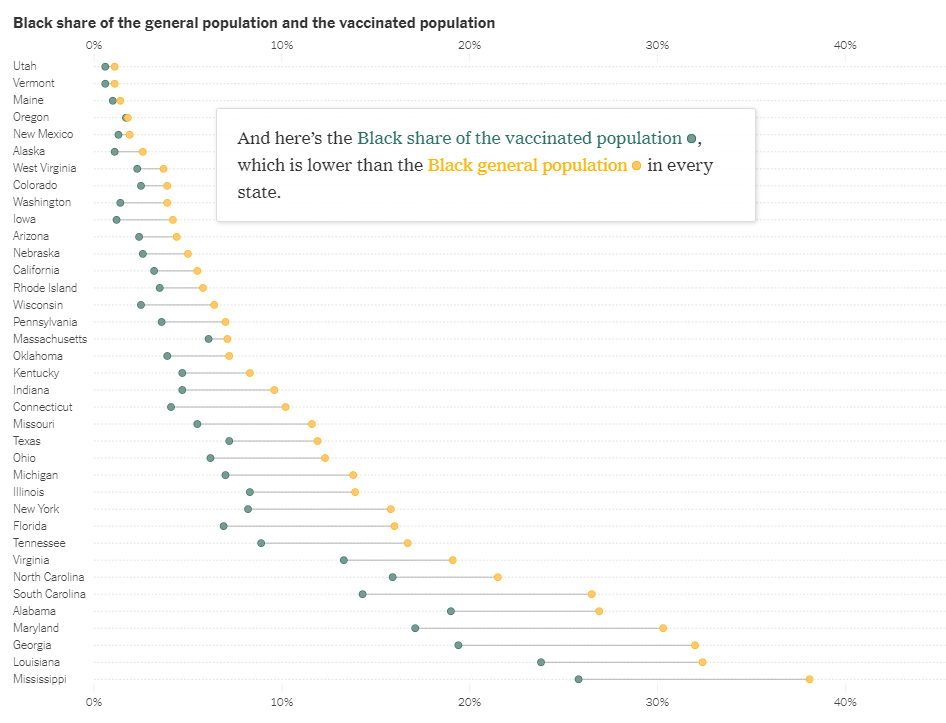
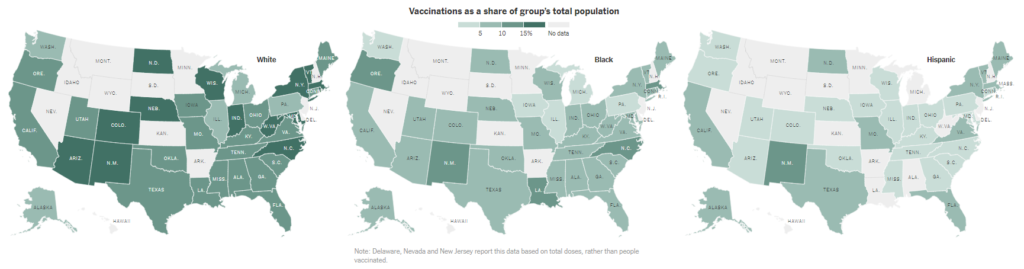
As of March 3, 38 states publicly shared race and ethnicity data for vaccinated people. The jurisdictions define race and ethnicity categories in slightly different ways, and with different levels of completeness — in some states as much as a third of vaccinations are missing race and ethnicity data.

Public health experts have said that despite these data limitations, the patterns emerging across states are clear.

“People of color are getting vaccinated at rates below their representation of the general population,” Dr. Marcella Nunez-Smith, the chair of President Biden’s coronavirus equity task force, said at a recent forum on the vaccine. “This narrative can be changed. It must be changed.”

Author(s): Amy Schoenfeld Walker, Anjali Singhvi, Josh Holder, Robert Gebeloff, Yuriria Avila

Publication Date: 5 March 2021

Publication Site: New York Times

People With Dementia Are Twice As Likely To Get Covid-19 And Four Times More Likely To Die From It

Link: https://www.forbes.com/sites/mishagajewski/2021/02/09/people-with-dementia-are-twice-as-likely-to-get-covid-19-and-four-times-more-likely-to-die-from-it/

Graphic:

Excerpt:

Patients with dementia are at higher risk for Covid-19 and are more likely to have worse outcomes, according to a new study published today.

The study, led by Case Western Reserve University researchers, reviewed electronic health records of 61.9 million adults in the United States and found that the risk for contracting Covid-19 was twice as high for people with dementia compared to the general population.

The risk was even greater still for African Americans with dementia, who were found to be close to three times as likely to be infected with Covid-19.

….

The study, which was published in the journal Alzheimer’s & Dementia: The Journal of the Alzheimer’s Association, also found that certain types of dementia had a greater risk than others.

Author(s): Misha Gajewski

Publication Date: 9 February 2021

Publication Site: Forbes

Covid-19 Isn’t the Only Thing Shortening American Lives

Link: https://www.bloomberg.com/opinion/articles/2021-02-23/covid-19-isn-t-the-only-thing-shortening-american-lives

Graphic:

Excerpt:

The 2020 life expectancy numbers also underscore longer-term health challenges that were already alarming. For two to three decades, life expectancy has been improving much more rapidly for higher earners than for lower earners, and 2020 has probably made these gaps worse. The one bright spot in the differential trends before the pandemic had been a narrowing of racial differences. These new estimates show a dramatic reversal of that hopeful pattern. From the early 1990s to 2016, the racial gap in life expectancy for males at birth shrunk from more than 8 years to about 4.5. During the first half of 2020, it widened to more than 7 years.

…..

On the contrary, 2020 mortality data indicate that death rates from non-Covid causes rose, despite the economic recession. More Americans than expected died from diabetes, high blood pressure and pneumonia. Some of these deaths may have been misreported, and actually caused by Covid. But a large number may also reflect the challenges in providing non-Covid health care during the past year, as people have avoided hospitals, and government mandates have restricted discretionary medical procedures. The pandemic will provide hard lessons on which types of medical care truly improve health, and which ones can be safely skipped or delayed.

Author(s): Peter R. Orszag

Publication Date: 23 February 2021

Publication Site: Bloomberg

Only One U.S. State Has Vaccinated 10% of Its Black Population: Covid-19 Tracker

Link: https://www.bloomberg.com/graphics/covid-vaccine-tracker-global-distribution/us-vaccine-demographics.html

Graphic:

Excerpt:

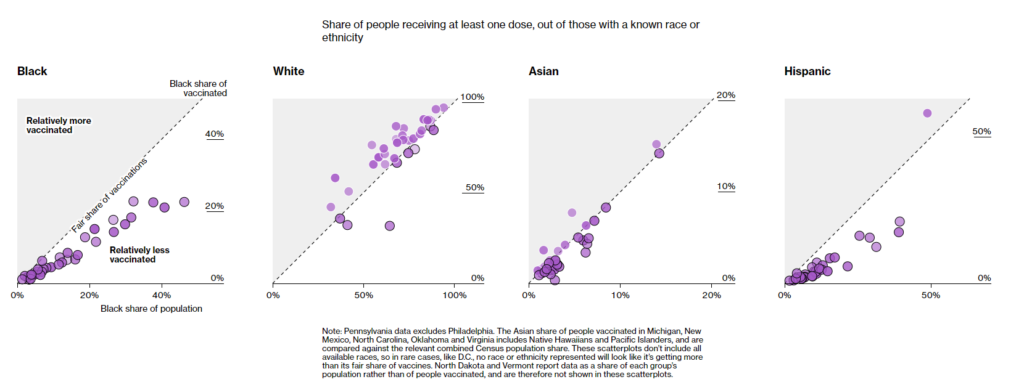
Some of the disparities are a result of who has approval to get shots so far. The elderly are more likely to be White, while the Hispanic population skews young and is less likely to work in hospitals and nursing care, groups targeted in the earliest phases of vaccine distribution.

Other disparities are a result of lower uptake rates among certain groups. Some health-care settings have reported that it’s taking longer to build up trust with communities of color, particularly Black people, who are wary of a medical establishment that for centuries has ignored and mistreated them. Anti-vaxx misinformation campaigns are targeting the already hesitant, including women and Black people. In addition, those with fewer resources may not be able to navigate the notoriously buggy and overloaded online sign-up systems. Meanwhile, others with connections, time, and money can snap up open slots.

Publication Date: 24 February 2021 (last updated)

Publication Site: Bloomberg

NAIC Reveals 5 Regulatory Priorities for 2021

Link: https://insurance-forums.com/health/long-term-care/naic-reveals-5-regulatory-priorities-for-2021/

Excerpt:

Race & Insurance — The insurance regulatory system, and insurance in general, reflects the society it protects. Through our special committee on race and insurance we will continue to ensure the availability and affordability of insurance products for persons of color and historically underrepresented groups and promote diversity and inclusion within our sector.

Climate Risk & Resiliency — The NAIC is committed to working with state, federal and international stakeholders to coordinate climate-related risk and resiliency assessments, disclosures, and evaluation initiatives so that each state has the information, policies, and tools that promote resiliency and ensure stable insurance markets for its citizens.

Author(s): Insurance Forums Staff

Publication Date: 17 February 2021

Publication Site: Insurance Forums

Black Health in America: Exploring Racial Disparities in COVID-19 Vaccination Data

Link: https://blog.d4bl.org/racial-disparities-in-covid19-vaccination-data/

Graphic:

Excerpt:

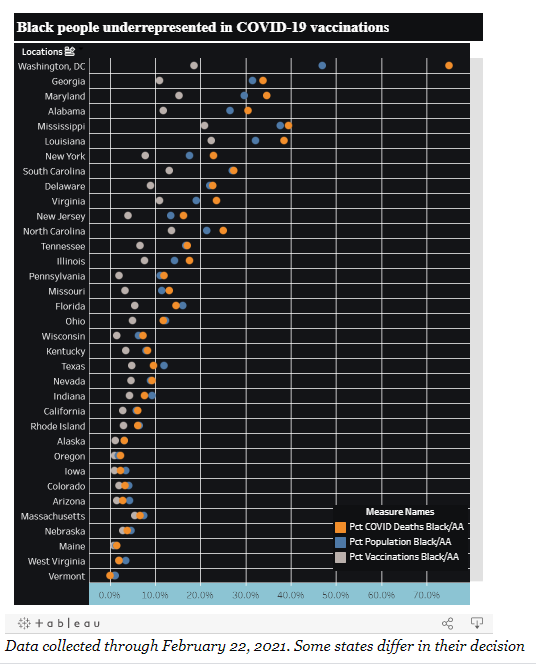
Below is a chart containing data from a number of states and Washington, D.C. to help visualize the gap between how many Black people are dying from COVID-19 and how many are receiving the vaccine. U.S. states and the percentages of Black people are respectively on the y- and x-axes. For each location, there are 3 data points:

Percent of State’s Black Population (Pct Population Black/AA): How many residents of the state identify as Black/African-American. Displayed as the blue dot.

Percent of State’s Vaccinated Population that are Black (Pct Vaccinations Black/AA): How many residents of the state have received at least one vaccine dose and identify as Black/African-American. Displayed as the gray dot.

Percent of State’s COVID-19 Deaths that are Black (Pct COVID Deaths Black/AA): How many residents of the state who died from COVID-19 identified as Black/African-American. Displayed as the orange dot.

Author(s): Paul Watkins

Publication Date: 25 February 2021

Publication Site: Data for Black Lives Blog

Banks Snub Chicago Aldermen On Equitable Mortgage Lending

Link: https://www.wbez.org/stories/banks-snub-chicago-aldermen-on-equitable-mortgage-lending/f470444a-42e1-478c-997e-db8dfe52229f

Excerpt:

Home ownership rates in Chicago’s Black and Latino communities have been falling, according to information presented by Anthony Simpkins, president and CEO of Neighborhood Housing Services of Chicago.

Citing research by the DePaul Institute for Housing, Simpkins said not only are banks lending less in Black and Latino neighborhoods, they are also filing more foreclosures.

And he said borrowers of color who are able to get a loan are often charged a higher interest rate; in 2019 he said Woodstock Institute found nearly 35% of African American mortgage borrowers in Chicago paid higher rates, 17% of Latino borrowers.

Author(s): Linda Lutton

Publication Date: 27 February 2021

Publication Site: WBEZ

Covid-19 Vaccine ‘Passports’ Raise Ethics Concerns, Logistical Hurdles

Link: https://www.wsj.com/articles/covid-19-vaccine-passports-raise-ethics-concerns-logistical-hurdles-11614335403

Excerpt:

In Israel, a vaccine passport was launched last week allowing those who are inoculated to go to hotels and gyms. Saudi Arabia now issues an app-based health passport for those inoculated, while Iceland’s government is doling out vaccine passports to facilitate foreign travel. Last month, President Biden issued executive orders asking government agencies to assess the feasibility of creating digital Covid-19 vaccination certificates.

Proponents of the plans say they will enable battered economies to reopen, even as vaccines are still being rolled out, allowing people to enjoy leisure activities and go to work safe in the knowledge they aren’t harming others or at risk themselves. It could also act as an incentive for people to get the shot.

The concept is potentially fraught with pitfalls. It could discriminate against minority communities, who are less likely to accept the vaccines, according to national surveys, or young people, who are less likely to be given priority to receive them.There are questions about the ethics of granting businesses access to peoples’ health records.

Author(s): Max Colchester, Felicia Schwartz

Publication Date: 26 February 2021

Publication Site: Wall Street Journal

‘Just not equal at all’: Vaccine rollout in Chicago a microcosm of racial disparities nationwide

Link: https://www.usatoday.com/in-depth/news/health/2021/02/12/data-analysis-chicago-vaccine-rollout-reflects-us-racial-disparities/4418978001/#new_tab

Graphic:

Excerpt:

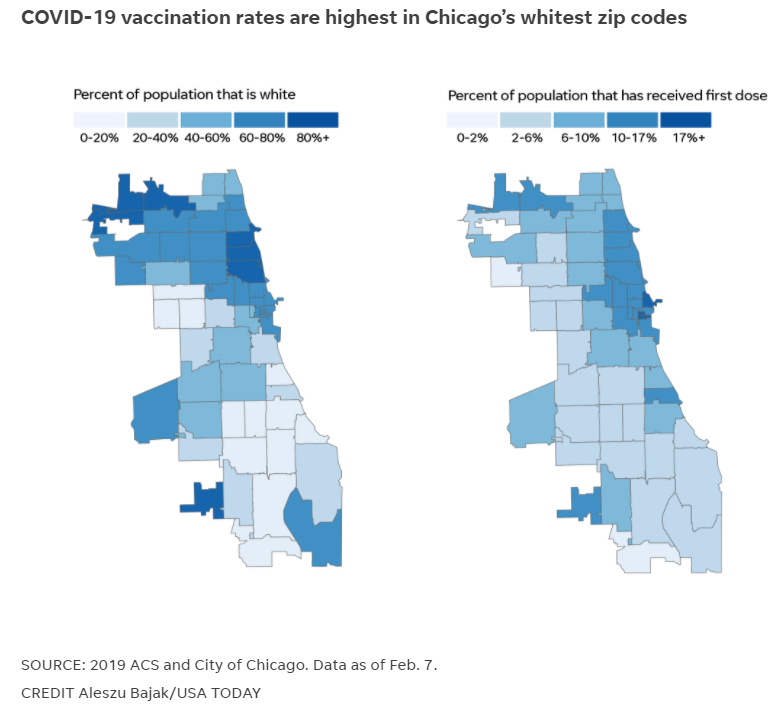
It’s possible some majority-white ZIP codes have higher rates of vaccination in part because they have higher concentrations of people in groups prioritized for the first round of vaccines.

Experts said the findings reflect festering systemic problems, including poor health care access and distrust of vaccines, colliding amid a chaotic rollout that failed to ensure equal access to communities of color.

Author(s): Nada Hassanein, Grace Hauck, Jayme Fraser, Aleszu Bajak, USA TODAY

Publication Date: 15 February 2021

Publication Site: USA Today

The Latino Health Paradox Goes Beyond U.S. Borders

Link: https://www.usnews.com/news/healthiest-communities/articles/2020-02-12/hispanic-paradox-in-health-extends-beyond-us-borders

Graphic:

Excerpt:

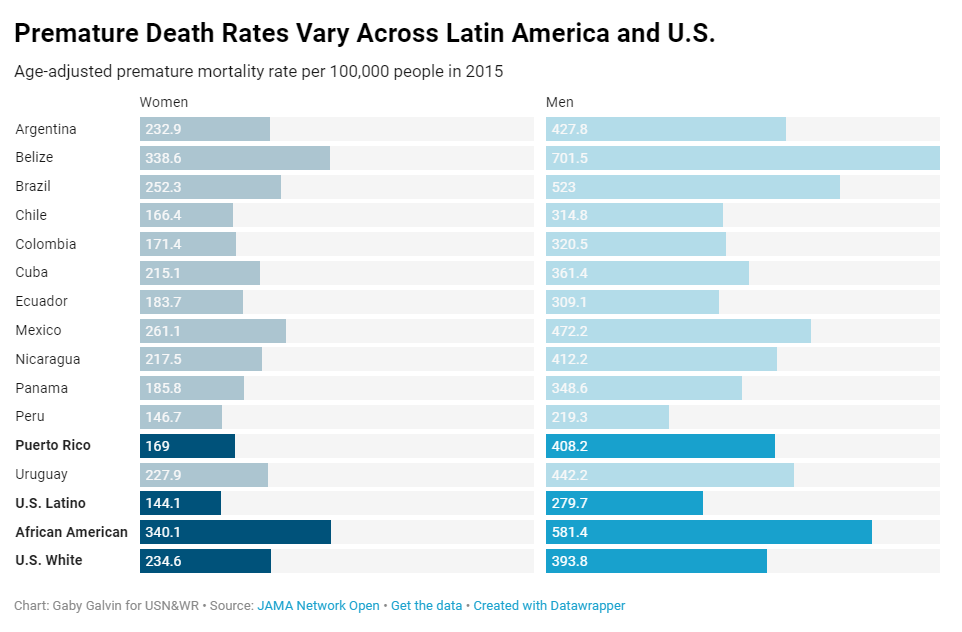
LATIN AMERICANS ARE less likely to die prematurely than non-Hispanic whites in the U.S. – whether they live in the country or not, a new study suggests.

Researchers have long theorized that a longer life expectancy among Latinos in the U.S. – despite often facing socioeconomic disadvantages – could be driven in part by a “healthy immigrant effect,” meaning healthier people may be more likely to immigrate to the U.S. than those in poorer health. But the new study, published Wednesday in JAMA Network Open, suggests “there may be a broader Latin American paradox” that extends far beyond U.S. borders.

Author(s): Gaby Galvin

Publication Date: 12 February 2021

Publication Site: U.S. News & World Report

American Indians and Alaska Natives are dying of COVID-19 at shocking rates

Graphic:

Excerpt:

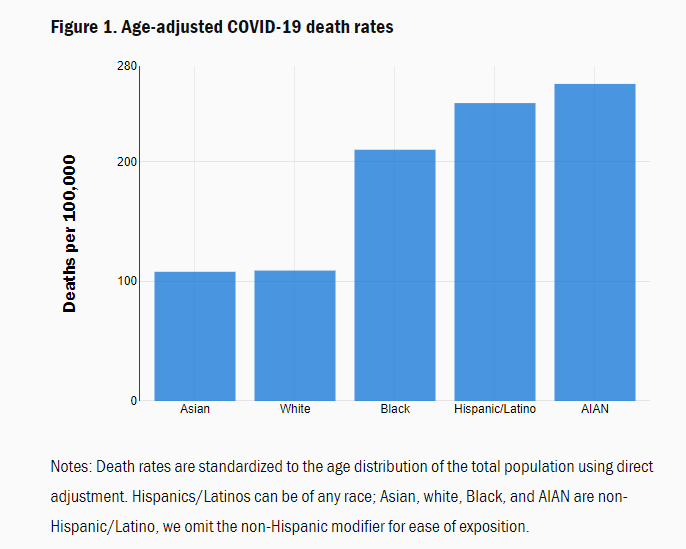
According to Centers for Disease Control (CDC) data, the age-adjusted COVID-19 mortality rate is now higher for AIAN people than for any other group (Figure 1); it is almost two and a half times the death rate for whites and Asians.[2] Figure 1 also shows that the disparities for Blacks and Hispanics/Latinos relative to whites, that we identified in June, remain substantial.[3] (That post also explains why it is important to adjust for age when comparing across groups.)

Author(s): Randall Akee and Sarah Reber

Publication Date: 18 February 2021

Publication Site: Brookings