Why a COVID Skeptic Finally Took the Vaccine

Link: https://slate.com/human-interest/2021/02/vaccine-skeptic-covid-latinos-california.html

Excerpt:

When a vaccine became available, did your dad immediately want it?

Oh, no, of course not. He was still conspiracy minded, and even to this day. But when the vaccine starts, they’re saying it’s going to be for people over 65, and my sisters said that we’ve got to get our dad to get the vaccine. We told my dad, and that’s when he started saying, I don’t need it, they’re saying that’s going to kill you, they’re saying there’s a chip. I don’t need it. I have strong blood and a positive outlook on life and insurance.

Plus, the vaccine is a vaccine of privilege. Let’s clear about that, especially the way it’s rolling out in California. You have to do it online. For weeks, there was only English, no Spanish translation. If you’re 65 and older, and especially if you’re an immigrant, more likely than not you’re not going to be the most social media–fluent of people. So not only do you need somebody you can rely on to translate any internet stuff for you, but you also need someone who’s going to have a job that allows them to be on social media nonstop. It was the luck of the draw that my sister randomly saw a friend who told her about this Instagram post with vaccine info. So she was able to do it immediately.

Author(s): Mary Harris

Publication Date: 16 February 2021

Publication Site: Slate
How a Black bioethicist makes the case for vaccination to people of color

Link: https://www.vox.com/future-perfect/2021/2/16/22266517/covid-19-moral-obligation-get-vaccinated

Excerpt:

And in the Black community, if we’re just thinking about ourselves, I do think there’s some obligation there to not infect fellow members of your Black population. Black people on average tend to have housing situations with more people, so there’s more chance for more infection. Black people are more likely to be essential workers, working in grocery stores and places where they’re interacting. If they’re not vaccinating themselves, they have an effect on the Black community that they come into contact with daily.

Even if you can’t think about your moral obligation to the general public because of what medicine has done to Black people in the past and currently, I would encourage you to think about what not being vaccinated means for your family, your friends, your community.

Author(s): Sigal Samuel

Publication Date: 16 February 2021

Publication Site: Vox

Monetary Policy and Racial Inequality

Graphic:

Excerpt:

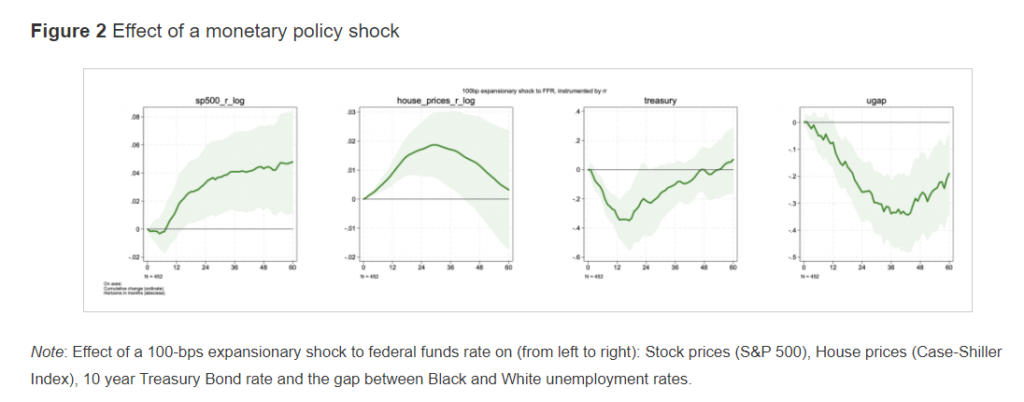
The gap between the income and wealth of black and white households in the US is large and persistent. According to the 2019 Survey of Consumer Finances (SCF), the median wealth of a white household is almost nine times higher than that of a black household. The income gap is smaller (1.7 times) but still large.  Moreover, these gaps are as large as they were 50 years ago (Kuhn et al. 2020).  Concern about racial inequality has increased recently with evidence that the COVID-19 pandemic is having a disproportionate effect on the black community (Bertocchi and Dimico 2020). These stark facts have attracted the attention of economists (e.g. Mayhew and Wills 2020, Chetty et al. 2018) and policymakers. For instance, Raphael Bostic, president of the Federal Reserve Bank of Atlanta, recently stated that the Federal Reserve “can play an important role in helping to reduce racial inequities and bring about a more inclusive economy”.1

A prominent line of thinking is that an accommodative monetary policy lowers unemployment rates and increases labour income for marginal workers, who are oftentimes low-income and minority households. This is what Coibion et al. (2014) call the earnings channel of monetary policy.  More specifically, Carpenter and Rodgers (2004) show that a monetary policy accommodation reduces the gap between the unemployment rates of black and white households.

Author(s): By Alina Kristin Bartscher, PhD candidate, University of Bonn, Moritz Kuhn, Professor at the Department of Economics, University of Bon, Moritz Schularick, Professor of Economics, University of Bonn, CEPR Research Fellow, Member of the Academy of Sciences of Berlin-Brandenburg and Paul Wachtel, Professor of Economics, New York University Stern School of Business. Originally published at VoxEU

Publication Date: 10 February 2021

Publication Site: naked capitalism

L.A. Tries to Combat Racial Inequities of COVID Inoculations

Link: https://www.governing.com/community/LA-Tries-to-Combat-Racial-Inequities-of-COVID-Inoculations.html

Excerpt:

As stark disparities emerge in vaccination rates, L.A. County officials are jump-starting efforts to improve access for people of color. Strategies include creating more vaccination sites as well as better public messaging campaigns, improving access to transportation and reserving spots at neighborhood vaccination locations before people from other parts of the county can scoop them up.

“We have a lot of work to do to fix this,” L.A. County public health director Barbara Ferrer said Tuesday at a county Board of Supervisors meeting. “However way you cut this data, it’s clear that in some of our hardest-hit communities, there are populations that are not getting vaccinated at the same rate as other groups.”

On Tuesday morning, Darby stood in line yet again, this time at a vaccination blitz in South Park aimed at administering doses to 800 seniors, particularly Blacks and Latinos, as well as healthcare workers in four days. Though there are historical and cultural issues that may make Black residents skeptical of vaccines, the biggest issue in L.A. County thus far has been access, said Councilman Curren Price, who helped plan the event.

Author(s): RUBEN VIVES, JACLYN COSGROVE AND SOUMYA KARLAMANGLA, LOS ANGELES TIMES

Publication Date: 10 February 2021

Publication Site: Governing

AI, Privacy, Racial Bias Among State Insurance Regulator Priorities for 2021

Link: https://www.carriermanagement.com/news/2021/02/10/216927.htm

Excerpt:

The NAIC 2021 priorities and the charges to its key committees are (in no specific order):

COVID-19 — In 2021, the NAIC will continue its “Priority One” initiative designed to support state insurance departments in their response to the ongoing pandemic and its impact on consumers and insurance markets. NAIC has a COVID resource page that includes information on actions taken by individual states in response to the COVID 19 pandemic that impact various lines of insurance. NAIC said insurance regulators will continue to analyze data and develop the tools so that consumer protection keeps pace with changes brought on by the virus.

Big Data/Artificial Intelligence — The Big Data and Artificial Intelligence Working Group is chaired by Doug Ommen, Iowa, joined by Elizabeth Kelleher Dwyer, co-vice chair, Rhode Island and Mark Afable, co-vice chair, Wisconsin.

…..

Race & Insurance — The Special Committee on Race and Insurance is co-chaired by Maine Superintendent Eric Cioppa and New York Executive Deputy Superintendent of Insurance My Chi To.

The 2021 agenda for this panel calls for research into the level of diversity and inclusion within the insurance sector; engagement with a broad group of stakeholders on issues related to race, diversity and inclusion in, and access to, the insurance sector and insurance products; and an examination of current practices or barriers in the insurance sector that potentially disadvantage people of color and historically underrepresented groups.

Publication Date: 10 February 2021

Publication Site: Carrier Management

CDC: Black people make up just 5% of those vaccinated against COVID-19

Link: https://www.upi.com/Health_News/2021/02/01/CDC-Black-people-make-up-just-5-of-those-vaccinated-against-COVID-19/7121612203443/

Excerpt:

White people received more than half of all vaccinations against COVID-19 during the first month of the rollout, according to data released Monday by the U.S. Centers for Disease Control and Prevention.

Just over 5% of the nearly 13 million people who received the shot between Dec. 14 and Jan. 14 people vaccinated against the coronavirus in the U.S. so far have been Black, and just under 12% were Hispanic, the data shows.

Author: Brian P. Dunleavy

Publication Date: 1 February 2021

Publication Site: UPI

Mortality with Meep: Pennsylvania, Illinois, Ohio, Georgia, North Carolina, and Michigan by Race/Ethnicity and Week

Link: https://marypatcampbell.substack.com/p/mortality-with-meep-pennsylvania

Excerpt:

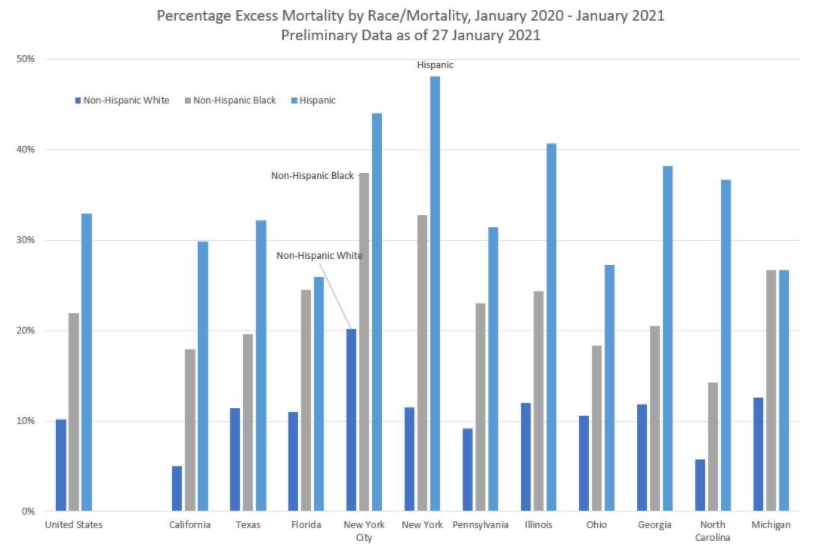
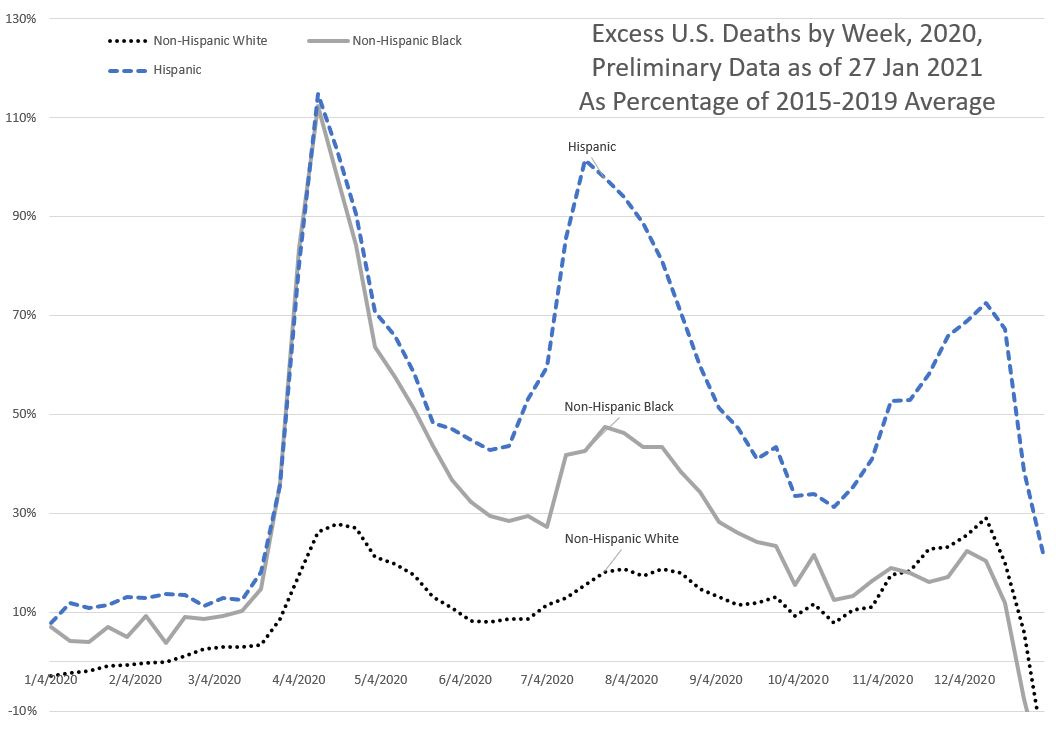
Overall, excess mortality (in a relative sense) for Hispanics is about three times than that seen by non-Hispanic Whites, and non-Hispanic Blacks have excess mortality about twice that of non-Hispanic Whites.

Note that New York City by itself has a very large amount of excess mortality. You can see why New York, as an area, reacted very drastically last year. When I saw the mortality spike coming from the city last year, I was just fine staying at home… because I could. The trade-offs have been relatively easy for me to see.

But it hasn’t been quite so extreme elsewhere.

Graph:

Author: Mary Pat Campbell

Publication Date: 1 February 2021

Publication Site: STUMP

Mortality with Meep: Excess Mortality in California, Texas, and Florida by Race/Ethnicity

Link: https://marypatcampbell.substack.com/p/mortality-with-meep-excess-mortality-8e2

Excerpt:

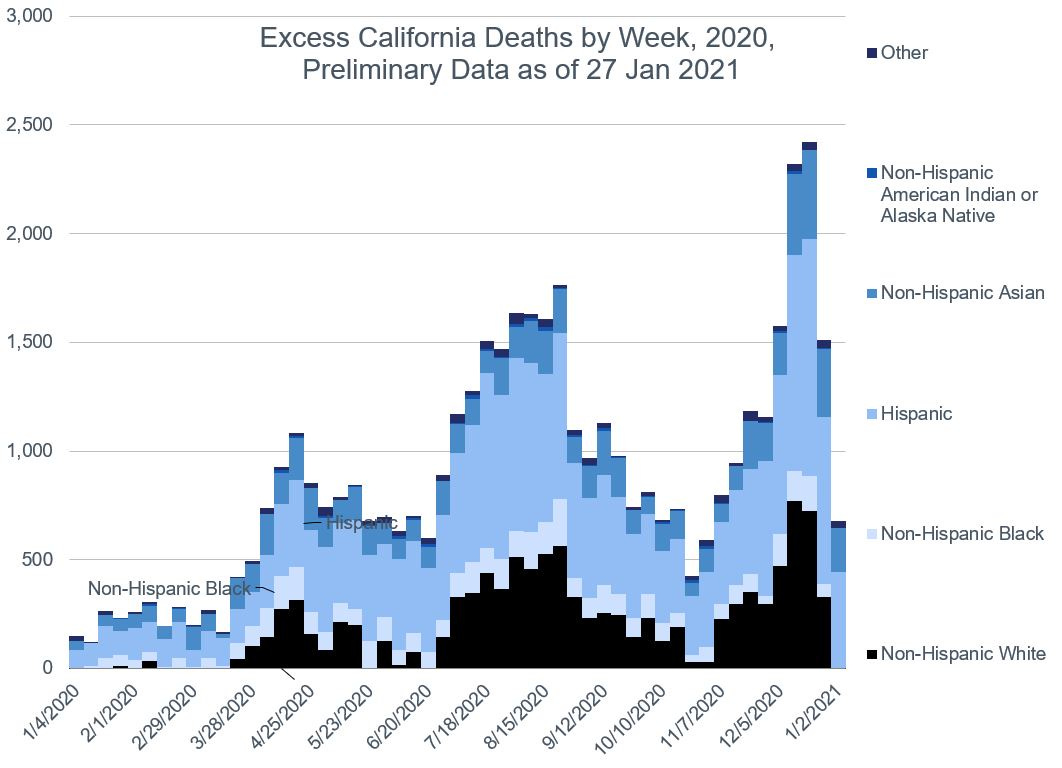
For Hispanics, it’s two thirds, with most of it coming from California (23%), then Texas (21%), then Florida (10%). New York City accounts for 9%, and then the rest of New York state for 3%.

UPDATE: Checking out the Hispanic population by state, these percentages are a little in line with national distribution — California (26% of U.S. Hispanic population), Texas (19%), Florida (9%), New York (including NYC — 6%). The most disproportionate effect comes from New York City.

Graph:

Author: Mary Pat Campbell

Publication Date: 31 January 2021

Publication Site: STUMP

Mortality with Meep: Excess Mortality in New York and New York City

Link: https://marypatcampbell.substack.com/p/mortality-with-meep-excess-mortality

Excerpt:

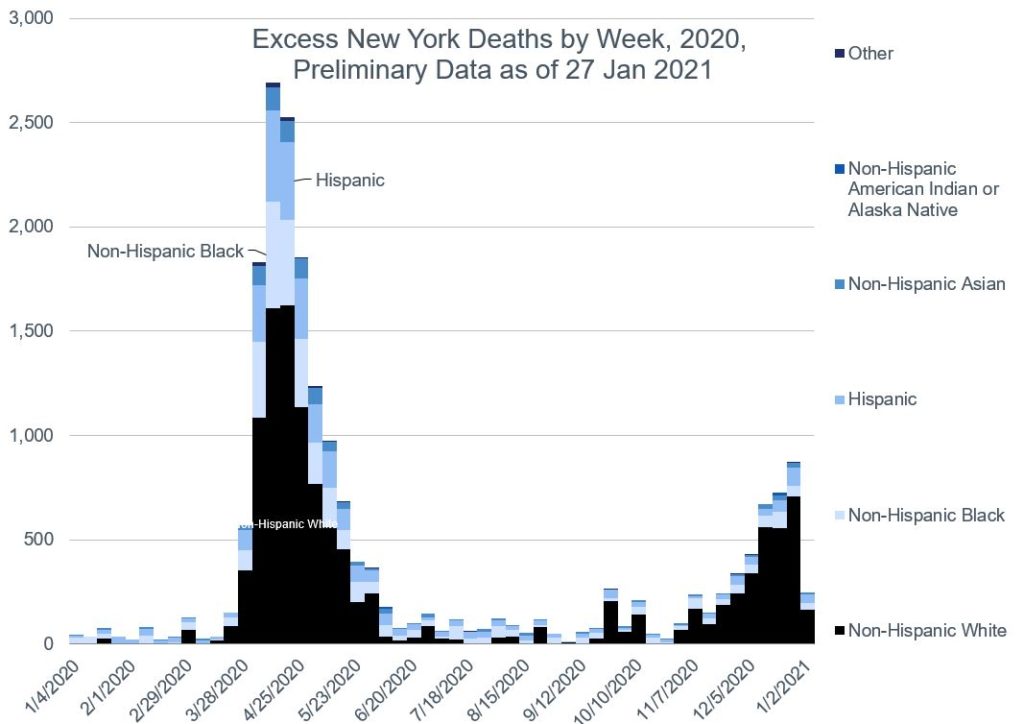
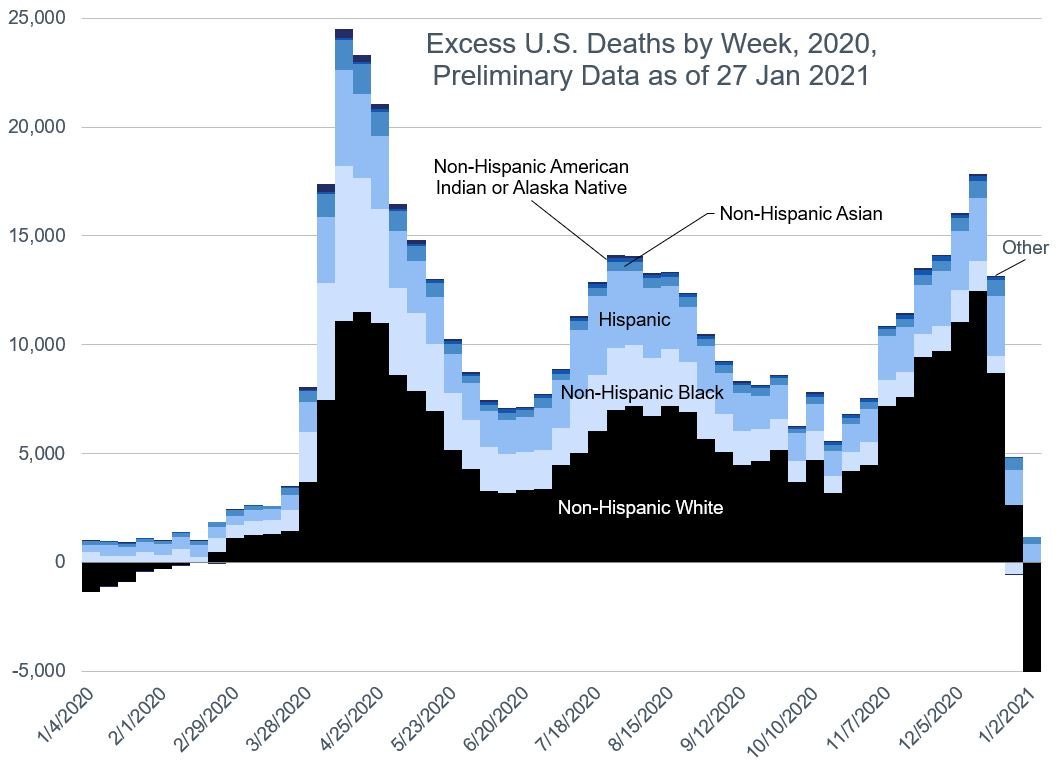
For the data I have as of 27 January 2021, NYC mortality provides 9% of excess mortality for non-Hispanic Black people in the entire U.S. [8,638 excess deaths for Black people in NYC out of total 99,514 excess deaths for Black people in the entire country].

We get the same statistics for Hispanics in NYC: 97,725 excess deaths for the whole country, and 8,608 in NYC alone.

So excess deaths for these two groups have about 9% each coming just from NYC alone.

Graphic:

Author: Mary Pat Campbell

Publication Date: 30 January 2021

Publication Site: STUMP