Graphic:
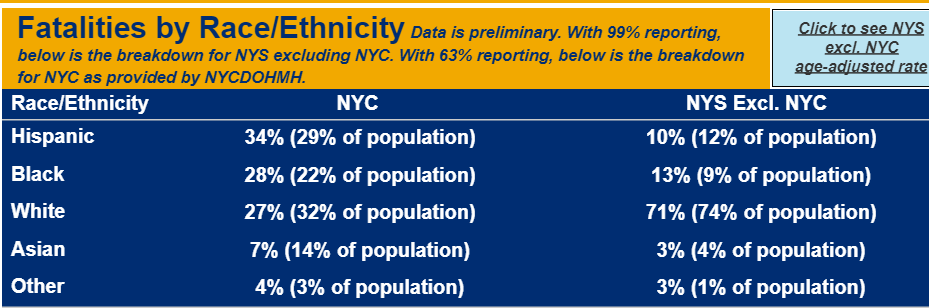
Author(s): New York Department of Health
Date Accessed: 21 February 2021
Publication Site: New York COVID Tracker
All about risk
Graphic:
Author(s): New York Department of Health
Date Accessed: 21 February 2021
Publication Site: New York COVID Tracker
Link: https://robjhyndman.com/publications/us-longevity/
Graphic:
Abstract:
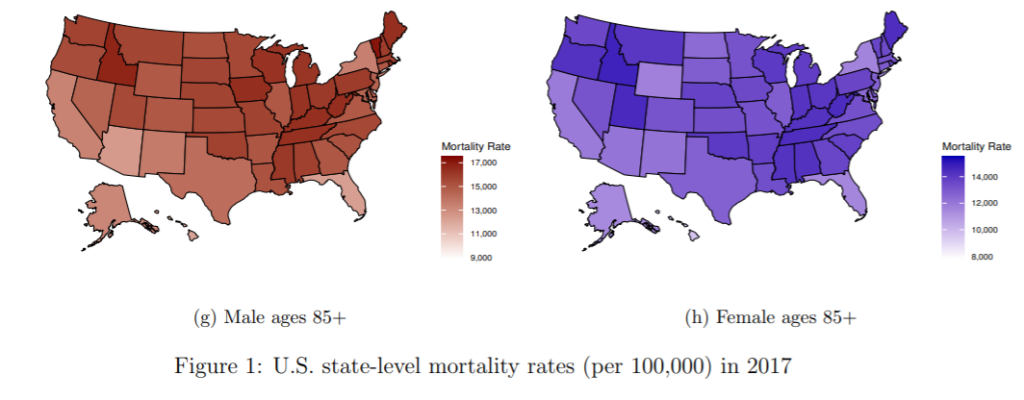
This paper investigates mortality inequality across U.S. states by modelling and forecasting mortality rates via a forecast reconciliation approach. Understanding the heterogeneity in state-level mortality experience is of fundamental importance, as it can assist decision-making for policy makers, health authorities, as well as local communities who are seeking to reduce inequalities and disparities in life expectancy. A key challenge of multi-population mortality modeling is high dimensionality, and the resulting complex dependence structures across sub-populations. Moreover, when projecting future mortality rates, it is important to ensure that the state-level forecasts are coherent with the national-level forecasts. We address these issues by first obtaining independent state-level forecasts based on classical stochastic mortality models, and then incorporating the dependence structure in the forecast reconciliation process. Both traditional bottom-up reconciliation and the cutting-edge trace minimization reconciliation methods are considered. Based on the U.S. total mortality data for the period 1969–2017, we project the 10-year-ahead mortality rates at both national-level and state-level up to 2027. We find that the geographical inequality in the longevity levels is likely to continue in the future, and the mortality improvement rates will tend to slow down in the coming decades.
Additional link: https://robjhyndman.com/papers/uslongevity.pdf
Author(s): Han Li, Rob J Hyndman
Publication Date: 14 February 2021
Publication Site: Rob J Hyndman’s personal site
Graphic:
Excerpt:
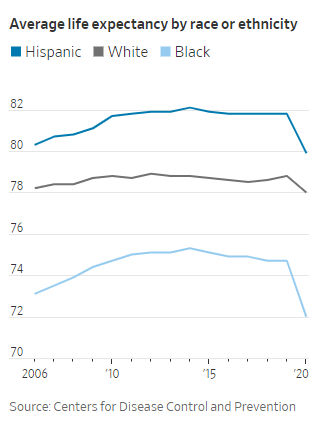
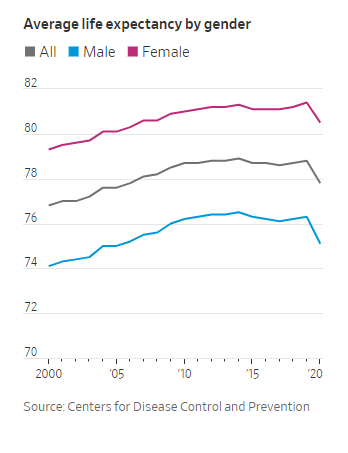
U.S. life expectancy declined by a year during the first half of 2020, according to federal figures released Thursday that show the deadly impact of the coronavirus pandemic’s early months.
The Centers for Disease Control and Prevention’s National Center for Health Statistics said life expectancy at birth was 77.8 years as of the end of June based on provisional estimates. The one-year decline from the previous year was the largest drop since World War II, when life expectancy fell 2.9 years between 1942 and 1943. It put life expectancy at its lowest level in the U.S. since 2006.
“It’s very concerning when we see mortality increase to such a degree,” said Elizabeth Arias, a health scientist at the center and a co-author of the report. “It gives you a clear picture of the magnitude of the effect of the Covid pandemic.”
Author(s): Janet Adamy
Publication Date: 18 February 2021
Publication Site: Wall Street Journal
Link: https://nypost.com/2021/02/11/study-smaller-cars-may-be-why-crashes-injure-women-more/
Excerpt:
The smaller, lighter vehicles that women more often drive and the types of crashes they get into, may explain why they are much more likely to suffer a serious injury in a collision than men, a new study published Thursday found.
Researchers from the Insurance Institute for Highway Safety, a research group supported by auto insurers, looked into whether there was some sort of gender bias in the research into vehicle crashes or whether body type had anything to do with the injuries.
Author(s): Associated Press
Publication Date: 11 February 2021
Publication Site: NY Pose
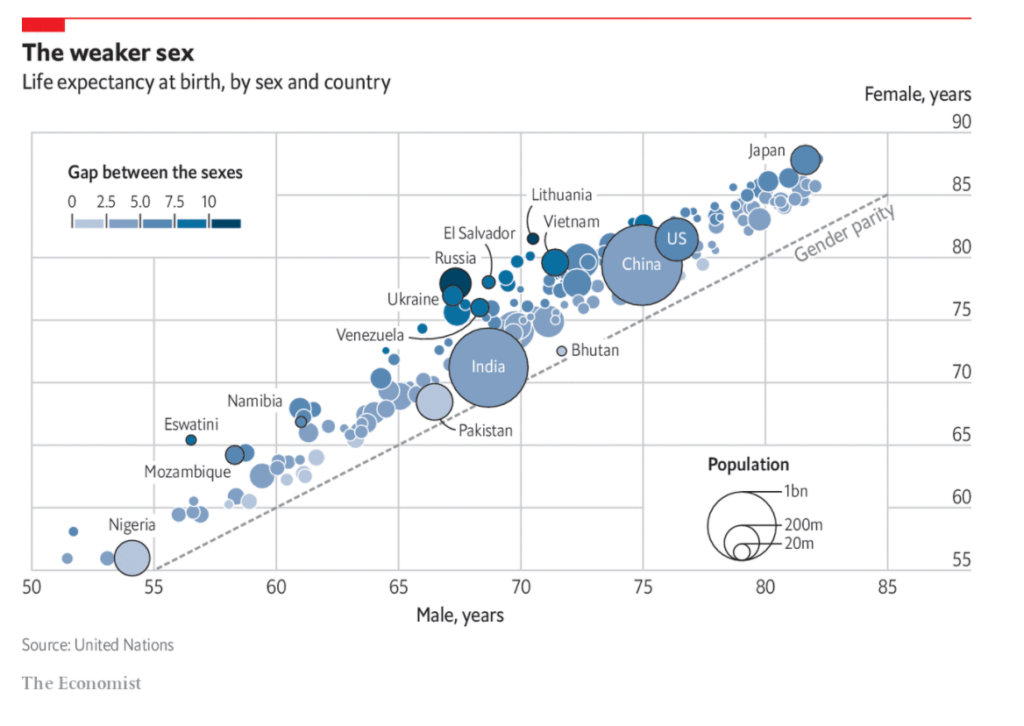
Graph:
Excerpt:
MEN ARE around 1.7 times more likely than women to die from covid-19, according to a recent paper by researchers at Yale University, published in Science. Men older than 30 have a significantly greater mortality risk. That is striking, but perhaps should not come as a surprise. Human lifespans have climbed steadily in recent decades, but wide disparities remain between women and men (see chart). Globally women live nearly five years longer than men, up from three years in 1950. The reasons for that gap are both biological and environmental, and help to explain why more men are dying from covid-19.
Publication Date: $ February 2021
Publication Site: The Economist