Two Years In, Golden Gate Bridge Suicide Prevention Nets Have Almost Completely Eliminated Bridge Suicides

Link: https://sfist.com/2026/01/20/two-years-in-golden-gate-bridge-suicide-prevention-nets-have-almost-completely-eliminated-bridge-suicides/

Excerpt:

In their second year since completion, the Golden Gate Bridge suicide prevention barriers allowed only four suicides in the first half of 2025. In the second half of 2025, the bridge saw zero suicides.

For decades, it was an irresistable magnet for those at the end of their ropes. There was an average of 30 successful suicide attempts each year from people jumping off the Golden Gate Bridge, and an estimated 2,000 such deaths since the bridge opened in 1937.

Back in 2014, the Golden Gate Bridge, Highway and Transportation District approved installing suicide prevention nets on the bridge in hopes of ending this dark phenomenon. And while the installation of those suicide nets took years longer than planned and went about $150 million over budget, the barriers were finally completed almost exactly two years ago, and are proving their worth.

We now have our statistical results for 2025, which would be the first full year of the barriers being in place. And the New York Times reports there were only four Golden Gate Bridge suicides in the first half of 2025, and then zero suicides between June and December 2025. The Times adds that “seven months might be the longest stretch without a suicide at the bridge, though early records are sparse.”

We must throw some cold water on this assessment and admit there has reportedly been one successful suicide at the bridge in the first 20 days of 2026. But given this historical average of 40 suicides annually, and only four in the entire year of 2025, the barriers certainly appear to be doing their job.

Author(s): Joe Kukura

Publication Date: 20 Jan 2026

Publication Site: SFist

Losing 40,000 men a year to suicide is a national tragedy

Link: https://ofboysandmen.substack.com/p/losing-40000-men-a-year-to-suicide

Graphic:

Excerpt:

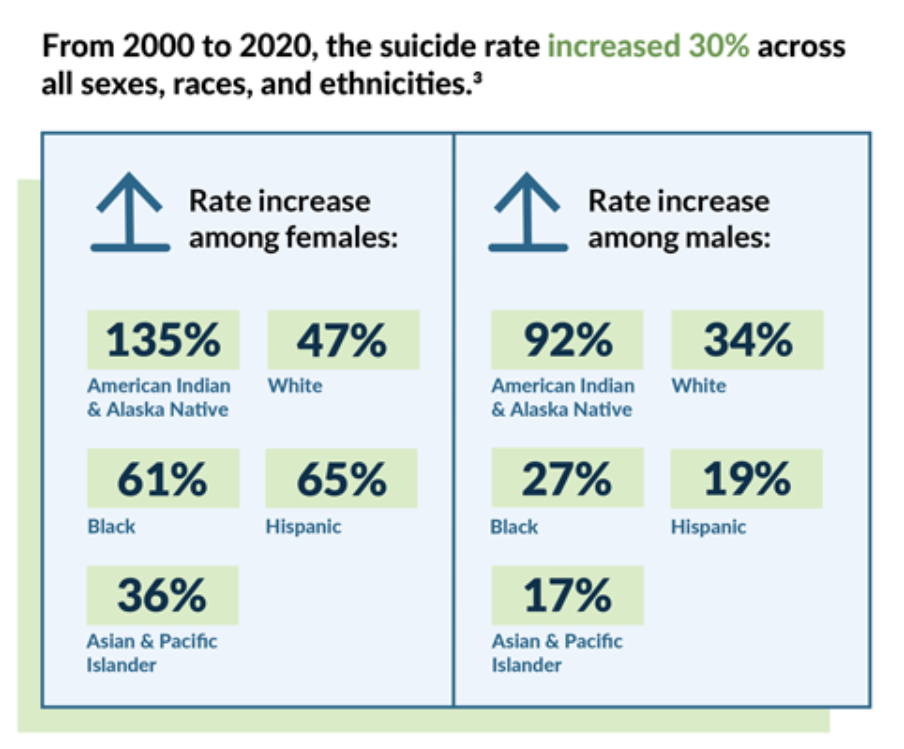
Boys and men account for 80% of the deaths from suicide in the United States. This amounts to almost 40,000 male deaths a year, about the same as the loss of women’s lives from breast cancer.

But the crisis of male suicide is not getting enough attention. I’m still being told by well-informed people that among teens and young adults, the suicide risk is higher for women than men, a dangerous untruth.

There are lots of risk factors for suicide, including being a veteran or living in a a rural area. Native Americans also have a higher risk than other racial groups. But by far the biggest gap of all is the one between women and men:

Author(s): Richard V Reeves

Publication Date: 10 Sept 2025

Publication Site: Of Boys and Men, substack

Guns, Germs, and Drugs Are Largely Responsible for the Decline in U.S. Life Expectancy

Link: https://reason.com/2024/01/08/guns-germs-and-drugs-are-largely-responsible-for-the-decline-in-u-s-life-expectancy/

Graphic:

Excerpt:

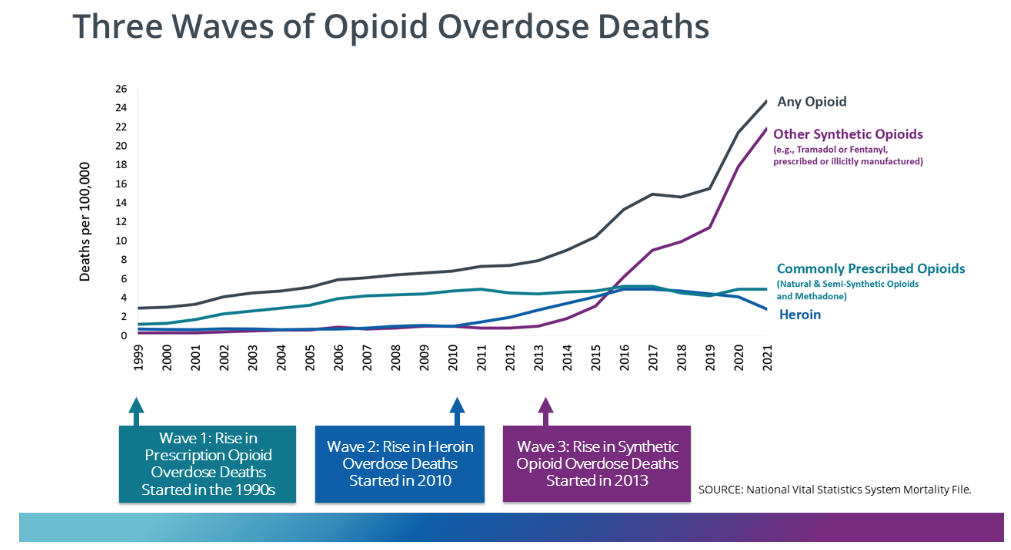
The Post reported that some politicians pointed to the rising death toll from “lethal drug overdoses” as a significant factor in declining U.S. life expectancy. The Post did, however, acknowledge that drug deaths “are not solely responsible for the decline in life expectancy.” It is worth noting that opioid overdose deaths began truly soaring after 2010 when users turned to illicit heroin and fentanyl after the introduction of Food and Drug Administration–approved abuse-deterrent formulations.

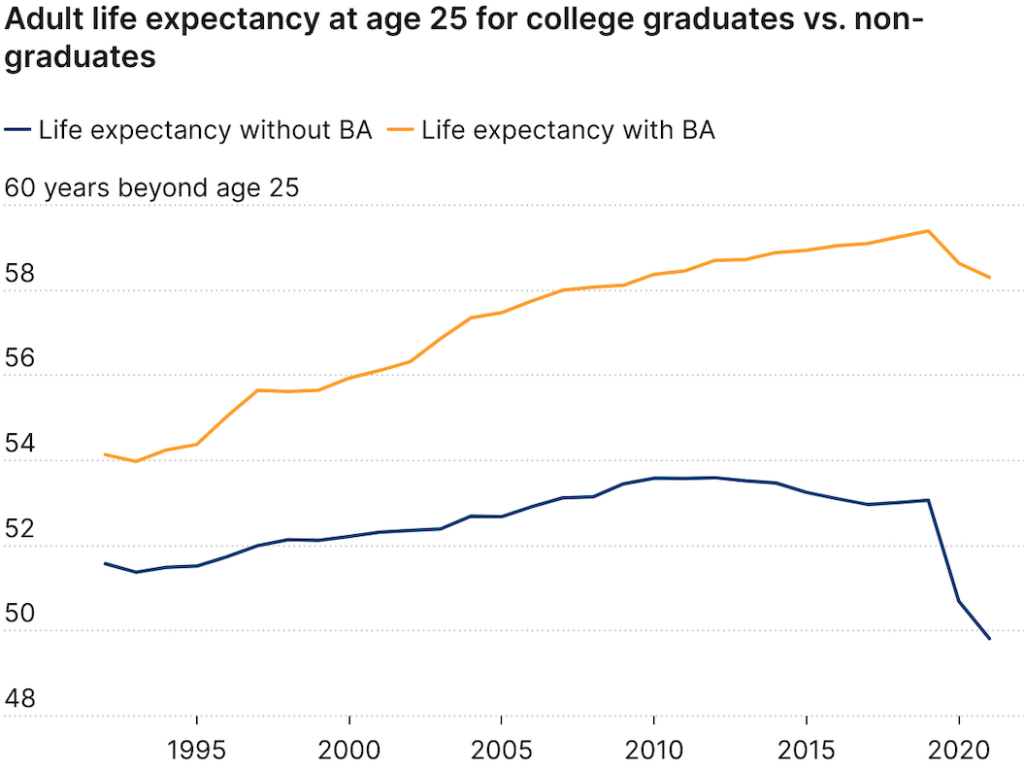
So how much do drug overdose deaths contribute to the recent decline in U.S. life expectancy? A 2021 comprehensive review of factors affecting mortality trends in the U.S. between 1999 and 2018 found that average life expectancy would “have been 0.3 years greater were it not for increases in unintentional drug poisoning.” In a 2023 preprint article, two Johns Hopkins University researchers calculated that opioid overdose deaths between 2019 and 2021 reduced U.S. life expectancy by 0.65 years. If politicians and policy makers really want to make increasing life expectancy a priority, one huge step would be to actually end the war on drugs. A cease-fire in the drug war would likely reduce gun deaths too.

Author(s): Ronald Bailey

Publication Date: 8 Jan 2024

Publication Site: Reason

U.S. Suicide Deaths Rose in 2022, C.D.C. Estimates Say

Link: https://www.nytimes.com/2023/08/11/well/mind/suicide-deaths-2022-cdc.html

Excerpt:

The estimated number of suicide deaths in the United States rose to nearly 50,000 in 2022, according to provisional data released on Thursday from the Centers for Disease Control and Prevention. The total would be an increase of approximately 2.6 percent since 2021.

The C.D.C. estimates the overall number of deaths to be 49,449 but has not yet calculated the suicide rates for 2022. Given that the U.S. population grew by about 0.4 percent in 2022, a 2.6 percent increase in deaths indicates that suicide rates are continuing to rise, although not universally among all groups.

Suicide deaths have fluctuated somewhat over the years and declined in 2019 and 2020. But the overall suicide rate, or the number of suicides per 100,000 people, has increased by about 35 percent over the last two decades. People 65 and older had the highest increase in the number of deaths by suicide in 2022 among the various age groups.

Author(s):Christina Caron

Publication Date: 11 Aug 2023

Publication Site: NY Times

Suicides rose in Japan among young women and girls during pandemic

Link:https://www.japantimes.co.jp/news/2023/06/26/national/female-suicides-increase-pandemic/?utm_source=pianoT5&utm_medium=email&utm_campaign=295&tpcc=take5&pnespid=_uCIiYNau7Ha8vagqxixsvFPuxwV_XNzwhEqAks2oB2VA3_UbhwgFChCladWaMcGiWrj

Excerpt:

Researchers in Japan have found a significant increase in the number of suicides among women and girls between the ages of 10 and 24 during the pandemic, while there was no significant change in the suicide rate for boys and men in the same age group.

The research team analyzed data on suicides by gender across three age groups — 10 to 14, 15 to 19 and 20 to 24 — comparing the number of suicides after July 2020 with the number of suicides before the pandemic began.

According to the health ministry, the number of suicides among women and girls age between 10 and 24 in 2022 was 745, an increase of 233 compared with the 2019 figure. The data also showed that the number of boys and men in that age range who committed suicide was 1,278, an increase of 100 cases from 2019.

The research was led by Nobuyuki Horita from Yokohama City University Hospital and Sho Moriguchi from the Department of Neuroscience at Keio University using data on deaths by suicide from July 2012 to June 2022 provided by the health ministry.

…..

Over the past 10 years, a total of 13,263 young people age 10 to 24 — 9,428 male and 3,835 female — died by suicide.

Author(s): KARIN KANEKO

Publication Date: 26 June 2023

Publication Site: Japan Times

Suicide Mortality in the United States, 2001–2021

Link: https://www.cdc.gov/nchs/products/databriefs/db464.htm

Graphic:

Excerpt:

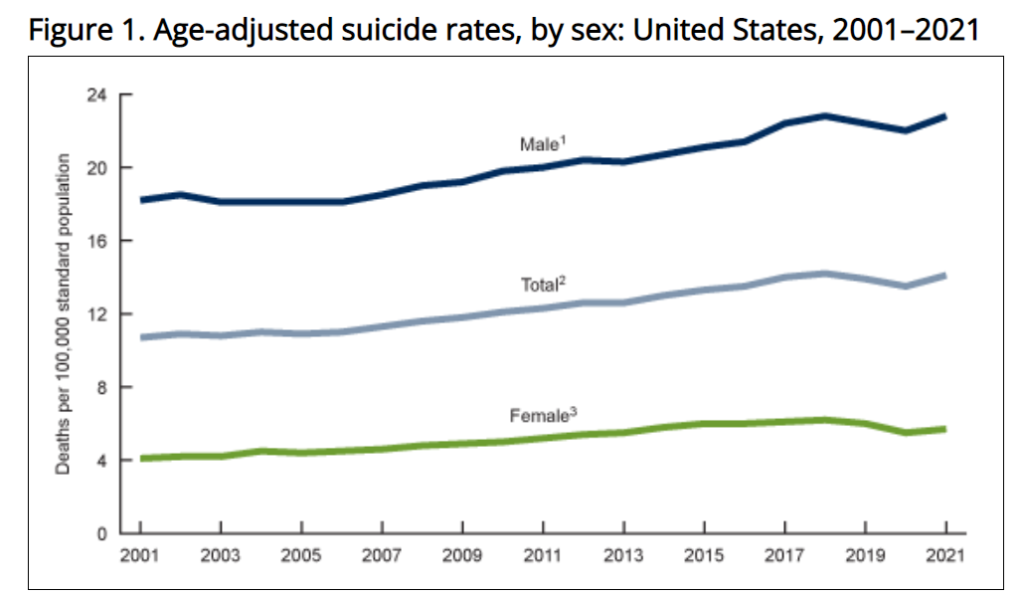
  • The total age-adjusted suicide rate increased from 10.7 deaths per 100,000 standard population in 2001 to a recent peak of 14.2 in 2018, and then declined to 13.5 in 2020. In 2021, the rate increased 4% to 14.1, the largest 1-year increase during the period (Figure 1).
  • The suicide rate for males did not change significantly from 2001 (18.2) through 2006 (18.1), and then increased to 22.8 in 2018. Rates declined in 2019 (22.4) and 2020 (22.0) but then increased 4% in 2021 (22.8).
  • The suicide rate for females increased from 2001 (4.1) through 2015 (6.0) and then did not change significantly through 2018 (6.2). Following a 2-year decline to 5.5 in 2020, the rate increased 4% in 2021 (5.7).
  • The suicide rate for males was three to four and one-half times the rate for females during the 2001–2021 period.

Author(s): Matthew F. Garnett, M.P.H., and Sally C. Curtin, M.A.

Publication Date: April 2023

Publication Site: National Center for Health Statistics, CDC

The Economic Cost of Gun Violence

Link: https://everytownresearch.org/report/the-economic-cost-of-gun-violence/

Graphic:

Excerpt:

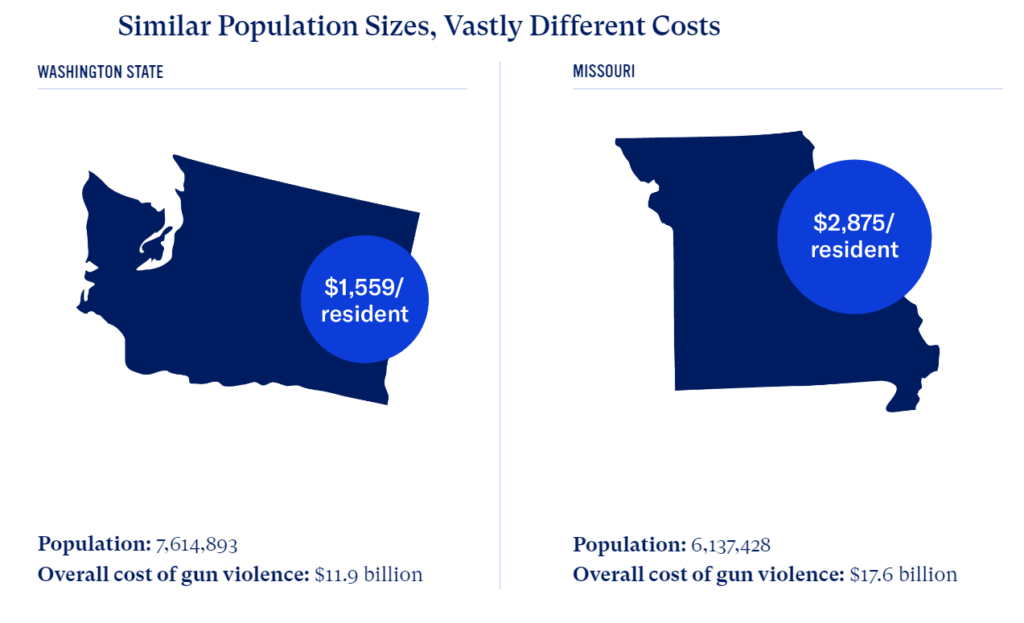
  • Taxpayers, survivors, families, and employers pay an average of $7.79 million daily in health care costs, including immediate and long-term medical and mental health care, plus patient transportation/ambulance costs related to gun violence, and lose an estimated $147.32 million per day related to work missed due to injury or death. 
  • American taxpayers pay $30.16 million every day in police and criminal justice costs for investigation, prosecution, and incarceration. 
  • Employers lose an average of $1.47 million on a daily basis in productivity, revenue, and costs required to recruit and train replacements for victims of gun violence.
  • Society loses $1.34 billion daily in quality-of-life costs from the suffering and lost well-being of gun violence victims and their families.

Author(s):

Publication Date: 19 July 2022

Publication Site: Everytown Research

World Suicide Prevention Day: U.S. Suicide Trend Update through 2021

Link: https://marypatcampbell.substack.com/p/world-suicide-prevention-day-us-suicide

Graphic:

Excerpt:

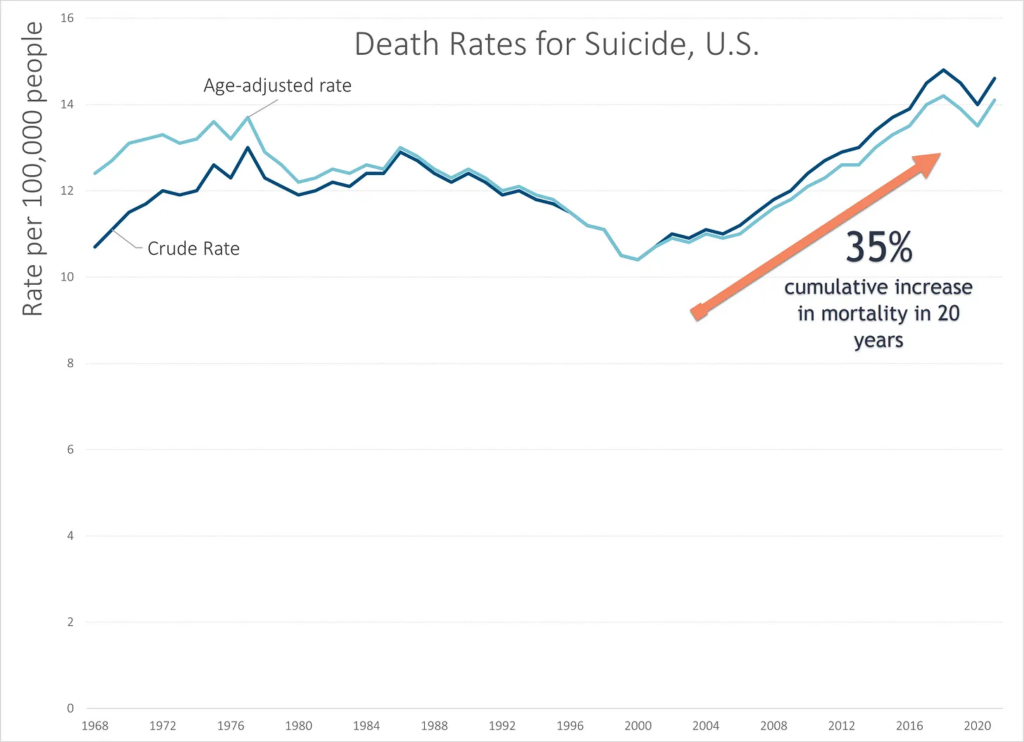
In updating the 2021 numbers, there is some bad news: while suicide rates had decreased in 2020, in 2021 they increased to continue a worrying trend:

The increase in 2021 brought the age-adjusted death rate back to a level close to the peak, which was in 2018.

As noted on the graph, the cumulative increase in the age-adjusted death rate from the minimum in 2000 to the current levels has been 35%. This is very worrying.

I could have exaggerated this trend by starting my vertical scale at 10 instead of 0, but I think it’s obvious enough the trend is bad.

I don’t need to exaggerate.

Author(s): Mary Pat Campbell

Publication Date: 10 Sep 2022

Publication Site: STUMP on substack

Childhood Mortality Trends, 1999-2021 (provisional), Ages 1-17

Link: https://marypatcampbell.substack.com/p/childhood-mortality-trends-1999-2021

Graphic:

Excerpt:

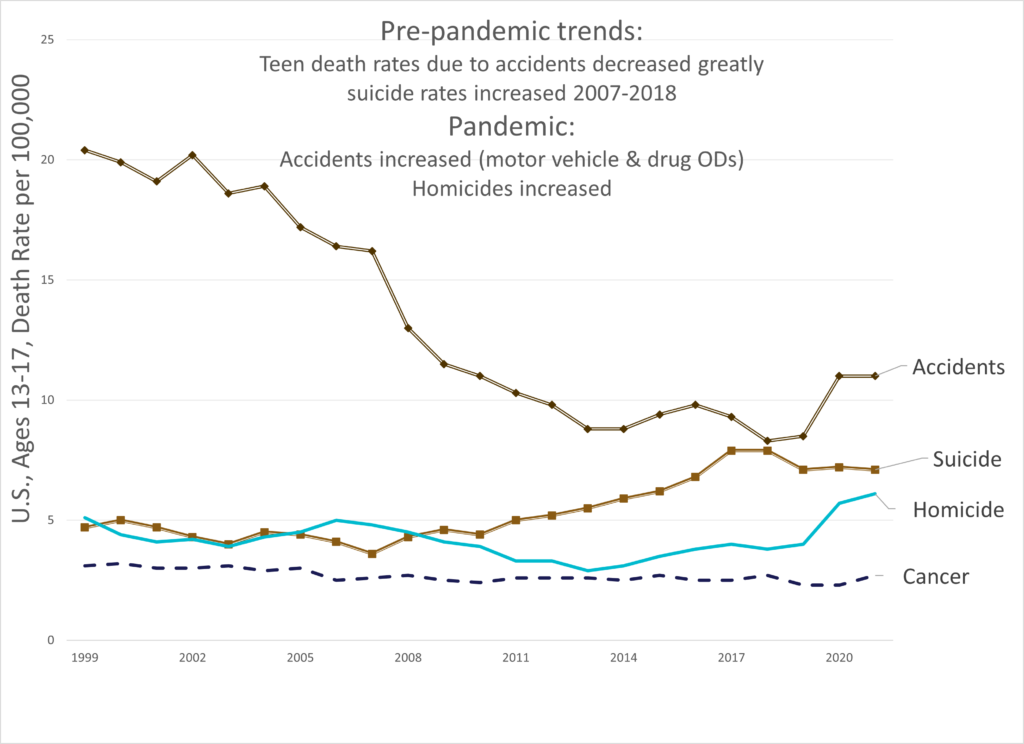
There was the good news from before the pandemic: the accidental death rate had come way, way down. That was mostly due to improved traffic safety. (Not reduced drug ODs, alas)

In the pandemic, both increased motor vehicle deaths and drug overdoses has pushed up the accidental death rate for teens to increase to levels seen a decade ago.

But there was a bad pre-pandemic trend: suicide rates had increased from 2007 to 2018 — increasing a total of 120% over that period. That was hideous.

It seemed to have reversed in 2019, and come down during the pandemic. The suicide trends in the pandemic really made no sense to anybody, but perhaps the increased drug ODs were actually suicides.

Homicides didn’t have a steady trend before the pandemic, but has definitely had a bad trend during the pandemic. Homicide death rates for teens increased over 50% from 2019 to 2021.

One observation: suicide and homicide death rates used to be about the same for teens in the early 2000s, and then with the bad suicide trend, suicide ranked higher. Even with the increase in homicide rates, suicide still ranks higher.

Author(s): Mary Pat Campbell

Publication Date: 15 June 2022

Publication Site: STUMP at substack

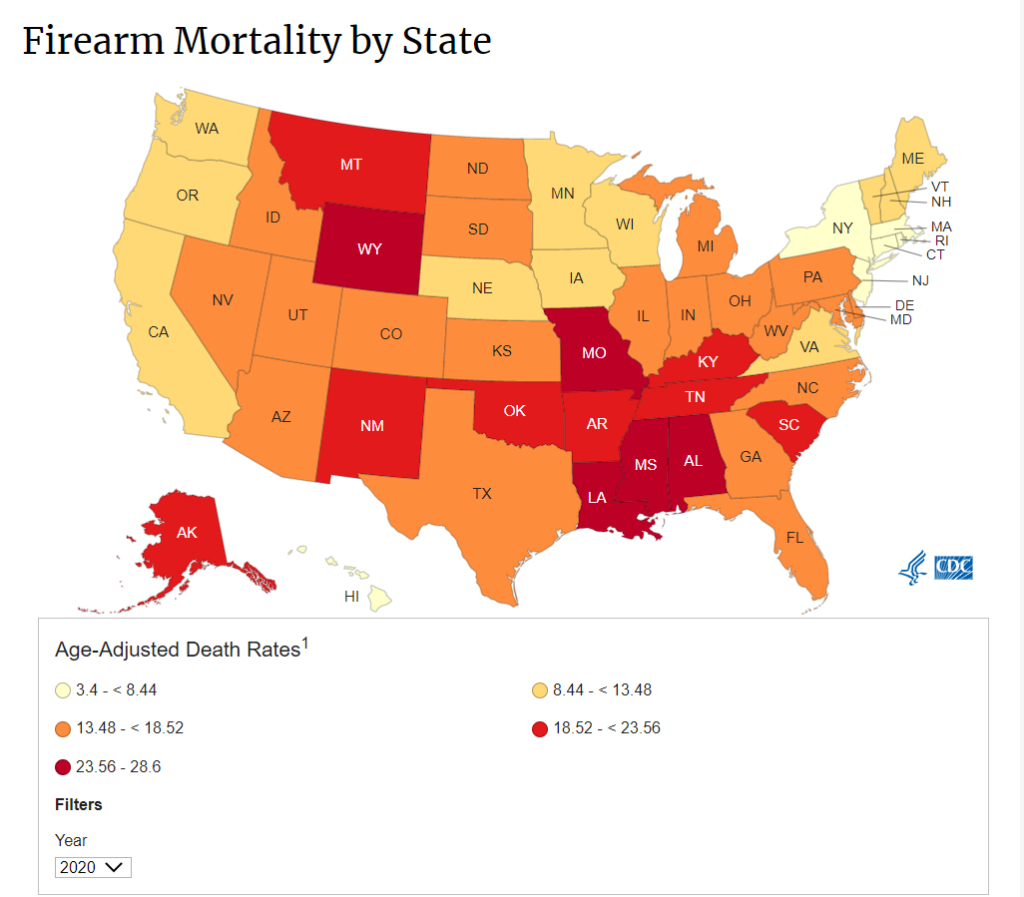
Firearm Mortality by State

Link: https://www.cdc.gov/nchs/pressroom/sosmap/firearm_mortality/firearm.htm

Graphic:

Excerpt:

1 The number of deaths per 100,000 total population.

Source: https://wonder.cdc.gov

States are categorized from highest rate to lowest rate. Although adjusted for differences in age-distribution and population size, rankings by state do not take into account other state specific population characteristics that may affect the level of mortality. When the number of deaths is small, rankings by state may be unreliable due to instability in death rates.

Publication Date: accessed 31 May 2022

Publication Site: CDC

Mortality Nuggets: Videos on Suicide Rate Trends, Society of Actuaries Report, and Fixing Their Graph

Link:https://marypatcampbell.substack.com/p/mortality-nuggets-videos-on-suicide

Video:

Graphic:

Excerpt:

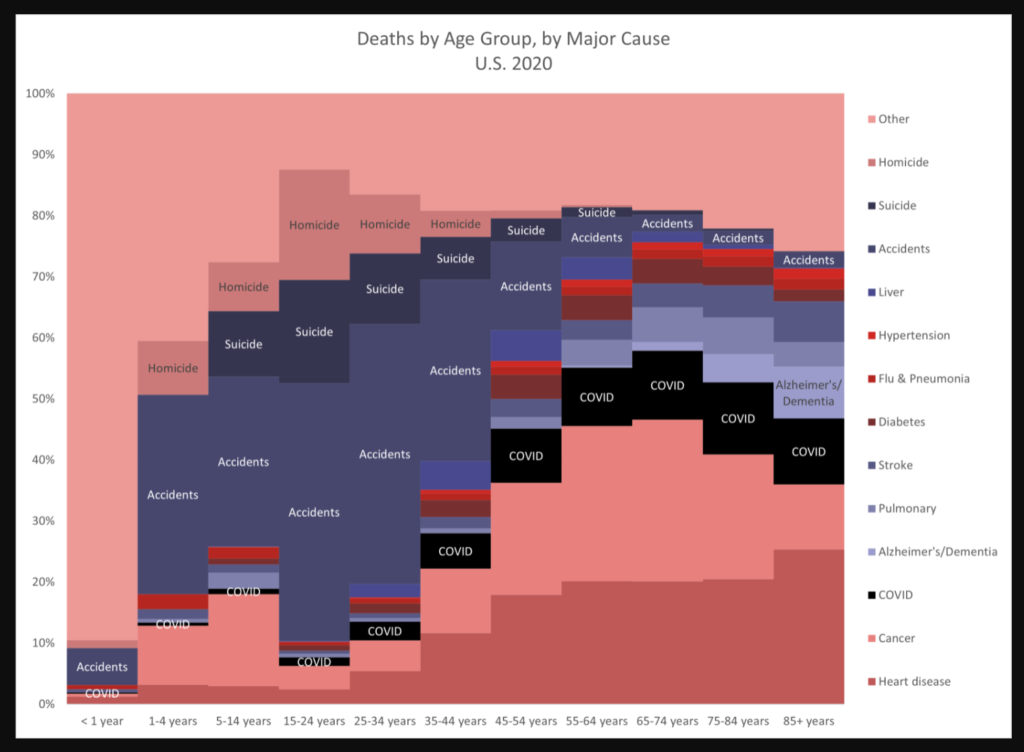
  • I highlighted a few of the cause-of-death trends. In particular, COVID (which, obviously, is biased more towards the old), and external causes of death: homicide, suicide, and accidents (which includes drug overdoses and motor vehicle accidents).
  • There are basically too many things going on in this graph, so there aren’t a lot of good choices for either me or the SOA. What I did was to pick four of the data series to highlight with data labels, as noted above (and I also slapped one data label on dementia for the oldest age group, just because). I am in the middle of a series going through how that external causes of death changed in 2020 — in particular, accidents and homicides went up, and really affected mortality for adults under age 45, plus male teens.
  • Yeah, check out heart disease and cancer (bottom of the graph). Ain’t old age great?

Author(s): Mary Pat Campbell

Publication Date: 6 Feb 2022

Publication Site: STUMP at substack