The Lost Year: What the Pandemic Cost Teenagers

Link: https://www.propublica.org/article/the-lost-year-what-the-pandemic-cost-teenagers

Excerpt:

As many of these experts have noted, the cost of restrictions on youth has gone beyond academics. The CDC found that the proportion of visits to the emergency room by adolescents between ages 12 and 17 that were mental-health-related increased 31% during the span of March to October 2020, compared with the same months in 2019.A study in the March 2021 issue of Pediatrics, the journal of the American Academy of Pediatrics, of people aged 11 to 21 visiting emergency rooms found “significantly higher” rates of “suicidal ideation” during the first half of 2020 (compared to 2019), as well as higher rates of suicide attempts, though the actual number of suicides remained flat.

….

Even with fall sports canceled, the Hobbs school district, with almost 10,000 students, was still hoping to open the new school year for as much in-person instruction as possible. More than just scholastic considerations were driving this. In late April, six weeks into the spring’s pandemic lockdowns, the community had been stunned by the suicide of an 11-year-old boy, Landon Fuller, an outgoing kid who loved going to school and had, his mother said, struggled with the initial lockdowns.

New Mexico has consistently had one of the highest youth suicide rates in the country — it’s roughly twice the national average — and preliminary state statistics would later show the 2020 rate as unchanged. Nationwide, deaths by suicide in the 10-to-24 age group increased by half between 2007 and 2018, a trend that has been linked to multiple factors, from the growing availability of guns to the spread of smartphones and social media. In New Mexico, mental health experts say, the factors also include high rates of depression on Native American reservations, and rural isolation in general.

Author(s): Alec MacGillis

Publication Date: 8 March 2021

Publication Site: ProPublica
America’s crisis of despair: A federal task force for economic recovery and societal well-being

Graphic:

Excerpt:

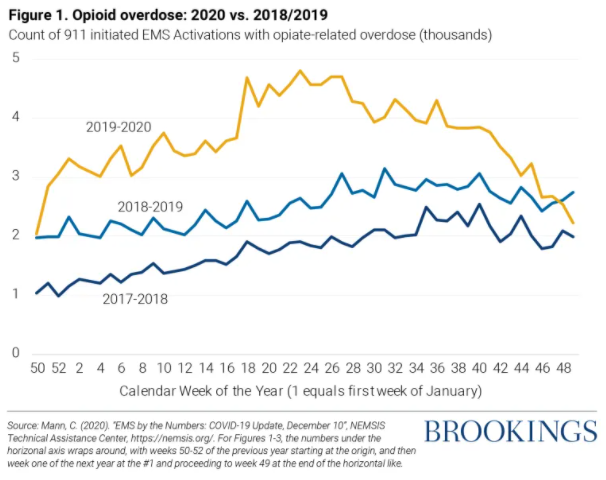
The results that we have to date are stark. New first responder data from the National EMS Information System (NEMSIS) shows significant increases in mental distress, overdose rates, and suicides. Mental health and overdose calls to first responders have doubled in 2020 compared to both 2018 and 2019 (Figures 1-2). Suicides have seen an uptick also, but at a lower rate (Figure 3)

Author(s): Carol Graham

Publication Date: 10 February 2021

Publication Site: Brookings

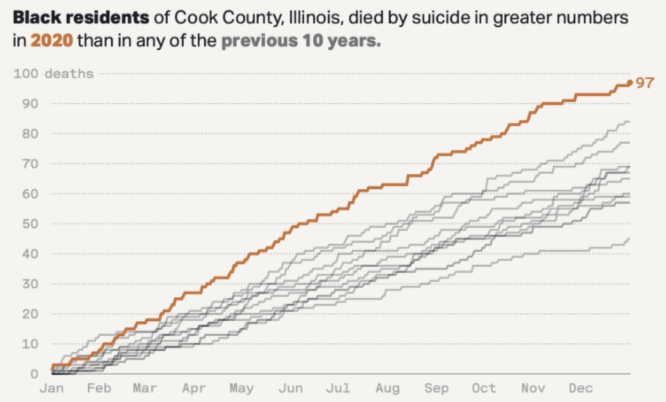
Officials Pledged to Address Rising Black Suicides in Chicago. Six Months On, There’s Still No Plan.

Link: https://www.thetrace.org/2021/02/chicago-black-suicide-data-cook-county-mental-health/#new_tab

Graphic:

Excerpt:

In July, a city official told The Trace andthe Sun-Times that the city would be releasing additional funds to address mental health, including several million for the expansion of existing mental health services and $1 million for suicide prevention. The official also said the city would seek proposals for a suicide-prevention plan in late 2020 or early 2021. 

In October, the city announced that more than 30 community-based mental health organizations would receive $8 million in annual grants to expand existing services. However, the grants do not fund suicide prevention specifically. Asked about the status of the city’s suicide-prevention efforts, a spokesperson with the Chicago Department of Public Health declined an interview request and said the agency was “finalizing our planning in regards to what we will be funding.” 

Author(s): Lakeidra Chavis

Publication Date: 19 February 2021

Publication Site: The Trace

Suicides in Japan dropped for a decade. Then the pandemic hit.

Link: https://www.japantimes.co.jp/news/2021/02/07/national/social-issues/suicides-rise-japan-pandemic/

Graphic:

Excerpt:

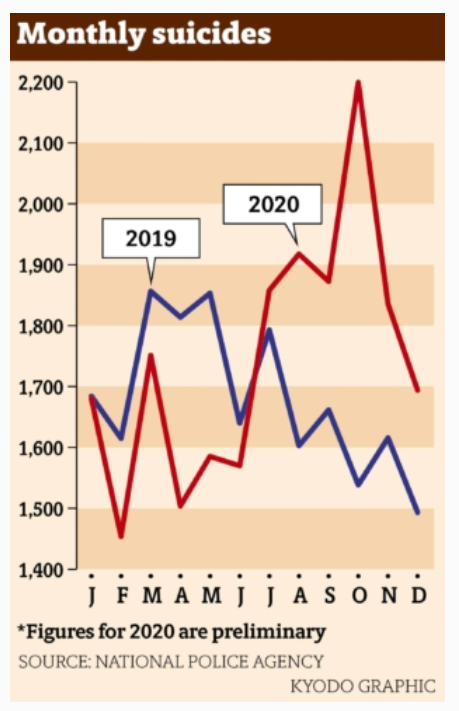
In Japan, a nation that has long struggled with one of the highest suicide rates in the world, the emotional strain is manifesting itself in a disturbing trend. For the first time in a little over a decade, the number of those who took their own lives last year exceeded the previous year, reversing years of work to curb a stubbornly high number of self-inflicted deaths.

According to the health ministry’s preliminary data, 20,919 people died by suicide in 2020, up 3.7% from 2019, compared with 3,459 coronavirus-related deaths in the same period.

While men in Japan are typically more likely to die by suicide, last year saw the number of women killing themselves grow by 885 to 6,976, while suicides among men fell slightly. Meanwhile, figures for those in their 20s and those age 19 or younger grew by 17% and 14%, respectively, according to a tally by the Nikkei business daily, providing insight into which groups are the most vulnerable.

Author(s): ALEX K.T. MARTIN

Publication Date: 7 February 2021

Publication Site: Japan Times