Study: U.S. had 23% more deaths than expected in 2020 due to pandemic

Link: https://www.upi.com/Health_News/2021/04/02/coronavirus-excess-deaths-study/7781617369688/

Excerpt:

The United States saw 23% more deaths than expected between March 1, 2020, and the start of this year, due primarily to the effects of the COVID-19 pandemic, which suggests the official number of U.S. coronavirus deaths is an undercount, according to an analysis published Friday by JAMA found.

More than 2.8 million people died nationally between when the first confirmed cases of the coronavirus were identified and Jan. 2, the data showed.

That’s roughly 522,000 more than would be expected for the 10-month period, based on figures from 2014 through 2019.

These excess deaths were higher than the number of publicly reported COVID-19 deaths across the country, researchers said.

Author(s): Brian P. Dunleavy

Publication Date: 2 April 2021

Publication Site: UPI
Pritzker digs Chicago financial hole deeper by increasing city firefighter pensions – Wirepoints

Graphic:

Excerpt:

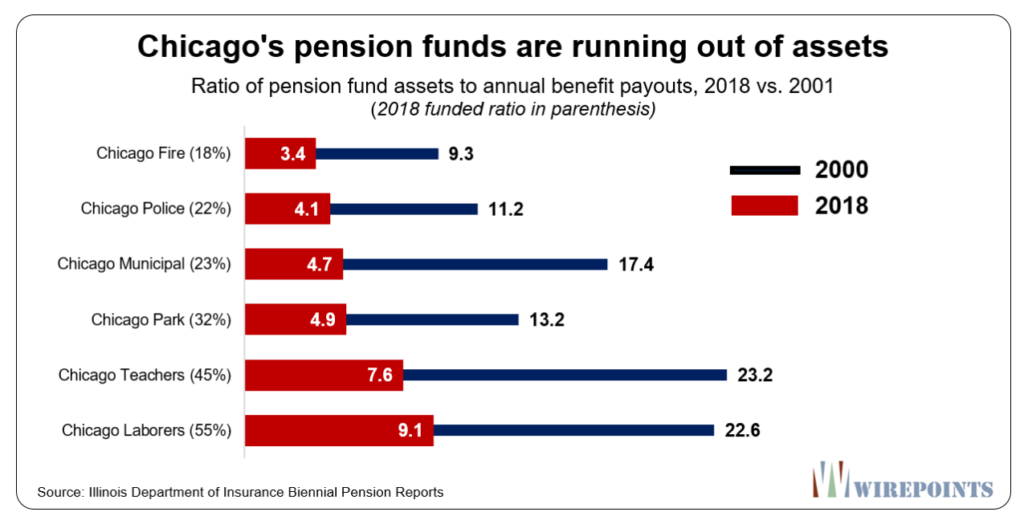
Chicago households are on the hook for a combined $63,000 in Chicago-only debt, based on Moody’s calculations. It’s why the city and the school district have been junk rated for years.

Pritzker’s COLA increase runs against what most of Illinois’ political elite already know – COLA cuts are necessary and inevitable at all levels of government. As Greg Hinz said in his review of Wirepoints’ Pension Solutions, “…that juicy perk over time has amounted to megabillions that state government just doesn’t have.”

The COLA hike will cause more financial headaches for Chicago. Mayor Lori Lightfoot says the COLA increase will cost the city an additional $18 to $30 million a year in pension costs. In all, the perk will force taxpayers to pay an additional $850 million over time.

Author(s): Ted Dabrowski, John Klingner

Publication Date: 8 April 2021

Publication Site: Wirepoints

NYTimes Map How-to

Link: https://livefreeordichotomize.com/2021/04/07/nytimes-map-how-to/

Graphic:

Excerpt:

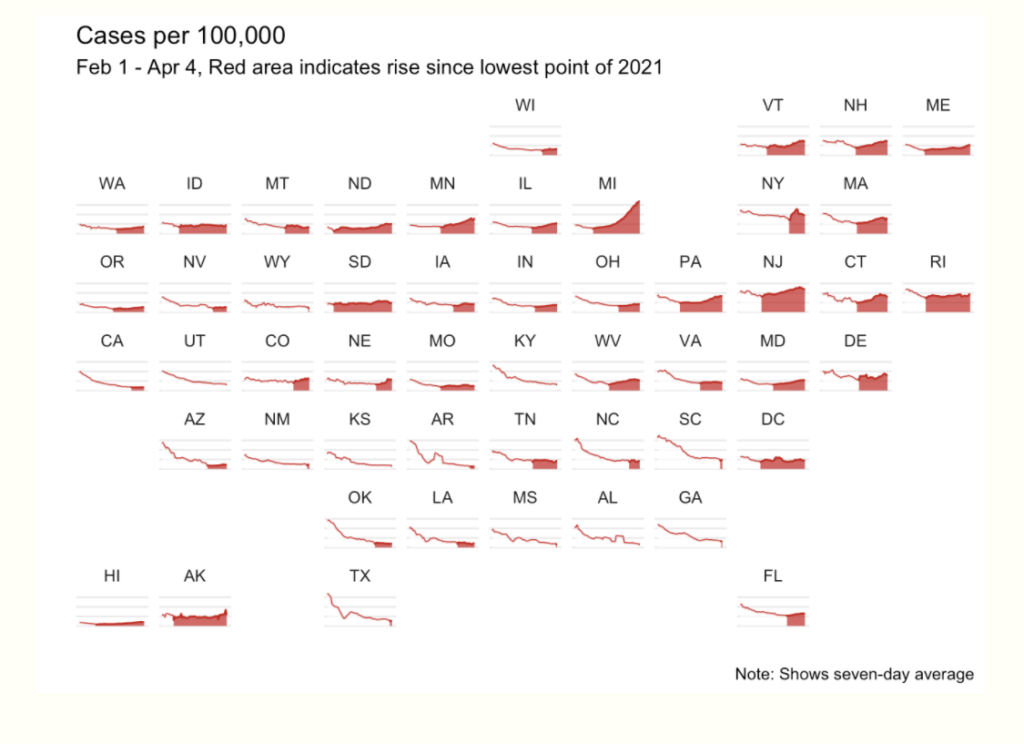
There was a recent email thread in the IsoStat listserv about a cool visualization that recently came out in the New York Times showing COVID-19 cases over time. This sparked a discussion about whether this was possible to recreate in R with ggplot, so of course I gave it a try!

Author(s): Lucy D’Agostino McGowan

Publication Date: 7 April 2021

Publication Site: Live Free or Dichotomize

A Better Corporate Tax for America

Link: https://www.wsj.com/articles/a-better-corporate-tax-for-america-11617813355

Excerpt:

If you’re a U.S. firm that does business abroad, the TCJA essentially gives you an easy — but perverse — choice: You can move your foreign profits and operations to America, where the corporate tax rate is 21%, or you can keep them anywhere else in the world, where the U.S. will charge you around half that. It’s not a hard call, especially because the minimum tax is calculated based on a firm’s total global profits rather than looking at what the company earns in each different country. With no one looking at individual jurisdictions, corporations can shift and book profits wherever they can get the lowest tax bill. The TCJA also makes the first 10% of returns earned by foreign assets tax exempt, a powerful incentive for companies to offshore factories and jobs. It isn’t an overstatement to say that today most firms would prefer to earn income anywhere but America.

The U.S. isn’t the only loser in this race to the bottom. So are our corporations. The global competition for low rates allows American firms to pay less taxes — or none at all — but they still pay a significant cost. Over the next 10 years, more than $2 trillion of the U.S. corporate tax base will flow out of the country because of the broken system I’ve described. Our tax revenues are already at their lowest level in generations, and as they continue to drop, the country will have less money to invest in airports, roads, bridges, broadband, job training, and research and development.

Author(s): Janet Yellen

Publication Date: 7 April 2021

Publication Site: Wall Street Journal

MADIGAN BEGINS COLLECTING $7,093-A-MONTH PUBLIC PENSION

Link: https://www.illinoispolicy.org/madigan-begins-collecting-7093-a-month-public-pension/

Excerpt:

Ousted Illinois House Speaker Michael Madigan collected his first public pension check March 24 for $7,093, or $85,117 a year, but he won’t have to worry about it becoming a fixed income.

A year from July Madigan’s state pension shoots up to $148,955 thanks to a pension sweetener no longer available to state lawmakers. That 75% bump results from a provision that once allowed lawmakers to “bank” 3% cost-of-living increases while still working for each year of service after 20 years or age 55, whichever comes first. Madigan “banked” 25 years of increases, according to the General Assembly Retirement System.

Because Madigan, 78, retired after Jan. 1, he will receive the benefits boost starting July 1, 2022. The sweetener will also allow former Senate President John Cullerton to retire with a pension that will spike to $128,000 just a couple of years into retirement. The perk was discontinued for lawmakers elected after 2002.

Author(s): Brad Weisenstein

Publication Date: 6 April 2021

Publication Site: Illinois Policy Institute

New York Taxes Go Skyscraper High

Link: https://www.wsj.com/articles/new-york-taxes-go-skyscraper-high-11617834769

Excerpt:

The budget deal Gov. Andrew Cuomo cut this week with the Legislature lifts the top marginal rate on the state’s income tax to 10.9%, from today’s 8.82%. Add New York City’s top local tax of 3.88%, and the total is 14.78%. Take a knee, California (top marginal rate of 13.3%), and recognize America’s new tax king. Wall Street types already are migrating to Florida, which has an income tax of 0%.

Mr. Cuomo’s budget deal also raises the business franchise tax to 7.25%, from 6.5%. This affects many independent proprietors and will be another incentive to escape from Manhattan. Both of these tax increases are sold as temporary “surcharges,” running through 2027 for the income tax and 2023 for the corporate tax. But politicians in Albany used the same line when they passed the “millionaires tax” in 2009. Does Mr. Cuomo think two decades is temporary?

The reason for the tax increase isn’t the pandemic or a revenue shortfall. Mr. Cuomo last year pointed a gun at New York’s head and threatened to shoot unless Congress sent more money. He received the ransom he demanded, and more. The state is getting $12.6 billion in direct budget relief from President Biden’s $1.9 trillion Covid bill.

Author(s): Editorial Board

Publication Date: 7 April 2021

Publication Site: Wall Street Journal

Biden Softens Tax Plan Aimed at Profitable Companies That Pay Little

Link: https://www.wsj.com/articles/biden-softens-tax-proposal-aimed-at-profitable-companies-that-pay-little-11617809422?mod=djemwhatsnews

Excerpt:

A 15% minimum tax on large, profitable corporations that is part of President Biden’s infrastructure proposal would affect far fewer companies than the version he campaigned on, according to details the Treasury Department released Wednesday.

The tax — aimed at companies that report large profits to investors but low tax payments — would apply only to companies with income exceeding $2 billion, up from the $100 million threshold that Mr. Biden pushed during the campaign.

The Biden plan would now also let companies subject to the tax get the benefit of tax credits for research, renewable energy and low-income housing, a recognition that the campaign-trail version could have undercut the president’s preference to encourage companies to invest in those areas.

The result is that just 180 companies would meet the income threshold and just 45 would pay the tax, according to administration estimates that assume the rest of the administration’s plan gets implemented. Nearly 1,100 U.S.-listed companies would meet the $100 million threshold, according to S&P Global Market Intelligence. Many of them would still face sharply higher tax bills from the rest of the Biden proposals, which raise rates on domestic and foreign income.

Author(s): Richard Rubin, Kate Davidson

Publication Date: 7 April 2021

Publication Site: Wall Street Journal

Illinois governor signs bill that increases Chicago’s pension liabilities

Link: https://fixedincome.fidelity.com/ftgw/fi/FINewsArticle?id=202104061236SM______BNDBUYER_00000178-a783-de03-a7ff-b7e7bf7e0001_110.1#new_tab

Excerpt:

Illinois Gov. J.B. Pritzker signed legislation that benefits retired Chicago firefighters, rejecting city warnings adding to its already burdensome pension tab could damage ratings and drive up taxes.

The added cost to bring cost-of-living adjustments for all firefighters in tier one up to a simple 3% annual increase despite their birth date amounts to $18 million to $30 million annually and up to $823 million in full by 2055 when the fund is slated to reach a 90% funded ratio.

Pending legislation to do the same for the police fund carries a steeper price tag of up to $90 million annually and $2.6 billion through 2055.

Author(s): Yvette Shields

Publication Date: 6 April 2021

Publication Site: Fidelity Fixed Income

EU life expectancy drops across bloc amid virus pandemic

Link: https://apnews.com/article/world-news-pandemics-europe-coronavirus-pandemic-covid-19-pandemic-8457898bffd5733e28eb9f566d54232c

Excerpt:

Life expectancy across much of the European Union has dropped last year, as the 27-nation bloc struggled with the impact of the coronavirus pandemic.

The EU statistical agency Eurostat said Wednesday that “following the outbreak of the COVID-19 pandemic last year, life expectancy at birth fell in the vast majority of the EU member states.” It said the biggest drop was in Spain, with a loss of 1.6 years compared with 2019.

Bulgaria followed with a loss of 1.5 years, followed by Lithuania, Poland and Romania, which all saw a drop of -1.4 years. Denmark and Finland were the only nations to see a rise in life expectancy, with 0.1 years.

Publication Date: 7 April 2021

Publication Site: Associated Press

So, Can States Cut Taxes or Not?

Link: https://www.governing.com/finance/So-Can-States-Cut-Taxes-or-Not.html

Excerpt:

Most observers believe that the Treasury will interpret the law narrowly. Rather than seeking to claw back funds from any states passing tax cuts or credits, the feds are considered likely to challenge only those states that clearly use federal dollars to pay for them. “Nothing in the act prevents states from enacting a broad variety of tax cuts,” Treasury Secretary Janet Yellen wrote in a response to the AGs. “It simply provides that funding received under the act may not be used to offset a reduction in net tax revenue resulting from certain changes in state law.”

But the fact that the law blocks federal money from being used even indirectly to pay for tax cuts has state officials not just worried but angry. “Democrats in Washington and in the White House are not going to tell me, or the Georgia General Assembly, that we can’t cut taxes for hard-working Georgians,” Gov. Brian Kemp complained at a news conference last month.

….

That prohibition lasts as long as the stimulus dollars are spent, which will be into 2024. And there are limits, Walczak notes, on where and how states can spend federal aid. They can use the money to address pandemic and health needs, for example. While those are clearly ongoing, much of the cost of vaccine supply and distribution has been underwritten by the feds. Other costs in these areas have already been addressed by last year’s federal CARES Act, which some states struggled to spend.

Author(s): Alan Greenblatt

Publication Date: 7 April 2021

Publication Site: Governing

TRUST THE SCIENCE: THE BLUE STATE SURGE IS REAL

Link: http://www.newgeography.com/content/007004-trust-science-the-blue-state-surge-real

Excerpt:

What did make a big difference, it turns out, is not so much the severity of lockdowns but pre-existing conditions. The likely cause here can be best identified as “exposure density” brought on by crowded housing, transit, and office environments.

That helps explain why, after New York City’s suburbs were hit hard in the first wave, the current surge has hit the outer boroughs, where a much higher share of workers have had little choice but to continue taking the subway or other transit.

Nationwide, urban exposure to the pandemic also reflects their greater inequality. Higher rates of poverty and overcrowded housing accentuate the worst effects of the pandemic, which tore through impoverished parts of New YorkHoustonLos Angeles CountyChicago’s poor south side, and similar areas. The Bronx, for example, has suffered an 80 percent worse death rate than denser yet wealthier Manhattan, while Brooklyn’s rate is 50 percent worse than Manhattan’s.

Author(s): Joel Kotkin, Wendell Cox

Publication Date: 6 April 2021

Publication Site: New Geography