Oxford Pauses Dosing in Trial of AstraZeneca Covid-19 Vaccine in Children, Teenagers

Link: https://www.wsj.com/articles/oxford-pauses-dosing-in-trial-of-astrazeneca-covid-19-vaccine-in-children-teenagers-11617729303

Excerpt:

The University of Oxford said it has paused administering doses of the Covid-19 vaccine it developed with AstraZeneca PLC in a small U.K. study to test the shot in children and teenagers, pending further information about rare blood-clotting issues in adults who have received it.

The Oxford-led pediatric trial started in mid-February and is aimed at testing the vaccine in more than 200 young people aged 6 to 17 years. An Oxford spokesman said Tuesday that no safety issues have arisen in the trial itself, but broader concerns about rare clotting problems in adults have triggered further regulatory reviews in the U.K. and Europe to investigate any potential link with the vaccine.

Oxford is waiting for more information from the U.K.’s drugs watchdog, the Medicines and Healthcare products Regulatory Agency, before giving any further vaccinations to children or teenagers in the pediatric trial, the spokesman said.

The pause is the latest setback for the Oxford-AstraZeneca shot, which has faced questions about its efficacy and potential side effects even as tens of millions of doses have been administered following safety signoffs in more than 70 countries.

Author(s): Jenny Strasburg, Eric Sylvers

Publication Date: 6 April 2021

Publication Site: Wall Street Journal
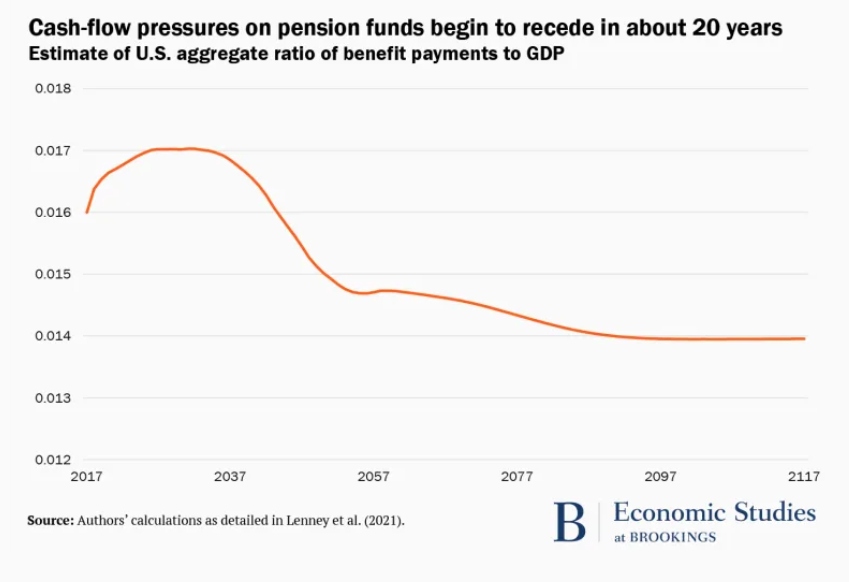
The sustainability of state and local government pensions: A public finance approach

Graphic:

Excerpt:

Their findings, however, imply that many state and local governments may be able to spend more than assumed on improving their educational systems and economically important infrastructure.

“Given other demands, fully funding their pension plans might not be the right thing for state and local governments,” Sheiner said in an interview with The Brookings Institution. “They should compare the benefits of upping their pension investments with the benefits of investing in their people.”

Author(s): Jamie Lenney, Byron Lutz, Finn Schüle, Louise Sheiner

Publication Date: 24 March 2021

Publication Site: Brookings

They Came, They Saw, They Taxed

Link: https://www.city-journal.org/ny-legislators-pile-on-tax-burden

Excerpt:

The New York tax burden is already punishing enough. New Yorkers pay a greater percentage of their earnings to the state than residents of any other state. The total tax burden, on top of federal taxes, amounts to 12.79 percent of income, according to a new study. Opponents of the latest tax increases claim that the state’s punishing rates are responsible for driving high earners and businesses away, and indeed the state consistently faced massive levels of net outmigration to other states even before the pandemic. That migration has included thousands of jobs in areas like financial services. Among the firms that have relocated significant jobs away from the city are Credit Suisse, Barclays, UBS, and AllianceBernstein, according to a recent Forbes article. Goldman Sachs has moved a big-money management division to Florida, and hedge fund manager Carl Icahn has decamped there as well. The Empire State’s taxes are one reason that former hedge fund manager Leon Cooperman said, “I suspect Florida will soon rival New York as a finance hub.”

Author(s): Steven Malanga

Publication Date: 6 April 2021

Publication Site: City Journal

Janet Yellen Proposes Bold Idea: The Same Minimum Corporate Tax Around The World

Link: https://www.npr.org/2021/04/05/984461923/janet-yellen-proposes-bold-idea-the-same-minimum-corporate-tax-around-the-world

Excerpt:

It’s an idea that has been debated widely across global capitals: impose the same minimum corporate tax rate all over the world to prevent companies from shopping around for the country that can offer the smallest tax bill.

Now, it has a powerful new adherent. Treasury Secretary Janet Yellen on Monday expressed support for a minimum tax rate, providing the vital backing of the U.S. government.

Yellen, in a speech, said a minimum global tax rate would stop what she described as a “30-year race to the bottom” that has allowed big corporations to avoid contributing fully to vital national needs.

Author(s): Scott Horsley

Publication Date: 5 April 2021

Publication Site: All Things Considered on NPR

Excess Deaths From COVID-19 and Other Causes in the US, March 1, 2020, to January 2, 2021

Link: https://jamanetwork.com/journals/jama/fullarticle/2778361

Graphic:

Excerpt:

Between March 1, 2020, and January 2, 2021, the US experienced 2 801 439 deaths, 22.9% more than expected, representing 522 368 excess deaths (Table). The excess death rate was higher among non-Hispanic Black (208.4 deaths per 100 000) than non-Hispanic White or Hispanic populations (157.0 and 139.8 deaths per 100 000, respectively); these groups accounted for 16.9%, 61.1%, and 16.7% of excess deaths, respectively. The US experienced 4 surge patterns: in New England and the Northeast, excess deaths surged in the spring; in the Southeast and Southwest, in the summer and early winter; in the Plains, Rocky Mountain, and far West, primarily in early winter; and in the Great Lakes, bimodally, in the spring and early winter (Figure). Excess deaths were increasing in all regions at the end of 2020. The 10 states with the highest per capita rate of excess deaths were Mississippi, New Jersey, New York, Arizona, Alabama, Louisiana, South Dakota, New Mexico, North Dakota, and Ohio. New York experienced the largest relative increase in all-cause mortality (38.1%). Deaths attributed to COVID-19 accounted for 72.4% of US excess deaths.

Joinpoint analyses revealed an increase in weekly mortality from non–COVID-19 causes, including heart disease from March 15 to April 11, 2020 (APC, 4.9 [95% CI, 0.7-9.3]), and October 11, 2020, to January 2, 2021 (APC, 1.1 [95% CI, 0.8-1.4]); Alzheimer disease/dementia from March 15 to April 11, 2020 (APC, 7.1 [95% CI, 2.4-12.0]), May 31 to August 15, 2020 (APC, 1.2 [95% CI, 0.7-1.6]), and September 6, 2020, to January 2, 2021 (APC, 1.3 [95% CI, 1.1-1.5]); and diabetes from March 8 to April 11, 2020 (APC, 6.5 [95% CI, 2.8-10.3]), May 31 to July 11, 2020 (APC, 2.6 [95% CI, 0.2-5.0]), and October 18, 2020, to January 2, 2021 (APC, 2.2 [95% CI, 1.6-2.8]).

Author(s): Steven H. Woolf, MD, MPH1Derek A. Chapman, PhD1Roy T. Sabo, PhD2et al

Publication Date: 2 April 2021

Publication Site: JAMA

Gov. Ned Lamont says Connecticut’s age-based COVID vaccine rollout is saving more lives — But is it?

Excerpt:

Connecticut’s neighbors have also prioritized age in their rollouts after prioritizing health care workers and nursing homes, though they have also made teachers, essential workers and people with underlying conditions eligible in tandem at different points in the pandemic. New York announced that teachers and some essential workers were eligible in January along with individuals 75+; Massachusetts included people with co-morbidities in its 65+ rollout in late February. Rhode Island deviated from an age-based strategy around mid-March when it opened up eligibility to teachers, and later to individuals with co-morbidities.

Prioritizing based on age is not a novel approach, said Omer, arguing that what’s really under debate is the decision to continue to do so for people younger than 65. Omer has previously criticized the state’s age-based rollout for de-emphasizing underlying conditions, though he has since described the state’s plan to prioritize individuals with co-morbidities after opening eligibility to all individuals 16+ as a “reasonable middle ground, depending on how it’s implemented.”

Author(s): KASTURI PANANJADY

Publication Date: 2 April 2021

Publication Site: CT Mirror

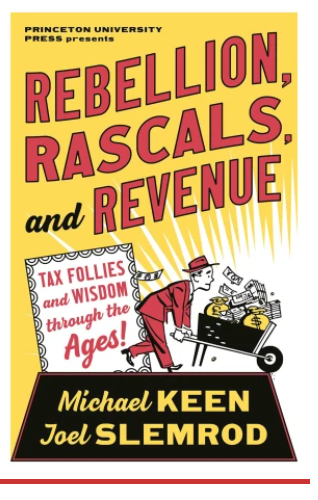
How taxes turned margarine pink, made ships sink, and more strange results

Link: https://nypost.com/2021/04/03/how-taxes-made-margarine-pink-ships-sink-and-more-odd-results/

Graphic:

Book listing: https://amzn.to/2PxVkFz

Excerpt:

Unmarried men in ancient Greece and Rome were taxed, as were British bachelors from 1695 to 1706. Some states in the US even had a similar policy into the 20th century. 

But what about those men who were unlucky in love? Were they to be “doubly cursed, embraced by the taxman but spurned by womankind?” the authors write. 

In some places, bachelors were made exempt from the tax if they could prove they had asked a woman to marry but were rejected. 

In Argentina around 1900, the tax gave rise to “professional lady rejectors” — women who, for a fee, would swear to authorities that a man had asked for their hand and that they had refused. 

Author(s): Reed Tucker

Publication Date: 3 April 2021

Publication Site: NY Post

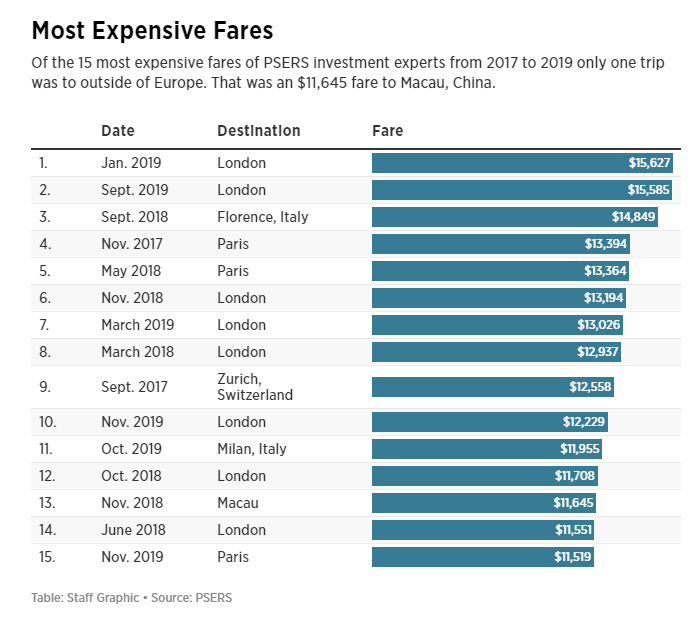
From Hong Kong to Sydney, San Francisco to Zurich, the staff at Pennsylvania’s largest pension fund have run up big travel bills

Link: https://www.inquirer.com/business/psers-pension-teachers-travel-expenses-sers-public-school-trips-cost-20210403.html

Graphic:

Excerpt:

The bills are high because PSERS for years has operated under a system in which it often never knew the true costs of travel. The fund repeatedly left the job of booking tickets, hotels, and meals to the outside money managers who invest the fund’s money. The charges were later buried in overall travel bills that the managers submitted to the fund to be paid by taxpayers and teachers.

In recent years, the fund has been roundly criticized for its lagging investment performance, especially given that the plan, underfunded by many governors and legislatures, is $44 billion short of the money to pay all future retirees

Author(s): Craig R. McCoy

Publication Date: 3 April 2021

Publication Site: The Philadelphia Inquirer

Why Investors Can’t Quit U.S. Debt

Link: https://www.nationalreview.com/2021/03/why-investors-cant-quit-u-s-debt/

Graphic:

Excerpt:

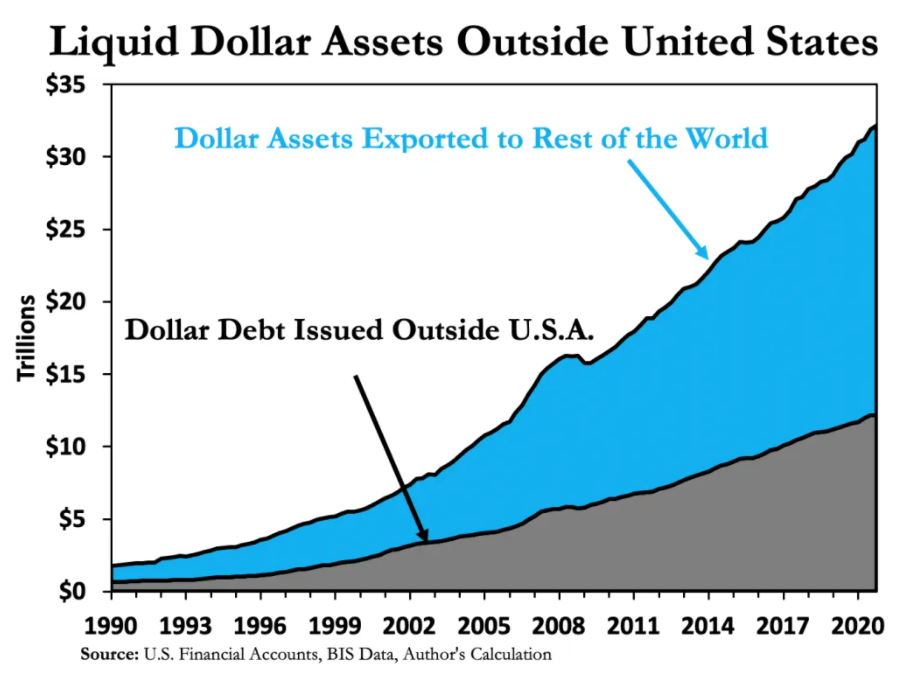
Second, there is another $12 trillion in dollar-denominated assets issued by entities outside the United States, according to the Bank for International Settlements. Combine this with the dollar assets exported from the United States, and there exists roughly $32 trillion in relatively liquid and safe dollar assets abroad, as seen in the figure below.

There is no other currency system that comes close to providing so many safe and liquid assets to the world. On one hand, this outcome is not surprising, given the dollar’s dominant role in the global economy. On the other hand, the implication of this fact is astonishing: There is no alternative source of safe and liquid assets available on such a large scale. This means that if investors wanted to break up with the global dollar system, there would be nowhere else to go to meet all their relationship needs.

Author(s): David Beckworth

Publication Date: 31 March 2021

Publication Site: National Review

Will States Resist Fresh Billions for Medicaid Expansion?

Link: https://www.governing.com/now/Will-States-Be-Able-to-Resist-Billions-for-Medicaid-Expansion.html

Excerpt:

As part of the most recent federal stimulus, states that haven’t expanded Medicaid under the Affordable Care Act can receive additional matching funds. Rather than paying 10 percent of the cost for new recipients, they’d only have to pay 5 percent over the next two years. Additional subsidies mean they would actually cost themselves money by refusing to expand. Florida, for instance, would come out ahead by $1.25 billion, even after paying its share of expanded coverage. Still, Gov. Ron DeSantis and legislative leaders remain opposed.

….

It’s true that the 95 percent match rate will only last for two years. But plenty of states have put in place triggers that would end their expansion programs if the federal share ever dipped below 90 percent, notes Trish Riley, executive director of the National Academy for State Health Policy.

Author(s): Alan Greenblatt

Publication Date: 31 March 2021

Publication Site: Governing

The Powerful New Financial Argument for Fossil-Fuel Divestment

Link: https://www.newyorker.com/news/daily-comment/the-powerful-new-financial-argument-for-fossil-fuel-divestment

Excerpt:

In places, BlackRock’s findings are redacted, so as not to show the size of particular holdings, but the conclusions are clear: after examining “divestment actions by hundreds of funds worldwide,” the BlackRock analysts concluded that the portfolios “experienced no negative financial impacts from divesting from fossil fuels. In fact, they found evidence of modest improvement in fund return.” The report’s executive summary states that “no investors found negative performance from divestment; rather, neutral to positive results.” In the conclusion to the report, the BlackRock team used a phrase beloved by investors: divested portfolios “outperformed their benchmarks.”

In a statement, the investment firm downplayed that language, saying, “BlackRock did not make a recommendation for TRS to divest from fossil fuel reserves. The research was meant to help TRS determine a path forward to meet their stated divestment goals.” But Tom Sanzillo—I.E.E.F.A.’s director of financial analysis, and a former New York State first deputy comptroller who oversaw a hundred-and-fifty-billion-dollar pension fund—said in an interview that BlackRock’s findings were clear. “Any investment fund looking to protect itself against losses from coal, oil, and gas companies now has the largest investment house in the world showing them why, how, and when to protect themselves, the economy, and the planet.” In short, the financial debate about divestment is as settled as the ethical one—you shouldn’t try to profit off the end of the world and, in any event, you won’t.

Author(s): Bill McKibben

Publication Date: 3 April 2021

Publication Site: The New Yorker

Leave the Cap on the SALT

Link: https://www.nationalreview.com/2021/04/leave-cap-salt/?utm_source=Sailthru&utm_medium=email&utm_campaign=TUE_20210406&utm_term=Tuesday-Smart

Excerpt:

Since the Republican tax reform of 2017, the federal government has allowed taxpayers to deduct $10,000 of their state and local tax payments from their federal taxes. What the Democrats now seek is a restoration of the unlimited tax deduction that had previously been in place. Only the highest earners hit that cap, so getting rid of it would directly benefit only them. The Tax Foundation estimates that lifting the cap would raise the after-tax incomes of the bottom-earning 40 percent of households by nothing. People in the middle of the income distribution would see an average increase of 0.01 percent. People in the top 1 percent, on the other hand, would receive a 2.8 percent increase. Another analysis, from the Tax Policy Center, found that the top 20 percent of taxpayers would receive 96 percent of the benefit of repealing the cap.

Publication Date: 6 April 2021

Publication Site: National Review