Vermont teachers, state employees say they were ‘blindsided’ by proposed pension fund plan

Excerpt:

 bill in the Vermont Legislature aimed at taking on a growing deficit in the state’s pension fund continues to face opposition from teachers and state employees.

At a public hearing on Monday, both groups said they feel blindsided by the bill, specifically the burden it would place on them to reduce the $5.8 billion shortfall in the pension system.

“If this is what it’s like to be a state employee, I’ll tell my kids and my grandkids don’t ever come and work for the state,” said Greg Machia. “I never thought in my 30 years I’d be talking about pensions.”

The legislation would have state employees and teachers pitching in more toward their pension plans, while increasing the age most workers would see retirement benefits.

Author(s): Devin Bates

Publication Date: 29 March 2021

Publication Site: myChamplainValley
Kentucky legislature overrides teacher pension veto, putting new hires on ‘hybrid’ plan

Link: https://www.courier-journal.com/story/news/politics/ky-general-assembly/2021/03/29/kentucky-general-assembly-overrides-teachers-pension-reform-veto/6997915002/

Excerpt:

Kentucky lawmakers have overridden Gov. Andy Beshear’s veto of a bill that would change pension benefits for future teachers.

In what some Republican legislators hope will be the beginning of larger pension reform, the House and Senate voted to override the veto of House Bill 258 Monday. 

The House voted 63-31, followed by a 25-13 vote in the Senate.

Beginning in 2022, new Kentucky teachers will be placed on a “hybrid” pension plan that combines elements of defined contribution and defined benefit plans.

Author(s): Olivia Krauth

Publication Date: 29 March 2021

Publication Site: Courier-Journal

ARPA and Pension Plans: A Closer Look

Link: https://www.asppa-net.org/news/arpa-and-pension-plans-closer-look

Excerpt:

Contribution Requirements. Callan expects that higher discount rates and longer periods for shortfall amortization probably will reduce pension plan sponsors’ contribution requirements. Further, they expect that effect to be greatest for plans with smaller normal costs and/or larger funding shortfalls.  
Callan continues that if smoothing is ever fully phased out, they anticipate contribution requirements would increase as discount rates “finally decline from historical highs to match market conditions,” but they also add that the longer amortization period “does provide a permanent reduction in annual cash requirements.”

The changes to the minimum funding requirements, Cheiron says, will result in lower minimum funding requirements. They will not affect segment rates used for other purposes such as calculation of lump sum benefits and the maximum deductible limit. 

Author(s): John Iekel

Publication Date: 29 March 2021

Publication Site: ASPPA

Mark Crow: The time is now for meaningful Vermont pension reform

Excerpt:

What if you owed someone a substantial amount of money and were making annual payments each year to pay down the debt. However, every year, year after year, the amount you owe and the annual payments you must make increases — significantly.

Now, what if, at the same time, you owed someone a separate substantial amount of money but there was no schedule to pay it back. You were making some intermittent, smaller payments when the lender periodically asked for them, but there was no plan in place to pay off the entire debt. And, like the first debt, each year, the amount you owe increases — significantly.  

Meanwhile, you’ve got other essential expenses — car and house payments and maintenance, child care, food, clothing, medical care, etc. But, with those large debts continuing to increase, you are finding that you can’t afford to pay for some or all of these essential expenses. You could try to borrow money to pay for them but, because of those troublesome and ever-increasing debts, your credit score is low (and is at risk of being further lowered) and the only loan you can get, if you can even get a loan, will bear interest at a high rate.

Author(s): Mark Crow

Publication Date: 29 March 2021

Publication Site: VT Digger

Employees voice concerns over new state pension proposal

Link: https://www.mynbc5.com/article/employees-voice-concerns-over-new-state-pension-proposal/35972945

Excerpt:

The proposed changes would make public employees work longer hours and contribute more money. When it was time to receive the pension, there would be less.

The proposed budget has $150 million for the pension program.

“We just have to take a look, do the best we can to protect those who are heavily invested,” Governor Phil Scott said on Friday. “We’ll come to some conclusion hopefully they come through but these are difficult times when the majority party is faced with this much pushback.”

This plan, brought forward by Democrats, is receiving heavy backlash from the teachers and police unions.

Author(s): Carolyn Sistrand

Publication Date: 30 March 2021

Publication Site: NBC 5

Consultant: Connecticut could see up to $900M in savings as retirement ‘tsunami’ approaches

Excerpt:

A study of Connecticut’s state government in advance of an expected wave of retirements next year has identified as much as $900 million in potential savings in executive agencies with total budgets of $14 billion, while acknowledging the significant obstacles to making changes in one of the most heavily unionized public-sector workforces in the United States.

The report released Wednesday by the administration of Gov. Ned Lamont says 8,000 of the 30,000 executive-branch employees are eligible to retire by July 1, 2022, when retirement benefits will be reduced under the terms of a 2017 concession deal. A survey found about 70% of the eligible workers were leaning toward retiring.

The highest percentage of expected retirements is among employees responsible for public safety and caring for at-risk children and people with intellectual disabilities and mental illnesses. As such, the exodus poses daunting challenges to maintaining essential services and perhaps offers once-in-a-generation opportunities for fundamental change. 

Author(s): MARK PAZNIOKAS

Publication Date: 31 March 2021

Publication Site: CT Mirror

Vermont lawmakers seek pension reforms to stem funding shortfalls

Link: https://www.pionline.com/pension-funds/vermont-lawmakers-seek-pension-reforms-stem-funding-shortfalls

Excerpt:

Vermont lawmakers are pushing a plan to reduce a widening shortfall in the state’s retirement systems by asking teachers and state employees to pay more into their pension plans and work more years.

During a March 24 meeting, the Vermont House Government Operations Committee proposed teachers base contribution rates be raised by 1.25% to 2.25% and that most state employees be increased by 1.1%, according to a proposal posted on the Vermont General Assembly website.

The proposal also bumps up the age at which most workers can qualify for retirement benefits, requiring them to reach full Social Security retirement age, which is currently 66 or 67. Some groups of teachers and state employees can now retire as early as 62 or with 30 years of service.

Author(s): Margarida Correia

Publication Date: 29 March 2021

Publication Site: Pensions & Investments

Kentucky Lawmakers Override Pension Bill Veto

Link: https://www.ai-cio.com/news/kentucky-lawmakers-override-pension-bill-veto/

Excerpt:

The GOP-run Kentucky state legislature has overridden Democratic Gov. Andy Beshear’s veto of a pension reform bill that will place new teachers in a hybrid pension plan that incorporates aspects of a defined contribution (DC) and a defined benefit (DB) plan.

Under House Bill 258, new teachers are required to contribute more to their retirement plans than current teachers do, and they will have to work for 30 years instead of 27 to earn their maximum benefits. The new rules will become effective at the beginning of 2022.

The bill had been passed by large majority of both chambers of the legislature earlier this year, with the House passing it by a vote of 68 to 28 and the Senate passing it by a count of 63 to 34. Because the state’s Republicans have a supermajority in both the House and Senate, they didn’t have much difficulty in overriding the veto, which was one of 24 vetoes passed down by Beshear, a Democrat, that were overridden in one day.

Author(s): Michael Katz

Publication Date: 1 April 2021

Publication Site: ai-CIO

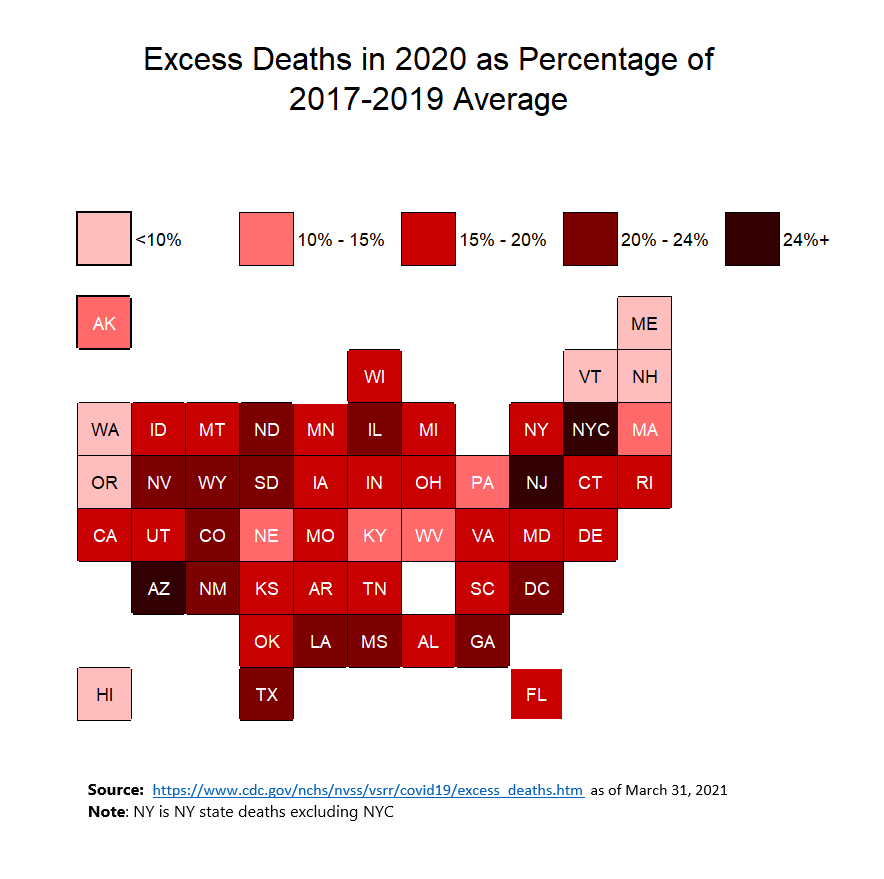
Mortality with Meep: Ranking the States (and NYC and DC) by Excess Mortality

Link: https://marypatcampbell.substack.com/p/mortality-with-meep-ranking-the-states

Graphic:

Excerpt:

The three worst areas just pop out: Arizona, New Jersey, and New York City.

(Also popping out: the hole where North Carolina should be. I’m going to guess it has landed in the midrange of states, like its neighbors South Carolina and Tennessee.)

New York state excluding NYC (which is what the NY square represents) is middle-of-the-pack for excess mortality, which is hardly surprising – as most of New Jersey is crowded near NYC, New York state is geographically huge and has significant populations on the Great Lakes, far away from NYC.

The lowest excess mortality also really pops out: some states bordering on the edges of Canada, plus Hawaii. It is a little surprising that Washington State, in particular, has not been hit hard by COVID mortality.

Author(s): Mary Pat Campbell

Publication Date: 1 April 2021

Publication Site: STUMP at substack

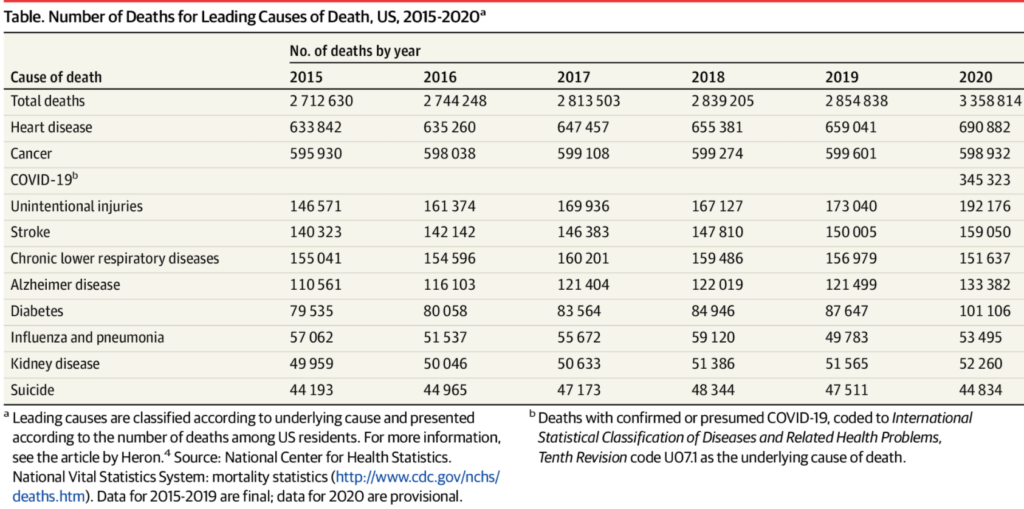
The Leading Causes of Death in the US for 2020

Link: https://jamanetwork.com/journals/jama/fullarticle/2778234

Graphic:

Excerpt:

The provisional number of deaths occurring in the US among US residents in 2020 was 3 358 814, an increase of 503 976 (17.7%) from 2 854 838 in 2019 (Table). Historic trends in mortality show seasonality in the number of deaths throughout the year, with the number of deaths higher in the winter and lower in the summer. The eFigure in the Supplement shows that death counts by week from 2015 to 2019 followed a normal seasonal pattern, with higher average death counts in weeks 1 through 10 (n = 58 366) and weeks 35 through 52 (n = 52 892) than in weeks 25 through 34 (n = 50 227). In contrast, increased deaths in 2020 occurred in 3 distinct waves that peaked during weeks 15 (n = 78 917), 30 (n = 64 057), and 52 (n = 80 656), with only the latter wave aligning with historic seasonal patterns.

Author(s): Farida B. Ahmad, Robert N. Anderson

Publication Date: 31 March 2021

Publication Site: JAMA