DEFINING DISCRIMINATION IN INSURANCE

Link: https://www.casact.org/sites/default/files/2022-03/Research-Paper_Defining_Discrimination_In_Insurance.pdf?utm_source=III&utm_medium=Issue+Brief&utm_campaign=RIP+Series

Graphic:

Excerpt:

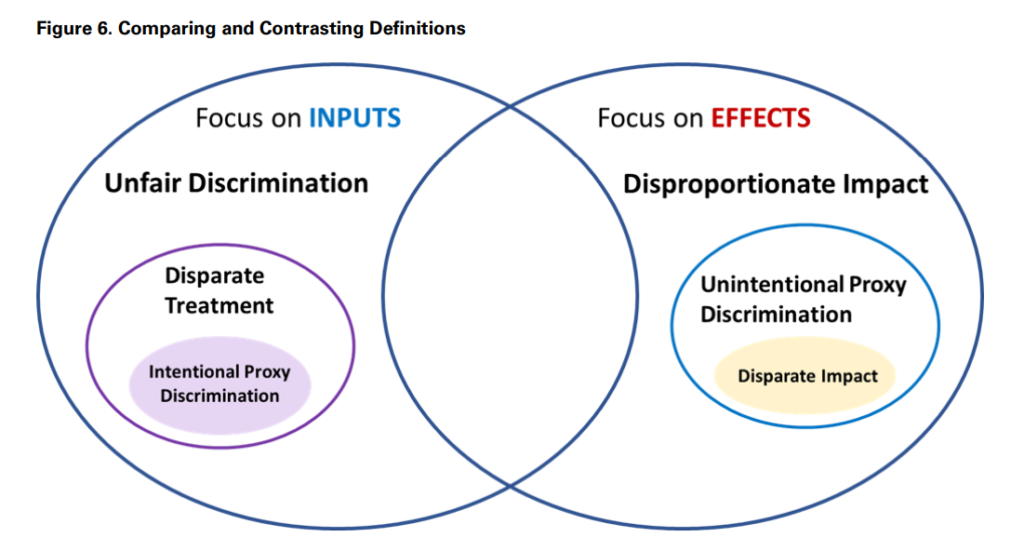
This research paper is designed to introduce various terms used in defining
discrimination by stakeholders in the insurance industry (regulators, consumer
advocacy groups, actuaries and insurers, etc.). The paper defines protected class,
unfair discrimination, proxy discrimination, disproportionate impact, disparate
treatment and disparate impact.
Stakeholders are not always consistent in their definitions of these terms, and
these inconsistencies are highlighted and illustrated in this paper. It is essential to
elucidate key elements and attributes of certain terms as well as conflicting
approaches to defining discrimination in insurance in order to move the industry
discussion forward.
While this paper does not make a judgment on the appropriateness of the
definitions put forth, nor does it promulgate what the definitions should be,
readers will be empowered to understand the components of discrimination terms
used in insurance, as well as be introduced to the potential implications for
insurers.
Actuaries who have a strong foundational knowledge of these terms are likely to
play a key role in informing those who define and refine these terms for insurance
purposes in the future. This paper is not a legal review, and thus discusses terms
and concepts as they are used by insurance stakeholders, rather than what their
ultimate legal definition will be. However, it is important for actuaries to
understand the point of view of various stakeholders, and the potential impact it
could have on actuarial work. As the regulatory and legislative landscape
continues to shift, this brief should be considered a living document, that will
periodically require update.

Author(s): Kudakwashe F. Chibanda, FCAS

Publication Date: March 2022

Publication Site: CAS
Actuarial Group Takes Steps to Identify Racial Bias in Insurance Rates

Link: https://www.investopedia.com/race-and-insurance-5224764

Excerpt:

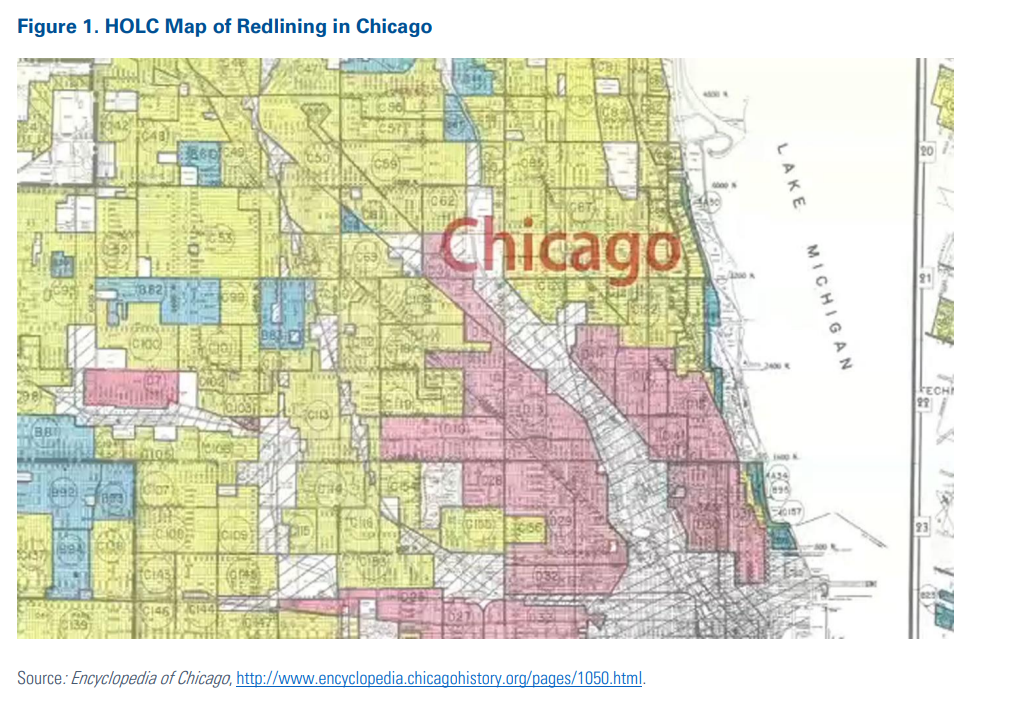
Two new papers from property casualty actuaries delve into issues of historical and ongoing bias in insurance pricing.

These papers are on potential Influences among four rating factors and attempts to actually define discrimination in insurance.

Factors such as geography, credit scoring, home ownership, and motor vehicle records affect homeowners and auto insurance rates and can cause Black consumers to pay higher premiums.

Actuaries and regulators are trying to untangle factors from societal prejudice for fairer pricing

AI or machine learning can augment or amplify these biases with their vast inputs, and data scientists will be analyzing outcomes for discriminatory pricing effects.

States have been taking action through regulation or pending legislation to extinguish some factors that can lead to racial bias or to examine data modeling to check for discriminatory effects.

Author(s): ELIZABETH FESTA

Publication Date: 5 April 2022

Publication Site: Investopedia

Tracking covid-19 excess deaths across countries

Link: https://www.economist.com/graphic-detail/coronavirus-excess-deaths-tracker?utm_campaign=a.coronavirus-special-edition&utm_medium=email.internal-newsletter.np&utm_source=salesforce-marketing-cloud&utm_term=2022042&utm_content=ed-picks-article-link-5&etear=nl_special_5&utm_campaign=a.coronavirus-special-edition&utm_medium=email.internal-newsletter.np&utm_source=salesforce-marketing-cloud&utm_term=4/2/2022&utm_id=1119326

Graphic:

Excerpt:

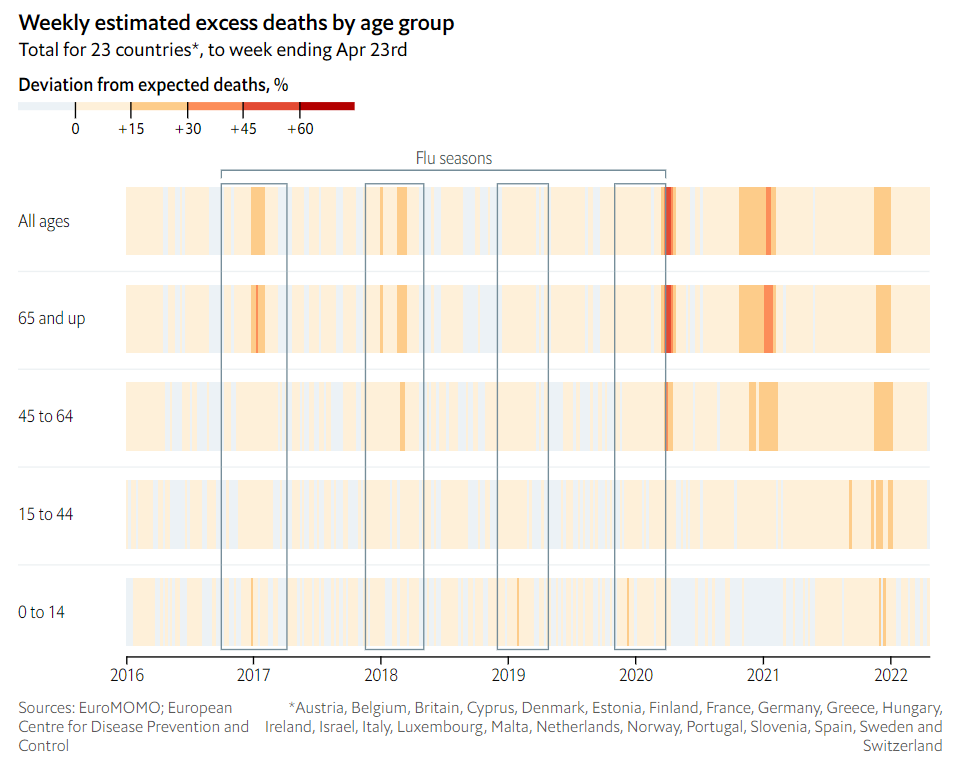
As covid-19 has spread around the world, people have become grimly familiar with the death tolls that their governments publish each day. Unfortunately, the total number of fatalities caused by the pandemic may be even higher, for several reasons. First, the official statistics in many countries exclude victims who did not test positive for coronavirus before dying—which can be a substantial majority in places with little capacity for testing. Second, hospitals and civil registries may not process death certificates for several days, or even weeks, which creates lags in the data. And third, the pandemic has made it harder for doctors to treat other conditions and discouraged people from going to hospital, which may have indirectly caused an increase in fatalities from diseases other than covid-19.

One way to account for these methodological problems is to use a simpler measure, known as “excess deaths”: take the number of people who die from any cause in a given region and period, and then compare it with a historical baseline from recent years. We have used statistical models to create our baselines, by predicting the number of deaths each region would normally have recorded in 2020 and 2021.

Many Western countries, and some nations and regions elsewhere, regularly publish data on mortality from all causes. The table below shows that, in most places, the number of excess deaths (compared with our baseline) is greater than the number of covid-19 fatalities officially recorded by the government. The full data for each country, as well as our underlying code, can be downloaded from our GitHub repository. Our sources also include the Human Mortality Database, a collaboration between UC Berkeley and the Max Planck Institute in Germany, and the World Mortality Dataset, created by Ariel Karlinsky and Dmitry Kobak.

Publication Date: last updated 13 May 2022

Publication Site: The Economist

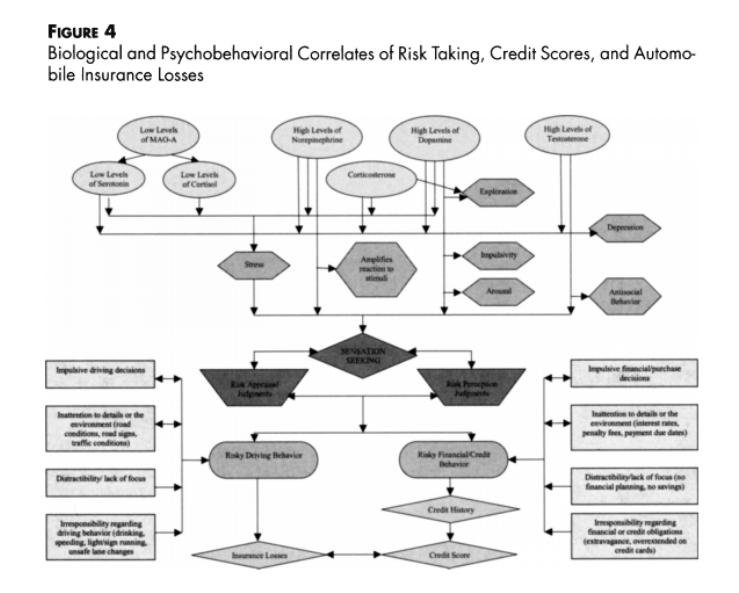
Biological and Psychobehavioral Correlates of Credit Scores and Automobile Insurance Losses: Toward an Explication of Why Credit Scoring Works

Link: https://www.jstor.org/stable/4138424

Graphic:

Abstract:

The most important new development in the past two decades in the personal lines of insurance may well be the use of an individual’s credit history as a classification and rating variable to predict losses. However, in spite of its obvious success as an underwriting tool, and the clear actuarial substantiation of a strong association between credit score and insured losses over multiple methods and multiple studies, the use of credit scoring is under attack because there is not an understanding of why there is an association. Through a detailed literature review concerning the biological, psychological, and behavioral attributes of risky automobile drivers and insured losses, and a similar review of the biological, psychological, and behavioral attributes of financial risk takers, we delineate that basic chemical and psychobehavioral characteristics (e.g., a sensation-seeking personality type) are common to individuals exhibiting both higher insured automobile loss costs and poorer credit scores, and thus provide a connection which can be used to understand why credit scoring works. Credit scoring can give information distinct from standard actuarial variables concerning an individual’s biopsychological makeup, which then yields useful underwriting information about how they will react in creating risk of insured automobile losses.

Author(s): Patrick L. Brockett and Linda L. Golden

Publication Date: originally 2007

Publication Site: jstor, The Journal of Risk and Insurance

Cite: Brockett, Patrick L., and Linda L. Golden. “Biological and Psychobehavioral Correlates of Credit Scores and Automobile Insurance Losses: Toward an Explication of Why Credit Scoring Works.” The Journal of Risk and Insurance, vol. 74, no. 1, 2007, pp. 23–63. JSTOR, http://www.jstor.org/stable/4138424. Accessed 22 May 2022.

METHODS FOR QUANTIFYING DISCRIMINATORY EFFECTS ON PROTECTED CLASSES IN INSURANCE

Link: https://www.casact.org/sites/default/files/2022-03/Research-Paper_Methods-for-Quantifying-Discriminatory-Effects.pdf

Graphic:

Excerpt:

This research paper’s main objective is to inspire and generate discussions
about algorithmic bias across all areas of insurance and to encourage
actuaries to be involved. Evaluating financial risk involves the creation of
functions that consider myriad characteristics of the insured. Companies utilize
diverse statistical methods and techniques, from relatively simple regression
to complex and opaque machine learning algorithms. It has been alleged that
the predictions produced by these mathematical algorithms have
discriminatory effects against certain groups of society, known as protected
classes.
The notion of discriminatory effects describes the disproportionately adverse
effect algorithms and models could have on protected groups in society. As a
result of the potential for discriminatory effects, the analytical processes
followed by financial institutions for decision making have come under greater
scrutiny by legislators, regulators, and consumer advocates. Interested parties
want to know how to quantify such effects and potentially how to repair such
systems if discriminatory effects have been detected.


This paper provides:


• A historical perspective of unfair discrimination in society and its impact
on property and casualty insurance.
• Specific examples of allegations of bias in insurance and how the various
stakeholders, including regulators, legislators, consumer groups and
insurance companies have reacted and responded to these allegations.
• Some specific definitions of unfair discrimination and that are interpreted
in the context of insurance predictive models.
• A high-level description of some of the more common statistical metrics
for bias detection that have been recently developed by the machine
learning community, as well as a brief account of some machine learning
algorithms that can help with mitigating bias in models.


This paper also presents a concrete example of an insurance pricing GLM
model developed on anonymized French private passenger automobile data,
which demonstrates how discriminatory effects can be measured and
mitigated.

Author(s): Roosevelt Mosley, FCAS, and Radost Wenman, FCAS

Publication Date: March 2022

Publication Site: CAS
Decentralized Finance for Actuaries

Link: https://www.soa.org/resources/research-reports/2022/decentralized-finance/

Graphic:

Excerpt:

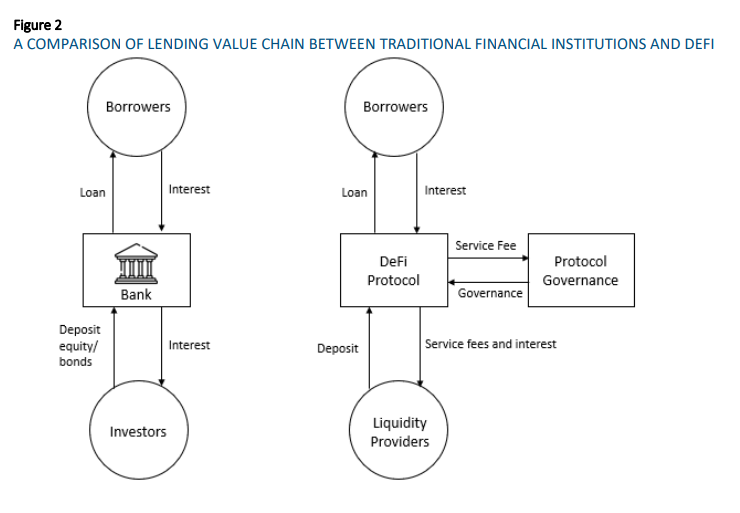
Decentralized finance, or DeFi, is an emerging financial system powered by blockchain technology. This research report aims to introduce actuaries to DeFi and help them develop a solid understanding of DeFi. It will begin with addressing “what is DeFi?” by providing an introduction on blockchains and DeFi. It will then discuss in further detail the key characteristics, applications, opportunities, and risks of DeFi. After providing the foundation, this report will discuss the potential adoption of DeFi and its interaction with the current financial system (sometime referred to as traditional finance for contrast with DeFi), and the implications for practicing and aspiring actuaries. In addition, a glossary of terms used in DeFi and a brief history of the development of DeFi have been included in the appendix.

Author(s):

Jen Houng (Erik) Lie, FSA, ZooFi Labs
Gwen Yun Weng, FSA, CFA, ZooFi Labs
Wai Chak Tse, ZooFi Labs

Publication Date: March 2022

Publication Site: SOA

DOJ Antitrust Chief Warns S&P Global Over Insurer Ratings Tweak

Link: https://www.yahoo.com/now/doj-antitrust-chief-warns-p-152645646.html

Excerpt:

S&P Global Inc. should “carefully consider” a proposed tweak to how it assesses the creditworthiness of bonds owned by insurance companies, the Justice Department said, warning that such a change “could raise significant concerns” under U.S. antitrust law.

The Justice Department’s antitrust division said in a letter dated last Friday that a proposed methodology change by S&P — the world’s largest credit ratings company — could raise barriers for its rivals. The changes could end up hurting the credit grades of insurance companies that invest in bonds that aren’t rated by S&P.

The firm should “carefully consider whether penalizing insurers that purchase securities rated by S&P’s competitors has the potential to raise barriers to entry and expansion by competitors, insulate S&P from competition, or otherwise suppress competition from rival rating agencies,” said antitrust chief Jonathan Kanter in the letter. “Such actions could raise significant concerns that the Sherman Act has been — or will be — violated and warrant additional scrutiny.”

Author(s): Leah Nylen

Publication Date: 4 May 2022

Publication Site: Yahoo (Bloomberg)

COVID-19 Mortality Study: Analytics – 2021 Q2

Link: https://www.limra.com/en/research/benchmarks/u.s.-individual-life-insurance-covid-19-mortality-experience-study/analytics/2021-q2/

Graphic:

Excerpt:

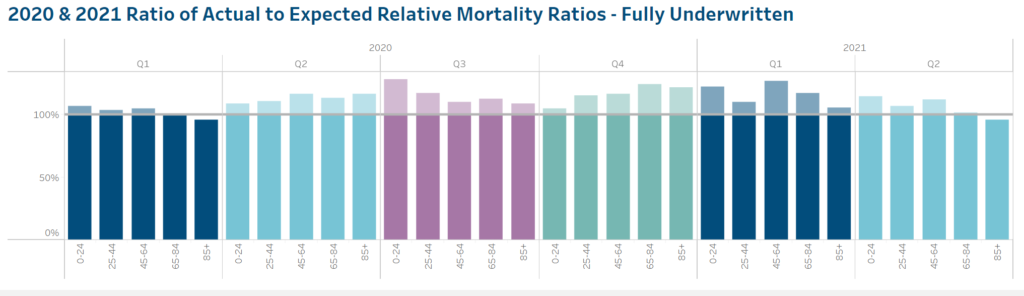
LIMRA, Reinsurance Group of America (RGA), the Society of Actuaries (SOA) Research Institute, and TAI have collaborated on an ongoing effort to analyze the impact of COVID-19 on the
individual life insurance industry’s mortality experience and share the emerging results with the insurance industry and the public. The Individual Life COVID-19 Project Work Group (Work
Group) was formed as a collaboration of LIMRA, RGA, the SOA Research Institute, and TAI to design, implement, and create the study and to produce and distribute a variety of analyses.
This report is the fifth public release from this collaboration and contains the results of the study of excess mortality for individual life insurance to include the second quarter of 2021.
Data from 31 companies representing approximately 72% of the industry face amount in force have been included in the analysis in this report. A total of 3.0 million death claims from
individual life policies from 2015 through June 30, 2021 make up the basis of the analysis.


Highlights for the 2nd Quarter

  • The second quarter of 2021 showed a significant realignment of the actual to expected relative mortality ratios, across many different cuts of the data.
  • It is worth noting that the third quarter 2021 results will likely not be as favorable due to the impact of the COVID-19 Delta variant whose impact first started in July 2021 and peaked
    around mid- September
  • All age groups improved in the second quarter compared to the first quarter of 2021, but the improvement was more dramatic in the older ages. While the three age groups shown under
    age 65 were still significantly over the trend established by 2015-2019, the age 65-84 group was within the 95% confidence bands and the age 85+ group was significantly better than the
    2015-2019 trend (p < 0.05).
  • Whereas the pandemic experience so far had showed substantial variations across different regions, this appears to have moderated during the 2nd quarter of 2022.

Author(s): Individual Life COVID-19 Project Work Group, SOA

Publication Date: May 2022, accessed 21 May 2022

Publication Site: LIMRA

U.S. Individual Life COVID-19 Reported Claims Analysis, Fourth Quarter, 2021 Update

Link: https://www.soa.org/resources/experience-studies/2022/us-ind-life-covid-q4/

PDF: https://www.soa.org/49ab0d/globalassets/assets/files/resources/research-report/2022/us-ind-life-covid-q4.pdf

Graphic:

Description:

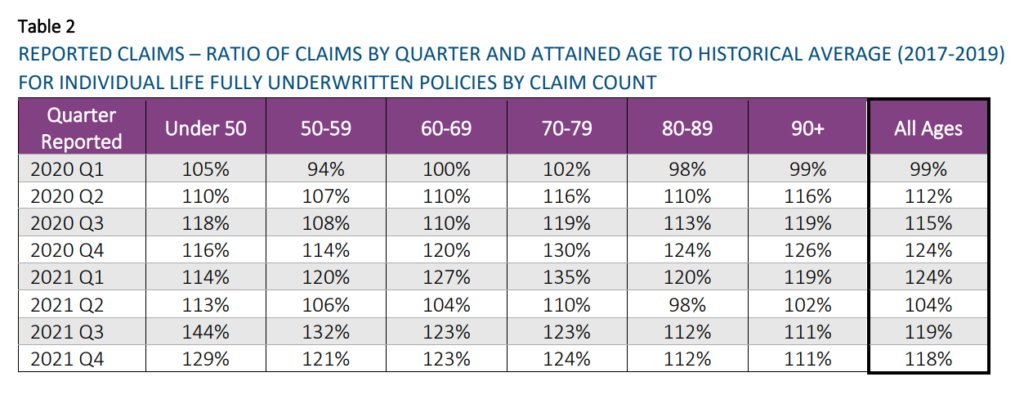
LIMRA, Reinsurance Group of America (RGA), the Society of Actuaries Research Institute (SOA), and TAI have collaborated on an ongoing effort to analyze the impact of COVID-19 on the individual life insurance industry’s mortality experience and share the emerging results with the insurance industry and the public. This report documents a high-level analysis of the claims that have been reported through December 31, 2021. The results presented here are based on data from 32 companies representing approximately 72% of the individual life insurance in force for the experience period of the study.

Author(s): Individual Life COVID-19 Project Work Group

Publication Date: May 2022, accessed 21 May 2022

Publication Site: Society of Actuaries

U.S. Life Insurance Sales Rise on Covid-19 Fears

Link: https://www.wsj.com/articles/u-s-life-insurance-sales-spike-on-covid-19-fears-11647347494

Graphic:

Excerpt:

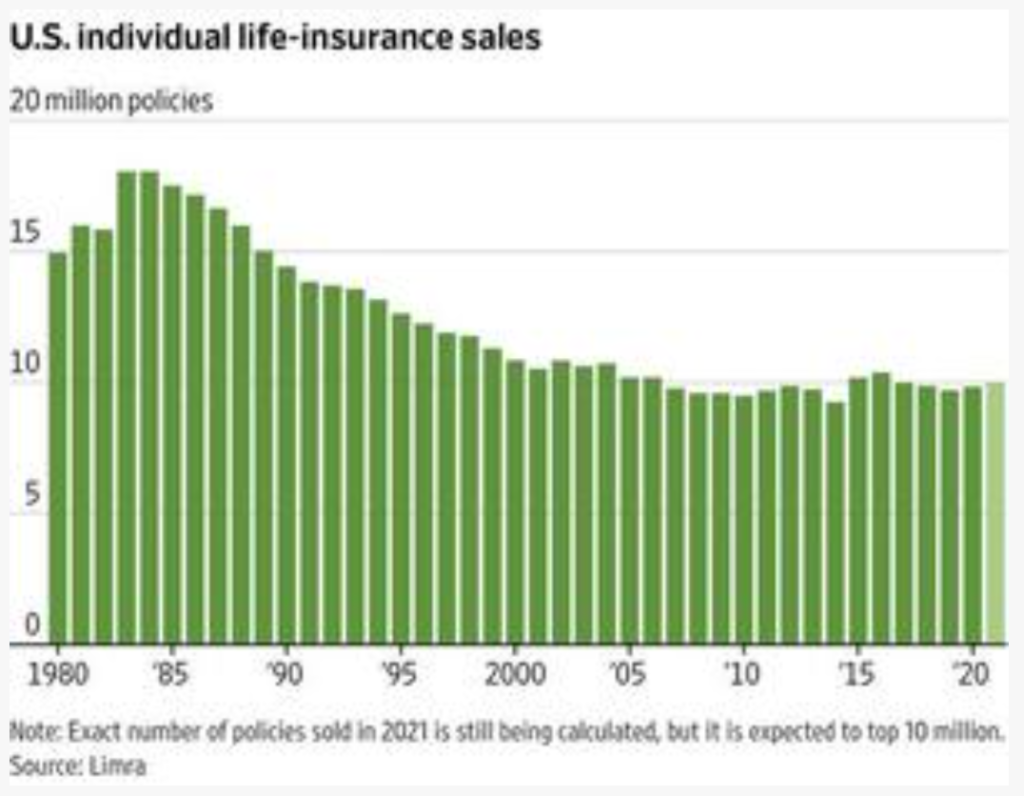
Americans went on a buying spree for life insurance in 2021, driven by concerns of death from the coronavirus pandemic.

Premium volume for new individual life-insurance policies surged 20% from 2020, while the number of policies issued rose 5%, the biggest year-over-year percentage gains since the 1980s, according to industry-funded research firm Limra.

“As we zero in on one million Americans who tragically lost their lives, it’s not a surprise that people are thinking about their own mortality and the impact on loved ones if anything were to happen to them,” said David Levenson, Limra’s chief executive.

The exact number of policies sold is still being calculated, but it is expected to top 10 million, Limra said. That milestone was last crossed in 2016. In 2020, an estimated 9.83 million policies were sold, up 1.7% from 2019.

Author(s): Leslie Scism

Publication Date: 15 March 2022

Publication Site: WSJ

Life Application Activity Cools Again

Link: https://www.thinkadvisor.com/2022/05/10/life-application-activity-cools-again/

Excerpt:

Policygenius, a life insurance web broker, uses its term life pricing information to provide monthly term life price index reports.

The company bases the index on prices for coverage with a 20-year-level premium term.

The lowest price shown is for coverage for a 25-year-old female nonsmoker who wants $250,000 in death benefits; The highest price is for a 55-year-old male smoker who wants $1 million in death benefits.

Policygenius figures suggest rising premiums may not be causing life application friction.

This month, the lowest price in the tables fell slightly, to $14.21, from $14.25 last month.

Author(s): Allison Bell

Publication Date: 10 May 2022

Publication Site: Think Advisor

Rise in Non-Covid-19 Deaths Hits Life Insurers

Link: https://www.wsj.com/articles/rise-in-non-covid-19-deaths-hits-life-insurers-11645576252

Graphic:

Excerpt:

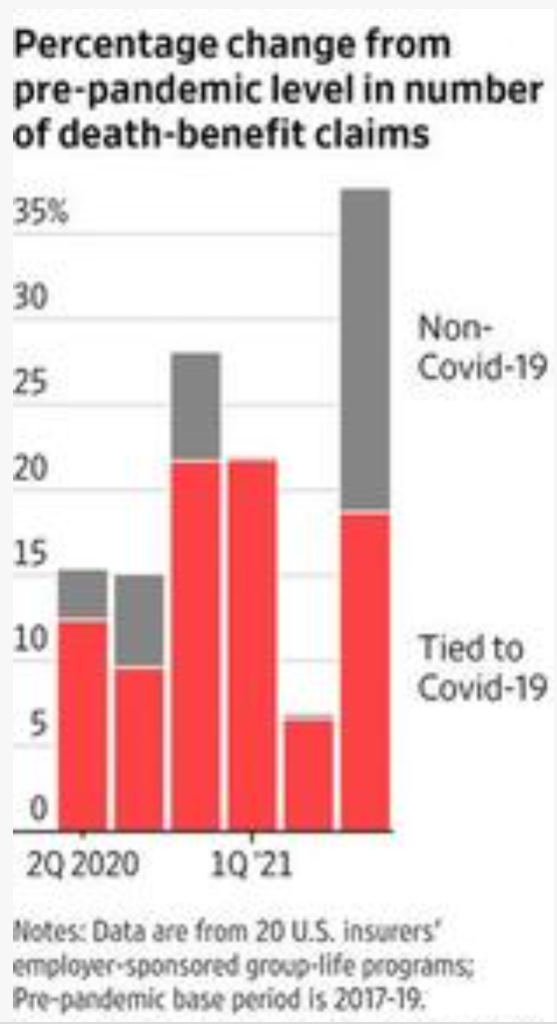
U.S. life insurers, as expected, made a large number of Covid-19 death-benefit payouts last year. More surprisingly, many saw a jump in other death claims, too.

Industry executives and actuaries believe many of these other fatalities are tied to delays in medical care as a result of lockdowns in 2020, and then, later, people’s fears of seeking out treatment and trouble lining up appointments.

…..

Primerica executives similarly cautioned in their fourth-quarter call about outsize numbers of non-Covid-19 deaths in 2022. “Some of these will be the result of delayed medical care or the increased incidence of societal-related issues, such as the increased prevalence of substance abuse,” Chief Financial Officer Alison Rand said in an email interview.

From early stages of the pandemic, many medical professionals have raised concerns about Americans’ untreated health problems, as Covid-19 put stress on the nation’s healthcare system.

Trade group American Council of Life Insurers said the pandemic in 2020 drove the biggest annual increase in death benefits paid by U.S. carriers since the 1918 influenza epidemic, totaling billions of dollars. The hit to the industry’s bottom line has been less than initially feared, however, because many victims have been older people who typically have smaller policies, if any coverage.

Still, Covid-19 and other excess deaths have cut into many carriers’ quarterly earnings, especially as deaths linked to the Delta variant increased for people in their working years with employer-sponsored death benefits. “Earnings impacts have been material and there still appears to be some Covid-19 discount, but investors are starting to look through mortality claims costs,” said Andrew Kligerman, a stock analyst with Credit Suisse Securities.

Author(s): Leslie Scism

Publication Date: 23 Feb 2022

Publication Site: WSJ